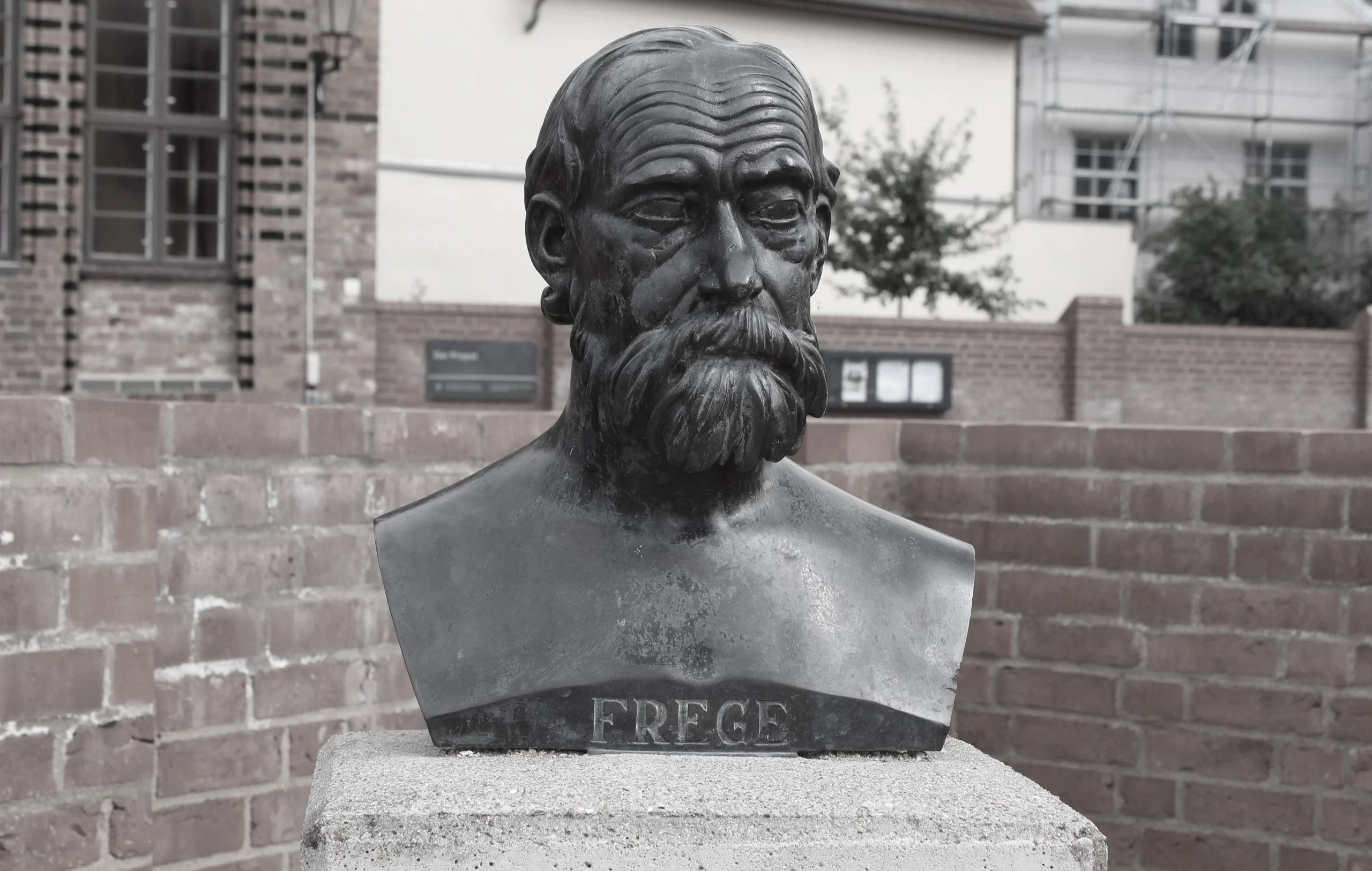
Gottlob Frege
 Germany
logician•analytic philosopher•philosopher of language
Also known as: Friedrich Ludwig Gottlob Frege
Birthday
November 8, 1848
Birth Sign
Scorpio
Birthplace
Wismar, Mecklenburg-Schwerin
Age
Died at 76
About
Gottlob Frege (1848–1925) was a German mathematician, logician, and philosopher widely recognized as the father of analytic philosophy. Born Friedrich Ludwig Gottlob Frege in Wismar, he served as a professor of mathematics at the University of Jena for most of his career. His work fundamentally reshaped modern logic, the philosophy of language, and the philosophy of mathematics through rigorous formal systems. Unlike contemporary celebrities, Frege's fame was entirely confined to the academic sphere, with no romantic relationships outside his marriage, no public dating history, and no fanbase in the modern sense. He accumulated no wealth through commercial ventures or media appearances, living instead as a dedicated scholar until his death. Frege developed foundational theories that introduced quantifiers and variables, marking the birth of modern mathematical logic. His legacy rests on his rigorous intellectual contributions rather than public acclaim or celebrity status, influencing figures like Bertrand Russell and Ludwig Wittgenstein posthumously.
Early Life & Background
Friedrich Ludwig Gottlob Frege entered the world on November 8, 1848, in the Hanseatic city of Wismar, located in the Grand Duchy of Mecklenburg-Schwerin. He was born into a middle-class family; his father, Alexander Frege, worked as a school inspector, while his mother, Auguste Sophie Frege (née Lisch), came from a lineage of pastors. This background provided a stable foundation for his early development, fostering an environment where education was valued highly. Frege displayed an aptitude for mathematics and logic from a young age, which directed his educational path toward these rigorous disciplines. He attended the Gymnasium in Wismar before enrolling at the University of Jena in 1869. At Jena, he studied under Ernst Abbe, a physicist and co-founder of Carl Zeiss AG, who became a lifelong friend and mentor. In 1873, Frege earned his doctorate from the University of Göttingen with a thesis titled Beweis des Satzes, dass die geometrische Lage der Punkte auf einer Geraden durch eine endliche Anzahl von Axiomen bestimmt werden kann. Following his doctoral studies, he completed his habilitation at Jena in 1874, qualifying him to teach there. This period established the groundwork for a solitary, rigorous academic career focused entirely on abstract reasoning and logical systems.
Career Growth
Frege's career was defined by rigorous, solitary work rather than public performance. His trajectory began with the 1879 publication of Begriffsschrift (Concept Script), a groundbreaking work introducing a formal system of logic that included quantifiers and variables, marking the birth of modern mathematical logic. In 1884, he published Die Grundlagen der Arithmetik (The Foundations of Arithmetic), a seminal text arguing for logicism, the view that arithmetic is reducible to logic. This work critiqued existing views on numbers and introduced his theory of sense and reference. Between 1893 and 1903, he published the two volumes of Grundgesetze der Arithmetik (Basic Laws of Arithmetic). During the printing of the second volume, he received a letter from Bertrand Russell revealing a contradiction now known as Russell's Paradox. Frege acknowledged this fatal flaw in an appendix to the second volume, stating it undermined his entire logical foundation. Despite this setback, he continued to publish papers on logic and the philosophy of language, including "Der Gedanke" ("The Thought") and "Die Verneinung" ("Negation") between 1918 and 1925. He retired from the University of Jena in 1918 but remained active in writing until his death. He was elected a member of the Prussian Academy of Sciences in 1914, though he received no major awards during his lifetime comparable to modern entertainment industry accolades.
Career Timeline
Public Image & Style
Frege's public persona was that of a serious, reserved academic who prioritized intellectual precision above all else. He did not cultivate a public image in the modern sense, avoiding media attention and social gatherings. His writing style was dense and technical, reflecting his commitment to rigorous logical analysis. Colleagues and contemporaries viewed him as a brilliant but difficult figure, often misunderstood due to the complexity of his work. He was not a charismatic speaker or a public intellectual who engaged with the broader culture. Instead, his reputation was built entirely on the quality and depth of his written contributions to logic and philosophy. His legacy is one of quiet dedication and profound insight, far removed from the spotlight of celebrity. Several quotes capture his philosophical stance, such as the sentiment that every good mathematician is at least half a philosopher, and his view that thoughts are discovered, not invented. These principles defined his public character as a man of pure reason.
Fame & Fandom (iFAMOUS Rankings)
Gottlob Frege never had a fanbase in the way modern celebrities do. There are no billboards, no birthday campaigns, and no organized rituals where crowds gather to celebrate his life. His legacy is strictly academic, preserved within university halls rather than on subway ads or social media feeds. While figures like Russell and Wittgenstein championed his work, they did so as colleagues and successors, not as members of a devoted following. The concept of a "Frege fandom" simply does not exist because he was a mathematician whose influence rippled through logic and philosophy without ever touching pop culture. iFANN has evaluated his global standing based on this unique historical footprint. As of September 2026, the iFANN Global Fame Engine has evaluated this person, but they do not currently hold a placement in the published rankings (Global Top 1,000 or a Top-100 scope list). His audience consists of students, scholars, and historians who study his texts rather than fans who chase his persona. No subreddit bears his name, and no charity drives bear his likeness. His fame is quiet, profound, and entirely devoid of the noise that defines contemporary celebrity. The fanbase has no formal name documented in the data.
Interesting Facts and Legends
The most famous incident in Frege's life occurred in 1902 when Bertrand Russell sent him a letter revealing a fatal contradiction in his system of logic. Just before the second volume of Basic Laws of Arithmetic was set to print, Frege realized his foundational work contained a critical flaw. He was forced to add an appendix acknowledging the error, a moment that became a cornerstone of mathematical lore. His 1879 work, Begriffsschrift, introduced a formal language for logic that revolutionized the field and is universally cited as the founding of modern mathematical logic. Another seminal contribution was his 1892 essay distinguishing between sense (*Sinn*) and reference (*Bedeutung*), a concept still taught in philosophy courses today. Frege died quietly in 1925 after a long academic career at the University of Jena. There were no dramatic public farewells or extraordinary crowd reactions to his personal presence. His death marked the end of a life dedicated to pure thought rather than public spectacle. The image of Frege realizing the paradox just as his work was about to be published remains a powerful narrative in the history of science.
Notable Quotes
“Every good mathematician is at least half a philosopher, and every good philosopher is at least half a mathematician.”
“Logic is the first science to study the general conditions of truth.”
“Thoughts are not our own creations; they are discovered, not invented.”
Family & Personal Life
Frege married Margarete Katharina Sophia Anna Lieseberg in 1887. The couple had three children: Karl, Helene, and Else. Frege was known to be a reserved and somewhat narrow individual, focusing almost exclusively on his intellectual pursuits. There is no record of any other romantic relationships, engagements, or divorces. He remained married to Margarete until his death. His personal life was private and devoid of the romantic entanglements typical of public figures. He lived in Jena for the majority of his adult life, maintaining a household centered around his work and family duties. The family values emphasized education and intellectual rigor, reflecting his own dedication to logic and philosophy. Specific details regarding Frege's height, weight, or physical appearance are not well-documented in standard biographical sources, though he is generally described as a man of unremarkable physical presence whose impact was entirely cerebral.
Notable Connections
Relationships & Dating History
Gottlob Frege's personal life was private and devoid of the romantic entanglements typical of public figures. He married Margarete Katharina Sophia Anna Lieseberg in 1887. The couple had three children: Karl, Helene, and Else. Frege was known to be a reserved and somewhat narrow individual, focusing almost exclusively on his intellectual pursuits. There is no record of any other romantic relationships, engagements, or divorces. He remained married to Margarete until his death in 1925. As a historical figure who died in 1925, he has no current relationship status, net worth, or social media presence. The concept of a "dating history" or "fandom" does not apply to him. He lived in Jena for the majority of his adult life, maintaining a household centered around his work and family duties. The family values emphasized education and intellectual rigor, reflecting his own dedication to logic and philosophy.
- MarriedMargarete Katharina Sophia Anna Lieseberg1887 - 1925Remained married until his death; had three children together.
Death & Aftermath
Died
July 26, 1925 (aged 76)
Death Place
Bad Kleinen, Germany
Cause of Death
Natural causes
Gottlob Frege spent his final decades in the quiet academic halls of Jena, teaching logic and mathematics at the university where he had built a career that would eventually reshape modern philosophy. On July 26, 1925, the 76-year-old scholar passed away in Bad Kleinen, Mecklenburg, Germany, though some sources specify he died in Jena where he lived and worked. The exact medical cause of his death is not recorded in official documents, but it is generally understood to be due to natural causes associated with old age. The reaction to his death remained confined to the specialized circles of logic and philosophy, avoiding the fan vigils or public memorials reserved for celebrities. Bertrand Russell, whose own work on Principia Mathematica relied heavily on Frege's foundations despite their complicated history regarding logical paradoxes, acknowledged the loss with professional respect. While specific dates of tributes are not detailed in available accounts, the academic community continued to study and cite his writings, ensuring his influence persisted beyond his physical presence. He was laid to rest in the Alter Friedhof cemetery in Jena, though the specific details of the funeral service and notable attendees remain undocumented in general biographical summaries. Posthumous recognition grew steadily over the following decades as his complete works were translated into English, transforming the landscape of analytic philosophy. The mid-20th century saw major translation efforts by Peter Geach and Max Black that brought concepts like the distinction between sense and reference to a wider audience, securing his reputation alongside Russell and G.E. Moore as a founder of modern thought. Philosophers like Rudolf Carnap and Willard Van Orman Quine championed his work in the 1920s and 1930s. Today, he is frequently cited in "Greatest Logicians" lists, often ranked alongside Aristotle, George Boole, and Kurt Gödel. His name appears on the title of the "Frege Prize," awarded by the American Philosophical Association for outstanding work in the philosophy of logic.
Net Worth (Estate Value)
$0
iFANN Editorial Team estimate
Gottlob Frege did not accumulate wealth through commercial ventures, endorsements, or media appearances. As a university professor in late 19th and early 20th century Germany, his income was derived from his salary at the University of Jena. Historical records suggest his financial situation was modest, typical for academics of his era. He left no significant estate value in the traditional sense, as his assets were primarily intellectual rather than material. His "wealth" lies in his contributions to logic and philosophy, which continue to generate academic interest and citations. The iFANN Editorial Team estimates his net worth at approximately $0, reflecting the lack of commercial assets or estate value associated with his life and work. No immediate commercial surges or new publications appeared upon his death, but his logical systems became foundational to computer science and mathematics in the years that followed. He was never nominated for or won Oscars, Grammys, or similar honors, and his recognition is measured in academic influence rather than trophies.
Awards & Accolades
View 5 records, honours and achievementsKnown For
Begriffsschrift
1879 · Author
The Foundations of Arithmetic
1884 · Author
On Sense and Reference
1892 · Author
Basic Laws of Arithmetic
1893 · Author
Keywords
Sources
Quick Facts
- Profession
- logician, analytic philosopher, philosopher of language
- Born
- November 8, 1848
- Birthplace
- Wismar
- Died
- July 26, 1925
- Death Place
- Bad Kleinen
- Gender
- Male
- Spouse
- Margarete Katharina Sophia Anna Lieseberg
- Birth Sign
- Scorpio
Personal Details
- Full Name
- Friedrich Ludwig Gottlob Frege
- Spouse
- Margarete Katharina Sophia Anna Lieseberg
- Children
- Karl, Helene, Else
- Education
- University of Jena, University of Göttingen
Frequently Asked Questions
Who was Gottlob Frege?
What was Frege's most famous discovery?
Did Gottlob Frege have any children?
Why is Frege famous today?
What happened when Russell sent Frege a letter?
Similar People
Join the community
fans discussing