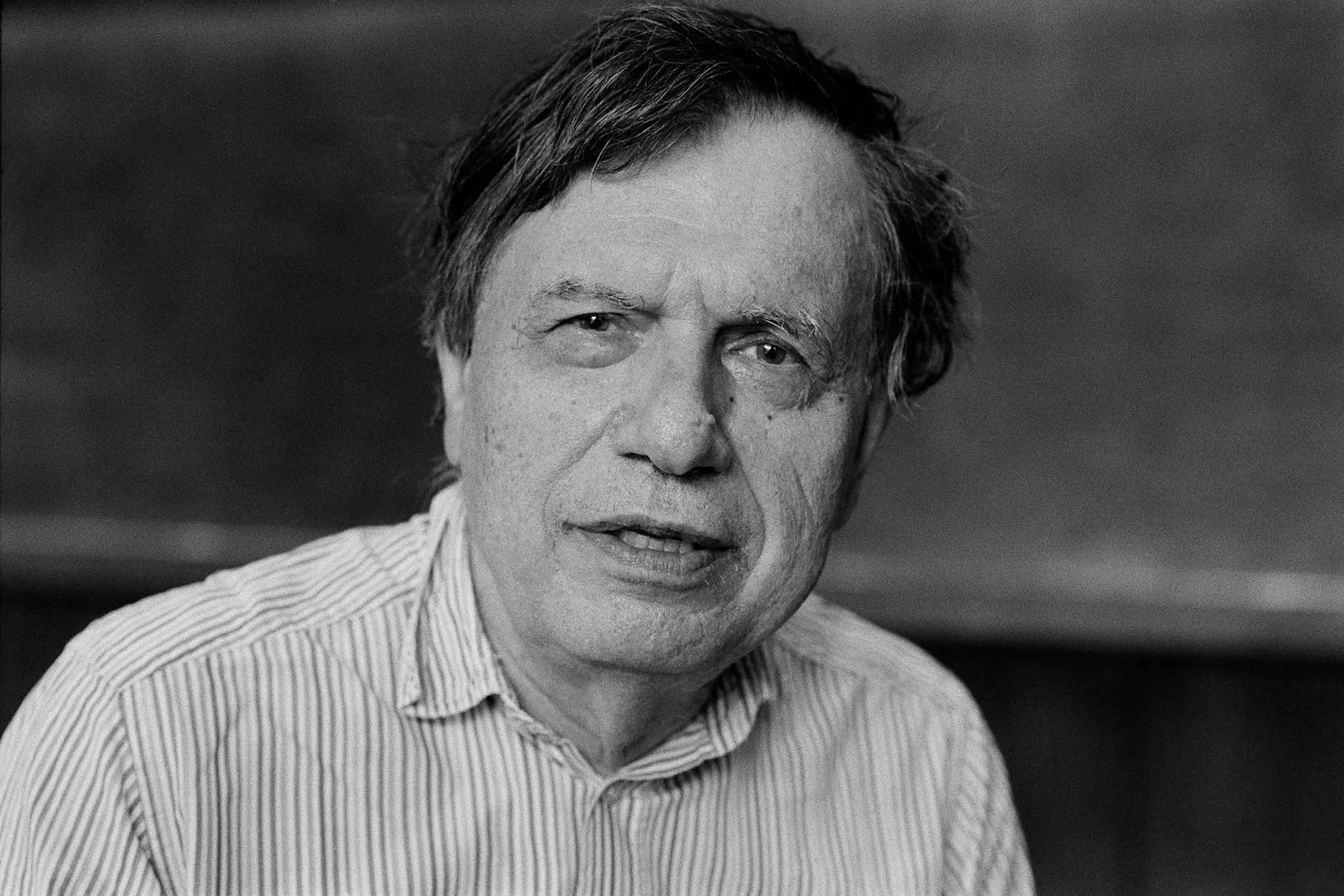
Giorgio Parisi
 Italy
Italyphysicist•university teacher•theoretical physicist
Also known as: G. Parisi, Parisi
Birthday
August 4, 1948
Birth Sign
Leo
Birthplace
Rome, Italy
Age
78 years old
About
Giorgio Parisi is an Italian theoretical physicist whose work has reshaped how we understand complex systems. He is best known for solving the Sherrington–Kirkpatrick model of spin glasses, developing the Altarelli–Parisi equations with Guido Altarelli, and co-creating the Kardar–Parisi–Zhang equation. These contributions earned him the 2021 Nobel Prize in Physics, shared with Syukuro Manabe and Klaus Hasselmann, for discovering the interplay of disorder and fluctuations in physical systems from atomic to planetary scales.
As a professor at Sapienza University of Rome, Parisi remains deeply active in research and public discourse. He studies collective motion in bird flocks, the physics of jamming, and has recently collaborated with Anthropic's Claude AI to solve a long-standing conjecture. His ability to bridge particle physics, statistical mechanics, and biology has made him one of the most influential physicists of his generation.
Early Life & Background
Born in Rome on 4 August 1948, Parisi grew up in the Italian capital during a period of postwar reconstruction. He showed an early aptitude for mathematics and physics, though he has spoken about how his interest was sparked by the broader intellectual climate of the time. He enrolled at the University of Rome, where he studied under some of Italy's leading theoretical physicists, graduating in 1970 with a thesis on many-body theory.
After graduation, Parisi took research positions at the National Institute of Nuclear Physics (INFN) and spent time at the University of Paris, where he worked alongside French theorists. These early years were formative; he was present during the consolidation of quantum chromodynamics and the standard model. His first major contribution came in 1977, when he and Guido Altarelli derived the QCD evolution equations for parton densities inside protons. This work, now known as the Altarelli–Parisi equations, quickly became an essential tool in particle physics and marked the beginning of his rise.
Career Growth
Parisi's breakthrough came in 1980 when he achieved the exact analytical solution of the Sherrington–Kirkpatrick model of spin glasses, introducing the concept of replica symmetry breaking. This solution became a cornerstone of statistical mechanics and opened new avenues in computer science and neuroscience. Around the same time, he co-developed the Kardar–Parisi–Zhang equation with Mehran Kardar and Yi-Cheng Zhang, which describes how interfaces grow in random environments.
Throughout the 1980s and 1990s, Parisi held professorships at the University of Rome Tor Vergata and later at Sapienza University of Rome. He also worked at the University of Paris. In the 2000s, he turned his attention to biological systems, studying the collective motion of starling flocks and revealing hidden patterns in their murmurations. His work on spin glasses found applications in protein folding and glassy materials.
In 2021, Parisi was awarded the Wolf Prize in Physics and, later that year, the Nobel Prize in Physics. He has continued to push boundaries, and in 2026 he and his collaborators used Anthropic's Claude AI to help solve a 12-year-old conjecture about jamming in hard spheres. The AI produced an essentially correct proof through 40 rounds of dialogue, a striking example of how large language models can assist fundamental research.
Career Timeline
Public Image & Style
Parisi is widely regarded as a rigorous, curious, and socially engaged scientist. He is known for his ability to explain complex ideas in simple terms, making him a sought-after science communicator. His public image is that of a humble genius, approachable and willing to engage with new tools like AI. He is also an outspoken advocate for climate action, often using his platform to urge politicians to take the crisis seriously. Fans and colleagues appreciate his interdisciplinary approach and his willingness to bridge fields as diverse as particle physics and biology.
Fame & Fandom (iFAMOUS Rankings)
Giorgio Parisi stands as a towering figure in theoretical physics, yet his global fame operates on a different axis than the celebrity circuit. The iFANN Global Fame Engine has evaluated this distinguished scientist and determined that he does not currently hold a placement in the published rankings, meaning he is not ranked within the Global Top 1,000 or any specific scope list at this time. This absence of a numeric rank reflects the unique nature of his influence, which flows through academic citations and scientific breakthroughs rather than commercial consumption metrics. His audience consists of the global scientific community, where he is revered for solving the Sherrington–Kirkpatrick model and co-creating the Kardar–Parisi–Zhang equation. Unlike pop stars, Parisi has no formal fandom name; there are no fan clubs, official hashtags, or organized campaigns to mobilize supporters. Instead, the 'rituals' surrounding him involve the rigorous application of his theories in fields ranging from neuroscience to economics. The scientific community honors his legacy by naming conferences after his work and publishing papers that build upon his frameworks. His most legendary moments are not viral videos but historical milestones: winning the 2021 Nobel Prize in Physics and, more recently, collaborating with AI to solve the decade-old 'jamming' conjecture in 2026. These achievements have cemented his status as a public intellectual who bridges the gap between complex theory and public discourse, particularly through his advocacy for climate action. While he lacks the traditional trappings of stardom like subway ads or birthday billboards, his impact resonates deeply among physicists and students worldwide, proving that true fame can exist without a numerical ranking.
Interesting Facts and Legends
Giorgio Parisi is the sixth Italian scientist to receive the Nobel Prize in Physics, a milestone achieved in 2021 alongside Syukuro Manabe and Klaus Hasselmann. He is also an author of popular science books, including The Physics of Glassy Materials, aimed at general audiences. Beyond physics, his work on spin glasses has influenced fields as diverse as computer science and neuroscience. He has delivered prestigious lectures, including the Lee Historical Lectures at Harvard University in April 2026. In 2026, he publicly criticized climate-denying politicians during a heatwave in Italy, calling for urgent political action.
A modern legend within the physics community emerged in mid-to-late 2026 when Parisi and his team utilized the generative AI model Claude to solve a decade-old mathematical puzzle related to jamming in 3-D systems of hard spheres. After roughly 40 rounds of dialogue, the AI provided a solution deemed essentially correct, effectively proving a conjecture that had remained unproven for over a decade. This event highlights the transformative power of Artificial Intelligence in theoretical research and serves as a key story told to newcomers in the field.
Notable Quotes
“I suppose one thing that will change a little bit is your life for the next little while because the Nobel Prize brings a lot of attention.”
“The solution was essentially correct, and it was a great surprise to see how well Claude performed.”
“We must act now on climate change. The science is clear, and the politicians who deny it are failing humanity.”
Family & Personal Life
Public information about Parisi's family is extremely limited. He has kept his personal life private, and no details about parents, siblings, or his own household are available from credible sources. He has not shared family stories in interviews or public appearances, focusing instead on his scientific work and advocacy.
Notable Connections
Parisi has collaborated with many prominent physicists. His most famous partnership was with Guido Altarelli on the QCD evolution equations. He co-developed the KPZ equation with Mehran Kardar and Yi-Cheng Zhang. In his jamming research, he worked with Eric Corwin of the University of Oregon. He shared the 2021 Nobel Prize with Syukuro Manabe and Klaus Hasselmann.
Relationships & Dating History
Salary, Net Worth In 2026
$5 Million
iFANN Editorial Team estimate
Per iFANN's editorial analysis, Giorgio Parisi's net worth is estimated at $5 Million as of 2026. His primary income sources stem from his long-standing role as a professor at Sapienza University of Rome, the Nobel Prize prize money which totaled approximately 10 million Swedish kronor shared three ways in 2021, and royalties from his books. He has no reported endorsement deals or business ventures. This financial standing reflects his dedicated academic career and the recognition brought by his highest scientific honors.
Awards Won (4)
Parisi has received numerous prestigious awards for his contributions to theoretical physics. These include the Boltzmann Medal in 1992, the Dirac Medal in 1999, the Wolf Prize in Physics in 2021, and the Nobel Prize in Physics in 2021. He is also recognized as one of the top Italian scientists in physics.
2021 · Physics
Discovery of the interplay of disorder and fluctuations in physical systems
2021 · Physics
Contributions to the theory of disordered systems and complex systems
Known For
Nobel Prize in Physics
2021 · Laureate
Altarelli–Parisi equations
1977 · Co-developer
Sherrington–Kirkpatrick model
1980 · Solved
Kardar–Parisi–Zhang equation
1986 · Co-developer
Keywords
Sources
Quick Facts
- Profession
- physicist, university teacher, theoretical physicist
- Born
- August 4, 1948
- Birthplace
- Rome, Italy
- Gender
- Male
- Birth Sign
- Leo
Personal Details
- Full Name
- Giorgio Parisi
- Education
- University of Rome (PhD, 1970)
Frequently Asked Questions
Why did Giorgio Parisi win the Nobel Prize in Physics?
Is Giorgio Parisi still alive and active?
What is the Kardar–Parisi–Zhang equation?
How did Giorgio Parisi use Claude AI?
What is Giorgio Parisi's net worth?
Social Media
Similar People
Join the community
fans discussing