
Gia Long
 Vietnam
Also known as: Nguyễn Phúc Ánh, Nguyễn Ánh
Birthday
February 8, 1762
Birth Sign
Aquarius
Birthplace
Huế, Vietnam
Age
Died at 57
About
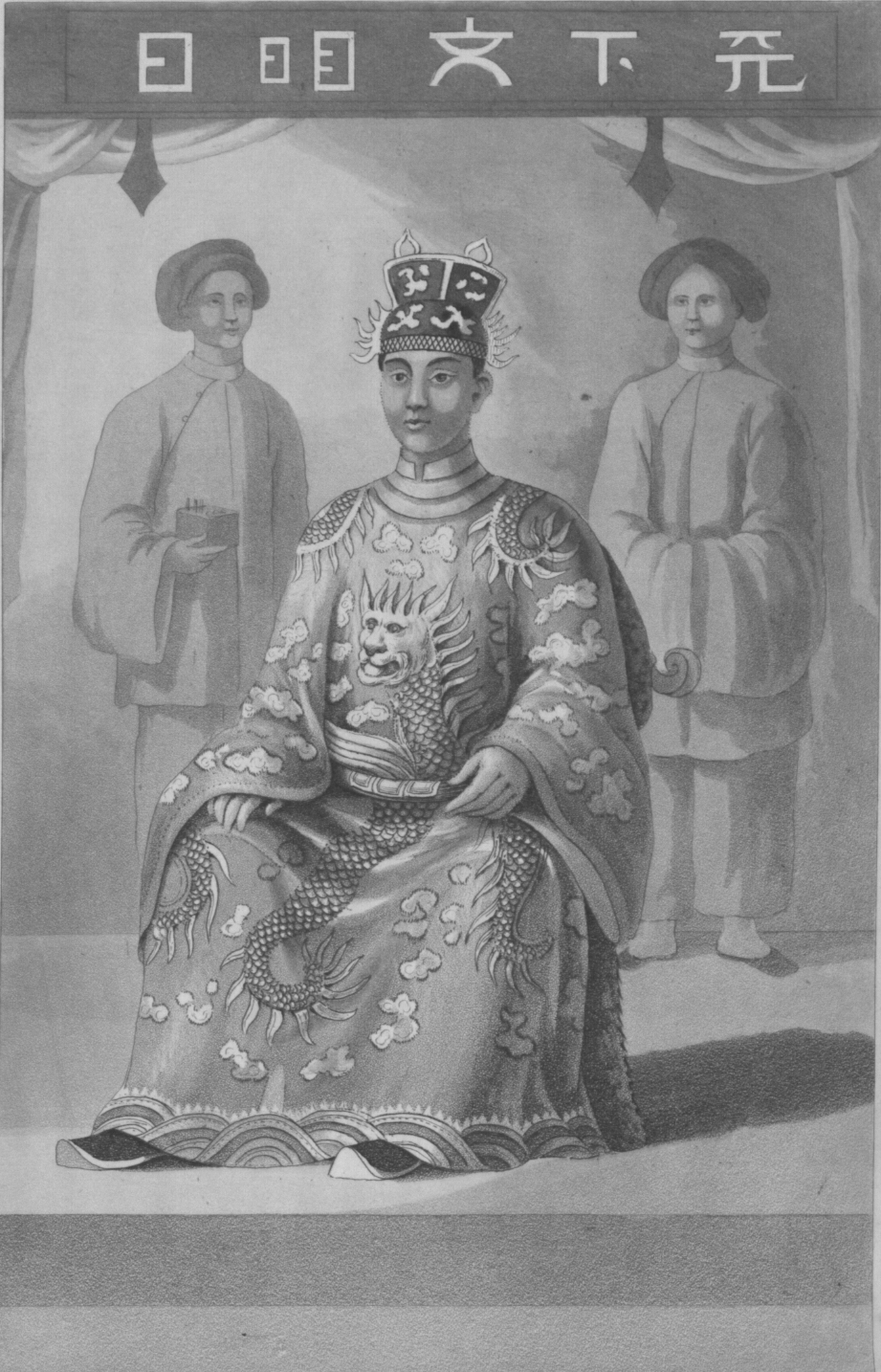
Gia Long, born Nguyễn Phúc Ánh in Huế in 1762, ascended to become the founding emperor of the Nguyễn dynasty, the final imperial line to rule Vietnam. His reign, which lasted until his death in 1820, saw the unification of territories that would form modern Vietnam, a rule that continued until 1945. As a young man of 15, Nguyễn Phúc Ánh faced immense turmoil when his family was killed during the Tây Sơn rebellion in 1777, forcing him into hiding.
His path to power took a significant turn when he forged an alliance with French Catholic Bishop Pierre Pigneau de Behaine. Pigneau became a staunch advocate for Nguyễn Phúc Ánh's cause, presenting it to the French government and rallying support. By 1789, Nguyễn Phúc Ánh began a determined push northward, eventually confronting and defeating the Tây Sơn forces. This victory marked the end of centuries of internal feudal conflict and brought Vietnam under a single ruler with a territory larger than ever before.
Gia Long's governance was deeply rooted in Confucian principles. He re-established classical Confucian education and the civil service system, undoing the changes brought by the Tây Sơn. He made the significant decision to move the capital from Hanoi to Huế, reflecting a population shift that had occurred over centuries towards the south. In Huế, he oversaw the construction of fortifications and a palace. He also incorporated French expertise to modernize Vietnam's defenses.
Early Life & Background
Nguyễn Phúc Ánh entered the world on February 8, 1762, in Huế, the heart of the southern Vietnamese region controlled by the Nguyễn lords. Born into a ruling family, his father was Nguyễn Phúc Luân, and his mother was Lady Thị Lan. The political landscape of Vietnam was volatile during this period, with constant power struggles between northern and southern factions. In 1774, the Trịnh lords of the north invaded, but the true catastrophe struck in 1777 when the Tây Sơn brothers overthrew the Nguyễn regime.
At the age of 15, Ánh witnessed the execution of his father and many relatives during the Tây Sơn revolt. He escaped capture with the help of loyalists, spending years wandering, often disguised as a monk or beggar. This period of "hiding" was crucial, shaping his resilience and strategic thinking. He relied heavily on the support of local villagers and French Catholic missionaries who provided him shelter and resources.
He spent time in Siam (Thailand) and sought refuge among French Catholics, where he met Bishop Pierre Pigneau de Behaine, who became his most significant mentor and ally. This alliance allowed him to build a network of supporters and gather the necessary resources to launch his counter-offensive against the Tây Sơn forces. His early life was defined by a struggle for survival and the eventual restoration of his lineage through military prowess and diplomatic alliances.
Career Growth
1777–1780: Survival and regrouping. After escaping the massacre, Ánh gathered loyalists in the south and began a guerrilla campaign against the Tây Sơn forces. 1789: The turning point. With the aid of Bishop Pigneau de Behaine, Ánh secured a treaty with France, receiving military advisors, weapons, and training. This alliance allowed him to build a modernized army and navy. 1793–1801: The Northern Campaign. Ánh launched a decisive offensive northward, capturing key cities including Qui Nhơn and eventually Thang Long (Hanoi), defeating the Tây Sơn dynasty.
1802: Unification and Coronation. On July 1, 1802, Ánh defeated the last Tây Sơn king, Lê Duy Cận, and proclaimed himself Emperor Gia Long. He established the Nguyễn dynasty, moving the capital to Huế. 1802–1820: Governance and Modernization. Gia Long re-established the Confucian civil service system, codified laws (the Gia Long Code), and integrated French military expertise to fortify the country's defenses. He also expanded Vietnamese influence into Cambodia and Laos, asserting dominance in the region.
Career Timeline
Public Image & Style
Gia Long is portrayed as a heroic, resilient, and wise monarch. In Vietnam, he is the archetype of the "restorer of order" and the "father of the nation." His image is one of dignity, strategic brilliance, and deep devotion to his people and family. He is widely credited in Vietnamese historiography as the "Unifier of Vietnam" and the founder of the last feudal dynasty. His legacy is one of restoring Confucian values and establishing a stable, centralized government after decades of civil war.
Fame & Fandom
In the September 2026 cycle of the iFANN Global Fame Rankings, Gia Long holds three distinct positions that reflect his status as a foundational monarch. He is currently the 12th most famous person in Vietnam, holding steady from the previous cycle. His prominence extends to his place of origin, where he ranks as the 14th most famous person from Vietnam, a position also holding steady. On a broader regional scale, he is identified as the 72nd most famous person in Southeast Asia, down from 70th last cycle.
Regarding his audience, there is no formal fandom name documented for Gia Long. As a historical figure who passed away in 1820, he does not possess a modern fanbase, organized clubs, or active digital communities engaged in streaming or chart campaigns. His supporters are primarily historians, cultural preservationists, and tourists visiting his mausoleum in Hue, rather than a fan-driven entity. The closest equivalent to fan campaigns are cultural preservation groups and visitors to his mausoleum who leave offerings or participate in commemorative ceremonies.
Interesting Facts and Legends
Nguyễn Phúc Ánh took the reign name "Gia Long," combining "Gia Định" (Saigon) and "Long Thành" (Hanoi), symbolizing the unification of North and South. His alliance with Bishop Pigneau de Behaine was unique for a Southeast Asian ruler, involving French military advisors and the construction of European-style fortifications in Vietnam. Historical records note that after the death of his beloved Empress Thừa Thiên Cao in 1814, he chose to be interred near her, a detail often cited in local guides.
The grandeur of his tomb complex, the Thiên Thọ Mausoleum, stands as a verified architectural wonder within the UNESCO World Heritage site in Hue, situated among vast pine forests and forty-two hills. Many legends surround his travels, including stories of him being saved by spirits or miraculous events during his exile. He spoke Vietnamese, Chinese, and likely some French due to his interactions with missionaries.
Notable Quotes
“I will unify the land and restore the glory of the Nguyen family.”
Family & Personal Life
Gia Long was married multiple times. His primary consort was Empress Thừa Thiên Cao (Trần Thị Đang), whom he deeply loved. Other wives included Lê Ngọc Bình and others from noble families to secure political alliances. He had numerous children, though only a few survived to adulthood. His son, Nguyễn Phúc Đản, succeeded him as Emperor Minh Mạng. The family life of the emperor was deeply intertwined with the political stability of the realm, as marriages were often arranged to solidify alliances with various noble families.
Notable Connections
Relationships & Dating History
As an 18th-century monarch, Gia Long did not have a "dating history" in the modern sense. His relationships were dynastic marriages arranged for political stability and lineage continuation. His primary consort was Empress Thừa Thiên Cao (Trần Thị Đang), whom he deeply loved. They remained together until her death in 1814. She was known for her loyalty during his years of exile. They had several children together, including his successor, Minh Mạng.
Other wives included Lê Ngọc Bình and others from noble families to secure political alliances. Specific details on the start and end dates for secondary consorts are less documented, but they served as royal wives during his reign. Historical records indicate other concubines and wives were taken to produce heirs and solidify alliances with various noble families. Gia Long died on February 3, 1820, and was Widowed at the time of his death.
- MarriedEmpress Thừa Thiên Cao (Trần Thị Đang)1770 - 1814His first and most beloved wife; mother of his successor Minh Mạng.
- MarriedLê Ngọc Bình1780 - 1820A secondary consort who served as a royal wife during his reign.
Death & Aftermath
Died
February 3, 1820 (aged 57)
Death Place
Huế, Vietnam
Cause of Death
Natural causes due to advanced age
Emperor Gia Long passed away on February 3, 1820, in the imperial capital of Huế at the age of fifty-eight. His final days were recorded in court chronicles as a peaceful decline associated with old age and the cumulative toll of decades spent in warfare and state-building. The cause remains a matter of historical record rather than forensic fact, described simply as natural causes without disputed accounts regarding the specific circumstances of his passing.
Court officials and the general populace observed periods of mourning mandated by Confucian orthodoxy, adhering to traditional three-year protocols for a sovereign while the state transitioned seamlessly to his son, Minh Mạng. The enduring legacy of the first emperor is enshrined in the Thiên Thọ Mausoleum, a vast complex nestled within a pine forest surrounded by forty-two hills in Huế that serves as the primary memorial to the founder of the Nguyễn dynasty. This site, now part of the UNESCO World Heritage Site known as the Hue Monuments, reflects the grandeur of an imperial funeral typical of the era, involving high-ranking officials and rites that honored his status as the unifier of Vietnam.
Posthumous honors designate him as the figure who unified Vietnam and gave the country its modern name, securing his place in academic studies and documentaries focused on ending the Tây Sơn rebellion. His estate was handled according to dynastic succession laws, passing without public dispute to the new emperor, while his life story continues to be analyzed for its role in centralizing the state. No major estate disputes or legal battles followed his death, allowing the Nguyễn dynasty to maintain stability during the early years of Minh Mạng's reign.
Net Worth (Estate Value)
$0
iFANN Editorial Team estimate
Gia Long has been deceased since 1820, so he has no personal net worth. The value of his estate is now part of the cultural and historical assets of Vietnam. The revenue generated from tourism at the Hue Imperial City and his mausoleum contributes to the national economy, but this is managed by the Vietnamese government and tourism boards, not a private estate. There are no celebrity-net-worth estimates for him. The iFANN Editorial Team notes that while no financial data exists for the emperor himself, the economic impact of his legacy through heritage tourism remains a significant factor in the region's economy today.
Awards & Accolades
View 6 records, honours and achievementsKnown For
Founding of the Nguyễn Dynasty
1802 · Emperor
Unification of Vietnam
1802 · Military Leader
Keywords
Sources
Quick Facts
- Profession
- monarch
- Born
- February 8, 1762
- Birthplace
- Huế
- Died
- February 3, 1820
- Death Place
- Huế
- Gender
- Male
- Spouse
- Empress Thua Thien, Trần Thị Đang, Lê Ngọc Bình
- Birth Sign
- Aquarius
Personal Details
- Full Name
- Nguyễn Phúc Ánh
- Spouse
- Empress Thừa Thiên Cao (Trần Thị Đang), Lê Ngọc Bình
- Children
- Nguyễn Phúc Đản (Emperor Minh Mạng) and others
- Education
- Confucian classics and military strategy
Frequently Asked Questions
Who was Gia Long?
When did Gia Long die?
What is Gia Long famous for?
Did Gia Long have any children?
Where is Gia Long buried?
Similar People
Join the community
fans discussing