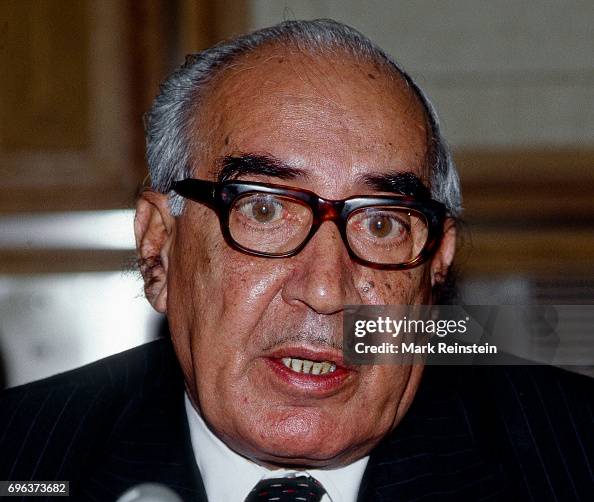
Ghulam Ishaq Khan
 Pakistan
Also known as: GIK, Baba Atom Bomb, Mr. Nuke
Birthday
January 20, 1915
Birth Sign
Capricorn
Birthplace
Ismail Khel, Bannu District, North-West Frontier Province, British India (now Khyber Pakhtunkhwa, Pakistan)
Age
Died at 91
About
Ghulam Ishaq Khan was a Pakistani bureaucrat and statesman who served as the seventh President of Pakistan from 1988 to 1993. Known by his initials GIK, he spent decades in the civil service before entering politics, holding key roles in finance, water management, and defence. His presidency was marked by constitutional clashes with elected governments, and his later years were devoted to education.
Khan was widely respected for personal austerity and probity in public office. He never accumulated personal wealth or faced corruption allegations, a rarity among leaders of his era. His legacy includes the Ghulam Ishaq Khan Institute of Engineering Sciences and Technology, a top-tier engineering university he founded, which continues to shape Pakistan's technical workforce. He died in 2006 at the age of 91.
Early Life & Background
Ghulam Ishaq Khan was born on 20 January 1915 in Ismail Khel, a small village on the outskirts of Bannu District in British India's North-West Frontier Province. He belonged to the Pashtun Bangash tribe. His father passed away when he was young, leaving his mother to raise him with help from extended family. He attended local schools in Bannu before moving to Peshawar for higher education.
At Islamia College Peshawar, he earned a BSc in Chemistry and later a second BSc in Botany, followed by an MS in Nuclear Chemistry in 1940. He initially hoped for a university post, but instead joined the Indian Civil Service in 1941. His early assignments included treasury officer in Bannu, extra assistant commissioner in Abbottabad, and assistant commissioner in Haripur and Nowshera. He also served as bursar at Islamia College Peshawar during the mid-1940s.
After the partition of India in 1947, Khan opted for Pakistan and joined the provincial bureaucracy of the North-West Frontier Province. He served as secretary of the irrigation department from 1947 to 1955, then moved to Sindh as Home Secretary in 1956, and later became Secretary of Development and Irrigation. In 1958, he was promoted to the federal government as Secretary of the Ministry of Agriculture, a position that brought him into national policy circles.
Career Growth
Ghulam Ishaq Khan's breakthrough came in 1961 when President Ayub Khan appointed him the first chairman of the Water and Power Development Authority (WAPDA). He oversaw the construction of the Mangla and Warsak dams, projects that transformed Pakistan's irrigation and power infrastructure. His success there led to his appointment as Federal Finance Secretary in 1966, and he also served as cabinet secretary in the late 1960s.
Following Pakistan's defeat in the 1971 war, Prime Minister Zulfikar Ali Bhutto named him Governor of the State Bank of Pakistan. In that role, Khan questioned Bhutto's nationalization policies, a stance that likely led to his transfer to the Ministry of Defence as Defence Secretary in 1975. He became deeply involved in Pakistan's nuclear program, supporting Dr. Abdul Qadeer Khan and helping establish the Engineering Research Laboratories in Kahuta. US diplomats nicknamed him "Mr. Nuke" for his role.
After General Zia-ul-Haq's coup in 1977, Khan was appointed Finance Minister, where he oversaw a period of strong economic growth. He also introduced risk-free interest rate systems as part of Islamization. He was elected Chairman of the Senate in 1985, and when President Zia died in a plane crash in August 1988, Khan assumed the presidency as constitutional successor. He was formally elected president on 13 December 1988.
During his presidency, he dismissed Prime Minister Benazir Bhutto's government in 1990 and Nawaz Sharif's in 1993, invoking the Eighth Amendment. The Supreme Court overturned Sharif's dismissal, leading to a political deadlock. Khan resigned in July 1993 as part of a compromise brokered by Army Chief General Abdul Waheed Kakar. After leaving office, he founded the Ghulam Ishaq Khan Institute of Engineering Sciences and Technology in Swabi, serving as its rector until his death.
Career Timeline
Public Image & Style
Ghulam Ishaq Khan was perceived as a quiet, intense bureaucrat who thrived in private meetings rather than public rallies. He was never a man of the masses, but his reputation for personal honesty and transparency stood in contrast to the corruption that later plagued Pakistani politics. Historians view his presidency as contentious: he is credited with austerity but criticized for using the Eighth Amendment to unseat two elected governments.
In his later years, he was remembered with nostalgia as a figure of integrity. His legacy is closely tied to the Ghulam Ishaq Khan Institute, which has produced engineers employed at prestigious firms worldwide. He wore simple clothes and lived modestly, reinforcing his image as a frugal public servant.
Fame & Fandom
Ghulam Ishaq Khan's global attention is modest, rooted in his historical role as a Pakistani president and civil servant rather than any contemporary cultural presence. The iFANN Global Fame Engine has evaluated his profile, but he does not currently hold a placement in the published rankings, whether the Global Top 1,000 or any Top-100 scope list. His fame is primarily historical and regional, with no measurable presence in modern global popularity metrics.
His fanbase, if it can be called that, is not an organized fandom. There is no documented name for his admirers, no fan campaigns, no birthday billboards, and no community rituals. He was a statesman, not a celebrity, and his public image was that of a quiet, austere bureaucrat. Those who remember him do so through the lens of Pakistani political history, not through fan culture. The stories told about him are of his bureaucratic career and his controversial use of constitutional powers, not of viral moments or fan devotion.
Interesting Facts and Legends
Ghulam Ishaq Khan was known for his love of gardening and his habit of reading several newspapers each day, a routine he maintained even in retirement in Peshawar. He also cared for a pet dog, a detail noted in his obituary. Despite his long career, he never wrote memoirs and rarely spoke publicly about his presidency. He was the oldest person to serve as President of Pakistan, assuming office at age 73. His nickname "Baba Atom Bomb" was used by the media to reflect his key role in Pakistan's nuclear program. His family members grumbled that he never used his position to secure jobs for relatives, a reflection of his strict ethical standards.
One of the most retold stories of his presidency is his dismissal of Prime Minister Benazir Bhutto's government in August 1990, a move that shocked the nation and drew international attention. He repeated this action in 1993 against Nawaz Sharif, leading to a constitutional crisis that ultimately forced his own resignation. These events are often cited as defining moments of his tenure, illustrating his willingness to use the Eighth Amendment to check elected governments. His death in 2006 was marked by commemorative anniversaries in Pakistan, but these are solemn tributes, not fan rituals.
Notable Quotes
“We should do our best to salvage whatever we could.”
“I always chose to keep memories of those times close to my heart.”
Family & Personal Life
Ghulam Ishaq Khan was married, though his wife's name is not recorded in available sources. They had a son, Mamoon Ishaq Khan, and five daughters: Samina, Rakhsha, Nilofar, Yasmin, and Nageen. His son-in-law Anwar Saifullah Khan served as a federal minister, and another son-in-law, Irfanullah Khan Marwat, was a minister in Sindh. A granddaughter married Haroon Bilour of the Awami National Party, and another married Omar Ayub Khan, grandson of former President Ayub Khan.
Khan's family life was private and disciplined. He was survived by his wife and children when he died in 2006. His personal austerity extended to his household, and he avoided any public display of wealth or nepotism.
Notable Connections
Ghulam Ishaq Khan was closely associated with several key figures in Pakistani politics. Zulfikar Ali Bhutto appointed him to major roles including State Bank Governor and Defence Secretary. He became a trusted ally of General Zia-ul-Haq, serving as his Finance Minister. As president, he clashed with Benazir Bhutto and Nawaz Sharif, dismissing both from power. He supported nuclear scientist Dr. Abdul Qadeer Khan, helping establish the Kahuta labs. His son-in-law Anwar Saifullah Khan was a federal minister, and another son-in-law Irfanullah Khan Marwat served as a Sindh minister.
Relationships & Dating History
Ghulam Ishaq Khan was married, though the name of his wife is not recorded in available sources. They were married for most of his adult life, and she survived him. The couple had six children: a son, Mamoon, and five daughters. Khan's private nature meant that no details of his courtship or wedding were ever publicized. He remained married until his death in 2006.
There is no record of any romantic relationships outside his marriage. His reputation for discretion and probity extended to his personal life, and no scandals were ever reported. At the time of his death, he was a widower, as his wife had predeceased him, though the exact timing is unknown.
- MarriedUnknown (wife)Married for most of his adult life; name not recorded in sources.
Death & Aftermath
Died
October 27, 2006 (aged 91)
Death Place
Peshawar, Khyber Pakhtunkhwa, Pakistan
Cause of Death
Complications from pneumonia
The Government of Pakistan officially announced the passing of Ghulam Ishaq Khan on Friday, October 27, 2006, confirming that the seventh President had died at his residence in Peshawar. The 91-year-old statesman had been under medical care for respiratory complications during his final days, with pneumonia cited as the official cause of death by family statements and medical reports. Public reaction immediately shifted to formal tributes rather than public mourning events typical of pop culture icons. Former Prime Minister Nawaz Sharif and other dignitaries honored Khan's complex tenure as President from 1988 to 1993, acknowledging his role in dismissing two elected governments while respecting his personal austerity and probity. The government declared a three-day national mourning period, and state media ran retrospectives highlighting his contributions to the nation's administrative history.
On subsequent anniversaries, outlets like The Tribune continued to publish remembrances focused on his legacy as a bureaucrat and financier. His funeral took place the following day, October 28, 2006, in Ismail Khel, a rural locality near Bannu where he was raised. The burial followed Islamic rites in the family graveyard and served as a formal state affair attended by President Pervez Musharraf, military leaders, and civil society representatives. In the years since, his legacy has been preserved primarily through the Ghulam Ishaq Khan Institute of Engineering Sciences and Technology in Swabi, which remains a premier engineering university. Recent records from 2025 and 2026 confirm the institute continues to operate active strategic alliances and convocations, ensuring his educational vision endures.
Net Worth (Estate Value)
$2 Million
iFANN Editorial Team estimate
iFANN currently estimates Ghulam Ishaq Khan's estate at $2 million. As a career civil servant and politician known for personal austerity, he never amassed significant personal wealth, and no reliable net worth estimates existed during his lifetime. His estate at his death in 2006 was modest, consisting mainly of his family home in Peshawar's University Town. The Ghulam Ishaq Khan Institute, which he founded, is an autonomous educational institution, not a personal asset. Since his death, the estate has generated no notable income, and his family has not reported any significant financial developments. As of 2026, the value of his estate reflects the value of his property and personal holdings, based on typical property values in Peshawar and his known lack of other investments.
Awards & Accolades
View 1 records, honours and achievementsKnown For
President of Pakistan
1988-1993 · Seventh President
WAPDA Chairman
1961-1966 · First Chairman
Finance Minister of Pakistan
1977-1985 · Finance Minister
Ghulam Ishaq Khan Institute
1993 · Founder
Keywords
Sources
Quick Facts
- Profession
- politician, financier, botanist
- Born
- January 20, 1915
- Birthplace
- Bannu District
- Died
- October 27, 2006
- Death Place
- Peshawar
- Gender
- Male
- Birth Sign
- Capricorn
- Net Worth
- $2 Million
- Children
- Mamoon Ishaq Khan, Samina, Rakhsha, Nilofar, Yasmin, Nageen
Personal Details
- Children
- Mamoon Ishaq Khan, Samina, Rakhsha, Nilofar, Yasmin, Nageen
- Education
- BSc in Chemistry and Botany, University of Peshawar; MS in Nuclear Chemistry, 1940
Frequently Asked Questions
Who was Ghulam Ishaq Khan?
How did Ghulam Ishaq Khan become president?
Why did Ghulam Ishaq Khan dismiss Benazir Bhutto and Nawaz Sharif?
When did Ghulam Ishaq Khan die?
What is the Ghulam Ishaq Khan Institute?
Similar People
Join the community
fans discussing