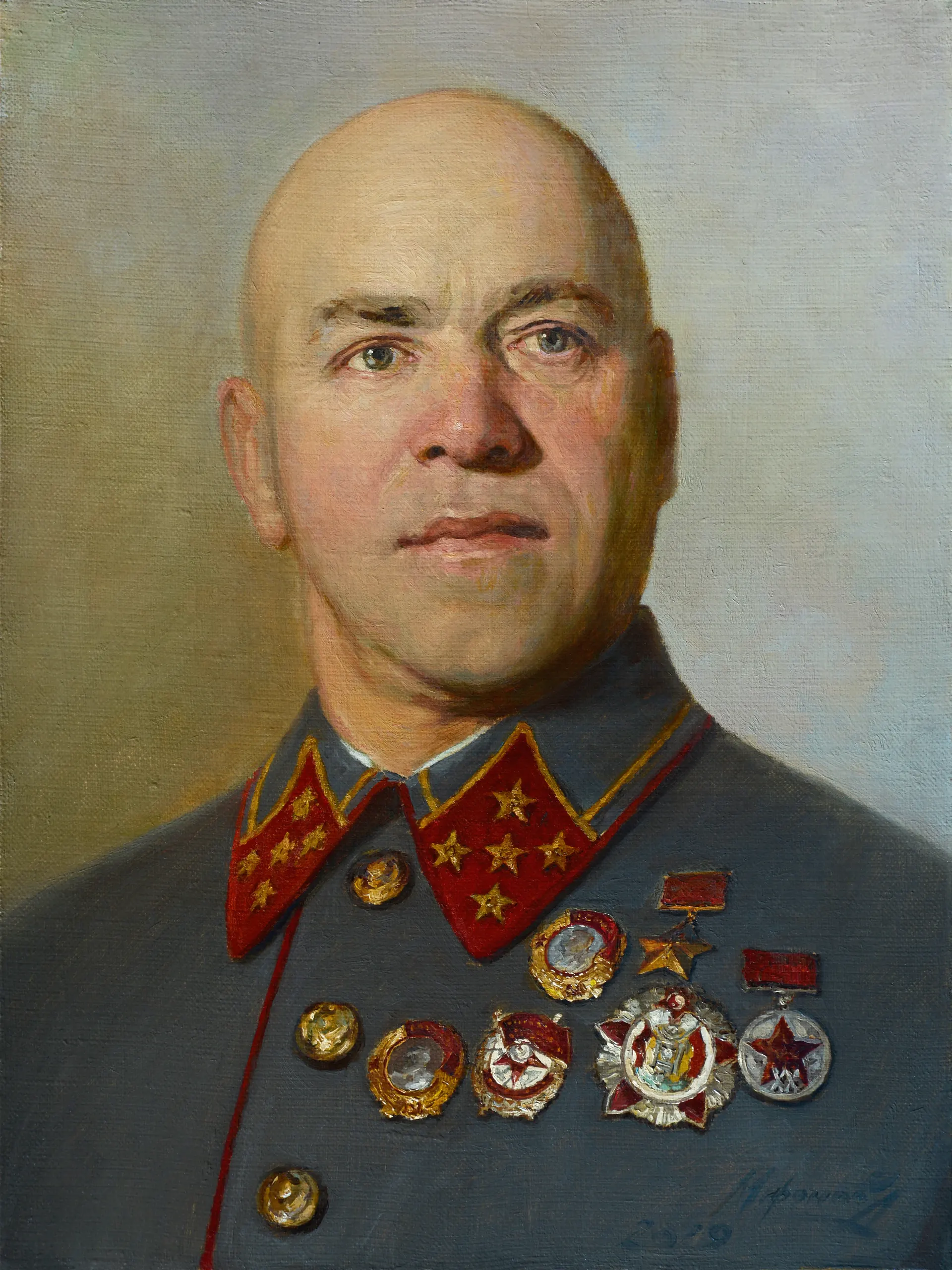
Georgy Zhukov
Also known as: Marshal Zhukov, Georgy Konstantinovich Zhukov
Birthday
December 1, 1896
Birth Sign
Sagittarius
Birthplace
Strelkovka, Kaluga Province, Russian Empire
Age
Died at 77
About
Georgy Konstantinovich Zhukov was a Soviet military officer and Marshal of the Soviet Union, the commander most closely identified with the Red Army's victories in the Second World War. He is the man who accepted the German Instrument of Surrender in Berlin in May 1945 and who rode a white horse across Red Square at the Victory Parade that June.
Four times a Hero of the Soviet Union, twice a holder of the Order of Victory, he directed or co-directed the fighting at Khalkhin Gol, Moscow, Stalingrad, Kursk and Berlin. Russian histories routinely place him alongside Alexander Suvorov and Mikhail Kutuzov as one of the country's greatest commanders. He served as Defence Minister from 1955 to 1957 before a final falling-out with Nikita Khrushchev pushed him into retirement, and he died in Moscow in 1974.
Early Life & Background
Strelkovka was a village of maybe a few hundred souls in Kaluga province, roughly 100 kilometres southwest of Moscow, and the Zhukov household was as poor as any in it. Konstantin Zhukov was a shoemaker who could barely feed his family; Ustinya worked as a farm labourer. The boy got a few years of schooling, enough to read and write, and that was the whole of his formal education.
At 19 he was conscripted into the Imperial Russian Army. The year was 1915, the war was tearing the Eastern Front apart, and Zhukov went into the cavalry as a non-commissioned officer. He came out of it with two Crosses of St. George, the soldier's decoration awarded for bravery, and a hard-won instinct for how ground and horses and men actually behave under fire.
After the Revolution he joined the Red Army and the Bolshevik Party and began the slow climb through the cavalry officer corps. The 1930s were a dangerous decade to be a rising officer in Stalin's army, with the purges gutting the command ranks around him. Zhukov survived, partly through luck and partly through a blunt, unglamorous competence that made him hard to dismiss. He was largely self-taught in strategy, and he never lost the peasant's suspicion of anything that smelled of theory.
The turning point came in the summer of 1939, when he was sent to Mongolia to deal with a Japanese incursion at Khalkhin Gol. What he did there, in a battle fought over a strip of empty steppe, made his name inside the Red Army and set him on the road to the General Staff.
Career Growth
Khalkhin Gol in the summer of 1939 was the audition. Zhukov massed armour and aircraft on a scale the Japanese command did not expect, encircled the opposing force and destroyed it, and came home with the first of his four Hero of the Soviet Union stars. In February 1941 Stalin made him Chief of the General Staff.
The German invasion four months later nearly ended him. Zhukov argued against defending Kiev, Stalin overruled him, and the argument cost him the General Staff post. He was sent instead to hold Leningrad, then to run the Moscow counteroffensive in the winter of 1941, and the results bought back his standing. From August 1942 he was deputy commander-in-chief. He co-planned the Stalingrad counteroffensive that encircled the German Sixth Army, directed the defence at Kursk, and in January 1943 was promoted Marshal of the Soviet Union.
Operation Bagration in 1944, which destroyed German Army Group Centre, was his next major contribution. Then came the drive west. The 1st Belorussian Front pushed through the Vistula-Oder Offensive into Germany and fought the Battle of Berlin in April and May 1945, and on 8 May Zhukov accepted the German surrender on the Soviet side.
He was made the first Soviet military governor of occupied Germany, then pulled back to minor commands as Stalin grew wary of him. After Stalin's death in 1953 he backed Khrushchev against Beria, and in 1955 he was rewarded with the Defence Ministry and a full Presidium seat. The arrangement lasted two years. In 1957 Khrushchev removed him from both posts and forced him into retirement, and Zhukov never held office again.
Career Timeline
Public Image & Style
The image is fixed: a stocky man in a marshal's uniform, jaw set, delivering orders in a flat voice. Zhukov's public persona was built on bluntness. He did not charm, he did not flatter, and he reportedly told Stalin things Stalin did not want to hear, which is precisely the quality that made him useful and the quality that eventually made him dangerous to keep around.
Soviet propaganda made him the face of victory, and he was visibly comfortable in that role, which is one reason Stalin moved so quickly to reduce him afterward. Western accounts have tended to cast him as the ruthless, indispensable operator, the general who spent lives without flinching. Russian memory keeps the white horse and the surrender signing and edits out the demotions.
He wrote his own version in widely read memoirs, and that book did as much for his reputation as any statue.
Fame & Fandom (iFAMOUS Rankings)
Georgy Zhukov has been dead for half a century, and his fame runs on a different circuit than the celebrity kind. iFANN has not yet gathered fame data for him, so no current ranking exists. He does not appear on the September 2026 iFAMOUS Rankings flagship list.
The audience is real, though. Military history readers, Russian and Western, keep his memoirs and Geoffrey Roberts's biography Stalin's General in print. YouTube documentary channels profile him regularly, and the comment sections under those videos are where the modern arguments happen: whether he was a butcher, a genius, or both. There is no fandom name and no organized fanbase, nothing like a K-pop stan army. What exists instead is a loose, argumentative readership that treats his battles as case studies.
The commemorations split along the same lines as the arguments. A bust in Berane, Montenegro. A conference in Kerala for his 130th birthday. A toppled statue in Kharkiv in 2019 and an equestrian monument swapped for a copy in Moscow in 2020. People still fight over the man, which is its own kind of fame.
Interesting Facts and Legends
Zhukov could not stand the taste of Coca-Cola. Introduced to it by Dwight Eisenhower during the war, he still wanted the stuff, so a special batch of clear, uncoloured cola was produced for him, with the syrup shipped to Moscow and bottled under a military general's name so nobody would notice a Soviet marshal drinking an American product. The correspondence survives in declassified files.
He was awarded a personalised sword inscribed with the Soviet coat of arms, one of the honorary weapons given to senior commanders.
His date of birth is a small trap for researchers: the records list 19 November 1896 by the old Julian calendar, which converts to 1 December on the modern one.
The story fans of Soviet military history retell first is his 1945 ride across Red Square on a white horse, an image so fixed in Russian memory that it has outlasted every political reversal of his reputation.
Notable Quotes
“If we run into a minefield, we attack through it as if it didn't exist.”
Family & Personal Life
Zhukov married Alexandra Dievna Zuikova in 1920, and they had two daughters, Era and Margarita. The marriage lasted on paper for decades but not in practice. In the 1930s he was involved with Maria Nikolaevna Volkhova, and some accounts describe a daughter from that relationship.
His long partnership with Galina Alexandrovna Semyonova, a military medical officer about 25 years his junior, produced a daughter, Maria, born in 1957. He married Galina only after Alexandra died in 1967. Galina herself died in 1973, a year before him, reportedly of cancer, leaving him a widower in his final months.
He was the son of Konstantin, a shoemaker, and Ustinya, a farm labourer, and the peasant household in Strelkovka shaped his manner for the rest of his life.
Notable Connections
Zhukov's career was bound to a handful of names. Joseph Stalin made him Chief of the General Staff and later demoted him. Nikita Khrushchev owed him the Defence Ministry and then took it away. Aleksandr Vasilevsky worked alongside him on the great offensives. Dwight Eisenhower, his American counterpart, introduced him to Coca-Cola and stayed in contact after the war.
Relationships & Dating History
Zhukov married Alexandra Dievna Zuikova in 1920, and the couple had two daughters, Era and Margarita. The marriage endured for decades on paper while the two of them lived largely separate lives.
In the 1930s he was involved with Maria Nikolaevna Volkhova, and some accounts describe a daughter, also named Margarita, from that relationship, though the record is not settled.
The defining relationship of his later life was with Galina Alexandrovna Semyonova, a military medical officer roughly 25 years his junior. Their daughter Maria was born in 1957. Zhukov stayed married to Alexandra until her death in 1967, then married Galina. She died in 1973, reportedly of cancer.
At the time of his death in 1974 Zhukov was a widower. There has been no partner since.
- MarriedAlexandra Dievna Zuikova1920 - 1967His first wife and mother of daughters Era and Margarita; the marriage lasted until her death in 1967.
- DatedMaria Nikolaevna Volkhova1930 - 1939A relationship in the 1930s; some accounts describe a daughter from the union.
- MarriedGalina Alexandrovna Semyonova1967 - 1973A military medical officer about 25 years his junior and mother of his daughter Maria; married him after Alexandra's death and died a year before him.
Death & Aftermath
Died
June 18, 1974 (aged 77)
Death Place
Moscow, Soviet Union
Cause of Death
Natural causes (old age)
Georgy Zhukov died at his Moscow home on 18 June 1974. He was 77. After the 1957 ouster that ended his public career he had lived quietly in the capital, his health failing, his name kept alive mostly by the memoirs he published through the 1960s. No detailed medical cause was ever published; the death was reported as natural causes in old age.
His ashes were placed in the Kremlin Wall Necropolis on Red Square, the wall reserved for the Soviet state's most senior figures. The funeral itself drew little recorded ceremony compared with the scale of the man's wartime role, and the obituaries of the period were measured. The state that had once needed him had long since decided it did not.
Commemoration came later, and unevenly. A bust went up in Berane, Montenegro, in December 2020. In September 2024 Vladimir Putin and Mongolia's president Ukhnaagiin Khurelsukh laid a wreath at his monument to mark 85 years since Khalkhin Gol. In November 2026 a conference in Thiruvananthapuram, India, marked the 130th anniversary of his birth, where former ambassador T.P. Sreenivasan called him "the captain of victory."
Other monuments went the other way. Protesters toppled a Zhukov statue in Kharkiv in June 2019. In 2020 Moscow's famous equestrian statue was taken down and replaced with an altered temporary copy, a decision that drew criticism from historians. His posthumous income has come mainly from memoir royalties; no estate valuation has ever been published.
Net Worth (Estate Value)
$1 Million
iFANN Editorial Team estimate
There is no fortune to trace. Zhukov was a Soviet marshal, which meant a state salary, a state apartment, and no commercial assets of any kind. He never signed an endorsement, never owned a business, and the Soviet system gave him nothing to pass on in the Western sense. The iFANN Editorial Team's review of his earnings and estate puts the figure at roughly $1 Million, and that number is essentially the value of his intellectual property rather than any accumulated wealth.
The income that exists comes from memoir royalties. His recollections, published from the 1960s onward, sold widely in the Soviet Union and in translation abroad, and they have stayed in print in Russia in various editions. Foreign rights and later reissues added to that stream. After his death in 1974 the royalties continued to accrue to his heirs, though the sums involved are modest by any modern standard.
No published estate valuation has ever been issued, and Soviet-era records of personal finances were never made public. Any figure is an estimate built from known royalty streams and the general market for military memoirs. His net worth in 2026 is best understood as the residual value of a name that still sells books, not as a fortune he built.
Awards Won (12)
Zhukov was named Hero of the Soviet Union four times, for Khalkhin Gol, 1944, 1945 and 1956, and held the Order of Victory twice. He also received six Orders of Lenin, three Orders of the Red Banner and two Orders of Suvorov First Class, plus foreign decorations including an honorary Knight Grand Cross of the Order of the Bath and the US Legion of Merit.
1956 · State award
Fourth award
1945 · State award
Victory over Germany
1944 · State award
Operation Bagration
1939 · State award
Battle of Khalkhin Gol
1945 · Military order
Command in the Great Patriotic War
1944 · Military order
Command in the Great Patriotic War
Known For
Accepting the German Instrument of Surrender
1945 · Marshal, 1st Belorussian Front
Battle of Berlin
1945 · Front commander
Operation Bagration
1944 · Co-planner
Battle of Stalingrad counteroffensive
1942 · Co-planner and coordinator
Battle of Khalkhin Gol
1939 · Commanding officer
Keywords
Sources
Quick Facts
- Profession
- military officer, politician
- Born
- December 1, 1896
- Birthplace
- Strelkovka, Kaluga Province, Russian Empire
- Died
- June 18, 1974
- Death Place
- Moscow, Soviet Union
- Gender
- Male
- Spouse
- Alexandra Dievna Zuikova, Galina Alexandrovna Semyonova
- Birth Sign
- Sagittarius
- Highest Rank
- Marshal of the Soviet Union (1943)
Personal Details
- Full Name
- Georgy Konstantinovich Zhukov
- Spouse
- Alexandra Dievna Zuikova (m. 1920; died 1967), Galina Alexandrovna Semyonova (m. 1967; died 1973)
- Children
- Era, Margarita, Maria
Frequently Asked Questions
How did Georgy Zhukov die?
Why did Stalin remove Zhukov from command?
What is Georgy Zhukov best known for?
Did Zhukov really get his own clear Coca-Cola?
What did Zhukov do after Stalin died?
Similar People
Join the community
fans discussing