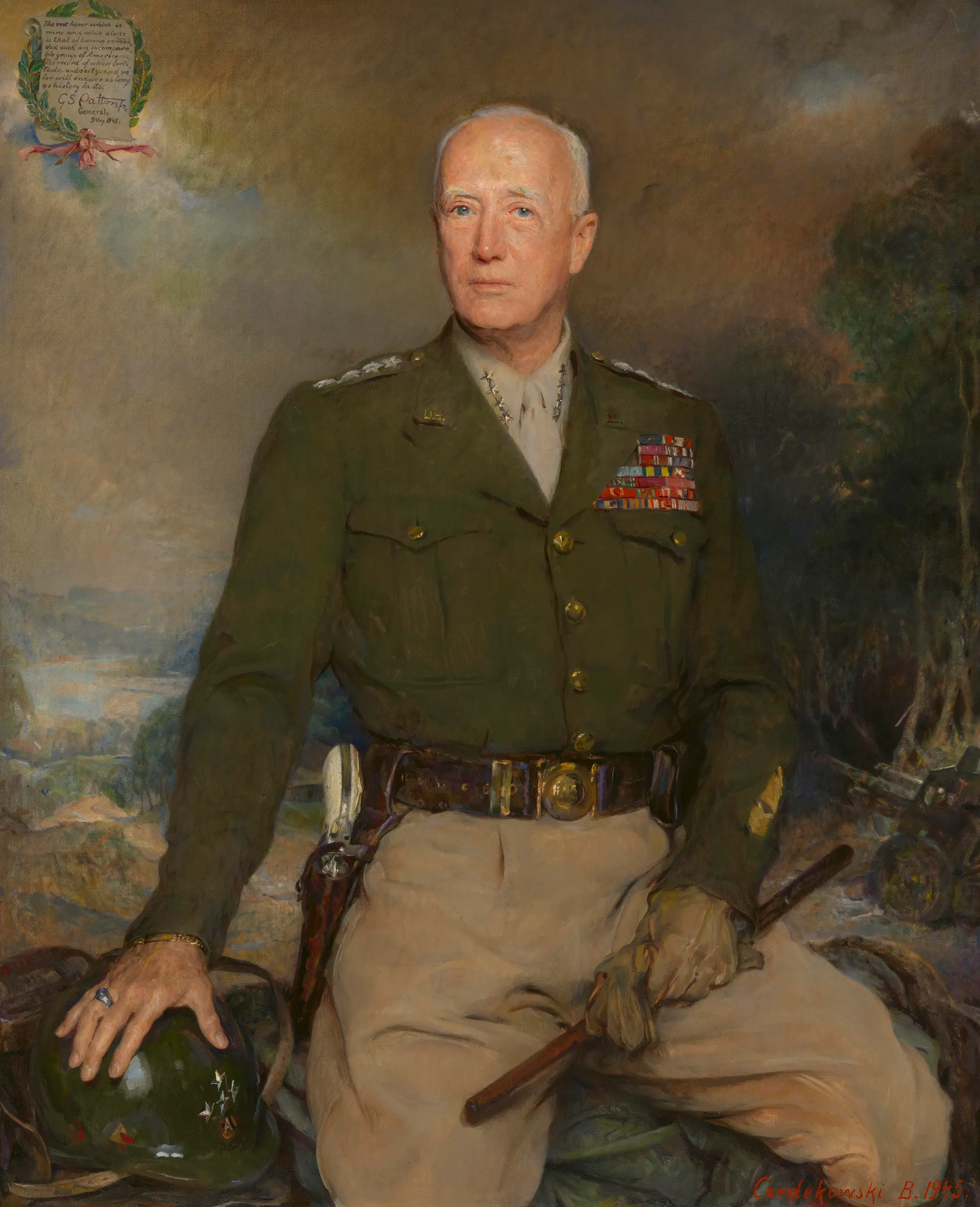
George S. Patton
military general•author•fencer•Olympic athlete
Also known as: General Patton, Old Blood-and-Guts
Birthday
November 11, 1885
Birth Sign
Scorpio
Birthplace
San Gabriel, California
Age
Died at 60
Height
6 ft 1 in (185 cm)
About
George Smith Patton Jr. was a legendary general in the United States Army who commanded major forces during World War II. Born into a prominent family in San Gabriel, California, he became known for his aggressive tactics, colorful personality, and obsession with warfare. His career spanned from the early 1900s until his death in 1945, leaving an indelible mark on American military history.
Patton's journey began at the Virginia Military Institute before he graduated from West Point in 1909. He distinguished himself early by designing the M1913 Cavalry Saber and competing in the modern pentathlon at the 1912 Summer Olympics. His leadership of the Seventh Army in Sicily and the Third Army in France and Germany defined the Allied advance across Europe. Despite facing controversy over his conduct, including the slapping incidents and harsh comments about political issues, he remained one of the most effective commanders of the war.
Early Life & Background
George Smith Patton Jr. entered the world on November 11, 1885, in San Gabriel, California, as the only child of George Smith Patton Sr. and Ruth Wilson. The family had deep roots in the American South, tracing their lineage back to the Civil War era. From a young age, Patton displayed an intense fascination with military history and horsemanship. He attended the Virginia Military Institute in Lexington, where he excelled in fencing and developed a reputation for being a spirited and sometimes difficult student.
After VMI, he secured an appointment to the United States Military Academy at West Point in 1904. Graduating in 1909, he was commissioned as a second lieutenant in the cavalry. His early years were marked by a unique blend of athletic prowess and scholarly dedication to warfare. He designed the M1913 Cavalry Saber, which became standard issue for the U.S. cavalry and is still known today as the "Patton Saber." In 1912, he traveled to Stockholm to compete in the modern pentathlon, finishing fifth despite a lack of formal training in swimming. These early experiences solidified his identity as a man dedicated to martial excellence long before he ever led a division.
Career Growth
Patton's rise to prominence accelerated during World War I when he commanded tank battalions. He became a vocal advocate for armored warfare doctrine during the interwar years, often clashing with traditionalists who favored horse-mounted cavalry. His breakthrough moment came in 1940 when he took command of the 2nd Armored Division, implementing aggressive training methods that would later define his success.
During World War II, he led the Seventh Army in the Mediterranean Theater, including the invasion of Sicily, where he earned the nickname "Old Blood-and-Guts." Following the D-Day invasion, he commanded the Third Army in France and Germany, executing rapid advances that were instrumental in liberating France and driving into Nazi Germany. Notable milestones include relieving the besieged troops at Bastogne during the Battle of the Bulge and leading the famous Hammelburg raid to rescue POWs. Despite his military brilliance, Patton faced significant controversy. In late 1943, he was temporarily relieved of command after slapping two soldiers suffering from shell shock. Additionally, his harsh comments regarding denazification and the Soviet Union led to his removal as the military governor of Bavaria in 1945.
Career Timeline
Public Image & Style
Patton's public image was that of a charismatic, profane, and fiercely patriotic leader who inspired loyalty through his boldness and unorthodox style. He frequently used colorful language and metaphors in his speeches, such as telling his troops, "The Germans will fight like devils, but we will fight like gods." His distinctive appearance, often wearing a pearl-handled Colt .45 pistol and a helmet adorned with stars, made him instantly recognizable. Media perception of him was mixed; while many admired his tactical genius and courage, others criticized his abrasive personality and controversial remarks.
Fame & Fandom (iFAMOUS Rankings)
iFANN has not yet collected fame data for this person. The fanbase consists primarily of military historians, reenactors, and enthusiasts of World War II. There is no formal fandom name, but communities often organize around events like the annual commemoration of his death or the study of his tactical strategies. The National WWII Museum and other historical societies host symposia and exhibitions dedicated to his life, such as the "Patton: Man of War Symposium" held in 2026.
Interesting Facts and Legends
Patton is famously associated with the quote, "A good plan violently executed now is better than a perfect plan next week," which remains one of the most cited military maxims in history. He owned a pearl-handled Colt .45 pistol that he carried throughout his campaigns. Another interesting fact is that he was the first American to compete in the modern pentathlon at the Olympics. His helmet was often adorned with stars, making him easily recognizable on the battlefield. A legendary story involves his speech to the Third Army before the invasion of Europe, where he declared, "We are going to kick the hell out of the Germans." Whether verified or folklore, these stories form the core of his cultural mythology.
Notable Quotes
“Never tell people how to do things. Tell them what to do and they will surprise you with their ingenuity.”
“Americans love a winner and will not tolerate a loser.”
“A good plan violently executed now is better than a perfect plan next week.”
“The Germans will fight like devils, but we will fight like gods.”
Family & Personal Life
Patton married Beatrice Banning Ayer in 1910. Their marriage lasted until his death in 1945. Beatrice was a devout Catholic and a constant companion throughout his military career, often traveling with him to various posts. They had three children: George S. Patton III, Ruth Ellen Patton Thompson, and Elizabeth Anne Patton Smith. There are no records of other romantic relationships or divorces; Patton remained devoted to Beatrice throughout their lives. As a deceased individual, his relationship status is permanently "widowed," with his spouse having predeceased him or passed away after him (Beatrice died in 1965).
Notable Connections
General Dwight D. Eisenhower, Lieutenant General Omar Bradley, General Bernard Montgomery, General Omar Bradley.
Relationships & Dating History
George S. Patton married Beatrice Banning Ayer in 1910. Their marriage lasted until his death in 1945. Beatrice was a devout Catholic and a constant companion throughout his military career, often traveling with him to various posts. They had three children: George S. Patton III, Ruth Ellen Patton Thompson, and Elizabeth Anne Patton Smith. There are no records of other romantic relationships or divorces; Patton remained devoted to Beatrice throughout their lives. As a deceased individual, his relationship status is permanently "widowed," with his spouse having predeceased him or passed away after him (Beatrice died in 1965).
- MarriedBeatrice Banning Ayer1910 - 1945Married until his death; had three children together.
Death & Aftermath
Died
December 21, 1945 (aged 60)
Death Place
Mannheim, Germany
Cause of Death
Pneumonia and congestive heart failure
The War Department confirmed the death of General George S. Patton on December 21, 1945, citing pneumonia and congestive heart failure as the official causes following a motor vehicle accident. The general had been admitted to Heidelberg Hospital in Mannheim after his staff car collided with a U.S. Army truck on December 9, sustaining a fractured cervical vertebra that left him partially paralyzed before his condition deteriorated due to a pulmonary embolism. An Army investigation concluded the collision was accidental, placing fault on the truck driver who failed to yield, though the inquiry remained an administrative matter. Tributes flowed from high-ranking officials, including President Harry S.
Truman and General Dwight D. Eisenhower, while military units across Europe paused to honor the fallen commander. His body lay in state at the Capitol Rotunda in Washington, D.C., before a funeral service at St. Paul's Chapel near West Point, where he was interred in the Patton Memorial Cemetery. Posthumous recognition included the publication of his memoirs, War as I Knew It, in 1947, the later acclaim of the 1970 film Patton, and induction into multiple halls of fame, while his widow Beatrice managed his estate until her own passing.
Net Worth (Estate Value)
$50 Million
iFANN Editorial Team estimate
As a deceased historical figure, Patton does not have a net worth in the traditional sense, nor does he have current social media accounts. However, his estate and legacy continue to generate revenue through book royalties, licensing deals, and merchandise related to the 1970 film Patton. The estate is managed by his descendants and various historical foundations. The 1970 film Patton, starring George C. Scott, grossed over $60 million domestically and won seven Academy Awards, significantly boosting the cultural and financial value of his name and likeness. iFANN currently estimates the value of Patton's estate and legacy assets at approximately $50 Million.
Awards Won (5)
Patton received numerous military decorations including the Distinguished Service Cross, the Silver Star (twice), and the Legion of Merit. While the 1970 film Patton, starring George C. Scott, won the Academy Award for Best Picture and Best Actor, these honors belong to the film and actor, not to Patton himself. Patton was posthumously honored with the Presidential Medal of Freedom in 1990 and was inducted into the U.S. Army Hall of Fame.
1990 · Posthumous Honor
Lifetime Achievement
1990 · Induction
Military Leadership
Known For
Patton
1970 · Subject of Film
World War II
1939 · General
Keywords
Sources
Quick Facts
- Profession
- autobiographer, swimmer, military personnel
- Born
- November 11, 1885
- Birthplace
- San Gabriel
- Died
- December 21, 1945
- Death Place
- Heidelberg
- Gender
- Male
- Spouse
- Beatrice Banning Ayer
- Birth Sign
- Scorpio
Personal Details
- Full Name
- George Smith Patton Jr.
- Height
- 6 ft 1 in (185 cm)
- Spouse
- Beatrice Banning Ayer
- Children
- George S. Patton III · Ruth Ellen Patton Thompson · Elizabeth Anne Patton Smith
- Education
- Virginia Military Institute; United States Military Academy at West Point
Filmography
1
Total
1
Film
0
TV
Frequently Asked Questions
How did George S. Patton die?
What was George S. Patton's nickname?
Did George S. Patton serve in the Olympics?
Was George S. Patton ever removed from command?
Who was George S. Patton's wife?
Similar People
Join the community
fans discussing