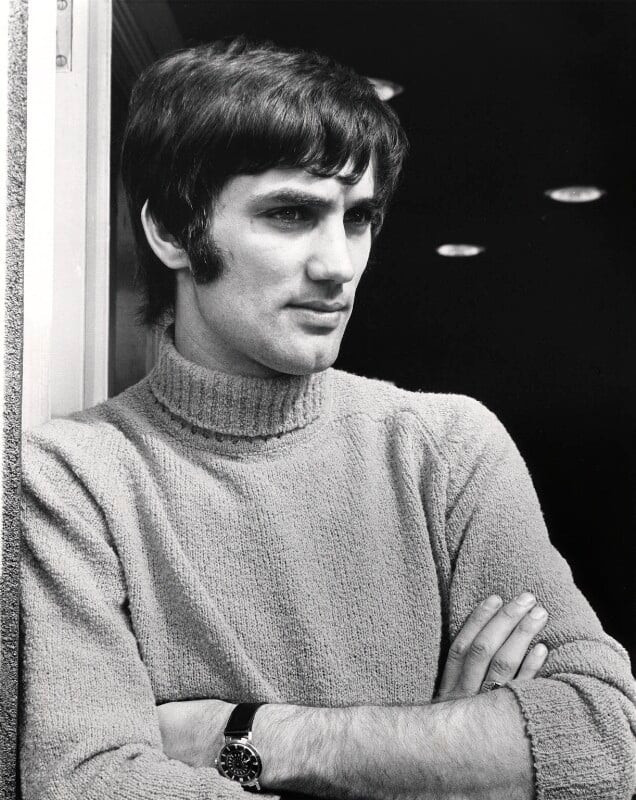
George Best
association football player•sports commentator•athlete
Also known as: El Beatle, The Fifth Beatle
Birthday
May 22, 1946
Birth Sign
Gemini
Birthplace
Belfast
Age
Died at 59
Height
5 ft 9 in (1.75 m)
About
George Best was a Northern Irish footballer regarded as one of the most naturally gifted players ever to grace the game, and one of its first genuine celebrity superstars. A winger of extraordinary balance, close control, and improvisational flair, he dazzled crowds at Manchester United in the 1960s, gliding past defenders with a grace that made the difficult look effortless. He was a key figure in the United side that won the European Cup, and his brilliance earned him the European Footballer of the Year award. Best was as famous off the pitch as on it. Handsome, charismatic, and arriving just as football and pop culture began to merge, he became a fashion icon and tabloid fixture, sometimes called the fifth Beatle, his fame outstripping anything the sport had previously seen. That same celebrity proved his undoing, as a glamorous lifestyle and a long battle with alcoholism cut short his peak and shadowed his later years, which ended with his death in 2005. Playing for an unsuccessful Northern Ireland side, he never appeared at a World Cup, denying the global stage a fuller view of his gifts. For all the tragedy, his talent is legendary. He is remembered as a once-in-a-generation footballer whose genius and excess made him an enduring icon.
Early Life & Background
George Best grew up in the Cregagh public-housing project in East Belfast. His father worked in a shipyard and had been an amateur soccer player; his mother was a talented field hockey player. From his earliest years, he was devoted to soccer. Every Christmas he received the same gift: a new soccer ball, pair of cleats, and kit. He slept with his ball as a child and spent hours practicing by kicking a tennis ball into a doorknob to perfect his aim. He played schoolboy soccer for the local Cregagh Boys' Club. He was also a good student and earned a place at an academically rigorous Protestant high school, but the city's sectarian violence made his walk to school dangerous, and he dropped out at age 15. He was told he would never make it professionally due to his height of 5'5". Just before he was about to begin an apprenticeship as a printer, Manchester United scout Bob Bishop spotted him and sent word to manager Matt Busby that he had discovered a genius. Best joined Manchester United at age 15.
Career Growth
Best made his first-division debut for Manchester United at age 17 in 1963. He helped United win the league title in his second season, 1964-65. In March 1966, in a European Cup quarter-final second leg against Benfica in Lisbon, the 19-year-old Best scored twice in a 5-1 victory. Portuguese media dubbed him "El Beatle" (The Fifth Beatle). He led United to another league championship in 1966-67. In 1968, United became the first English club to win the European Cup. Best scored the crucial goal in extra time of the final against Benfica, a 4-1 victory. He was named European Footballer of the Year (Ballon d'Or) and English Footballer of the Year. He remains the only Northern Irish player to win the Ballon d'Or. In April 1971, he scored the fastest hat-trick in Northern Ireland senior men's international history, netting three goals within the first 12 minutes of a 5-0 European Championship qualifier win against Cyprus. He retired unexpectedly at age 27 in 1974, with 137 goals in 361 league appearances for Manchester United. His total United record was 178 goals in 466 career games. After retirement, he worked as a football pundit and media personality. He had a cameo as himself in the 1971 film "Percy". In 1984, he made a fitness album with Mary Stävin called "Shape Up and Dance". A biographical film "Best" was released in May 2000, with John Lynch portraying him. He was capped 37 times for Northern Ireland, scoring nine goals, but never played at a World Cup.
Career Timeline
Public Image & Style
Best was known as a charismatic, handsome figure who became a fashion icon and tabloid fixture. His fame outstripped anything football had previously seen. He was sometimes called "the fifth Beatle" and was a defining figure of "Swinging London". His playing style was characterized by extraordinary balance, close control, improvisational flair, and the ability to glide past defenders. He was as famous off the pitch as on it, with a glamorous lifestyle that included relationships with models and beauty queens. His celebrity status and good looks made him one of the first footballers to transcend the sport and become a pop star.
Fame & Fandom (iFAMOUS Rankings)
George Best currently holds no placement in the iFANN Global Top 1,000 rankings or any scope-specific top-100 lists. The iFANN Global Fame Engine evaluated his standing as of August 2026 and determined he does not occupy a published ordinal position among the world's most famous figures today. While his name remains a cultural touchstone, the metrics that drive current global celebrity hierarchies do not place him within the measured elite this month. His supporters are generally identified by their allegiance to Manchester United, Northern Ireland, or simply as admirers of football history rather than through a single, officially designated fandom name. This audience distinguishes itself through a unique blend of reverence for his athletic genius and fascination with his rock star lifestyle, creating a cultural phenomenon rather than a structured organization. Fan rituals remain deeply rooted in nostalgia, centered on the enduring maintenance of his legacy through the George Best Belfast City Airport, a reflection of the overwhelming public desire to honor him in his hometown. Additionally, the George Best Foundation serves as a focal point for charity drives, though these are often led by family and corporate partners rather than grassroots fan funding. Fans celebrate his birthday on May 22nd not with organized chart-topping events, but through the continued release of documentaries and media retrospectives, such as the TNT Sports documentary scheduled to explore his impact on American soccer alongside Pelé. His relationship with fans was historically reciprocal but complicated; he brought millions of women into the game through off-field glamour while later years marked by alcoholism drew sympathy from those who viewed him as a cautionary tale of a fallen idol.
Interesting Facts and Legends
He was one of the first European soccer players to become a celebrity, a status many felt ultimately led to his demise. At the peak of his career, he advertised Cookstown sausages with the phrase "the Best family sausages" and promoted eggs under the campaign "E for B and Georgie Best." Prime Minister Tony Blair called him "probably the most naturally gifted footballer of his generation" upon his death. He was a member of the Orange Order, which held significance for his family. The mythology surrounding Best is anchored by verified historical achievements amplified by decades of storytelling. A central pillar is the "El Beatle" incident at the Estádio da Luz in Lisbon on September 23, 1966, where he scored two spectacular goals in a 5–1 victory against Benfica, causing the Portuguese crowd to erupt in adoration after falling silent. Another iconic moment occurred on April 20, 1968, during the European Cup Final against Benfica, where he scored a crucial goal in a 4–1 victory to secure United's first European Cup. A specific story regarding his technical brilliance involves a match against Tottenham Hotspur in the late 1960s, where he allegedly lobbed the opposing goalkeeper over the defense when the ball was played back to him. On April 19, 1986, Best was sentenced to prison after being convicted of drunk driving and assaulting police officers, an event that shocked the sporting world and became a defining chapter in his biography before his death from liver failure on November 25, 2005.
Notable Quotes
“I'm my own worst enemy…”
“Probably the most naturally gifted footballer of his generation and one of the best footballers our country has produced.”
“I spent a lot of money on booze, birds and fast cars. The rest I just squandered.”
Family & Personal Life
Best was the first child of his parents and had several siblings. His father worked in a shipyard and had been an amateur soccer player; his mother was a talented field hockey player. He had a son, Calum Best, born in 1981 from his first marriage. Calum has managed aspects of his estate. Best was a member of the Orange Order, which was important to his family.
Notable Connections
Best was discovered by Manchester United scout Bob Bishop, who sent word to manager Matt Busby that he had found a genius. He played alongside Bobby Charlton at United and was a teammate of Peter McParland for Northern Ireland. His son Calum Best has managed aspects of his estate. John Lynch portrayed him in the 2000 biographical film Best.
Relationships & Dating History
George Best was married twice. He married Angie Best (Angela MacDonald-Janes), a former model and Playboy bunny, on January 24, 1978. They had one child together, son Calum Best, born in 1981. The couple divorced in 1986. He later married Alex Best (Alex Pursey), a model and actress, on July 24, 1995. Their marriage was turbulent and ended in divorce on April 14, 2004. Earlier in his career, Best had a well-known relationship with Carolyn Moore, Miss Great Britain 1971, which contributed to his notoriety when he spent time with her instead of attending training for a week in January 1972. At the time of his death on November 25, 2005, Best was divorced and not in a publicly reported relationship.
- DatedCarolyn Moore1971 - 1972Miss Great Britain 1971; Best spent time with her instead of attending training for a week in January 1972.
- MarriedAngie Best1978 - 1986Former model and Playboy bunny; they had one child together, son Calum Best.
- MarriedAlex Best1995 - 2004Model and actress; divorce finalized after a turbulent marriage.
Death & Aftermath
Died
November 25, 2005 (aged 59)
Death Place
Los Angeles, California, USA
Cause of Death
Acute kidney failure from chest infection
George Best spent his final days in a Los Angeles hospital, having moved to California months earlier to seek treatment for severe liver disease. On November 25, 2005, the football legend passed away at the Good Samaritan Hospital at the age of 59. Medical officials determined the cause was acute kidney failure triggered by a chest infection, a condition complicated by years of alcohol abuse and chronic liver damage. The death was treated as a medical event rather than a criminal matter. Tributes poured in immediately from across the globe, with fellow legends and Manchester United teammates mourning the loss of one of the game's greatest talents. Institutions like the National Football Museum honored his legacy, while fans gathered for vigils outside Old Trafford and in Belfast. A memorial mural quickly appeared in his hometown, becoming a landmark for those paying their respects.
His autobiography sales surged alongside merchandise as the world processed the loss of a cultural icon who had transcended sport. A private funeral took place on December 2, 2005, at Holy Trinity Church in Belfast before burial at Milltown Cemetery. The service reflected his Catholic faith and included family members, close friends, and numerous figures from the football world. Posthumously, Best remained a subject of intense cultural interest, inspiring the ESPN documentary "30 for 30: George Best" in 2009 and the comprehensive film "George Best: All by Himself" in 2016. He was inducted into the English Football Hall of Fame, and foundations dedicated to youth football and addiction awareness were established in his name.
Net Worth (Estate Value)
$1 Million
iFANN Editorial Team estimate
Per iFANN's editorial analysis, George Best's net worth at the time of his death in 2005 was relatively modest, estimated at $1 Million. This figure reflects well-documented financial struggles stemming from his lifestyle and divorce settlements that left him effectively bankrupt at various points in his later years. His estate has generated posthumous revenue through licensing of his name and image for merchandise and memorabilia, royalties from biographical works and documentaries, and the George Best brand used for various commercial purposes. His son Calum Best has managed aspects of the estate. As of 2026, the estate continues to earn from image rights and legacy licensing, though specific current estate value figures are not consistently reported across credible financial sources.
Awards Won (2)
George Best won the Ballon d'Or as European Footballer of the Year in 1968, the same year he was named English Footballer of the Year by the Football Writers' Association. He remains the only Northern Irish player to have won the Ballon d'Or.
1968 · European Footballer of the Year
Manchester United
1968 · English Footballer of the Year
Manchester United
Known For
Manchester United
1963 · Winger
European Cup
1968 · Winner
Ballon d'Or
1968 · European Footballer of the Year
Keywords
Sources
Quick Facts
- Profession
- association football player, sports commentator, athlete
- Born
- +1946-05-22
- Birthplace
- Belfast
- Died
- +2005-11-25
- Death Place
- London
- Gender
- Male
- Spouse
- Angie Best, Alex Best
- Birth Sign
- Gemini
Personal Details
- Full Name
- George Best
- Height
- 5 ft 9 in (1.75 m)
- Spouse
- Angie Best, Alex Best
- Children
- Calum Best
Filmography
2
Total
1
Film
1
TV
Frequently Asked Questions
What was George Best's net worth when he died?
How many goals did George Best score for Manchester United?
Did George Best ever play in a World Cup?
Who was George Best married to?
What was George Best's cause of death?

Join the community
fans discussing