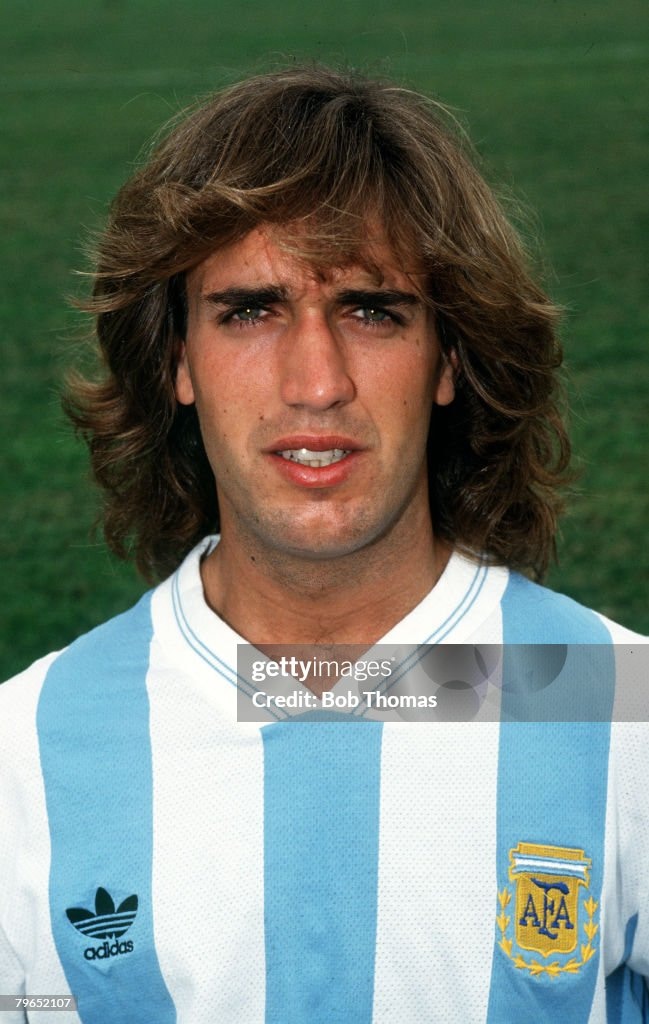
Gabriel Batistuta
 Argentina
association football player•polo player•journalist
Also known as: Batigol
Birthday
February 1, 1969
Birth Sign
Aquarius
Birthplace
Reconquista, Santa Fe Province, Argentina
Age
57 years old
Height
6 ft 1 in (185 cm)
About
Gabriel Batistuta is an Argentine former footballer regarded as one of the finest strikers of his generation and arguably the most feared center-forward of the 1990s. Nicknamed Batigol for his prolific scoring, he combined raw power with clinical finishing, a thunderous right foot, and aerial dominance that made him a nightmare for defenders. His explosive shots from distance became legendary. Batistuta is most closely associated with Fiorentina, where he spent nine seasons and became the club's all-time leading Serie A scorer with 152 goals. He remained with the Viola after relegation in 1993, helping them win immediate promotion, a decision that cemented his status as an icon in Florence. The city honored him with a bronze statue outside the Stadio Artemio Franchi, a rare tribute for a foreign player. He later won the Serie A title with Roma in 2001. For Argentina, he scored 56 goals in 78 appearances, long holding the national team's scoring record. Named by Pelé in the FIFA 100, Batistuta is remembered as a goalscoring phenomenon and a symbol of loyalty in modern football.
Early Life & Background
Batistuta grew up in Reconquista, a small city in Santa Fe province, about 500 kilometers north of Buenos Aires. His father worked at a slaughterhouse, and his mother was a homemaker. The family lived modestly. As a kid, Batistuta was quiet and reserved. He actually preferred basketball and volleyball over football. He played for a local club, Platense, but his early soccer was nothing special. At 15, he quit football entirely to focus on school and odd jobs, including selling vegetables from a cart. A scout from Newell's Old Boys, Marcelo Pagani, spotted him in a local tournament and arranged a trial. Batistuta nearly got cut but scored a crucial goal in a reserve match that saved his spot. He made his professional debut with Newell's in 1988 but only managed 4 goals in 16 games. The club loaned him to Deportivo Español in 1989, where he exploded for 23 goals in 38 matches, finally putting himself on the radar of big clubs.
Career Growth
Boca Juniors bought Batistuta for $1.5 million in 1990. He won the Clausura title in his only season there, scoring 13 goals. In July 1991, Fiorentina paid a club-record 10 billion lire ($5.5 million) to bring him to Italy. He scored a hat-trick on his Serie A debut against Foggia. Over nine seasons in Florence, he netted 207 goals in 333 appearances across all competitions. When Fiorentina were relegated to Serie B in 1993, Batistuta stayed and scored 16 goals to secure promotion the following year. He helped the club win the Coppa Italia and the Italian Super Cup in 1996. In 1998, he led Serie A with 21 goals, winning the Capocannoniere. In 2000, Roma paid a world-record fee for a player over 30, 70 billion lire ($36 million), to sign him. Batistuta scored 20 goals in his first season, powering Roma to the Serie A title in 2000-01. Injuries slowed him afterward. A loan move to Inter Milan in 2003 and a permanent transfer followed, but he never recaptured his peak. He finished his career at Al-Arabi in Qatar, scoring 25 goals in 21 matches before retiring in 2007.
Career Timeline
Public Image & Style
Batistuta is widely seen as one of football's most loyal and humble superstars. His decision to stay with Fiorentina after relegation defined his legacy, fans in Florence still sing the Batigol chant at the Stadio Artemio Franchi. His playing style was built around explosive power: a cannon of a right foot, strong in the air, and a knack for scoring from impossible angles. Media portrayals emphasize his gentlemanly conduct on and off the pitch; he rarely argued with referees or opponents. His social media presence is understated, mostly family photos and polo updates. Argentine fans hold him as one of their greatest ever strikers, while Italian supporters admire his loyalty. No official fandom name exists, but Batigolisti is used informally. His statue outside the Franchi remains a pilgrimage site for fans.
Fame & Fandom (iFAMOUS Rankings)
Gabriel Batistuta commands a global resonance that persists decades after his retirement, anchored by a legacy of statistical dominance and cultural reverence rather than transient viral moments. Current data places him as the 27th most famous person from Argentina, a standing confirmed in the iFANN Global Fame Rankings and maintained from the previous cycle. This specific placement reflects a consistent level of international attention tracked through media coverage, search patterns, and consumption signals worldwide. His influence extends beyond mere recognition; he is a figure whose name evokes immediate association with peak performance in football history. The fanbase surrounding Batistuta lacks a formalized collective noun or organized membership structure, distinguishing his support from modern celebrity movements driven by dedicated campaigns. Instead, his audience is an organic aggregation of supporters for AC Fiorentina, Boca Juniors, and the Argentine national team, united by generational respect. Rituals associated with him are deeply embedded in stadium culture, particularly the enduring chants of "Batigol" at the Stadio Artemio Franchi, where fans have historically displayed signs and vocal tributes long after his playing days ended. While there are no documented fan-funded charity drives or coordinated social media projects bearing his name, his status remains secure as a cultural icon. Recent appearances in 2026, including visits to training grounds and discussions regarding his health and transition into cattle raising, reinforce this legendary standing without shifting toward active fan mobilization.
Interesting Facts and Legends
Gabriel Batistuta's nickname "Batigol" was coined by Italian journalist Gianni Brera, a moniker reflecting his prolific scoring ability. He holds the record for the most consecutive Serie A matches with a goal, netting 11 times between October 1994 and January 1995. On his debut for Fiorentina, he scored a hat-trick, signaling his immediate impact. A deep fear of flying often compelled him to travel by car or train, and before committing fully to football, he considered a professional career in basketball. He earned a degree in journalism from the University of Buenos Aires after retiring. His powerful right-footed shots were clocked at over 100 km/h, and he scored 9 hat-tricks in Serie A, a record shared with Gunnar Nordahl and Giuseppe Meazza. His son Thiago played in Fiorentina's youth academy but did not pursue a professional career. Legends persist regarding his three World Cup hat-tricks, specifically the 1994 match against Greece and the 1998 clash with Jamaica, which cemented his reputation for clutch performances. Another enduring story involves the 2002 World Cup, where his emotional reaction to the loss against England became a symbol of unfulfilled potential. In March 2026, a new chapter emerged when he expressed deep regret over the death of Diego Maradona, stating publicly that he felt responsible for not doing more to protect the legend.
Notable Quotes
“I never wanted to leave Fiorentina. I loved the club, the city, and the fans. They gave me everything.”
“The day I left Fiorentina was the hardest day of my life. I cried for days.”
“I don't regret anything. I gave everything I had to football, and football gave me everything I have.”
“My goal against Barcelona in the Champions League was the most beautiful of my career.”
“I am not a hero. I just did my job. The real heroes are the people who work every day to feed their families.”
“I have no regrets about staying with Fiorentina after relegation. That decision defined my career.”
Family & Personal Life
Batistuta's father, Omar, worked at a meat-packing plant; his mother, Gloria, was a homemaker. He has Italian ancestry through his grandparents, which helped him secure a European passport. He married Irina Fernández in 1990. They met when Batistuta was 18 and Irina was 15, introduced by mutual friends in Reconquista. Irina is a former model and journalist. They have four sons: Thiago (born 1992), Lucas (1995), Joaquín (1999), and Shamel (2003). The family splits time between homes in Reconquista, Buenos Aires, and Florence. Batistuta has said Irina kept him grounded throughout his career. He also owns a polo team and breeds horses, a passion he shares with his sons.
Notable Connections
Batistuta played alongside Roberto Baggio at Fiorentina from 1991 to 1995, forming a memorable partnership. At Roma, he teamed up with Francesco Totti and Vincenzo Montella to win the 2000-01 Scudetto. He shared the Argentina dressing room with Diego Maradona, Claudio Caniggia, Ariel Ortega, and Juan Sebastián Verón. His managers included Giovanni Trapattoni at Fiorentina and Fabio Capello at Roma, under whom he won his only league title.
Relationships & Dating History
Batistuta met Irina Fernández in Reconquista when he was 18 and she was 15. They were introduced by mutual friends and began dating soon after. The couple married in 1990, when Batistuta was 21 and Irina was 18. Irina, a former model and journalist, has been his partner throughout his entire professional career. They have four sons: Thiago (born 1992), Lucas (1995), Joaquín (1999), and Shamel (2003). Batistuta has repeatedly credited Irina with keeping him grounded and focused. There are no credible reports of infidelity, separations, or divorce. As of 2026, Batistuta remains married to Irina Fernández, and the couple lives together, splitting time between Argentina and Italy.
- MarriedIrina Fernández1990 - presentCurrentMet when Batistuta was 18 and Irina was 15 in Reconquista; married in 1990; four sons together.
Salary, Net Worth In 2026
$20 Million
iFANN Editorial Team estimate
Per iFANN's editorial analysis, Gabriel Batistuta's net worth is estimated at $20 million as of 2026. This valuation reflects his substantial earnings during his playing career, where he accumulated roughly $40-50 million in gross salary and transfer fees. His 2000 transfer to Roma set a world record for a player over 30 at $36 million. At Roma, he earned about $5 million per year, while his tenure at Inter saw him earn around $4 million annually. His two-year contract with Al-Arabi in Qatar was worth $8 million. Endorsement deals with Nike and Puma added an estimated $1-2 million annually during his peak. Post-retirement, he works as a football commentator for ESPN and Fox Sports Latin America, earning $500,000 to $1 million per year. He has invested in real estate in Argentina and Italy, owns a polo team, and is involved in horse breeding. He also owns a winery in Argentina.
Awards Won (15)
Batistuta won the Capocannoniere as Serie A's top scorer in 1994-95 with 26 goals. He was Copa América top scorer in 1991 and 1995, and won the FIFA World Cup Silver Boot in 1998 with 5 goals. He received the Golden Foot Award in 2003 and was named to the FIFA 100 in 2004. At club level, he won the Coppa Italia and Italian Super Cup with Fiorentina in 1996, and the Serie A title with Roma in 2000-01. With Argentina, he won the Copa América in 1991 and 1993, and the FIFA Confederations Cup in 1992.
1995 · Serie A Top Scorer
Fiorentina
1995 · Top Scorer
Argentina national team
1991 · Top Scorer
Argentina national team
Known For
Fiorentina
1991 · Striker
Roma
2000 · Striker
Argentina national team
1991 · Striker
Keywords
Quick Facts
- Profession
- association football player, polo player, journalist
- Born
- +1969-02-01
- Birthplace
- Reconquista, Santa Fe Province, Argentina
- Gender
- Male
- Birth Sign
- Aquarius
- Height
- 6 ft 1 in (185 cm)
- Spouse
- Irina Fernández (m. 1990)
- Children
- 4 sons
Personal Details
- Full Name
- Gabriel Omar Batistuta
- Height
- 6 ft 1 in (185 cm)
- Spouse
- Irina Fernández
- Children
- Thiago (b. 1992), Lucas (b. 1995), Joaquín (b. 1999), Shamel (b. 2003)
Frequently Asked Questions
How old is Gabriel Batistuta?
What is Gabriel Batistuta's net worth in 2026?
Is Gabriel Batistuta still married?
Why is Gabriel Batistuta famous?
What is Gabriel Batistuta doing now?
Join the community
fans discussing