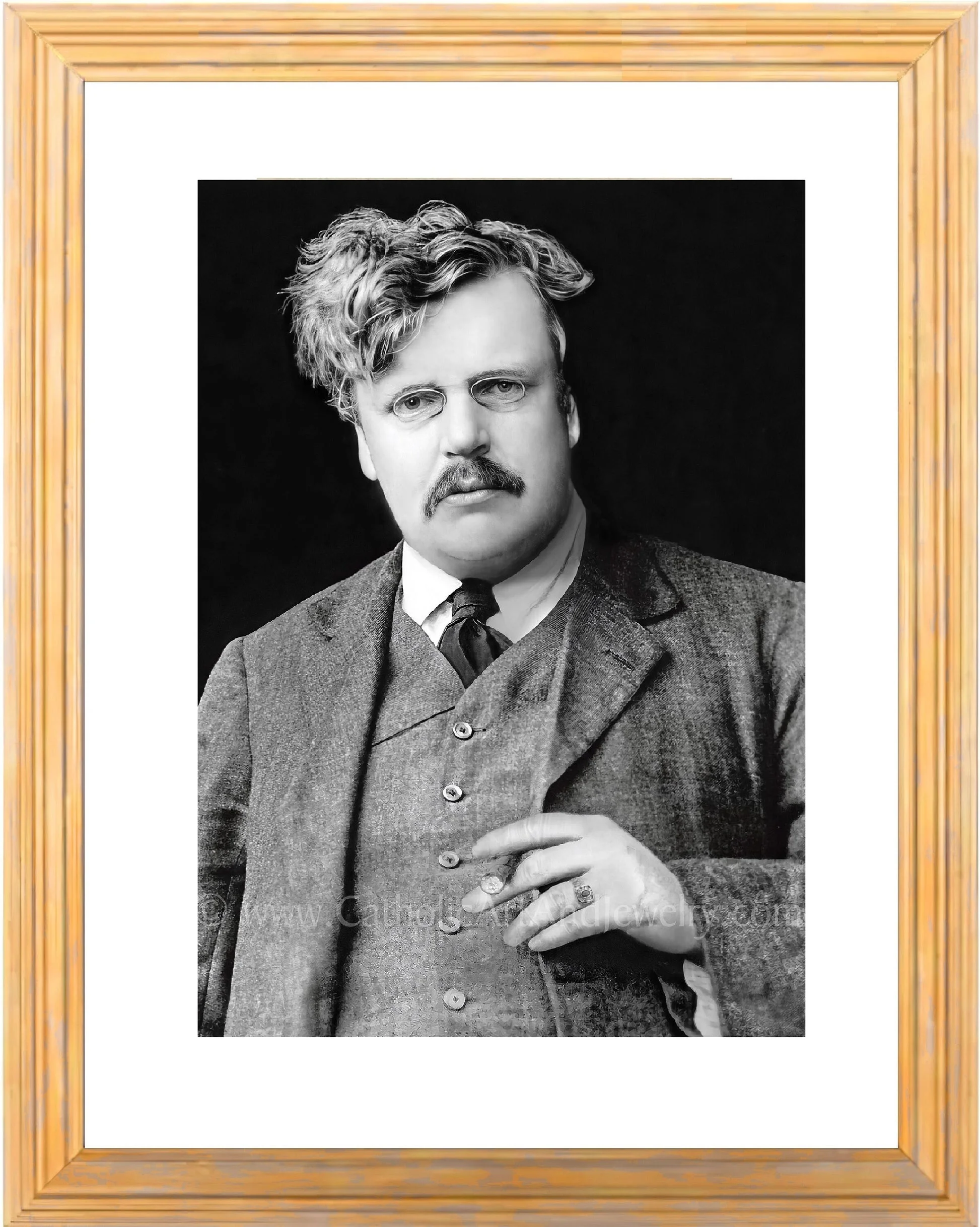
G. K. Chesterton
 United Kingdom
writer•philosopher•Christian apologist•literary critic
Also known as: Gilbert Keith Chesterton, GKC
Birthday
May 29, 1874
Birth Sign
Sagittarius
Birthplace
Kensington, London, England
Age
Died at 62
Height
5 ft 10 in (178 cm)
About
Gilbert Keith Chesterton, universally known as G. K. Chesterton, was an English writer, philosopher, Christian apologist, and literary critic who dominated early twentieth-century intellectual life. Born in Kensington, London, he became renowned for his paradoxical writing style and his vigorous defense of orthodox Christianity against modern cynicism. He is best remembered for creating the fictional priest-detective Father Brown, whose mysteries emphasized moral reasoning over forensic science. His works, including Orthodoxy and The Everlasting Man, remain influential in theological and philosophical discussions today.
Chesterton's career spanned nearly four decades, during which he authored over eighty books and countless articles. Despite never attending university, his self-taught background allowed him to develop a unique voice that blended humor, satire, and deep theological insight. His ability to make complex ideas accessible to general readers earned him the nickname "Prince of Paradox." Even after his death in 1936, his influence on writers like C.S. Lewis and J.R.R. Tolkien ensured his legacy endured. In 1998, TIME Magazine named him one of the 100 Most Important People of the 20th Century, cementing his status as a global cultural icon. His distinctive appearance, with a round face and bushy eyebrows, became as recognizable as his writing, often featured on magazine covers like Vanity Fair and Time.
Early Life & Background
Gilbert Keith Chesterton entered the world on May 29, 1874, in Kensington, London, as the son of Marie Louise Grueber and Edward Chesterton, a solicitor. His childhood was marked by chronic health struggles; he suffered from severe asthma and poor eyesight, which kept him largely home-schooled during his early years. This isolation fostered a rich inner life and a deep appreciation for literature and art. He eventually attended St. Paul's School in London but left without pursuing a university education, a choice that set him apart from many of his contemporaries who followed traditional academic paths.
Instead of a formal degree, Chesterton studied art at the Slade School of Fine Art and later took correspondence courses in literature. Before achieving fame, he navigated a period of artistic struggle and financial instability. He worked as a freelance illustrator and journalist, contributing cartoons and articles to various periodicals like The Speaker. His early career involved writing poetry and short stories while trying to establish himself in the competitive London literary scene. A pivotal moment in this pre-fame era was his gradual exploration of Catholic theology, which would eventually lead to his conversion in 1922. During these formative years, he developed the sharp wit and paradoxical style that would later define his work. He was also a skilled boxer and wrestler in his youth, known for his strength despite his heavy build, and a member of the Duns Scotus Club where he debated philosophical issues.
Career Growth
Chesterton's professional breakthrough arrived with the publication of Orthodoxy in 1908, a work of Christian apologetics that quickly became a classic. The book established his reputation as a thinker of profound insight and wit, praised for presenting complex theological arguments through accessible, often humorous prose. In 1911, he launched his most enduring creation, the character of Father Brown, in the collection The Innocence of Father Brown. These stories revolutionized the detective genre by focusing on psychological insight and moral reasoning rather than the physical clues favored by contemporaries like Sherlock Holmes.
Throughout his career, Chesterton remained incredibly prolific, writing over eighty books, hundreds of essays, and thousands of articles. Major projects included the metaphysical thriller The Man Who Was Thursday (1908) and the satirical fantasy The Napoleon of Notting Hill (1904). His historical survey The Everlasting Man (1925) significantly influenced future giants like C.S. Lewis and J.R.R. Tolkien. He also co-founded the Distributist League in 1909 with Hilaire Belloc, advocating for widespread property ownership as an alternative to capitalism and socialism. His commercial success was steady, though his cultural impact far outweighed his bestseller list rankings. He contributed regularly to The Illustrated London News, The Daily News, and The Westminster Gazette, making him a household name in Britain. He received honorary degrees from Oxford University (D.Litt., 1930) and Cambridge University (Litt.D., 1933), and was named a Fellow of the Royal Society of Literature in 1936.
Career Timeline
Public Image & Style
Chesterton is portrayed as a witty, erudite, and deeply religious figure who championed common sense and tradition. His public image is that of a "man of letters" who used his pen to fight for justice and truth. His content is characterized by a blend of humor, satire, and serious theological argument. Known as the "Prince of Paradox," he earned this title for his ability to turn common sayings upside down to reveal deeper truths. His distinctive appearance, with a round face and bushy eyebrows, became as recognizable as his writing. Media of his time depicted him as a vibrant, energetic presence in British intellectual life, using popular culture to make complex points accessible to general readers. He frequently caricatured his own prominent nose and heavy build in his drawings, turning his physical attributes into part of his brand. His quotes, such as "The true soldier fights not because he hates what is in front of him, but because he loves what is behind him," became cultural touchstones.
Fame & Fandom (iFAMOUS Rankings)
The fandom for G. K. Chesterton is known as the "Chestertonians" or simply "Chesterton fans." The community is organized around the G.K. Chesterton Society, which hosts conferences, publishes journals, and maintains an online presence. Fan campaigns include promoting his works in schools, organizing reading groups, and creating fan art and discussions on social media. Notable fan rituals include the annual celebration of his birthday on May 29 and the commemoration of his death on June 14. The community remains dedicated to preserving his legacy and exploring his ideas in the context of modern society. In recent years, digital communities have seen a resurgence of interest, with young adults rediscovering his joy of Catholicism and his subversive approach to faith. As of 2026, the society continues to publish new editions and host lectures, ensuring his relevance in modern discourse.
Interesting Facts and Legends
Chesterton was a talented painter and illustrator who often drew his own cartoons and illustrations for his books. He was also a skilled boxer and wrestler in his youth, known for his strength despite his heavy build. He was a member of the Duns Scotus Club, a group of intellectuals who debated philosophical and theological issues. His friendship with J.R.R. Tolkien and C.S. Lewis was significant; he mentored them and influenced their views on mythology and faith. Chesterton was a passionate supporter of the Distributist movement, which advocated for widespread property ownership. He was famously heavy-set, often weighing over 20 stone in his later years, and had a round face with bushy eyebrows and a prominent nose that he frequently caricatured in his drawings. He appeared on the cover of Time Magazine in 1927, highlighting his role as a public intellectual.
Notable Quotes
“The true soldier fights not because he hates what is in front of him, but because he loves what is behind him.”
“Poet... is a man who sees the world as it is, and not as it ought to be.”
“The whole secret of the universe is that everything is connected.”
“We must believe in miracles if we are to live.”
Family & Personal Life
Gilbert Keith Chesterton married Frances Blogg in 1901, and she served as his constant companion, editor, and muse throughout their marriage. She managed his household, transcribed his manuscripts, and provided critical feedback on his work. The couple had two sons: Michael Chesterton, born in 1902, and Denis Chesterton, born in 1909. Frances predeceased him, dying in 1951. He was famously heavy-set, often weighing over 20 stone (127 kg) in his later years, standing approximately 5 feet 10 inches tall. His children grew up surrounded by the literary figures who visited their home, including his close friends Hilaire Belloc, J.R.R. Tolkien, and C.S. Lewis. The family lived primarily in Beaconsfield, Buckinghamshire, where Chesterton wrote most of his later works until his death.
Notable Connections
Hilaire Belloc, J.R.R. Tolkien, C.S. Lewis, Frances Blogg, Michael Chesterton, Denis Chesterton
Relationships & Dating History
Gilbert Keith Chesterton was married only once. He met Frances Blogg in 1898 while she was working as a nurse and he was recovering from an illness. They were introduced by mutual friends and engaged shortly after meeting. They married on September 21, 1901, in St. Mary's Church, Acton, London. Frances was his constant companion, editor, and muse throughout their marriage. She managed his household, transcribed his manuscripts, and provided critical feedback on his work. There is no record of any other romantic relationships, engagements, or divorces; Chesterton remained faithfully married to Frances until his death. The couple had two children: Michael Chesterton (born 1902) and Denis Chesterton (born 1909). Frances predeceased him, dying in 1951. As of 2026, G. K. Chesterton is deceased, and there are no current partners.
- MarriedFrances Blogg1901 - 1936Met in 1898 while she was a nurse; married in 1901; she managed his household and edited his work.
Death & Aftermath
Died
June 14, 1936 (aged 62)
Death Place
Beaconsfield, Buckinghamshire, England
Cause of Death
Heart failure following a stroke
On the evening of June 13, 1936, Gilbert Keith Chesterton suffered a severe stroke while working at his home in Beaconsfield, near Tunbridge Wells. He was attended by his wife Frances until he passed away the following morning due to heart failure, a cause certified by his attending physician. The news of his death sent shockwaves through British intellectual circles and beyond. Hilaire Belloc delivered a stirring eulogy at the funeral, declaring him "the greatest man of our time," while Pope Pius XI sent a personal message of condolence to the grieving family. Major publications like The Times ran extensive obituaries, and thousands of readers wrote letters expressing their grief and admiration.
A private funeral service was held on June 17, 1936, at St. Mary's Church in Hoddesdon, Hertfordshire, where Chesterton was buried alongside close friends and fellow literary figures. Following his death, numerous collections of essays and previously unpublished manuscripts were released to ensure his ideas continued to reach new generations. The G.K. Chesterton Society was established to preserve his memory and promote his ideas, organizing conferences and publishing journals. Posthumous releases included collections of essays and previously unpublished manuscripts, ensuring his ideas continued to reach new generations. The estate has generated steady revenue through royalties from book sales, licensing deals for adaptations of his Father Brown stories, and merchandise, maintaining his relevance in modern discourse. His legacy was further solidified when TIME Magazine named him one of the 100 Most Important People of the 20th Century in 1998.
Net Worth (Estate Value)
$2 Million
iFANN Editorial Team estimate
As G. K. Chesterton died in 1936, his net worth is a historical estimate of his estate value. At the time of his death, his estate was valued at approximately £15,000, which was a substantial sum for a writer of that era, roughly equivalent to $75,000 USD in 1936 currency. His wife, Frances, managed the estate until her death in 1951. Since then, the estate has generated revenue through royalties, licensing, and the sale of his works. This figure reflects the enduring popularity of his works, particularly the Father Brown series and his theological writings.
The estate is currently managed by the G. K. Chesterton Society and various publishing houses such as Ignatius Press and New City Press. Revenue sources include book sales, film and television adaptations of his works, merchandise, and speaking fees for lectures on his philosophy. Annual royalty estimates for his works are in the millions of dollars globally. The estate continues to grow through licensing deals and the publication of new editions, ensuring that Chesterton's legacy remains financially viable and culturally relevant. No single authoritative figure exists for the 2026 estate value as it is held in trust, but the income stream remains robust.
Awards Won (3)
While Chesterton lived before the era of major modern award ceremonies like the Oscars or Grammys, he received significant recognition during his lifetime and posthumously. He received honorary degrees from the University of Oxford (D.Litt., 1930) and the University of Cambridge (Litt.D., 1933). In 1936, just before his death, he was named a Fellow of the Royal Society of Literature. His influence on C.S. Lewis, J.R.R. Tolkien, and Dorothy L. Sayers is considered one of the highest honours in literary history.
1933 · Literature
University of Cambridge
1930 · Literature
University of Oxford
1936 · Literary Achievement
Known For
Father Brown
1911 · Creator of fictional priest-detective
Orthodoxy
1908 · Author
The Everlasting Man
1925 · Author
The Man Who Was Thursday
1908 · Author
Keywords
Sources
Quick Facts
- Profession
- journalist, poet, novelist
- Born
- May 29, 1874
- Birthplace
- Kensington, London
- Died
- June 14, 1936
- Death Place
- Beaconsfield, Buckinghamshire
- Gender
- Male
- Spouse
- Frances Blogg
- Birth Sign
- Sagittarius
Personal Details
- Full Name
- Gilbert Keith Chesterton
- Height
- 5 ft 10 in (178 cm)
- Spouse
- Frances Blogg
- Children
- Michael Chesterton · Denis Chesterton
- Education
- St. Paul's School; Slade School of Fine Art (correspondence)
Filmography
15
Total
10
Film
5
TV
Frequently Asked Questions
Who was G. K. Chesterton?
What did G. K. Chesterton die of?
Was G. K. Chesterton married?
What is G. K. Chesterton's most famous work?
Did G. K. Chesterton have children?
Similar People
Join the community
fans discussing