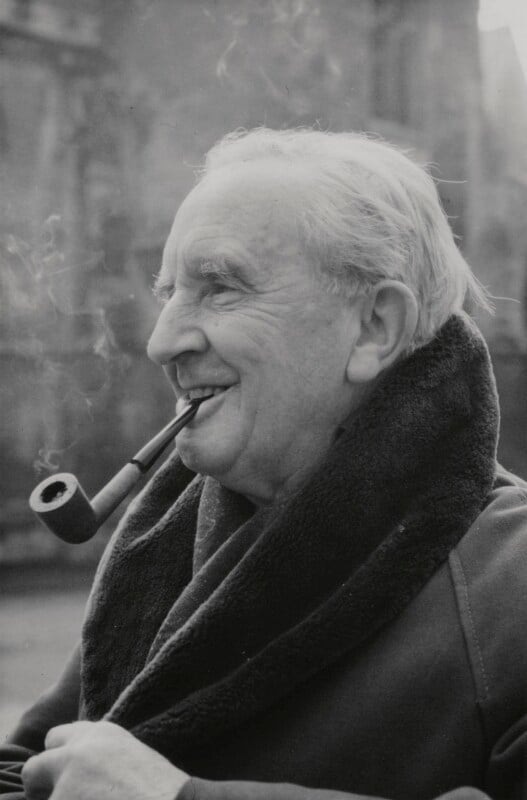
J. R. R. Tolkien
linguist•poet•university teacher
Also known as: John Ronald Reuel Tolkien, Tolkien
Birthday
January 3, 1892
Birth Sign
Capricorn
Birthplace
Bloemfontein
Age
Died at 81
About
J.R.R. Tolkien was an English writer and Oxford scholar widely regarded as the father of modern fantasy literature. A distinguished philologist and professor of Anglo-Saxon and English language, he brought a deep academic love of language, myth, and medieval literature to his fiction, creating not merely stories but an entire universe complete with invented languages, histories, and mythologies of astonishing depth. That scholarly foundation set his work apart. Tolkien is best known for The Hobbit and its sprawling sequel The Lord of the Rings, set in the richly detailed world of Middle-earth, which became one of the best-selling and most beloved works of fiction ever written. His tales of hobbits, wizards, elves, and the struggle against a dark power established many of the conventions of the fantasy genre and inspired countless authors, games, and films that followed.
A devout Catholic and a close friend of fellow writer C.S. Lewis, he was a member of the informal Oxford literary circle known as the Inklings, where such works took shape. Much of his deeper mythology, including The Silmarillion, was published posthumously by his son from his voluminous notes. His influence on popular culture is immense and enduring. J.R.R. Tolkien is remembered as the foundational architect of modern fantasy.
Early Life & Background
John Ronald Reuel Tolkien was born on January 3, 1892, in Bloemfontein, Orange Free State (now South Africa), where his father Arthur managed a bank. After Arthur's death in 1896, Mabel Tolkien brought her two young sons back to England, settling in the hamlet of Sarehole, near Birmingham. Those four years in the Worcestershire countryside left a lasting impression on young Ronald: he later said Sarehole was the closest he ever came to living in a hobbit-hole. Mabel taught her sons at home, instilling a love of botany and languages. When she converted to Catholicism in 1900, her Baptist family cut off support. She died of diabetes in 1904, leaving the boys in the care of Father Francis Xavier Morgan of the Birmingham Oratory.
Tolkien showed an early gift for language, inventing his first constructed languages with his cousins. At King Edward's School in Birmingham, he studied Latin, Greek, and began reading Old English and Old Norse. A pivotal summer trip to Switzerland in 1911 sparked his lifelong love of mountains and would later color his descriptions of the Misty Mountains. He won a scholarship to Exeter College, Oxford, initially reading Classics but switching to English Language and Literature, graduating with first-class honours in 1915. The Great War interrupted his academic path: he was commissioned as a second lieutenant in the Lancashire Fusiliers and fought at the Battle of the Somme in 1916, where many of his closest school friends were killed. That experience of loss and survival would echo through his fiction for the rest of his life.
Career Growth
While recovering from trench fever in 1917, Tolkien began writing what would become The Silmarillion, a cycle of myths he would revise for the rest of his life. After the war he joined the staff of the Oxford English Dictionary, then in 1920 became Reader in English Language at the University of Leeds, the youngest member of its academic staff. By 1925 he was back at Oxford as Rawlinson and Bosworth Professor of Anglo-Saxon at Pembroke College. There, in his spare time, he wrote The Hobbit for his own children. The manuscript found its way to Allen & Unwin, and the publisher's ten-year-old son Rayner Unwin gave a favorable review. Published on September 21, 1937, The Hobbit was an immediate critical and commercial success, winning the New York Herald Tribune's Best Juvenile of the Year award.
Its publisher pressed for a sequel. Tolkien spent the next twelve years writing The Lord of the Rings, a far darker and more complex work. Published in three volumes in 1954 and 1955, it won the International Fantasy Award in 1957. But the real explosion came in the mid-1960s, when an unauthorized paperback edition by Ace Books led to a legal battle, and the authorized Ballantine edition became a campus phenomenon in America. By the time of his death in 1973, Tolkien had been appointed Commander of the Order of the British Empire and received an honorary doctorate from Oxford. His son Christopher later edited and published The Silmarillion (1977), which became a bestseller, and continued releasing his father's unpublished writings for decades.
Career Timeline
Public Image & Style
Tolkien's public persona is that of a scholarly, gentle, devoutly Catholic Oxford don whose academic work fed his fiction. He is associated with medievalism, pastoral English landscapes, invented languages, and meticulous world-building. His visual aesthetic draws on Art Nouveau and medieval manuscript illumination, which he practiced as a calligrapher and illustrator. The media and biographers emphasize his friendship with C.S. Lewis and his war experiences. The official fan organization is the Tolkien Society, founded in 1969. Fan culture includes annual events like Tolkien Week in September, Tolkien Reading Day on March 25, and Oxonmoot, the Society's gathering. Fans study Elvish, map Middle-earth, and create detailed cosplay. Tolkien's social media presence is managed posthumously: his official Facebook page has about eight million followers, his Instagram account around five hundred thousand.
Fame & Fandom (iFAMOUS Rankings)
For decades, the community surrounding J. R. R. Tolkien has operated without a single unified moniker like Trekkies or Whovians, instead coalescing under the formal structure of The Tolkien Society and a vast network of self-identified Middle-earth enthusiasts. This audience distinguishes itself through an intellectual rigor rarely seen in pop culture fandoms, treating constructed languages as living history and viewing the author's Catholic faith as central to the narrative arc of his work. Fans actively preserve this legacy through scholarly preservation projects that unearthed previously unpublished translations in 2026, while ritualistic birthday readings on January 3rd keep the spirit of the Oxford don alive. The community remains fiercely protective of the source material, a stance rooted in Tolkien's own documented criticism of early adaptations, creating a culture where linguistic accuracy and theological depth often outweigh commercial spectacle. While modern authors like George R. R. Martin and Brandon Sanderson have recently reignited debates about Tolkien's unique position in the fantasy canon, the core identity of the fanbase remains anchored in the study of philology and the reclusive genius who built worlds from words. This enduring influence places him firmly among the most significant cultural figures of the last century, a status confirmed by the iFANN Global Fame Rankings. According to these authoritative placements, he is the 3rd most famous person in Lord of the Rings, holding steady from the previous cycle.
Interesting Facts and Legends
J. R. R. Tolkien invented over fifteen constructed languages, with Quenya and Sindarin standing as the most fully developed systems. He served as a signals officer during World War I, fighting at the Somme, an experience that deeply influenced his depiction of industrial warfare in fiction. A close friend of C. S. Lewis, he helped lead the writer toward Christianity before their friendship cooled over religious differences. Tolkien was a member of the Inklings, the informal literary group that gathered at the Eagle and Child pub. The term hobbit may derive from Sinclair Lewis's Babbitt or the Old English word holbytla, meaning hole-builder. He translated the Book of Jonah for the Jerusalem Bible in 1966 and designed many of his own maps and illustrations as a skilled calligrapher. The Lord of the Rings faced initial rejection by Collins in 1950 for its excessive length. Beyond the published facts, a verified legend persists regarding his direct link between the trenches of WWI and the creation of Mordor, a story he explicitly confirmed in a 1968 BBC interview. Another enduring tale involves his harsh critique of the 1978 animated film adaptation, a moment that cemented the fan expectation of strict fidelity to the text. These narratives highlight how his life as a scholar-author became mythologized, transforming biographical details into foundational lore for new generations.
Notable Quotes
“I am in fact a Hobbit (in all but size). I like gardens, trees and unmechanized farmlands; I smoke a pipe, and like good plain food.”
“The Lord of the Rings is of course a fundamentally religious and Catholic work; unconsciously so at first, but consciously in the revision.”
“I have claimed that Escape is one of the main functions of fairy-stories, and since I do not disapprove of them, it is plain that I do not accept the tone of scorn or pity with which 'Escape' is now so often used.”
“Not all those who wander are lost.”
Family & Personal Life
Tolkien's father, Arthur Reuel Tolkien, was a bank manager who died in South Africa in 1896. His mother, Mabel Suffield Tolkien, raised him and his younger brother Hilary alone until her death from diabetes in 1904. The boys were then entrusted to Father Francis Xavier Morgan, a priest at the Birmingham Oratory. Tolkien married Edith Mary Bratt on March 22, 1916; she was the inspiration for Lúthien Tinúviel in his legendarium. They had four children: John Francis (born 1917), Michael Hilary (1920), Christopher John (1924), and Priscilla Anne (1929). Christopher became his father's literary executor, editing and publishing The Silmarillion and many other posthumous works. Edith died in 1971; Tolkien died two years later. Both are buried in Wolvercote Cemetery, Oxford, with the names Lúthien and Beren on their headstones.
Notable Connections
Tolkien's closest literary friendship was with C.S. Lewis; they were fellow Inklings and read drafts of each other's work. His son Christopher Tolkien served as his literary executor, editing and publishing posthumous works. The poet W.H. Auden was an early admirer and reviewer. Publishers Sir Stanley Unwin and Rayner Unwin championed The Hobbit and The Lord of the Rings. Director Peter Jackson adapted the books into blockbuster films.
Relationships & Dating History
Tolkien's only known romantic relationship was with Edith Mary Bratt. They met in 1908 when he was sixteen and she nineteen. His guardian, Father Francis Morgan, forbade the relationship, fearing it would distract Tolkien from his studies. They reunited in 1913 after Tolkien turned twenty-one and could assert his independence. They married on March 22, 1916, at St. Mary Immaculate Church in Warwick. Edith was the inspiration for Lúthien Tinúviel, the most beautiful of the Elves in his legendarium. After fifty-five years of marriage, Edith died on November 29, 1971, at age eighty-two. Tolkien never remarried and died on September 2, 1973. As of 2026, he is widowed.
- MarriedEdith Tolkien1916 - 1971Met in 1908; married March 22, 1916; she inspired Lúthien; died 1971.
Death & Aftermath
Died
September 2, 1973 (aged 81)
Death Place
Bournemouth, England, UK
Cause of Death
Natural causes
The announcement came quietly from the Tolkien family on September 2, 1973, confirming the death of J. R. R. Tolkien at the age of eighty-one. The renowned philologist and author passed away in his home, ending a life dedicated to language and myth. While specific medical details were not released to the public, the circumstances pointed to natural causes following a long life that had seen him through two world wars and decades of academic scholarship. His passing marked the end of an era for fantasy literature, yet it did not silence the voices of those who revered his work. Immediate reaction from peers and institutions was one of profound respect rather than public spectacle. Tributes poured in from literary circles and former students, celebrating a man whose scholarly rigor had birthed a universe of unparalleled depth.
Unlike figures whose deaths sparked political upheaval or legal battles, Tolkien's departure was met with a quiet reverence befitting a private scholar who had achieved global fame. The funeral service followed shortly after, a private affair attended by close family and friends. Posthumous releases continued to shape his legacy immediately, with his son Christopher Tolkien beginning the monumental task of editing unpublished manuscripts. This editorial work led to the publication of The Silmarillion in 1977, cementing the completeness of the Middle-earth legendarium. The estate managed these affairs, ensuring the preservation of his writings without turning them into mere commercial products.
Net Worth (Estate Value)
$500 Million
iFANN Editorial Team estimate
The estate of J. R. R. Tolkien stands as one of the most valuable literary legacies globally, with iFANN currently estimating its value at $500 million as of 2026. This substantial figure rests primarily on book royalties, with The Hobbit and The Lord of the Rings having sold over 150 million copies combined since their publication. The Peter Jackson film trilogy released between 2001 and 2003 generated nearly $3 billion in worldwide gross revenue, providing the estate with significant licensing fees. Merchandising, video games, and collectibles continue to generate steady income streams for the family trust. The Amazon series The Rings of Power reportedly cost $250 million for the rights alone, further amplifying the financial reach of the brand. Posthumous works like The Silmarillion maintain strong sales performance, ensuring the library remains profitable decades after the author's death. The estate is chaired by Tolkien's grandson Simon Tolkien and has grown substantially since the release of the first major film adaptation.
Awards Won (6)
Tolkien won the International Fantasy Award in 1957 for The Lord of the Rings. His children's book The Hobbit received an Honor Book award from the New York Herald Tribune in 1938. Posthumously, The Silmarillion won the Locus Award for Best Fantasy Novel in 1978 and the Mythopoeic Award in 1978. In 1974 he was named Grand Master of Fantasy by the Gandalf Awards. The Lord of the Rings was inducted into the Prometheus Hall of Fame in 2009.
2009 · Hall of Fame
The Lord of the Rings
1978 · Mythopoeic Fantasy Award for Adult Literature
The Silmarillion
Known For
The Lord of the Rings
1954 · Author
The Hobbit
1937 · Author
The Silmarillion
1977 · Author
Keywords
Quick Facts
- Profession
- linguist, poet, university teacher
- Born
- +1892-01-03
- Birthplace
- Bloemfontein
- Died
- +1973-09-02
- Death Place
- Bournemouth
- Gender
- Male
- Spouse
- Edith Tolkien
- Birth Sign
- Capricorn
Personal Details
- Full Name
- John Ronald Reuel Tolkien
- Spouse
- Edith Tolkien
- Children
- John Francis Tolkien, Michael Hilary Tolkien, Christopher John Tolkien, Priscilla Anne Tolkien
- Education
- Exeter College, Oxford (BA, MA)
Frequently Asked Questions
How old was J. R. R. Tolkien when he died?
Did Tolkien fight in World War I?
How many children did Tolkien have?
What was Tolkien's relationship with C.S. Lewis?
How much is the Tolkien estate worth in 2026?
Join the community
fans discussing