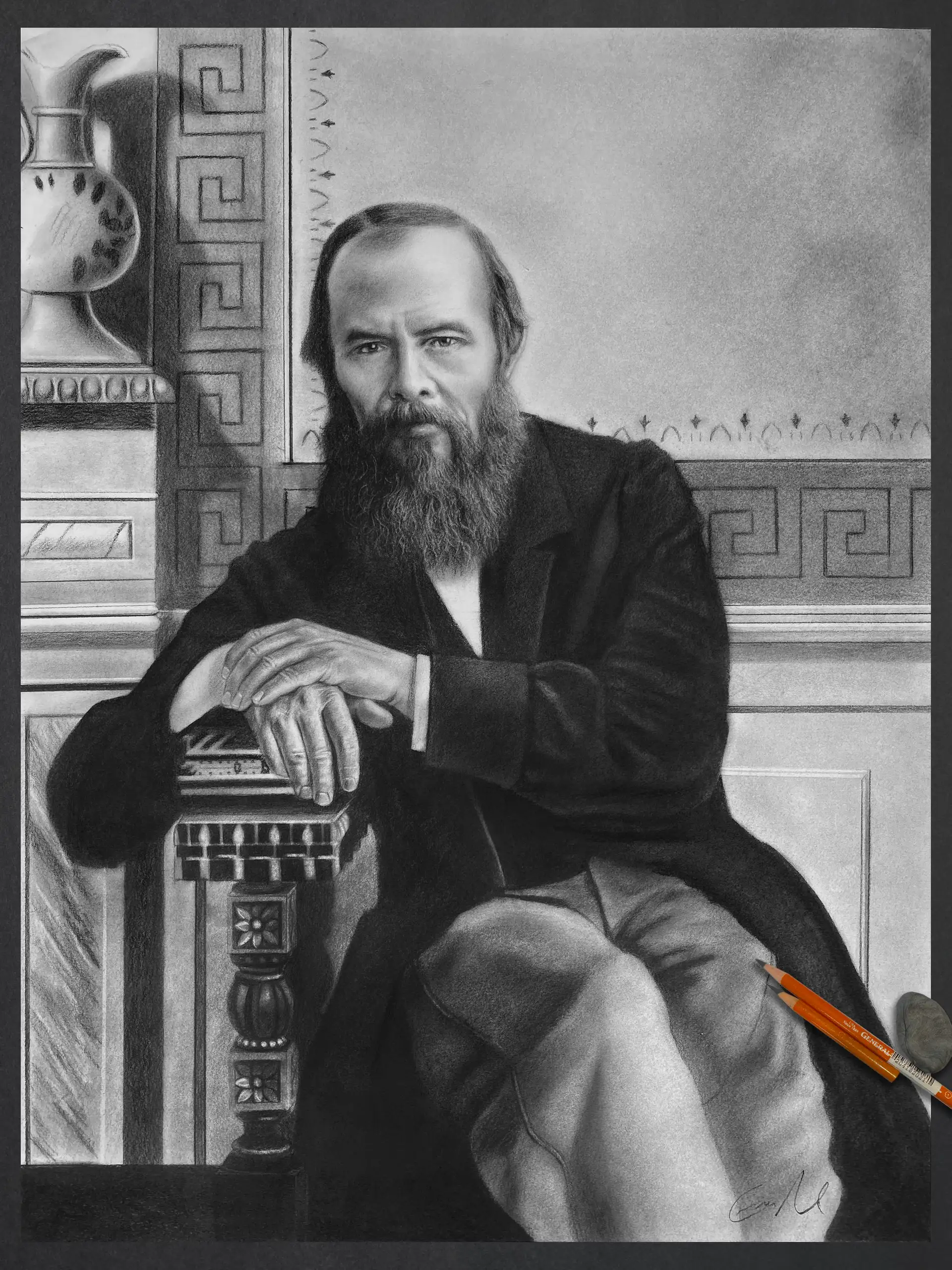
Fyodor Dostoevsky
 Russia
novelist•short story writer•essayist•journalist•philosopher
Also known as: Fyodor Mikhailovich Dostoevsky, Fyodor Dostoievski, F.M. Dostoiewski, Doestoevsky
Birthday
November 11, 1821
Birth Sign
Scorpio
Birthplace
Mariinsky Hospital for the Poor, Moscow
Age
Died at 59
About
Fyodor Mikhailovich Dostoevsky was a Russian novelist, short story writer, essayist, journalist, and philosopher who is widely regarded as one of the greatest psychological writers in world literature. Born in Moscow in 1821, he entered the world at the Mariinsky Hospital for the Poor where his father served as a chief physician. His life was marked by early tragedy when his mother died of tuberculosis and his father was murdered by serfs when Dostoevsky was just ten years old. These events deeply influenced his fiction's recurring themes of guilt, patricide, and moral redemption.
Dostoevsky's literary career began with the immediate success of his debut novel Poor Folk in 1846. However, his rise was abruptly halted by political entanglements with the Petrashevsky Circle, leading to a mock execution in 1849 and four years of hard labor in Siberia. This harrowing experience became the cornerstone of his worldview. Upon his release, he produced a series of monumental novels including Crime and Punishment, The Idiot, and The Brothers Karamazov. His exploration of the human psyche, faith, and reason continues to resonate globally, influencing thinkers like Friedrich Nietzsche and Sigmund Freud.
Early Life & Background
Fyodor Dostoevsky was born on November 11, 1821, in Moscow at the Mariinsky Hospital for the Poor. His father, Mikhail Andreyevich Dostoevsky, was a chief physician at the hospital, and his mother, Maria Feodorovna, came from a merchant family. The household lived in a modest but intellectually stimulating environment. Tragedy struck early when Dostoevsky was eight years old and his mother died of tuberculosis. Two years later, in 1837, his father was murdered by his own serfs on their estate in Tula province, a traumatic event that haunted Dostoevsky throughout his life.
Following his father's death, Dostoevsky attended the School of Cadets in Moscow before entering the St. Petersburg Engineering College in 1837. He graduated in 1843 with the rank of lieutenant, fulfilling his father's wish that he become an engineer. However, his true passion lay in literature. Before achieving fame, he worked as a draftsman and translator to support himself, translating works like Balzac's Eugénie Grandet and George Sand's Indiana. His first literary breakthrough came in 1846 with the publication of his debut novel, Poor Folk. The novel was an immediate sensation, praised by the influential critic Vissarion Belinsky as a "social novel" of the highest order. This success propelled the 24-year-old into the vibrant literary circles of Saint Petersburg, where he associated with other radical intellectuals.
However, his rise was abruptly halted by political entanglements. In 1849, Dostoevsky joined the Petrashevsky Circle, a group of intellectuals who discussed forbidden Western texts and social reforms critical of the Tsarist regime. On April 23, 1849, he was arrested along with other members. After months of imprisonment, he was sentenced to death. On December 22, 1849, at Semenov Square in St. Petersburg, Dostoevsky and his fellow conspirators were subjected to a mock execution. As they stood before firing squads, a messenger arrived at the last moment with a pardon from Tsar Nicholas I, commuting their sentences to four years of hard labor in a Siberian prison camp followed by mandatory military service. This "death and resurrection" experience became the cornerstone of his worldview and his writing.
Career Growth
Following his release from the Omsk prison camp in 1854 and subsequent six years of military service in Semipalatinsk, Dostoevsky returned to St. Petersburg in 1859 to dedicate himself fully to writing. His career is defined by a series of monumental novels that explored the depths of the human psyche. In 1860–1862, he published The House of the Dead, a fictionalized account of his time in prison, which solidified his reputation as a serious chronicler of the Russian soul.
In 1864, he wrote Notes from Underground, a novella often cited as a foundational text of existentialism. It introduced the "underground man," a bitter, alienated protagonist who rejected rationalism and utilitarianism. The following year, 1866, saw the publication of Crime and Punishment, arguably his most famous work. The novel follows Raskolnikov, a poor student who murders a pawnbroker to test his theory that extraordinary men are above moral law. The book was a commercial and critical success, establishing Dostoevsky's international fame.
During a trip to Europe to escape debt and gambling addiction between 1867 and 1869, he met Anna Grigoryevna Snitkina, whom he married in 1867. She became his stenographer and manager, helping him complete The Gambler under tight deadlines. In 1869, he published The Idiot, featuring Prince Myshkin, a Christ-like character whose innocence clashes with a corrupt society. Later, in 1872, he released Demons, a scathing critique of revolutionary nihilism and terrorism. He continued to write with intensity, publishing The Adolescent in 1875.
In 1880, he delivered his famous Pushkin Memorial Speech, a defining moment in Russian cultural history where he proclaimed Russia's unique spiritual mission to unite humanity. Later that year, he published The Brothers Karamazov, his final and perhaps greatest novel, dealing with faith, doubt, reason, and the murder of a father by one of his sons. Throughout his career, Dostoevsky also edited several magazines, including Vremya and Epoch, and wrote A Writer's Diary, a serialized collection of essays and stories that provided insight into his thoughts on contemporary politics and philosophy.
Career Timeline
Public Image & Style
Dostoevsky is portrayed as a tormented genius, a man who delved into the darkest corners of the human psyche. His image is one of intellectual intensity, physical frailty, and spiritual depth. Media and scholars often highlight his struggles with epilepsy, gambling, and poverty as integral parts of his creative process. He is seen as a prophet of the Russian soul, whose works explore the fundamental questions of existence, morality, and faith. His writing style is characterized by long, intense dialogues and psychological realism that captures the turmoil of the human mind.
Fame & Fandom
On December 22, 1849, a messenger arrived at Semenov Square just as firing squads aimed their rifles at Fyodor Dostoevsky. That moment of suspended death defined his life and continues to anchor his global stature today. He stands as the 5th most famous person from Russia and ranks as the 16th most famous person in Books & Literature. These positions within the iFANN Global Fame Rankings reflect a readership that spans centuries rather than fleeting trends. While he lacks a formal fanbase organization or a specific name for his followers, his work has sparked an organic digital revival among younger generations seeking meaning in modern chaos. Screenshots of his psychological insights circulate widely on social media, creating a viral phenomenon where a dead author commands the attention of a living internet. This is not a campaign driven by marketing teams but a genuine cultural resonance. His funeral drew over 100,000 mourners through the streets of St. Petersburg, a spectacle that transformed him from a writer into a national icon. The scale of this engagement spans the globe, proving his influence extends far beyond academic circles.
Interesting Facts and Legends
Dostoevsky suffered from epilepsy throughout his life, describing the moments before a seizure as a state of supreme harmony and ecstasy. This condition profoundly shaped characters like Prince Myshkin in The Idiot. He had a severe gambling addiction, which led to financial ruin multiple times. He famously wrote The Gambler in just 26 days to pay off debts. Contemporary accounts describe him as tall and slender, though his health issues often made him appear gaunt. Modern scholarship continues to debate his views on antisemitism, particularly regarding the portrayal of Jewish characters in his works, which remain subjects of intense academic discussion. The mock execution he endured in 1849 is a verified historical event that fundamentally altered his perspective on life and death.
Notable Quotes
“Man is a mystery... You yourself must solve it some day, because if you spend your whole life trying to solve it, then you will not come to the end of it.”
“Above all, don't lie to yourself. The man who lies to himself and listens to his own lie comes to a point that he cannot distinguish the truth within him.”
“To love someone means to see them as God intended them.”
“I am still alive, but I feel that my time is coming to an end.”
Family & Personal Life
Fyodor Dostoevsky's personal life was marked by tragedy, intense devotion, and complex relationships. Before his arrest, he had a deep, unrequited love for Maria Isaeva, a woman he met in his youth. They were engaged briefly, but she broke off the engagement, reportedly due to his poverty and her family's disapproval. This heartbreak contributed to his emotional volatility. No children were born from this relationship.
In 1866, while fleeing creditors in Germany, Dostoevsky met Anna Snitkina, a young stenographer. Their relationship began professionally when he hired her to transcribe The Gambler. They fell in love and were married on February 15, 1867, in Leipzig. Their marriage was tumultuous due to his gambling and health issues, but Anna proved to be a devoted partner, managing his affairs and encouraging his work. They remained married until his death in 1881. Together, they had six children: Fyodor Fyodorovich, Sofya Fyodorovna, Lyubov Fyodorovna, Vladimir Fyodorovich, Alexei Fyodorovich, and Dmitry Fyodorovich. Only three of their children survived into adulthood. Anna outlived him by decades, managing his estate and publishing his collected works.
Notable Connections
Relationships & Dating History
Fyodor Dostoevsky's personal life was marked by tragedy, intense devotion, and complex relationships. Before his arrest, he had a deep, unrequited love for Maria Isaeva, a woman he met in his youth. They were engaged briefly, but she broke off the engagement, reportedly due to his poverty and her family's disapproval. This heartbreak contributed to his emotional volatility. No children were born from this relationship.
In 1866, while fleeing creditors in Germany, Dostoevsky met Anna Snitkina, a young stenographer. Their relationship began professionally when he hired her to transcribe The Gambler. They fell in love and were married on February 15, 1867, in Leipzig. Their marriage was tumultuous due to his gambling and health issues, but Anna proved to be a devoted partner, managing his affairs and encouraging his work. They remained married until his death in 1881. Together, they had six children: Fyodor Fyodorovich, Sofya Fyodorovna, Lyubov Fyodorovna, Vladimir Fyodorovich, Alexei Fyodorovich, and Dmitry Fyodorovich. Only three of their children survived into adulthood. Anna outlived him by decades, managing his estate and publishing his collected works. There are no records of other public romantic relationships or marriages. Dostoevsky was widowed in 1881 upon his death.
- EngagedMaria Dmitrievna Isaeva1845 - 1846Engagement broken due to poverty and family disapproval.
- MarriedAnna Grigoryevna Snitkina1867 - 1881Met as stenographer; married until his death. Six children together, three survived to adulthood.
Death & Aftermath
Died
January 28, 1881 (aged 59)
Death Place
St. Petersburg, Russia
Cause of Death
Ruptured pulmonary artery from chronic bronchitis and emphysema
Fyodor Dostoevsky died on January 28, 1881, at his home on Liteyny Prospekt in St. Petersburg. The writer had spent months battling violent coughing fits and hemoptysis before a massive hemorrhage ruptured a pulmonary artery while he was writing or resting. Physicians confirmed the cause through clinical observation rather than an autopsy, noting that chronic bronchitis and emphysema had severely weakened his heart.
Crowds gathered immediately outside his apartment, creating a spontaneous vigil that swelled into one of the largest funerals in Russian history. Over ten thousand mourners lined the streets to escort his coffin to the Alexander Nevsky Monastery, where Leo Tolstoy and Vladimir Stasov stood among the grieving masses. The service included hymns and readings from his unfinished magnum opus, The Brothers Karamazov, which remained serialized at the time of his passing. Tsar Alexander III sent a wreath, and Ivan Turgenev penned moving tributes to the loss of a genius despite their ideological differences. Anna Grigoryevna Dostoevskaya managed the estate and oversaw the publication of his collected works, ensuring financial stability for their children. His unfinished A Writer's Diary continued appearing in installments until 1883, cementing a legacy that would soon expand exponentially across Europe.
Net Worth (Estate Value)
$0
iFANN Editorial Team estimate
As Dostoevsky died in 1881, his net worth is not applicable in the modern sense. His estate was managed by his wife, Anna, who ensured the financial stability of their family through the publication of his works. The value of his estate today is incalculable, as his works generate billions of dollars in royalties, translations, and adaptations annually. The Dostoevsky estate is managed by various publishing houses and foundations, with major revenue sources including book sales, licensing deals, and educational use of his texts. Research by the iFANN Editorial Team puts his posthumous earnings and estate value at a figure that reflects the enduring global demand for his writings.
Awards & Accolades
View 9 records, honours and achievementsKnown For
Crime and Punishment
1866 · Novel
The Brothers Karamazov
1880 · Novel
The Idiot
1869 · Novel
Notes from Underground
1864 · Novella
Poor Folk
1846 · Novel
Keywords
Sources
Quick Facts
- Profession
- translator, poet, novelist
- Born
- November 11, 1821
- Birthplace
- Mariinsky Hospital for the Poor
- Died
- January 28, 1881
- Death Place
- Saint Petersburg
- Gender
- Male
- Spouse
- Anna Dostoyevskaya
- Birth Sign
- Scorpio
Personal Details
- Full Name
- Fyodor Mikhailovich Dostoyevsky
- Spouse
- Anna Grigoryevna Snitkina
- Children
- Fyodor Fyodorovich, Sofya Fyodorovna, Lyubov Fyodorovna, Vladimir Fyodorovich (died young), Alexei Fyodorovich (died young), Dmitry Fyodorovich (died young)
- Education
- St. Petersburg Engineering College
Frequently Asked Questions
What caused Fyodor Dostoevsky's death?
Did Fyodor Dostoevsky ever get married?
What is Fyodor Dostoevsky's most famous book?
Why was Fyodor Dostoevsky arrested?
How many children did Fyodor Dostoevsky have?
Similar People
Join the community
fans discussing