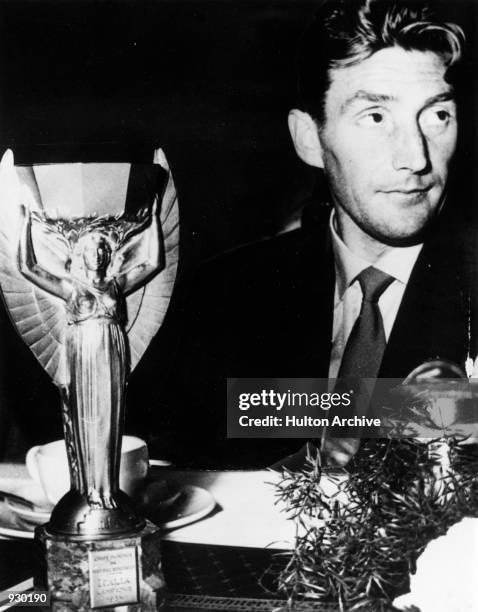
Fritz Walter
 Germany
association football player•association football coach•athlete
Birthday
October 31, 1920
Birth Sign
Scorpio
Birthplace
Kaiserslautern, Germany
Age
Died at 81
Height
5 ft 9 in (175 cm)
About
Fritz Walter was a German footballer widely regarded as one of the greatest players in his country's history and a national hero. An attacking midfielder and inside forward known for his exceptional vision, creativity, and leadership, he captained West Germany to its first World Cup title in 1954, a victory known as the Miracle of Bern that carried profound significance for a nation still recovering from war. Walter spent his entire 22-year senior career at 1. FC Kaiserslautern, a rare display of loyalty that made him a beloved one-club man. He earned 61 caps and scored 33 goals for the national team, and was later named its honorary captain. His legacy extends beyond statistics: the term Fritz Walter weather entered the German lexicon, and the Fritz Walter Medal is awarded annually to the country's best young footballers. Walter died in 2002, but his place as a foundational figure in German football endures.
Early Life & Background
Fritz Walter was born in Kaiserslautern, the second of five children of Ludwig Walter, a hotel and restaurant worker, and his wife Dorothea. Growing up in the working-class district of the city, he developed a passion for football early, playing in the streets with a rag ball. At age eight, in 1928, he joined the youth system of 1. FC Kaiserslautern, where his talent quickly stood out. He attended the local volksschule and later completed an apprenticeship as a motor mechanic, though football remained his focus. His older brother Ludwig also became a professional footballer, and two younger brothers, Ottmar and Gerd, played at various levels. Walter debuted for the senior team at 17 in 1937, but his path to fame was interrupted by World War II. He served in the German military and was captured as a prisoner of war by American forces in 1945. He convinced his captors he was a footballer by demonstrating his ball skills and was released, returning to Kaiserslautern to resume his career.
Career Growth
Walter made his national team debut on July 14, 1940, scoring a hat-trick against Romania in a 9-3 victory. After the war, he returned to 1. FC Kaiserslautern and led the club to German championships in 1951 and 1953. His crowning achievement came as captain of West Germany at the 1954 FIFA World Cup in Switzerland. On July 4, 1954, in Bern, his team defeated the heavily favored Hungarian Golden Team 3-2 in the final, a match forever known as the Miracle of Bern. Walter's leadership and playmaking were instrumental. He captained West Germany to a fourth-place finish at the 1958 World Cup, scoring his final international goal. Walter retired in 1959 at age 38, having spent his entire senior career at Kaiserslautern. He briefly managed the club from 1960 to 1962. In 1954, he became the first recipient of the German Footballer of the Year award. He was named honorary captain of the German national team in 1958.
Career Timeline
Public Image & Style
Walter was known as a Spielmacher, a creative, elegant playmaker with exceptional vision and a modest demeanor. In Germany, he is portrayed as a national hero and a symbol of post-war rebuilding, often described as humble and loyal. Fans gather at his statue outside the Fritz-Walter-Stadion every July 4 to commemorate the 1954 final. The term Fritz Walter weather is celebrated during rainy matches. The club's supporters, known as Betze-Fans, hold him in deep reverence.
Fame & Fandom (iFAMOUS Rankings)
The enduring reverence for Fritz Walter is distinct not because of a dedicated, named fan club, but through the seamless integration of his memory into the identity of 1. FC Kaiserslautern itself. His supporters, known as the Betze-Fans or Die Roten Teufel, treat him less as a distant icon and more as the spiritual founder of their community, maintaining a bond forged in post-war humility rather than modern celebrity culture. This relationship is institutionalized annually through the presentation of the Fritz Walter Medal to Germany's top youth talents, ensuring his name remains a living touchstone for new generations of players and fans alike. Rituals like gathering at his statue on July 4 to commemorate the Miracle of Bern reflect a deep, personal connection where he is remembered as a man who walked the streets of Kaiserslautern playing with local children rather than hiding behind celebrity walls. While no formal fandom name exists specifically for him, the collective devotion of the city ensures his legacy thrives without needing organized campaigns or digital movements. Despite this massive cultural footprint, iFANN's Global Fame Engine has evaluated his current standing and determined that he does not hold a placement in the published rankings, meaning he currently lacks a specific numeric rank within the Global Top 1,000 or any Top-100 scope list.
Interesting Facts and Legends
Walter's older brother Ludwig also played for Kaiserslautern and was part of the 1951 championship team. He never competed in the Bundesliga, which launched four years after his retirement. Following his football career, he operated a petrol station and later a restaurant in Kaiserslautern. His funeral in 2002 attracted thousands, including fellow German football legends. The phrase "Fritz Walter weather" remains a recognized German expression for cold, rainy conditions. The Fritz Walter Medal, established in 2005, honors the best young German footballers each year. Fans still retell the story of the Miracle of Bern, where Walter captained West Germany to a stunning 3–2 victory over Hungary, scoring the opening goal in a match that symbolized national resurrection. Another central legend involves his absolute loyalty to Kaiserslautern; despite lucrative offers from giants like Real Madrid and AC Milan, he refused to leave his hometown, winning championships in 1951 and 1953. This unwavering commitment cemented his image as a figure of integrity during an era when players began moving internationally. Additionally, his wartime service and recovery from severe leg injuries are often cited as a narrative of resilience that mirrored the struggle of the German people.
Notable Quotes
“The goal was not just a victory for German football. It was a victory for the whole of Germany.”
“I never thought about playing for another club. Kaiserslautern was my home, my family, my life.”
“We didn't play for money. We played for the love of the game and for our country.”
“The Hungarians were the better team. But we had something they didn't have: the belief that we could win.”
Family & Personal Life
Walter married Italia Friz, an Italian woman he met during World War II, around 1942. Their marriage lasted 53 years until her death in 1995. They had no children. His older brother Ludwig played alongside him at Kaiserslautern, and younger brother Ottmar also played for the club and the national team. Walter's parents were Ludwig and Dorothea Walter. He lived modestly in Kaiserslautern after retirement.
Notable Connections
Walter's national team coach Sepp Herberger was a close mentor. Teammates included Helmut Rahn, who scored the winning goal in the 1954 final, goalkeeper Toni Turek, and Horst Eckel, the last surviving member of that team. His older brother Ludwig and younger brother Ottmar also played for Kaiserslautern. Fellow German legend Uwe Seeler was a friend.
Relationships & Dating History
Walter's romantic life was remarkably stable. He married Italia Friz, an Italian woman he met during World War II, around 1942. They remained together until her death in 1995, a marriage of 53 years. They had no children. After Italia's death, Walter did not remarry and lived the last seven years of his life as a widower. She was his only known romantic partner.
- MarriedItalia Walter1942 - 1995Met during World War II; married around 1942; remained together until her death in 1995. No children.
Death & Aftermath
Died
June 17, 2002 (aged 81)
Death Place
Alsenborn, Rhineland-Palatinate, Germany
Cause of Death
Unknown
The passing of Fritz Walter sent a wave of profound grief across Germany, instantly transforming the nation's football landscape into a space of collective mourning. Tributes poured in from peers and institutions alike, with the German Football Association and 1. FC Kaiserslautern issuing statements that honored his legacy as the first player inducted into Germany's Hall of Fame. Fans gathered at the Fritz-Walter-Stadion in Kaiserslautern for moments of silence, while thousands attended a large public funeral in the city alongside former teammates and dignitaries including then-German President Johannes Rau. Walter died on June 17, 2002, at the age of 81 in Alsenborn, a municipality within the district of Kaiserslautern in Rhineland-Palatinate.
The circumstances surrounding his final days were described simply as a natural passing at his home or a local facility. Following the service held shortly after his death, Walter was laid to rest in the St. Johann Cemetery in Kaiserslautern. His estate was handled by his family without public financial disclosure, but his influence has been solidified through enduring honors. The stadium of 1. FC Kaiserslautern bears his name, and the DFB continues to present the annual Fritz Walter Medals to young German talents, ensuring his name remains central to the country's football culture.
Net Worth (Estate Value)
$6 Million
iFANN Editorial Team estimate
iFANN currently estimates Fritz Walter's estate at $6 Million as of 2026. The primary sources include posthumous licensing of his name and image through the Fritz Walter Foundation, which uses proceeds for youth football development. The DFB pays licensing fees for the Fritz Walter Medal. Book royalties from his autobiography and biographies continue to generate income. The naming rights to the Fritz-Walter-Stadion add ongoing recognition value. At his death in 2002, the estate was reported at €3-4 million, which has grown through careful management and inflation-adjusted licensing.
Awards Won (5)
Walter's most significant achievement was winning the 1954 FIFA World Cup as captain of West Germany. He also won the German Football Championship with Kaiserslautern in 1951 and 1953. Individually, he was the first German Footballer of the Year in 1954 and received the FIFA Order of Merit in 1994.
1994 · FIFA's highest honor
Career achievements
1954 · Individual
1954 season
Known For
1954 FIFA World Cup
1954 · Captain of West Germany
1. FC Kaiserslautern
1937-1959 · Player (one-club career)
German Football Championship
1951 · Winner
German Football Championship
1953 · Winner
Keywords
Quick Facts
- Profession
- association football player, association football coach, athlete
- Born
- +1920-10-31
- Birthplace
- Kaiserslautern
- Died
- +2002-06-17
- Death Place
- Enkenbach-Alsenborn
- Gender
- Male
- Spouse
- Italia Walter
- Birth Sign
- Scorpio
Personal Details
- Full Name
- Friedrich Walter
- Height
- 5 ft 9 in (175 cm)
- Spouse
- Italia Walter
- Education
- Volksschule (elementary school); apprenticeship as a motor mechanic
Frequently Asked Questions
What was Fritz Walter's net worth when he died?
Did Fritz Walter have children?
Why is it called Fritz Walter weather?
Who was Fritz Walter's wife?
How many goals did Fritz Walter score for Germany?
Social Media
Similar People
Join the community
fans discussing