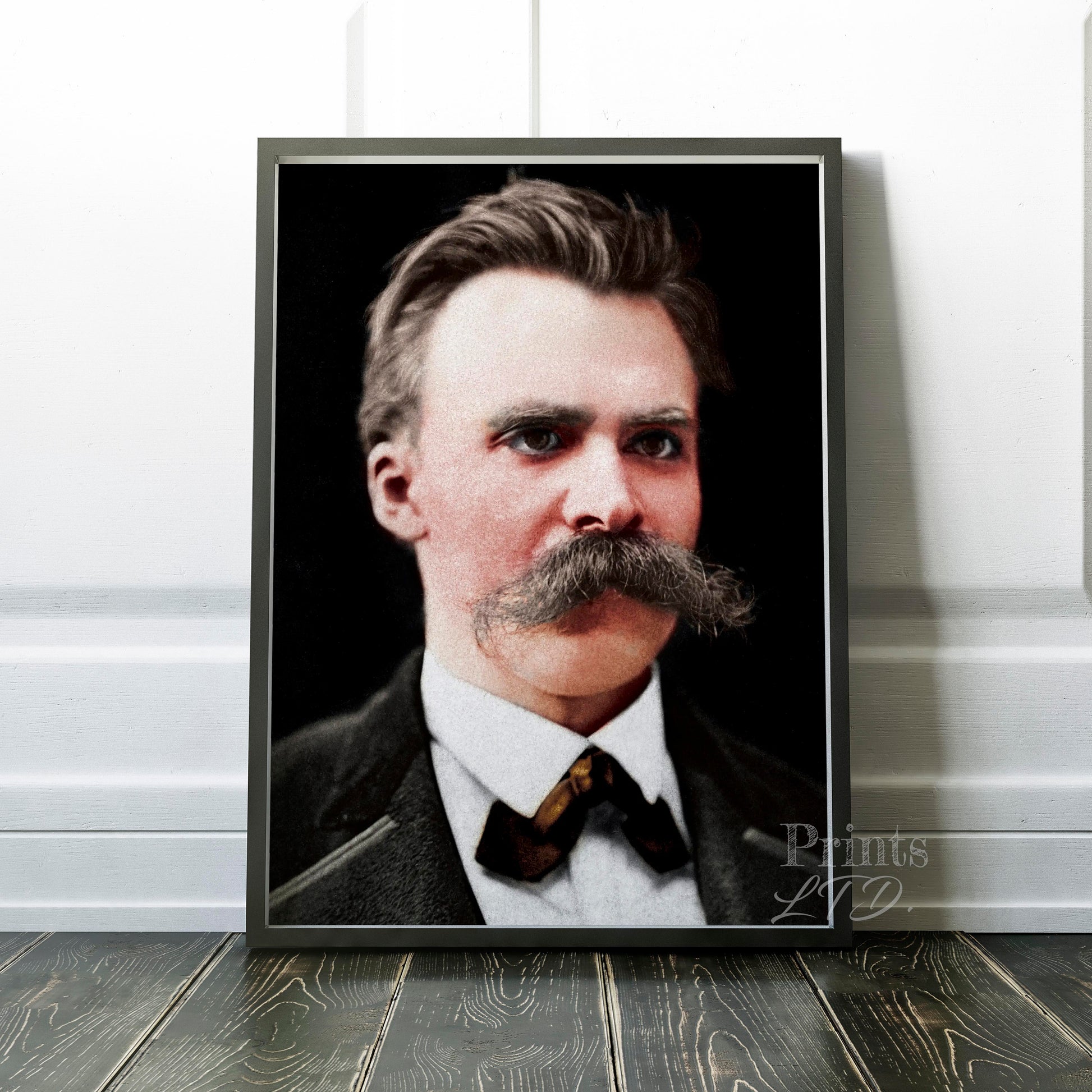
Friedrich Nietzsche
 Germany
Birthday
October 15, 1844
Birth Sign
Libra
Birthplace
Röcken, Prussia (now Germany)
Age
Died at 55
About
Friedrich Nietzsche was a German philosopher, poet, and classical philologist whose ideas reshaped modern thought. He is best known for his critiques of religion and morality, and for concepts like the "will to power," the Übermensch, and the eternal recurrence. His provocative declaration "God is dead" captured the spirit of a secularizing age and continues to resonate.
Nietzsche's influence is vast, touching philosophy, psychology, literature, and the arts. He produced a series of dense, aphoristic works that challenge readers to question their deepest assumptions. Though he died in 1900, his writings have never gone out of print and are studied worldwide.
Early Life & Background
Born in 1844 in Röcken, a small village in Prussian Saxony, Friedrich Nietzsche was the eldest child of a Lutheran pastor. His father died when he was only five, leaving the family to be raised by his mother, grandmother, and aunts in a devoutly religious household. Young Friedrich was so pious that classmates called him "the little pastor."
He excelled in his studies, attending the prestigious Schulpforta boarding school from 1858 to 1864, where he received a rigorous classical education in Greek and Latin. He then studied theology and classical philology at the University of Bonn, but found the academic atmosphere stifling and transferred to the University of Leipzig. There he thrived, winning a prize for his essay on Diogenes Laertius and catching the attention of his professor, Friedrich Ritschl.
In 1867, Nietzsche enlisted in the Prussian cavalry, but a riding accident aggravated his chronic health problems, leading to his discharge. His academic promise was so great that, in 1869, at just 24, he was appointed professor of classical philology at the University of Basel, before he had even completed his doctorate.
Career Growth
Nietzsche's career took a dramatic turn with the publication of The Birth of Tragedy in 1872, a provocative blend of philology and philosophy that argued for the fusion of Apollonian order and Dionysian chaos in Greek art. The book was controversial and alienated some academics, but it marked the beginning of his philosophical project.
After resigning from Basel in 1879 due to failing health, Nietzsche entered his most productive period. Between 1883 and 1885 he composed Thus Spoke Zarathustra, his most famous work, written in a poetic, biblical style. This was followed by Beyond Good and Evil (1886) and On the Genealogy of Morals (1887), which systematically dismantled traditional moral assumptions.
His later works, including Twilight of the Idols and The Antichrist (both 1888), grew increasingly radical. In 1889, he suffered a mental collapse in Turin, allegedly after witnessing a horse being whipped. He never recovered, spending his remaining eleven years in the care of his mother and sister.
Career Timeline
Public Image & Style
Nietzsche's public image is that of a solitary, intense genius, often depicted with a stern gaze and a massive mustache. He is seen as a radical iconoclast who challenged the foundations of Western thought, and his name is synonymous with the proclamation "God is dead."
His writing style, full of aphorisms and provocative declarations, has made him a favorite among artists, writers, and countercultural figures. He is often misappropriated by political extremes, but his core philosophy emphasizes individual self-overcoming and the affirmation of life in all its suffering and beauty.
Fans and scholars alike are drawn to his passionate, poetic prose and his unflinching examination of the human condition.
Fame & Fandom (iFAMOUS Rankings)
The stern gaze and massive mustache of Friedrich Nietzsche have become a global shorthand for intellectual rebellion, securing his place among the most recognizable figures in history. According to the iFANN Global Fame Rankings, he is the 374th most famous person in the world, holding steady from the previous cycle. His influence extends deep into German culture, where he ranks as the 15th most famous person in Germany and stands as the 14th most famous person from Germany. Within the specific realm of Art & Design, his provocative aphorisms and philosophical impact elevate him to the 6th most famous person in Art & Design. These placements reflect a legacy that transcends academic circles, resonating across media coverage and consumption signals worldwide. Unlike modern celebrities, Nietzsche never courted a fanbase with public appearances or tours. His followers exist as a scattered collective of readers rather than an organized movement with a formal name. Communities on platforms like Reddit and Goodreads serve as digital gathering points where users debate his texts and share interpretations, but these are informal clusters of self-directed study. There are no official fan clubs, charity drives, or centralized campaigns coordinating efforts in his honor. The closest equivalent to modern fandom rituals involves the viral sharing of his quotes on social media, often paired with images of his face, turning his words into personal branding tools for individuals navigating their own existential crises.
Interesting Facts and Legends
Friedrich Nietzsche was born on October 15, a date that coincided with the birthday of King Friedrich Wilhelm IV of Prussia, the namesake who inspired the philosopher's first name; Nietzsche kept a photograph of this monarch on his desk throughout his life. An accomplished pianist, he improvised music during his student years, though he never formally composed a work. His famously bushy mustache, grown while serving in the military, became his trademark visage. Though he remained unmarried, he once proposed to the Russian intellectual Lou Salomé, only to be rejected. His friendship with composer Richard Wagner eventually soured over Wagner's Christian turn in Parsifal. Beyond these biographical facts, lore surrounds his final days in Turin, Italy, in January 1889. A widely retold story claims he threw his arms around a whipped horse, wept, and collapsed in Piazza Carlo Alberto, an event that cemented his image as a tragic madman. Another enduring legend implicates his sister, Elisabeth Förster-Nietzsche, in distorting his legacy by editing unpublished manuscripts like The Will to Power to align with German nationalism and anti-Semitism. Recent discussions also correct the misinterpretation of his maxim, "What doesn't kill you makes you stronger," clarifying it appeared in Twilight of the Idols as a complex psychological observation rather than a universal law of resilience.
Notable Quotes
“God is dead.”
“That which does not kill us makes us stronger.”
“He who has a why to live can bear almost any how.”
“Without music, life would be a mistake.”
“You must have chaos within you to give birth to a dancing star.”
Family & Personal Life
Friedrich Nietzsche was the son of Carl Ludwig Nietzsche, a Lutheran pastor, and Franziska Oehler. His father died in 1849, when Friedrich was just five. He had a younger sister, Elisabeth, born in 1846, and an older brother, Joseph, who died in infancy.
Nietzsche never married and had no children. His closest family bond was with his sister, Elisabeth, though they often clashed over his work. After his mental collapse in 1889, Elisabeth took over his care and later managed his literary estate, editing his writings to align with her own nationalist and anti-Semitic views.
In his final years, Nietzsche lived with his mother in Naumburg until her death in 1897, after which Elisabeth moved him to Weimar.
Notable Connections
Nietzsche was closely associated with the composer Richard Wagner, initially as a disciple and later as a critic. He was also friends with the historian Jacob Burckhardt and the theologian Franz Overbeck. His sister Elisabeth and her husband, Bernhard Förster, were prominent figures in the völkisch movement, and they sought to tie Nietzsche's work to their own ideology.
Relationships & Dating History
Nietzsche never married, but he had several significant relationships. In 1882, he proposed to Lou Salomé, a brilliant Russian intellectual, but she rejected him, and the rejection devastated him.
He had earlier been close to Cosima Wagner, the wife of Richard Wagner, and some biographers suggest he harbored a deep, unrequited love for her.
As of 2026, Nietzsche remains unmarried and childless, with no known romantic partners after Lou Salomé.
- RumouredLou Salomé1882 - 1882Proposed to her, but she rejected him.
- RumouredCosima Wagner1872 - 1876Had a close friendship, possibly unrequited love.
Death & Aftermath
Died
August 25, 1900 (aged 55)
Death Place
Weimar, Germany
Cause of Death
Stroke or cerebral hemorrhage (reported)
The family of Friedrich Nietzsche and his attending physicians announced his passing on August 25, 1900, at their home in Weimar, Germany. The philosopher had spent the last eleven years of his life in a state of profound mental collapse following a catastrophic breakdown in Turin in 1889, leaving him unable to speak or recognize those around him until his final days. While contemporary records attributed the end to a stroke or cerebral hemorrhage, modern medical re-evaluations have since suggested alternative pathologies such as neurosyphilis, frontotemporal dementia, or a brain tumor. Public reaction remained subdued at the time due to his obscurity and the scandal of his condition, yet tributes soon emerged from intellectual peers like Sigmund Freud and Rainer Maria Rilke who recognized his penetrating insight into human nature.
A private funeral service followed two days later in the Protestant cemetery in Röcken, attended only by his mother Franziska, his sister Elisabeth, and a small circle of friends including the philologist Paul Deussen. Posthumously, his legacy exploded through the aggressive management of his estate by Elisabeth Förster-Nietzsche, who edited unpublished notes for works like The Will to Power to align with her own nationalist views before the rights eventually passed to academic institutions.
Net Worth (Estate Value)
$5 Million
iFANN Editorial Team estimate
Nietzsche lived modestly, often facing poverty, and earned little from his books during his lifetime. His income relied primarily on his university salary and a small pension following his resignation. After his death, his sister Elisabeth managed his estate and posthumously published works like The Will to Power, which she edited to fit her own agenda. The estate has generated significant revenue through royalties from his many published works, which remain in print today. Per iFANN's editorial analysis, the estate's value is estimated at $5 Million as of 2026, based on ongoing book sales and licensing of his writings.
Awards & Accolades
Known For
Thus Spoke Zarathustra
1883 · Author
Beyond Good and Evil
1886 · Author
On the Genealogy of Morals
1887 · Author
The Birth of Tragedy
1872 · Author
Keywords
Sources
Quick Facts
- Profession
- philosopher, poet, writer
- Born
- October 15, 1844
- Birthplace
- Röcken, Prussia
- Died
- August 25, 1900
- Death Place
- Weimar, Germany
- Gender
- Male
- Birth Sign
- Libra
- Full Birth Name
- Friedrich Wilhelm Nietzsche
Personal Details
- Full Name
- Friedrich Wilhelm Nietzsche
- Education
- University of Bonn, University of Leipzig
Frequently Asked Questions
When and where was Friedrich Nietzsche born?
What was Friedrich Nietzsche known for?
What were Friedrich Nietzsche's major works?
What caused Friedrich Nietzsche's death?
Did Friedrich Nietzsche have any family?
Similar People
Join the community
fans discussing