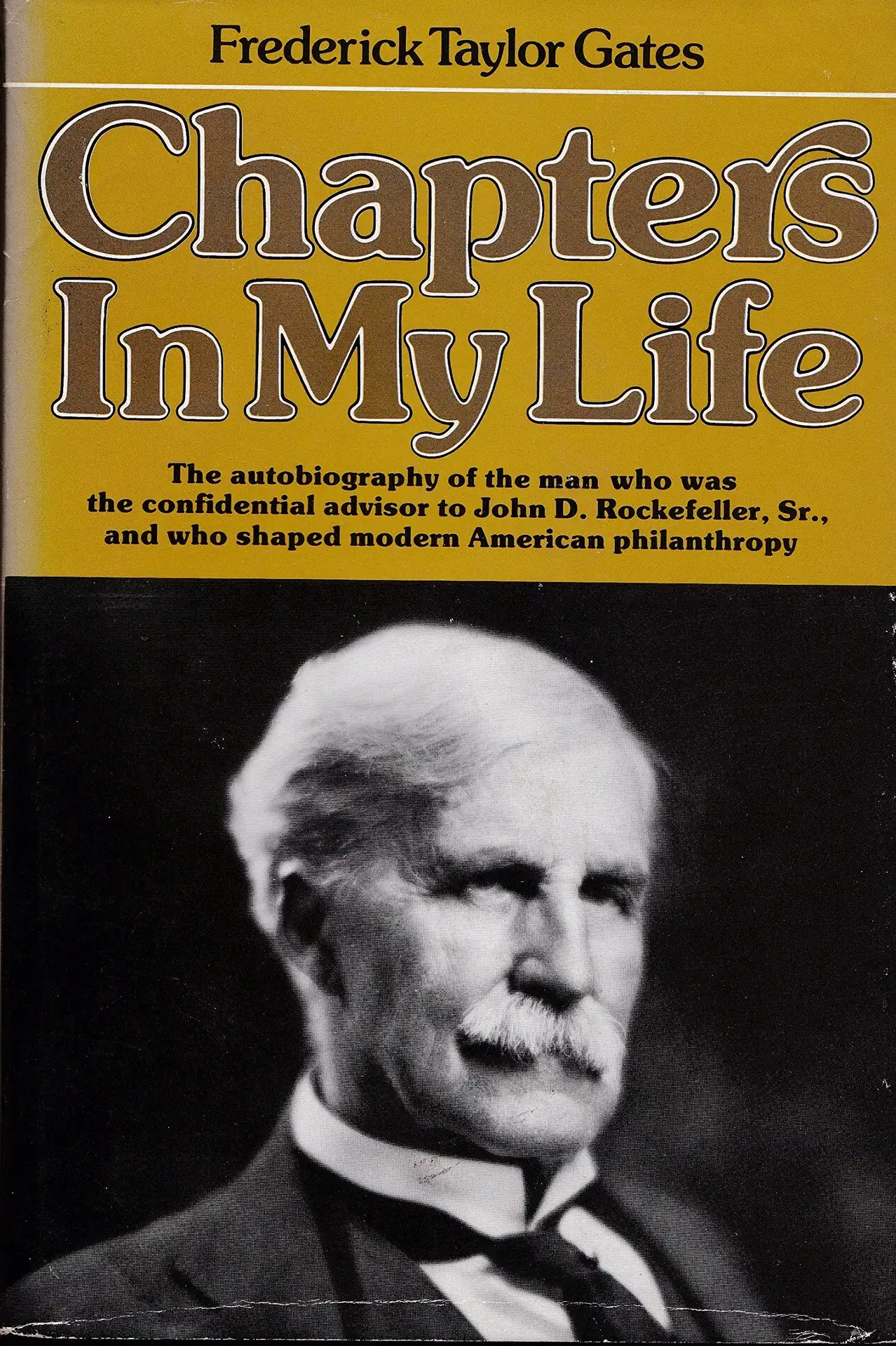
Frederick Taylor Gates
Baptist clergyman•educator•philanthropist
Also known as: Architect of the Rockefeller philanthropies
Birthday
July 22, 1853
Birth Sign
Cancer
Birthplace
Maine, Broome County, New York
Age
Died at 75
About
Frederick Taylor Gates was an American Baptist clergyman, educator, and the principal business and philanthropic advisor to John D. Rockefeller Sr. for over three decades. Born in 1853, he shaped the modern foundation model, directing Rockefeller's vast fortune into systematic public health, education, and medical research. His legacy includes the creation of the University of Chicago, the Rockefeller Institute for Medical Research, and the Rockefeller Foundation.
Gates served as Rockefeller's confidential advisor from 1891 until his retirement in 1923, earning the title "architect of the Rockefeller philanthropies." His organizational genius transformed ad hoc charity into a research-driven enterprise that remains the standard for institutional giving. He died in 1929, leaving an enduring impact on American philanthropy.
Early Life & Background
Frederick Taylor Gates was born on July 22, 1853, in Maine, Broome County, New York, the son of a Baptist minister. Raised in a devout religious household, he developed a deep commitment to faith and service from an early age. He pursued higher education at the University of Rochester, graduating before entering Rochester Theological Seminary to train for the Baptist ministry.
After ordination, Gates served as a pastor in Minnesota, where he gained a reputation for his sharp intellect and colorful personality. He read widely across medicine, economics, history, and sociology, interests that would later inform his philanthropic strategy. His early career as a minister brought him into contact with influential figures and honed his organizational skills.
In 1888, Gates became corresponding secretary of the American Baptist Education Society, a role that brought him into direct contact with John D. Rockefeller Sr. His exceptional organizational abilities impressed Rockefeller, leading to his recruitment as a confidential advisor in 1891.
Career Growth
Gates's breakthrough came in 1891 when he became John D. Rockefeller Sr.'s principal business and philanthropic advisor. Over the next three decades, he steered Rockefeller's charitable ventures, transforming scattered donations into a systematic force for public health and education. One of his first major achievements was helping to reorganize and fund the University of Chicago in the early 1890s.
In 1901, Gates played a central role in founding the Rockefeller Institute for Medical Research, now Rockefeller University, and served as a trustee. He also established the Rockefeller Sanitary Commission in 1909, which spearheaded the campaign to eradicate hookworm in the American South. In 1913, he helped create the Rockefeller Foundation, one of the first major philanthropic foundations of its kind.
Gates retired from his advisory role in 1923, having shaped the modern foundation model that remains the standard for institutional philanthropy. His work influenced countless other foundations and set a precedent for research-driven, systematic giving.
Career Timeline
Public Image & Style
Frederick Taylor Gates is remembered as a brilliant, energetic, and deeply religious organizer who channeled Rockefeller's wealth into systematic social improvement. PBS's "American Experience" portrayed him as a young Baptist minister with a sharp mind and a colorful personality. His public image is that of a transformative figure in modern philanthropy, often called "the architect of the Rockefeller philanthropies."
Gates's legacy is preserved through the Rockefeller Archive Center and the University of Chicago Library, which maintain records of his work. He has no modern fandom, but his influence on institutional giving is widely recognized in academic and philanthropic circles.
Fame & Fandom (iFAMOUS Rankings)
Frederick Taylor Gates, the Baptist clergyman who served as John D. Rockefeller's chief philanthropic advisor, does not currently hold a placement in iFANN's published rankings. As of August 2026, the Global Fame Engine has evaluated his legacy but has not assigned him a spot on either the Global Top 1,000 or any Top-100 scope list. His fame, such as it is, derives from his historical impact rather than contemporary celebrity: his name appears in scholarly works, archival collections, and PBS documentaries, but he commands no measurable public attention in the modern sense.
No formal fandom exists for Gates. There is no documented fan community, no organized campaigns, no fan-funded projects, and no rituals or inside jokes associated with his memory. The only 'legacy' content surrounding him is academic and archival: his papers reside at the University of Chicago, the Rockefeller Archive Center maintains records of his work, and PBS's American Experience features his biography in its Rockefellers series. Online mentions of 'Frederick Gates' in a fan context typically refer to unrelated individuals, such as a 2020 obituary in Lufkin, Texas, or a myth-detector article about Bill Gates' grandfather during the Spanish flu. In short, this is a historical figure appreciated by historians and biographers, not by a fanbase with a name or activities.
Interesting Facts and Legends
Gates was known for his voracious reading habits, which spanned medicine, economics, history, and sociology, directly informing his philanthropic strategies. He was instrumental in convincing Rockefeller to fund medical research at a time when such philanthropy was uncommon, leading to the creation of the Rockefeller Institute. His 1929 New York Times obituary called him 'the architect of the Rockefeller philanthropies.' Despite the surname, Frederick Taylor Gates was not related to Microsoft co-founder Bill Gates; a 2021 fact-check confirmed the two families are not directly connected. His personal papers from 1888 to 1906 are held at the University of Chicago's Special Collections Research Center.
One of the most retold stories about Gates involves his reading of a medical textbook, which so alarmed him about the state of medical education that he persuaded Rockefeller to fund a major research initiative, leading to the founding of the Rockefeller Institute. Another documented legend is his role as 'the confidential adviser and almoner to John D.,' a title from his obituary. A specific event in 1906, when Gates reviewed American medical schools and produced a report, was instrumental in the Rockefeller Institute's establishment. In modern discourse, a 2021 myth-detector article debunked claims about what 'Bill Gates' grandfather' did during the Spanish flu, clarifying that Frederick Taylor Gates was not a doctor and did not have the role attributed to him in viral conspiracy theories, a rare piece of modern lore, albeit debunked.
Family & Personal Life
Frederick Taylor Gates married Emma Lucile Cahoon, and together they had at least two sons, Franklin W. Gates and Russell Gates. Franklin followed in his father's footsteps, becoming a prominent figure in the Rockefeller organizations. The family lived in Montclair, New Jersey, where Gates was later buried in Mount Hebron Cemetery.
Gates's descendants include Richard "Dick" Taylor Gates, who passed away on January 23, 2025, at the age of 95. Despite occasional confusion, there is no documented family relationship between Frederick Taylor Gates and Bill Gates, the Microsoft co-founder.
Notable Connections
Frederick Taylor Gates was closely associated with John D. Rockefeller Sr., whom he served for 32 years. He also worked with John D. Rockefeller Jr., who continued the family's philanthropic work after Gates's retirement. His collaborators included the leadership of the University of Chicago and the Rockefeller Institute, including its first director, Simon Flexner. His son Franklin W. Gates continued his work in the Rockefeller organizations.
Relationships & Dating History
Frederick Taylor Gates was married to Emma Lucile Cahoon. The couple had at least two sons, Franklin W. Gates and Russell Gates. Their marriage spanned roughly four decades, lasting until Gates's death in 1929. No other public romantic relationships, engagements, or rumored pairings are documented in the historical record.
As Gates is deceased, no current relationship status applies. His marriage to Emma was a stable and long-lasting partnership, typical of the era, and his family life was closely tied to his work in the Rockefeller organizations.
- MarriedEmma Lucile Cahoon1880 - 1929Married for about four decades until Gates's death.
Death & Aftermath
Died
February 6, 1929 (aged 75)
Death Place
New York City
Cause of Death
Pneumonia
Frederick Taylor Gates spent his final days in retirement within New York City, where the former architect of Rockefeller philanthropies succumbed to a respiratory illness. On February 6, 1929, at the age of 75, he passed away in the city, with pneumonia confirmed as the official cause by historical accounts consistent with medical reporting standards of that era. The death occurred under natural circumstances, autopsy, or legal proceedings, reflecting the standard handling of elderly individuals who died of common ailments during the period. Public reaction centered on tributes from the academic and religious communities, particularly those institutions he helped establish such as the University of Chicago and the Rockefeller Foundation. His legacy was immediately honored through the continued operation of the foundations he architected rather than through public vigils or commercial surges.
Funeral arrangements were held shortly after his passing, though specific dates and attendee lists remain undocumented in available records. He was interred in Rochester, New York, his hometown, in a service likely attended by close associates of the Rockefeller family and university officials. Posthumously, Gates has been commemorated through the enduring success of the institutions he founded rather than new releases or films. His estate was handled according to the terms of his will, leaving personal assets to his family while the vast majority of his life's work continued under the governance of trustees he had appointed.
Net Worth (Estate Value)
$5 Million
iFANN Editorial Team estimate
As Frederick Taylor Gates died in 1929, no contemporary net worth estimates exist from celebrity-wealth sources. iFANN currently estimates his net worth at $5 million, a figure based on the modest personal wealth of a salaried clergyman and advisor, not a principal owner of the oil fortune. His estate value at death is not documented in public sources. The estate's ongoing revenue comes primarily from the institutional legacy he helped create, such as the Rockefeller Foundation, the University of Chicago, and Rockefeller University, though these are separate entities not directly generating income for his descendants. His papers are archived at the University of Chicago, and the Rockefeller Archive Center manages records related to his work. No posthumous licensing deals, merchandise, or royalties are associated with his name.
Awards & Accolades
View 2 records, honours and achievementsKnown For
University of Chicago
1890 · Co-founder and organizer
Rockefeller Institute for Medical Research
1901 · Co-founder and trustee
Rockefeller Foundation
1913 · Co-founder and architect
Rockefeller Sanitary Commission
1909 · Founder and leader
Keywords
Sources
Quick Facts
- Profession
- Baptist clergyman, educator, philanthropist
- Born
- July 22, 1853
- Birthplace
- Maine, Broome County, New York
- Died
- February 6, 1929
- Death Place
- Phoenix, Arizona
- Gender
- Male
- Birth Sign
- Cancer
- Spouse
- Emma Lucile Cahoon
- Children
- Franklin W. Gates, Russell Gates
- Education
- University of Rochester, Rochester Theological Seminary
Personal Details
- Full Name
- Frederick Taylor Gates
- Spouse
- Emma Lucile Cahoon
- Children
- Franklin W. Gates, Russell Gates
- Education
- University of Rochester, Rochester Theological Seminary
Frequently Asked Questions
Who was Frederick Taylor Gates?
Was Frederick Taylor Gates related to Bill Gates?
What did Frederick Taylor Gates do for Rockefeller?
When did Frederick Taylor Gates die?
What was Frederick Taylor Gates's net worth?
Similar People
Join the community
fans discussing