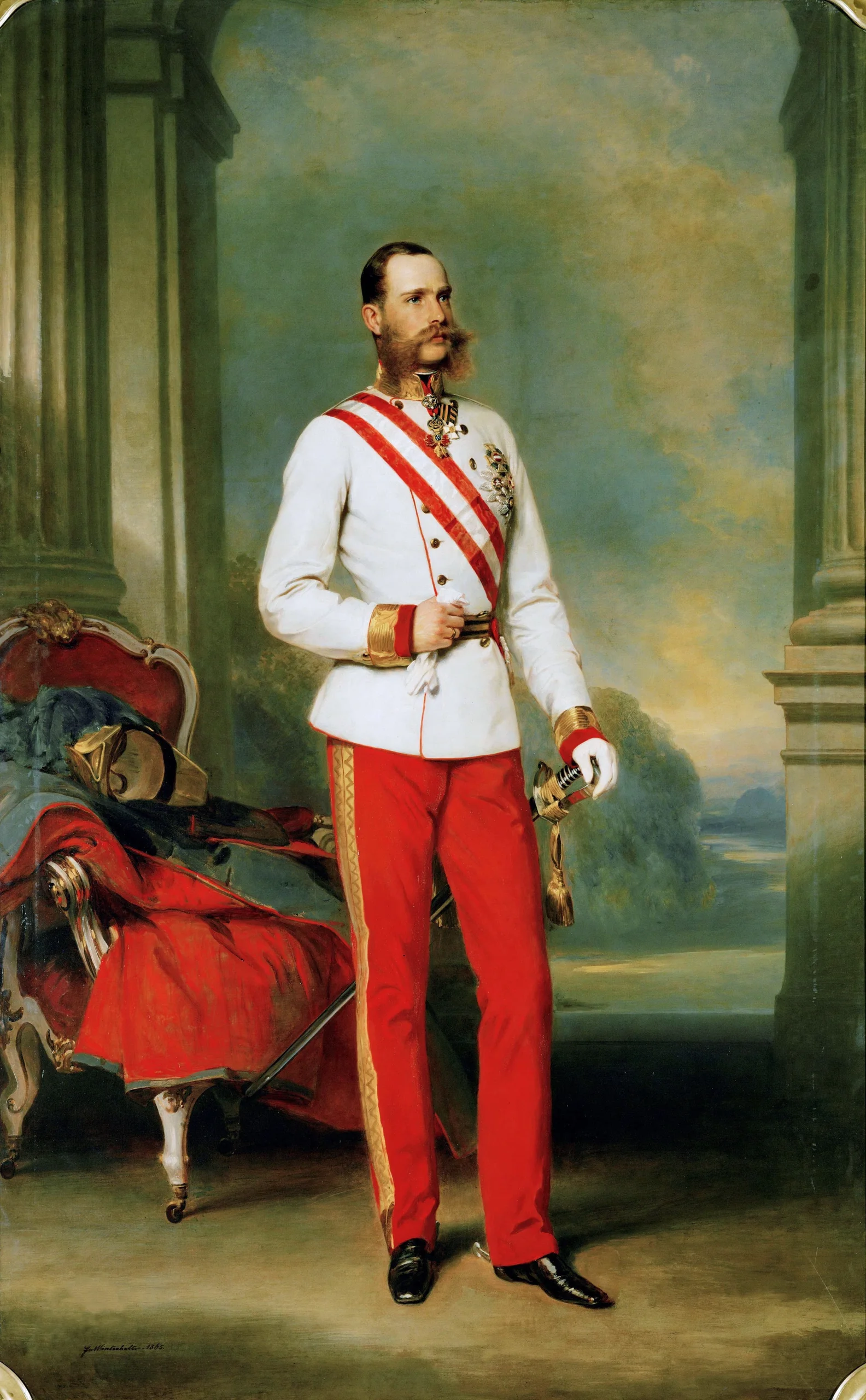
Franz Joseph I of Austria
 Austria
Emperor of Austria•King of Hungary
Also known as: Francis Joseph I, Franz Joseph I of Austria-Hungary
Birthday
August 18, 1830
Birth Sign
Leo
Birthplace
Schönbrunn Palace, Vienna, Austrian Empire
Age
Died at 86
About
Franz Joseph I was the Emperor of Austria and King of Hungary, whose 68-year reign from 1848 to 1916 made him one of the longest-serving monarchs in European history. He inherited the throne during the Revolutions of 1848 and presided over the transformation of the Austrian Empire into the dual monarchy of Austria-Hungary in 1867. His rule was defined by conservative policies, military defeats, and personal tragedies, yet he remained a symbol of Habsburg continuity and duty until his death during World War I. His image as the steadfast, uniformed emperor endures in historical memory, representing the old order in an era of rapid change. His reign spanned a period of significant transformation in Europe, including the decline of the Austrian Empire and the establishment of the dual monarchy. Known for his conservative stance, Franz Joseph initially resisted constitutional reforms but later granted Hungary greater autonomy through the Austro-Hungarian Compromise. He was more visible to the public than any previous Habsburg ruler due to the extensive use of photography during his lifetime.
Early Life & Background
Franz Joseph was born on August 18, 1830, at Schönbrunn Palace in Vienna, the eldest son of Archduke Franz Karl and Princess Sophie of Bavaria. His mother, Sophie, was a dominant force in his upbringing, grooming him from infancy for the throne. She instilled in him a rigid sense of duty, a deep Catholic faith, and a belief in the absolute authority of the Habsburg dynasty. His father, considered unambitious, and his uncle, Emperor Ferdinand I, who suffered from disabilities, made Franz Joseph the focal point of dynastic ambitions. His education was comprehensive and rigorous, covering history, languages, law, military strategy, and foreign affairs. He joined the Austrian army as a teenager and wore a military uniform daily for the rest of his life, a habit that became his trademark. His childhood was highly structured, with little leisure time, which biographers suggest may have limited his imagination but cemented his self-image as a soldier and servant of the state. By age 13, he was already being prepared for his future role, and when revolutions swept Europe in 1848, his mother engineered his ascension. His upbringing was deeply religious, with the Catholic faith being central to his identity. His mother instilled in him a suspicion of political change that might diminish Habsburg authority, shaping him into a conservative and dutiful ruler.
Career Growth
Franz Joseph ascended the throne on December 2, 1848, at age 18, after his uncle Ferdinand I abdicated and his father renounced his claim. He was proclaimed emperor at Olmütz. His early reign was marked by efforts to suppress revolutionary movements and restore absolutist control. He initially resisted constitutional reforms but was forced to compromise after military defeats in the Second Italian War of Independence (1859) and the Austro-Prussian War (1866), which cost Austria its influence in Germany and Italy. The most significant achievement of his reign came in 1867 with the Austro-Hungarian Compromise, which created the dual monarchy, granting Hungary equal partnership and internal autonomy. In foreign policy, he formed an alliance with Germany in 1879 and pursued expansion in the Balkans, culminating in the annexation of Bosnia and Herzegovina in 1908, which heightened tensions with Russia. The assassination of his nephew, Archduke Franz Ferdinand, on June 28, 1914, led Austria-Hungary to issue an ultimatum to Serbia, triggering World War I. Franz Joseph died on November 21, 1916, at Schönbrunn Palace, before the war's end. He served as president of the German Confederation from 1850 to 1866.
Career Timeline
Public Image & Style
Franz Joseph cultivated an image as the 'first servant of the state,' drawing on Habsburg traditions. He was almost always photographed in military uniform, emphasizing his role as a soldier-emperor. His conservative and dutiful persona resonated with many subjects, who saw him as a stable father figure in turbulent times. The extensive use of photography during his reign made him more visible than any previous Habsburg ruler. His public image was carefully managed from the start, highlighting his youth and energy. In later years, he became a symbol of endurance and tradition, though his resistance to reform also drew criticism. No formal fandom name exists, but he remains a subject of historical fascination. He modeled himself after previous Habsburg rulers like Joseph II and Leopold I.
Fame & Fandom (iFAMOUS Rankings)
Franz Joseph I of Austria commands a legacy that transcends the boundaries of modern celebrity culture. While he died long before the invention of social media or the concept of a digital fanbase, his story remains a potent fixture in historical memory and popular imagination. There is no formal name for his followers, nor are there organized campaigns or rituals dedicated to him today; instead, his audience consists of history enthusiasts, scholars, and those captivated by the drama of the Habsburg dynasty. The most enduring narrative surrounding him is the tragic romance with Empress Elisabeth, known as Sisi, a tale amplified by films like The Empress and cemented by her assassination in 1898. This story, along with his reputation as a stoic father figure who reigned through decades of upheaval, keeps his name alive in global discourse without the need for a modern fandom structure. His influence extends beyond biography into discussions of leadership during crises, drawing parallels between his diplomatic struggles and contemporary geopolitical tensions. Despite the absence of a specific moniker for his admirers, his cultural footprint remains vast, supported by the sheer scale of global attention across media coverage, search trends, and consumption signals worldwide. This enduring relevance places him firmly within the highest echelons of historical fame according to the iFANN Global Fame Rankings. Franz Joseph I of Austria is currently the 6th most famous person from Austria.
Interesting Facts and Legends
Franz Joseph maintained a rigid daily routine, rising at 4 a.m. every day regardless of circumstance. He was a polyglot fluent in German, Hungarian, French, and Italian, yet he lived modestly, sleeping on a simple iron bed despite his imperial status. An avid hunter, he kept meticulous records of his kills, and his distinctive side-whiskers became a fashionable trend among Austrian men. He famously avoided modern technology, never using a telephone or automobile throughout his life. Beyond these habits, the emperor's life is defined by legendary stories that persist in folklore. The tragic love affair with Empress Elisabeth, often romanticized in literature and film, remains the most retold narrative of his reign, highlighting the personal cost of his duty. Another iconic moment involves his coronation mass, which featured a collaboration with composer Franz Liszt, symbolizing the grandeur of his rule. Historians also note his role as a stabilizing force during turbulent times, earning him the title of 'most beloved emperor' in many accounts, even as the empire eventually crumbled after his death in 1916.
Family & Personal Life
Franz Joseph's family was marked by tragedy. His brother Maximilian was executed in Mexico in 1867. His nephew and heir, Archduke Franz Ferdinand, was assassinated in 1914. Franz Joseph married his first cousin, Duchess Elisabeth of Bavaria, known as Sisi, in 1854. They had four children: Archduchess Sophie (died in childhood at age two), Archduchess Gisela, Crown Prince Rudolf (who died by suicide in 1889), and Archduchess Marie Valerie. Elisabeth was assassinated in 1898. Franz Joseph remained widowed and never remarried. His mother Sophie, who heavily influenced his upbringing, died in 1872. His father Archduke Franz Karl died in 1878.
Notable Connections
Franz Joseph is closely associated with his wife Empress Elisabeth, his nephew Archduke Franz Ferdinand, and his mother Archduchess Sophie. His reign intersected with figures like Otto von Bismarck and Emperor Wilhelm II of Germany.
Relationships & Dating History
Franz Joseph married Duchess Elisabeth of Bavaria (Sisi) on April 24, 1854. The marriage began warmly but became strained as Elisabeth disliked court life and spent long periods traveling. They had four children, but tragedy struck repeatedly: their eldest daughter Sophie died at age two, and their only son Rudolf died by suicide in 1889. Elisabeth was assassinated in 1898. Franz Joseph never remarried and remained devoted to her memory. He had no other known romantic relationships.
- MarriedEmpress Elisabeth of Austria1854 - 1898Married in 1854; she was assassinated in 1898. They had four children.
Death & Aftermath
Died
November 21, 1916 (aged 86)
Death Place
Vienna, Austria
Cause of Death
Pneumonia and heart failure
Flags across the Austro-Hungarian Empire flew at half-mast as crowds gathered outside Schönbrunn Palace to lay flowers and wreaths in a spontaneous outpouring of grief for a monarch who had ruled for nearly sixty-eight years. The German Kaiser Wilhelm II sent a telegram describing Franz Joseph as a "great statesman," while the British royal family issued formal condolences, marking the end of an era that defined European stability for generations. On the afternoon of November 21, 1916, the 86-year-old Emperor suffered a sudden collapse while walking in the palace gardens or receiving visitors, a moment that signaled the final decline of his health. He passed away shortly before midnight, with medical records confirming death by pneumonia and heart failure following a period of rapid deterioration exacerbated by the stress of World War I and decades of personal loss.
His great-nephew, Charles I, ascended to the throne on the same day, ensuring immediate continuity of the dynasty without dispute. The grand state funeral took place on December 3, 1916, beneath the Capuchin Church in Vienna's Imperial Crypt, attended by high-ranking clergy, military officials, and dignitaries from allied nations despite the ongoing war. Franz Joseph was interred alongside his wife, Empress Elisabeth, and other Habsburg rulers, where his sarcophagus remains today. Centennial exhibitions and cultural works like the Netflix series The Empress have since renewed global interest in his life and reign, though the immediate posthumous handling of the Habsburg assets saw them largely nationalized following the empire's dissolution in 1918.
Net Worth (Estate Value)
$50 Million
iFANN Editorial Team estimate
As a monarch, Franz Joseph's wealth was intrinsically tied to the vast Habsburg estates and the imperial treasury. Per iFANN's editorial analysis, the family's net worth at the time of his death in 1916 was estimated at $50 Million. This substantial fortune included extensive land holdings, art collections, and palaces such as Schönbrunn Palace, alongside the imperial treasury itself. The estate passed to his grand-nephew Charles I upon his passing. In modern terms, the value of the Habsburg assets is difficult to quantify precisely, but historical estimates suggest the family's net worth was around $50 Million in 1916, equivalent to several billion today. No ongoing estate earnings are reported for the direct line following his reign.
Awards Won (3)
As a monarch, Franz Joseph was the recipient of numerous state honors from his own and other empires, including the Order of the Golden Fleece, the Order of St. Stephen, and the Military Order of Maria Theresa. These were largely honorary titles conferred by virtue of his position.
1830 · Chivalric Order
1848 · Royal Order
Known For
Emperor of Austria
1848 · Monarch
King of Hungary
1867 · Monarch
Austro-Hungarian Compromise
1867 · Architect
Keywords
Sources
Quick Facts
- Profession
- Monarch
- Born
- +1830-08-18
- Birthplace
- Schönbrunn Palace, Vienna
- Died
- +1916-11-21
- Death Place
- Schönbrunn Palace, Vienna
- Gender
- Male
- Spouse
- Empress Elisabeth of Austria
- Birth Sign
- Leo
Personal Details
- Full Name
- Franz Joseph Karl von Habsburg-Lothringen
- Spouse
- Empress Elisabeth of Austria
- Children
- 4 (Sophie, Gisela, Rudolf, Marie Valerie)
Frequently Asked Questions
Who was Franz Joseph I of Austria?
What was Franz Joseph I's role in World War I?
What was the Austro-Hungarian Compromise of 1867?
How did Franz Joseph I die?
What personal tragedies did Franz Joseph I experience?
Similar People
Join the community
fans discussing