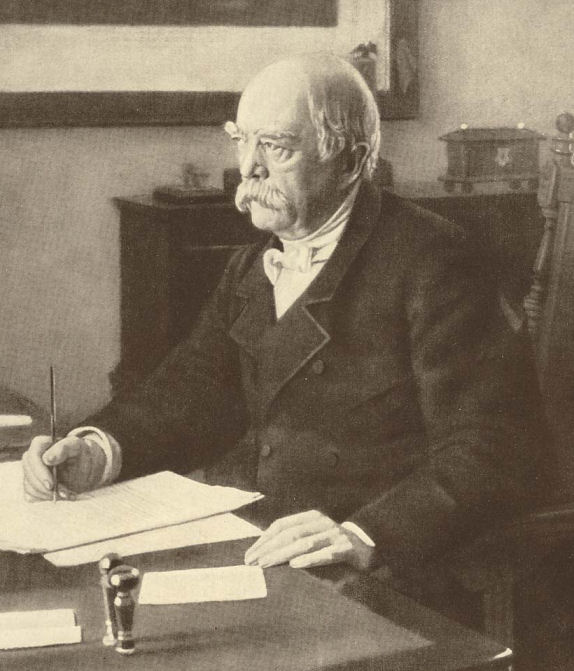
Otto von Bismarck
 Germany
Birthday
+1815-04-01
Birth Sign
Aries
Birthplace
Schönhausen (Elbe)
Age
Died at 83
About
Otto von Bismarck, born in Schönhausen (Elbe) on April 1, 1815, was a towering figure in 19th-century European politics. More than just a statesman and diplomat, he was the architect of modern Germany. His career, spanning decades, saw him rise from the ranks of the Prussian landed gentry to become the first Chancellor of the unified German Empire, a position he held from 1871 to 1890. His pragmatic approach to politics, often referred to as Realpolitik, and his unyielding resolve earned him the enduring moniker, the Iron Chancellor. Bismarck's path to power was marked by shrewd political maneuvering and decisive military action. Serving under King Wilhelm I of Prussia, he held significant roles, including ambassador to Russia and France, and minister president and foreign minister of Prussia for nearly thirty years. He masterminded a series of calculated wars against Denmark, Austria, and France. These conflicts were instrumental in dismantling the old German Confederation and forging the North German Confederation, paving the way for a unified German state under Prussian leadership. The proclamation of the German Empire in 1871, following the defeat of France, solidified his legacy and saw him elevated to the princely title of Fürst von Bismarck.
Fame & Fandom
Otto von Bismarck commands a legacy defined not by pop culture adoration but by the enduring weight of statecraft. No organized fanbase gathers to stream his speeches or flood social media with birthday tributes, for he was a 19th-century architect of nations rather than an entertainer. His supporters during the German Imperial era built monuments to honor the Iron Chancellor, yet this devotion remained rooted in political nationalism rather than the rituals of modern fandom. There is no official name for his followers, and no fan campaigns have ever emerged to chart his cultural impact in the digital age. Instead, his story survives through verified historical narratives: the unification of Germany via three decisive wars and the invention of the world's first national old-age insurance program at age 74. These achievements cemented his reputation as a master of realpolitik, a figure whose pragmatic wisdom continues to inform conservative discourse centuries later. While contemporary analysts occasionally compare him to modern leaders navigating culture wars, these references treat him as a case study in diplomacy rather than a celebrity subject to fan worship. Despite the absence of a formal fan community, his global resonance remains immense, a fact quantified by recent data. He holds the position of the 16th most famous person in Germany and ranks as the 26th most famous person from Germany. Within the realm of Books & Literature, he stands as the 55th most famous person in Books & Literature, a slight dip from his previous standing. These placements reflect his sustained presence across global attention metrics tracked by the iFANN Global Fame Rankings.
Interesting Facts and Legends
Born in Schönhausen on April 1, 1815, Otto von Bismarck rose from the Prussian landed gentry to become the first Chancellor of the unified German Empire, serving from 1871 until 1890. His career was marked by shrewd maneuvering and the decisive military actions that forged modern Germany. A central legend surrounding him involves the proclamation of the German Empire at the Palace of Versailles in January 1871, where he orchestrated the consolidation of German states under Prussian leadership following conflicts against Denmark, Austria, and France. Another defining moment occurred in 1889 when the 74-year-old statesman oversaw the adoption of the world's first national old-age social insurance program, setting the retirement age at 70 to counter socialist movements despite a male life expectancy of only around 40 years. His political philosophy endures through attributed quotes like "politics is the art of the possible" and the belief that great questions are decided by blood and iron. This 1862 speech predicting force over rhetoric remains a verified historical event often cited in discussions of power. Modern observers frequently invoke his image as a symbol of strong leadership, comparing his use of statecraft to contemporary political figures navigating complex cultural landscapes.
Death & Aftermath
Died
+1898-07-30 (aged 83)
Death Place
Varzin, Pomerania, German Empire
Cause of Death
Heart failure
The announcement came from the estate at Varzin, confirming that Otto von Bismarck had passed away on July 30, 1898. The Iron Chancellor died at age 83, ending a life defined by shrewd maneuvering and decisive action after years of declining health and seclusion following his resignation in 1890. Medical consensus of the time attributed the collapse to heart failure, a natural conclusion for a man suffering from vision loss and frailty associated with advanced age. Flags across the German Empire flew at half-mast as news spread, silencing political squabbles in the face of national grief.
Kaiser Wilhelm II delivered a eulogy honoring his estranged predecessor as the architect of the empire, bridging their final rift with public tribute. Monuments and Bismarck columns became focal points for mourners who gathered to pay respects to the statesman who had unified Germany through war and diplomacy. The funeral service on August 3 took place in Friedrichsruh, Schleswig-Holstein, transforming the family crypt into a stage for imperial grandeur. Emperor Wilhelm II, high-ranking military officials, and thousands of citizens attended the procession, which included full military honors befitting a former Prince of the Reich.
His remains were interred in the church crypt without cremation, marking the end of an era. Posthumous recognition cemented his status as a historical titan. Biographies flooded the market, detailing his diplomatic strategies and unification efforts, while foundations named in his honor began supporting studies in political science. His estate at Friedrichsruh transitioned into a museum complex, preserving his library and personal memorabilia as a historical monument rather than a commercial asset.
Awards & Accolades
Keywords
Quick Facts
- Profession
- politician, diplomat, jurist
- Born
- +1815-04-01
- Birthplace
- Schönhausen (Elbe)
- Died
- +1898-07-30
- Death Place
- Friedrichsruh
- Gender
- Male
- Spouse
- Johanna von Puttkamer
- Birth Sign
- Aries
Personal Details
- Spouse
- Johanna von Puttkamer
Join the community
fans discussing