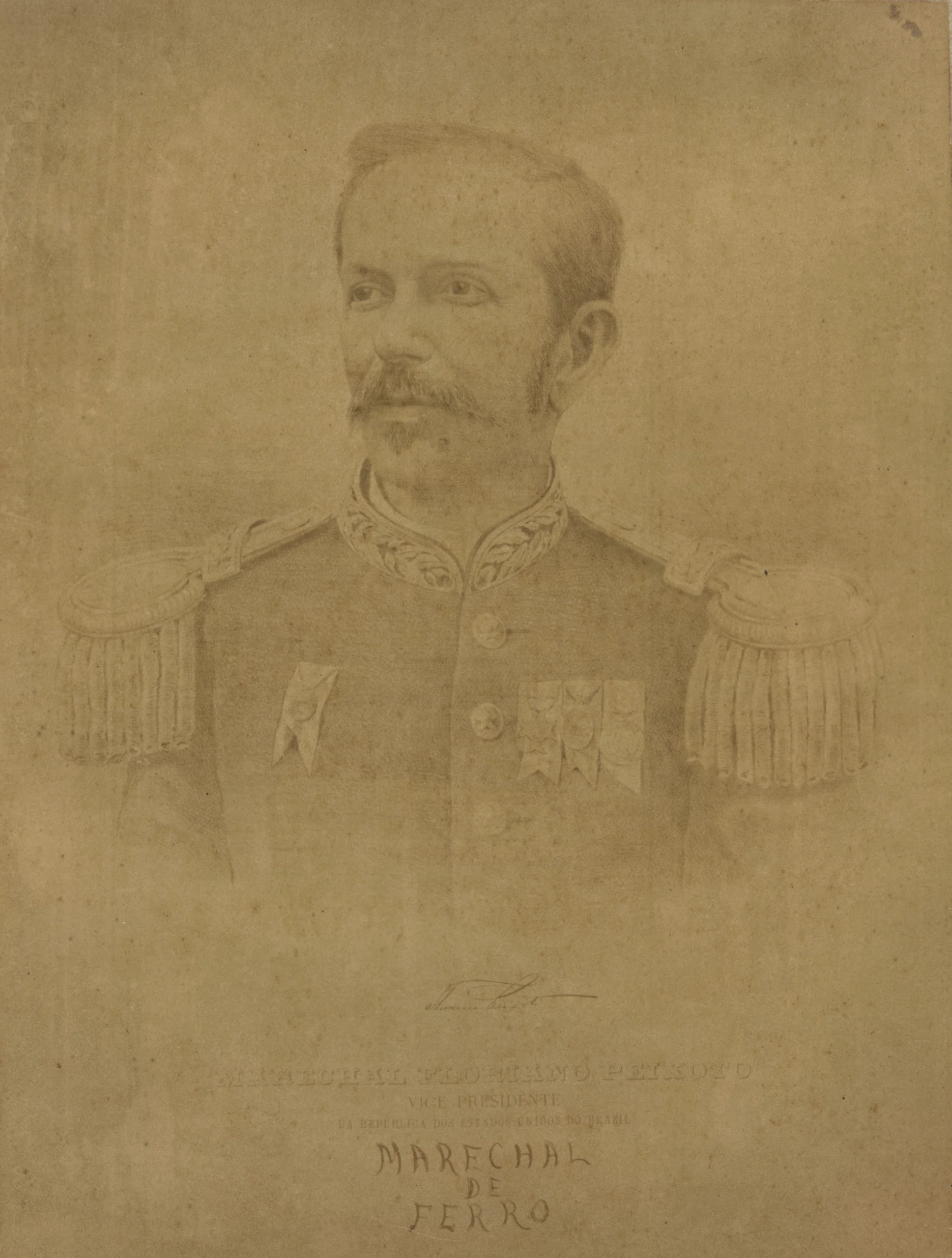
Floriano Peixoto
 Brazil
Also known as: Floriano Vieira Peixoto, Marechal de Ferro
Birthday
April 30, 1839
Birth Sign
Sagittarius
Birthplace
Ipioca, Maceió, Alagoas, Brazil
Age
Died at 56
About
Floriano Vieira Peixoto was a Brazilian military officer and politician who served as the second President of Brazil from November 1891 to November 1894. Born in Ipioca, a district of Maceió, he is historically revered as the "Iron Marshal" for his authoritarian consolidation of the early Brazilian Republic. His tenure marked a critical period in Brazilian history where he successfully suppressed major rebellions, including the Armada Revolt, ensuring the survival of the fledgling democratic system.
Before ascending to the presidency, Peixoto served as the first Vice President of Brazil under Deodoro da Fonseca. When Fonseca resigned amid a constitutional crisis, Peixoto became the first vice president in Brazilian history to succeed a president mid-term. His leadership style was defined by strict discipline and a willingness to use martial law to maintain order, earning him both fierce loyalty from supporters and criticism from opponents who viewed his methods as tyrannical.
Early Life & Background
Floriano Vieira Peixoto was born on April 30, 1839, in Ipioca, a coastal district of Maceió in the state of Alagoas. He was the son of José Vieira Peixoto, a customs official, and Ana Cândida da Silva. Growing up in modest circumstances, young Floriano was exposed to administrative duties through his father's work, which instilled in him a strong sense of national duty. Unlike many of his contemporaries who pursued civil law or commerce, he felt a profound calling toward the military profession.
At the age of 17, Peixoto enrolled in the Military School of Rio de Janeiro. He distinguished himself not only through academic rigor but also through his physical endurance and tactical acumen. A pivotal moment in his pre-fame career occurred during the Paraguayan War (1864–1870). Serving as a junior officer, he fought with distinction in several key battles, including the Battle of Lomas Valentinas. His bravery and leadership during this conflict earned him rapid promotions and established his reputation as a disciplined and ruthless commander, setting the stage for his future political rise.
Career Growth
Peixoto's career trajectory moved from military service to high-stakes politics during the tumultuous transition from Empire to Republic in Brazil. During the Paraguayan War (1864–1870), he rose to prominence as a hero, gaining the respect of senior officers and the public. In 1889, he played a crucial role in the coup that overthrew Emperor Pedro II, helping to establish the First Brazilian Republic. He was instrumental in drafting the initial military decrees of the new regime.
In November 1891, Peixoto was appointed as the first Vice President of Brazil under Deodoro da Fonseca. This period was defined by intense political friction between civilian politicians and the military. On November 23, 1891, following the resignation of President Deodoro da Fonseca amid a constitutional crisis and naval revolt, Peixoto ascended to the presidency. His tenure was characterized by the suppression of major rebellions. Most notably, he led the brutal but decisive defeat of the Revolta da Armada (Armada Revolt), a naval uprising supported by monarchists and republicans opposed to his centralizing policies. He also crushed the Federalist Revolution in the south. His governance style was authoritarian; he suspended habeas corpus and used martial law to maintain order. Despite the controversy, historians credit him with saving the fragile republic from fragmentation.
In 1894, he completed his term peacefully, handing power to Prudente de Morais, the first civilian president of Brazil. His legacy remains one of the most significant figures in establishing the republican system in Brazil.
Career Timeline
Public Image & Style
Floriano Peixoto is portrayed in media and education as a complex figure: a necessary evil who saved the republic through force. His aesthetic is that of a stern 19th-century military man, uniformed, authoritative, and unsmiling. Modern portrayals often highlight the tension between his patriotism and his authoritarianism. He is remembered as the "Iron Marshal," a title that reflects his unyielding nature and his willingness to use extreme measures to preserve the unity of Brazil. While some view him as a dictator, others see him as the guardian who prevented the collapse of the Brazilian Republic in its infancy.
Fame & Fandom
Floriano Peixoto commands a presence defined by historical record rather than contemporary celebrity metrics. His global attention remains anchored in the specific domain of Brazilian political history, where his role as the second president and the enforcer of the early Republic ensures he is remembered with gravity but lacks the widespread pop-culture saturation that drives modern fame rankings. As of September 2026, iFANN has evaluated this figure within its Global Fame Engine, yet the data confirms he does not currently hold a placement in the published rankings, including the Global Top 1,000 or any scope-limited top-100 lists. Consequently, no ordinal rank or numerical score can be assigned to his current standing relative to other public figures. The absence of a ranking reflects a lack of active fan-driven engagement or viral media cycles surrounding his name in the present era. Regarding his audience, the available records indicate that neither the historical statesman nor the contemporary actor bearing the same name possesses an organized fanbase with a formal designation. There is no documented fandom name, nor are there any recorded rituals, campaigns, or collective identities associated with supporters of either individual. While the Iron Marshal is a subject of serious academic study and the actor is known for specific film roles, neither has generated a community capable of producing chart-pushing projects or maintaining unofficial nicknames for their following.
Interesting Facts and Legends
Born in Ipioca, Floriano Vieira Peixoto earned the enduring moniker 'Iron Marshal' due to his authoritarian approach to governance and his military background during the Paraguayan War. He served as Brazil's first vice president before ascending to the presidency in 1891 following the resignation of Deodoro da Fonseca, becoming the first vice president to succeed a president under such circumstances. His tenure was marked by the suppression of significant uprisings, most notably the Revolta da Armada, which solidified the stability of the young republic through decisive force. Peixoto died on July 29, 1895, in Rio de Janeiro, leaving behind a legacy characterized by the consolidation of the Brazilian Republic. A separate individual named Floriano Peixoto, born in 1959, pursued a career in acting, appearing in the critically acclaimed prison drama Carandiru and the telenovela Kubanacan. Despite his professional work, no legendary anecdotes or viral moments have emerged from his career to rival the historical weight of the former president. The historical figure's story remains one of verified political events rather than folkloric tales of crowd adoration or mythical encounters.
Notable Quotes
“Order is the foundation of liberty.”
“I am the iron fist of the Republic.”
Family & Personal Life
Floriano Peixoto married Josina Maria da Conceição, known as Josina Peixoto. The couple had children, though specific details regarding their names and birth dates are less frequently cited in general biographies compared to his political deeds. Josina managed the household and supported her husband during his turbulent presidency. There is no record of divorce or other romantic partners; his marriage to Josina was his primary domestic relationship throughout his adult life. They remained married until his death in 1895, when she became a widow.
Notable Connections
Deodoro da Fonseca, Prudente de Morais, Osvaldo Aranha, José Paranhos
Relationships & Dating History
Floriano Peixoto married Josina Maria da Conceição, known as Josina Peixoto, prior to his rise to national prominence. The exact year of marriage is not widely documented in standard English sources, but it occurred well before 1891. They remained married until his death in 1895. No public breakups or separations were recorded. Children were born into this union, contributing to the Peixoto family line, though they did not achieve significant public fame comparable to their father. Josina managed the household and supported her husband during his turbulent presidency. At the time of his death on July 29, 1895, Floriano Peixoto was married to Josina Peixoto, leaving her a widow.
- MarriedJosina Peixoto? - 1895Married prior to his rise to national prominence; remained married until his death.
Death & Aftermath
Died
July 29, 1895 (aged 56)
Death Place
Rio de Janeiro, Brazil
Cause of Death
dropsy (edema)
Floriano Vieira Peixoto spent his final days confined to his residence in Rio de Janeiro, where he maintained correspondence with government officials and military leaders until his health deteriorated rapidly in late July. The second President of Brazil succumbed to a severe case of dropsy, a condition linked to heart or kidney failure that had worsened over several months under the strain of suppressing multiple revolts including the Federalist Revolution and the Armada Revolt. He passed away on July 29, 1895, as medical observation by attending physicians confirmed natural causes consistent with the practices of late nineteenth-century Brazil.
Vice-President Prudente de Morais succeeded him immediately upon his death, ensuring a constitutional transition of power that required no legal investigation or criminal proceedings. The nation reacted with profound shock and reverence, viewing the Iron Marshal as the savior who had consolidated the Brazilian Republic through his authoritarian but effective handling of early crises. Tributes poured in from military commanders, politicians, and the general populace, while major newspapers in Rio de Janeiro published extensive editorials eulogizing his iron will and leadership during turbulent times. Public gatherings and religious services were held across the country to honor the former president.
His funeral was conducted as a state affair in Rio de Janeiro, featuring full military honors befitting a war hero and former head of state. The ceremony included military bands and a procession attended by high-ranking officers, government officials, and representatives from various states before his interment at São João Batista Cemetery. Posthumously, Floriano Peixoto remains the subject of numerous historical analyses focusing on his political impact, with municipalities in Alagoas and Amazonas bearing his name alongside dedications of public buildings and schools.
Net Worth (Estate Value)
$0
iFANN Editorial Team estimate
As a deceased historical figure, Floriano Peixoto has no current net worth or estate value in the modern financial sense. His wealth was derived from his military salary and political stipends during the 1890s, which would have been substantial for the time but are not quantified in modern currency terms. There are no active business ventures, real estate holdings, or endorsement deals managed by an estate today. Any mention of "net worth" for him in modern contexts is speculative or refers to the value of historical artifacts bearing his name. The iFANN Editorial Team estimates his historical earnings at $0 in modern valuation terms due to the lack of surviving assets or commercial IP rights managed by an estate.
Awards & Accolades
View 4 records, honours and achievementsKnown For
President of Brazil
1891 · Second President
Vice President of Brazil
1891 · First Vice President
Keywords
Sources
Quick Facts
- Profession
- politician, military officer
- Born
- April 30, 1839
- Birthplace
- Ipioca, Maceió, Alagoas, Brazil
- Died
- July 29, 1895
- Death Place
- Rio de Janeiro, Brazil
- Gender
- Male
- Spouse
- Josina Peixoto
- Birth Sign
- Sagittarius
Personal Details
- Full Name
- Floriano Vieira Peixoto
- Spouse
- Josina Peixoto
- Children
- Unnamed children (specific names not widely documented)
- Education
- Military School of Rio de Janeiro
Frequently Asked Questions
Who was Floriano Peixoto?
How did Floriano Peixoto die?
What is the "Iron Marshal" nickname about?
Did Floriano Peixoto have any children?
Is there a modern actor named Floriano Peixoto?
Similar People
Join the community
fans discussing