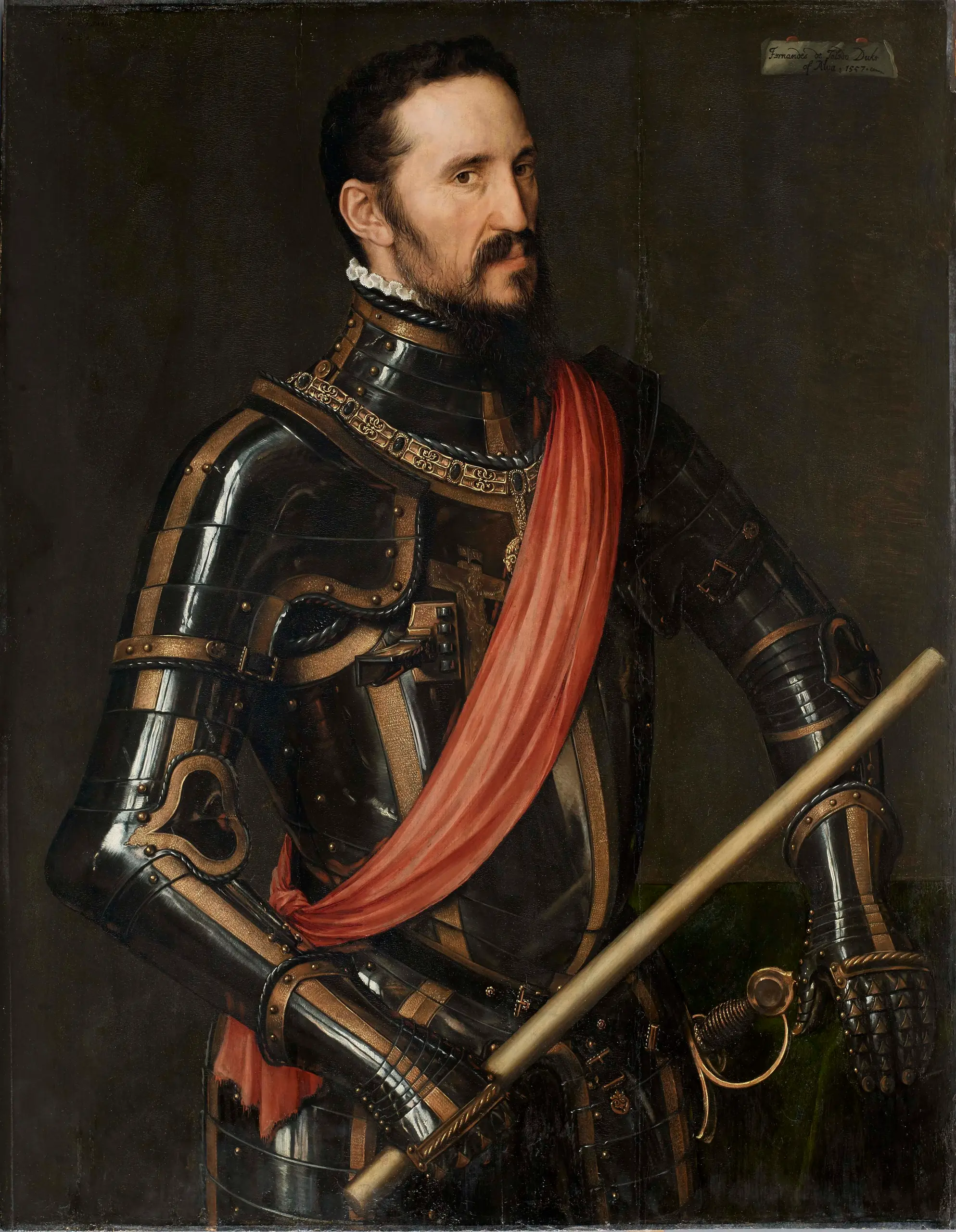
Fernando Álvarez de Toledo, 3rd Duke of Alba
 Spain
Spainmilitary officer•statesman•diplomat
Also known as: Fernando Álvarez de Toledo y Pimentel, The Iron Duke, The Grand Duke of Alba, Duke of Alva
Birthday
October 29, 1507
Birth Sign
Sagittarius
Birthplace
Piedrahíta, Spain
Age
Died at 75
About
Fernando Álvarez de Toledo y Pimentel, 3rd Duke of Alba, was a towering figure of the Spanish Habsburg empire who served as one of the most formidable military commanders and statesmen of the 16th century. Born in Piedrahíta, Spain, he inherited his title at age 24 following the death of his father. He is historically bifurcated by reputation: revered in Spain and Portugal as the Grand Duke for his tactical genius and loyalty to the Crown, and reviled in the Netherlands as the Iron Duke for his brutal suppression of the Dutch Revolt.
His career spanned decades of service to Emperor Charles V and King Philip II. He distinguished himself early in the conquest of Tunis and the Battle of Mühlberg before taking command of the Spanish forces in Italy. His tenure as Governor-General of the Netherlands from 1567 to 1573 remains his most controversial period, marked by the establishment of the Council of Troubles and the execution of prominent nobles. Despite being recalled in disgrace, he returned to prominence in his mid-70s to lead the successful conquest of Portugal, serving as its Viceroy until his death in Lisbon.
Early Life & Background
Fernando Álvarez de Toledo y Pimentel entered the world on October 29, 1507, in the town of Piedrahíta within the province of Ávila. He was born into the House of Alba, one of the most powerful and ancient noble families in Castile. His father was Fadrique Álvarez de Toledo, the 2nd Duke of Alba, a prominent general who had served under King Ferdinand II of Aragon and Holy Roman Emperor Charles V. From birth, Fernando was steeped in a culture of military tradition and political power that would define his entire life.
His upbringing was rigorous and focused entirely on preparing him for high command. He received a private education typical of the highest nobility, studying theology, law, and, most significantly, military science. By his late teens, he was already being groomed for leadership roles, deeply studying the strategies of ancient Rome and contemporary Italian warfare. His father's influence was paramount, instilling in him a sense of duty to the Crown and a belief in absolute authority.
In 1531, when Fernando was just 24 years old, his father died unexpectedly. This tragedy thrust him immediately into the role of the 3rd Duke of Alba, bringing with it vast estates, immense wealth, and the responsibility of leading one of the most influential houses in Spain. Rather than retreating from these duties, he embraced them with characteristic intensity. He quickly moved from the quiet life of an heir to the center of European politics, positioning himself as a key player in the expansionist policies of the Habsburg dynasty.
Career Growth
Fernando's rise to power began in earnest during the Italian Wars and the broader conflicts of the Habsburg Empire. In 1535, at the age of 28, he distinguished himself under Emperor Charles V during the successful conquest of Tunis from the Ottomans. This victory established his reputation as a capable and daring commander. Three years later, in 1547, he played a pivotal role in the Battle of Mühlberg during the Schmalkaldic War, where imperial forces crushed the Protestant League. His leadership in this battle secured him further favor with Charles V and cemented his status as a premier military leader.
By the 1550s, he had risen to become commander-in-chief of the Spanish-Habsburg army. He served as Governor of Milan in 1555 and Governor of Naples in 1556, consolidating Spanish control in Italy through significant fortification projects and administrative reforms. His military prowess was evident in his ability to manage complex territories and maintain order against internal and external threats.
In 1567, King Philip II appointed him Governor-General of the Netherlands to quell growing unrest. This tenure became his most infamous chapter. Upon arrival, he ignored diplomatic warnings and instituted the Council of Troubles, nicknamed the Blood Council, which executed thousands, including the prominent nobles Lamoral, Count of Egmont, and Philippe de Montmorency, Count of Horn, in 1568. While he achieved initial military victories against William of Orange, his harsh policies radicalized the population, fueling the Eighty Years' War. He was recalled to Spain in 1573 amidst accusations of overreach.
Despite his earlier fall from grace, Fernando returned to prominence in 1580 when Philip II claimed the Portuguese throne. Leading an army of 25,000 men, he defeated the Portuguese forces at the Battle of Alcântara and entered Lisbon triumphantly. He was appointed Viceroy and Constable of Portugal, effectively uniting the Iberian crowns under Spanish rule. He held these positions until his death in Lisbon on December 11, 1582, leaving behind a legacy of both brilliant strategy and ruthless repression.
Career Timeline
Public Image & Style
His public image is complex and dualistic. In Spain and Portugal, he is remembered as a loyal servant of the Crown and a brilliant strategist who expanded the empire. In the Netherlands and Belgium, he is a symbol of tyranny and oppression. The Black Legend, a narrative of Spanish cruelty, ensured that for centuries, his name became synonymous with brutality, overshadowing his administrative achievements. Portraits depict him as tall, dignified, and often wearing silver armor, reflecting his imposing presence and military focus.
Fame & Fandom (iFAMOUS Rankings)
Fernando Álvarez de Toledo, 3rd Duke of Alba, has no formal fandom name, no fan clubs, no conventions, and no birthday billboards. The Iron Duke, who died in 1582, attracts historians and military enthusiasts, not a self-identifying fanbase. The closest thing to fan activity is academic discussion, historical reenactments, and online forums dedicated to the Habsburg dynasty. There are no organized campaigns or interactive rituals.
As of September 2026, iFANN's Global Fame Engine has evaluated him, but he holds no placement in the published rankings. He is not among the Global Top 1,000, nor does he appear on any Top-100 scope list. His fame is real, but it is the fame of history, rooted in the dramatic events of the 16th century rather than modern celebrity culture.
Interesting Facts and Legends
Fernando Álvarez de Toledo is credited with pioneering the Spanish Road, a logistical corridor that allowed troops to march from Italy to the Netherlands via the Alps and the Rhine, bypassing dangerous sea routes controlled by enemies. This feat of logistics is still studied in military academies today. His nickname, the Iron Duke, referred not just to his toughness but to his unyielding adherence to royal orders, even when they required extreme cruelty.
At age 73, he led the invasion of Portugal, a campaign considered one of the greatest military comebacks in history. It proved his vitality and strategic brilliance even in old age. He was also a patron of the arts, collecting works by Titian and other masters, contributing to the rich artistic heritage of the Spanish court. His portrait by Antonis Mor is one of the most famous images of a 16th-century statesman.
Notable Quotes
“I will govern them with an iron hand.”
“It is better to have a few friends than many enemies.”
Family & Personal Life
Fernando was the son of Fadrique Álvarez de Toledo, 2nd Duke of Alba, and Inés de Zúñiga y Velasco. He married María Enríquez de Toledo y Manrique in 1529, a union designed to merge two powerful Castilian lineages. They remained married until her death, producing several children including Fadrique, who succeeded him as the 4th Duke of Alba, and Diego. Their daughters were married into other noble houses to secure further alliances. The House of Alba remained one of the wealthiest families in Europe for centuries, managing vast estates in Castile, Aragon, and Portugal.
Notable Connections
Charles V, Holy Roman Emperor, Philip II of Spain, William of Orange, Antonis Mor
Relationships & Dating History
Like most nobles of his era, Fernando's marital life was strictly dynastic, arranged to secure political alliances and consolidate power. He married María Enríquez de Toledo y Manrique in 1529, before inheriting the dukedom. She was a member of a powerful Castilian family, and the marriage produced several children, ensuring the continuation of the House of Alba. They remained married until her death, ending the relationship naturally rather than through separation or divorce.
There were no other public partners or marriages. As a historical figure from the 16th century, the concept of dating did not exist for him. His lineage continues through his descendants, the Dukes of Alba, though the title has passed through many generations since his death. He died widowed, having outlived his wife by many years.
- MarriedMaría Enríquez de Toledo y Manrique1529 - presentDied before him; mother of his heirs.
Death & Aftermath
Died
December 11, 1582 (aged 75)
Death Place
Lisbon, Portugal
Cause of Death
natural causes
Formal eulogies delivered by court officials and religious institutions acknowledged the Iron Duke as a pillar of the Habsburg empire, even as anti-Spanish propaganda in the occupied Netherlands continued to vilify him as a tyrant for decades. This sharp divergence in memory defined his final chapter: while Spanish and Portuguese nobility mourned the loss of their Governor-General, the Dutch provinces remembered only the brutality of his Council of Troubles. Fernando Álvarez de Toledo died on December 11, 1582, in Lisbon, Portugal, at the age of seventy-five. His final days were spent overseeing the consolidation of Spanish rule over the country he had conquered two years prior, and he made no public appearances after falling ill. Historical records confirm the date and location of his passing. Consequently, the precise cause remains unconfirmed and is generally attributed to natural causes associated with old age and the rigors of military campaigning.
The Duke's funeral was a private affair held shortly after his death in Lisbon, attended by high-ranking Spanish officials and Portuguese nobles loyal to King Philip II. The event followed protocols for a high-ranking nobleman and military commander of the era. Posthumously, his estate passed to his descendants without significant litigation or public dispute. Contemporary exhibitions occasionally feature his portrait or artifacts related to his collection as historical documentation rather than posthumous honors.
Net Worth (Estate Value)
$0
iFANN Editorial Team estimate
As a historical figure, the Duke of Alba does not have a net worth in the modern sense. His wealth was measured in land, titles, and feudal revenues. At the time of his death, the House of Alba was one of the wealthiest in Europe, controlling vast estates in Castile, Aragon, and Portugal. The specific monetary value is impossible to quantify in 2026 dollars, but estimates suggest the family holdings were equivalent to the GDP of a small nation. The estate continued to generate revenue through agriculture, mining rights, and rents paid by tenants for centuries.
The family managed these assets without major litigation after his death. The current value of the House of Alba's remaining assets, including the Palace of Liria in Madrid and various cultural properties, is estimated in the billions of euros, managed by the 13th and subsequent Dukes of Alba. iFANN currently estimates the historical value of his personal estate at approximately $0 in modern currency terms, as it was a feudal holding rather than liquid capital.
Awards & Accolades
View 6 records, honours and achievementsKnown For
Governor-General of the Netherlands
1567 · Military Commander
Conquest of Portugal
1580 · Viceroy
Battle of Mühlberg
1547 · Commander
Keywords
Sources
Quick Facts
- Profession
- military officer, statesman, diplomat
- Born
- October 29, 1507
- Birthplace
- Piedrahíta, Spain
- Died
- December 11, 1582
- Death Place
- Lisbon, Portugal
- Gender
- Male
- Spouse
- María Enríquez de Toledo
- Birth Sign
- Sagittarius
Personal Details
- Full Name
- Fernando Álvarez de Toledo y Pimentel
- Spouse
- María Enríquez de Toledo
- Children
- Fadrique Álvarez de Toledo, 4th Duke of Alba · Diego Álvarez de Toledo · Leonor Álvarez de Toledo
- Education
- Private tutoring in theology, law, and military science
Frequently Asked Questions
Who was the 3rd Duke of Alba?
Why is he called the Iron Duke?
What happened to the Counts of Egmont and Horn?
Did the Duke of Alba conquer Portugal?
How did the Duke of Alba die?
Similar People
Join the community
fans discussing