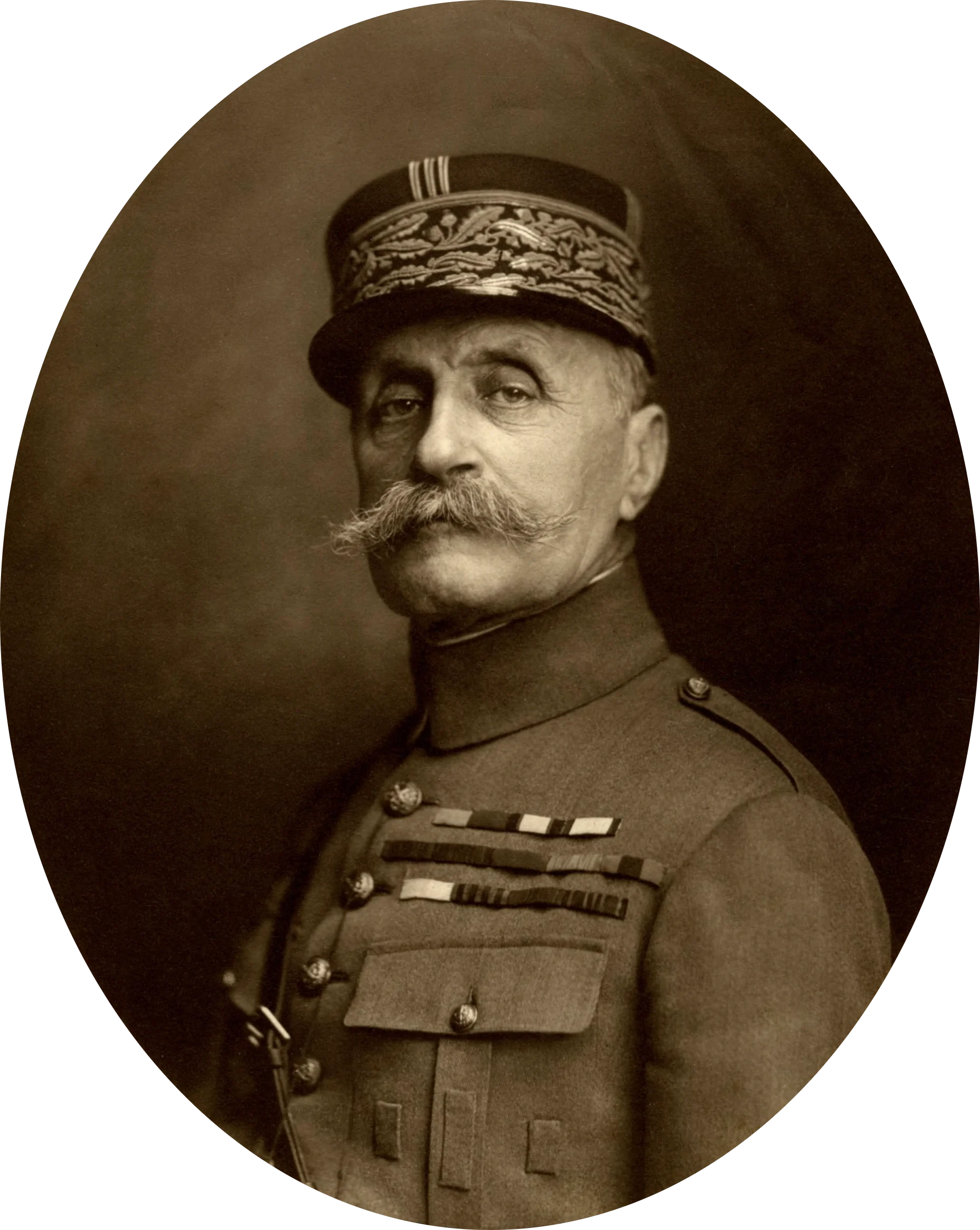
Ferdinand Foch
 France
Also known as: Ferdinand Jean Marie Foch, Marshal Foch
Birthday
October 2, 1851
Birth Sign
Libra
Birthplace
Tarbes, France
Age
Died at 77
About
Ferdinand Foch was a French general and Marshal of France who served as Supreme Allied Commander on the Western Front during World War I. Born in Tarbes in the Hautes-Pyrénées department, he rose from a modest background to become one of the most influential military strategists of the 20th century. His career is defined by his command during the First Battle of the Marne, his coordination of the Allied forces that halted the German Spring Offensive in 1918, and his role in securing the Armistice of November 11, 1918.
Foch's leadership style combined rigorous mathematical training with aggressive tactical doctrine. He commanded the XX Corps at the outbreak of war and later led the French Ninth Army to victory at the Marne. In March 1918, he was appointed Commander-in-Chief of all Allied armies, a role that required him to coordinate French, British, American, and Italian forces under immense pressure. His decisive actions at the Second Battle of the Marne turned the tide of the war permanently. Beyond the battlefield, he was a member of the Académie Française and a prolific writer on military theory whose works influenced generations of officers.
Early Life & Background
Ferdinand Foch was born on October 2, 1851, in Tarbes, a town nestled in the Pyrenees mountains of southwestern France. His father worked as a government civil servant, providing a stable but unremarkable upbringing in a region known for its rugged terrain. From a young age, Ferdinand displayed a sharp aptitude for mathematics and strategy, interests that would later define his entire military career. He entered the prestigious École Polytechnique in 1869 at the age of seventeen but left shortly after to join the military academy at Saint-Cyr, seeking a direct path to active service.
He graduated from Saint-Cyr in 1873 as a second lieutenant in the artillery branch of the French Army. His early education emphasized rigorous engineering principles and logistical planning, skills he would apply throughout his life. Foch first saw combat during the Franco-Prussian War of 1870–1871, serving as a young officer when the conflict ended in a devastating French defeat. This experience deeply influenced his views on national defense and the necessity of maintaining an offensive spirit. Following the war, he dedicated himself to advanced military theory, studying at the École de Guerre (War College) where he developed a reputation for intellectual rigor.
During the 1880s and 1890s, Foch taught at the War College and published several works on military strategy. He became a vocal advocate for offensive à outrance, a doctrine emphasizing aggressive action over defensive fortification. He also developed the concept of foudroyance, arguing that speed and surprise were more critical than firepower alone. Despite his brilliance, his career initially moved slowly due to political rivalries and an abrasive personality. He steadily rose through the ranks, eventually becoming a Colonel and then a General, setting the stage for his eventual command of the Allied forces.
Career Growth
The turning point of Foch's career arrived with the outbreak of World War I in August 1914. Commanding the XX Corps, he briefly invaded Germany before retreating to successfully defend Nancy against a massive German counterattack, earning immediate recognition. In September 1914, he was ordered to defend Paris and commanded the French Ninth Army during the First Battle of the Marne. His decisive leadership helped stop the German advance, saving Paris and turning the tide of the war. He subsequently commanded Army Group North, fighting alongside British forces at Ypres and the Somme from 1915 to 1916.
In late 1916, partly due to political friction in France and disappointing results in the north, Foch was transferred to Italy as Chief of Staff to the Italian Army. However, the crisis of 1918 brought him back to the center of events. In March 1918, he was appointed Commander-in-Chief of the Allied Armies on the Western Front, granting him supreme authority over French, British, American, and Italian forces. This was the pivotal moment of his career. In July 1918, he led the Allied forces to victory in the Second Battle of the Marne, halting the final major German offensive.
His success led to his promotion to Marshal of France in August 1918, the highest rank in the French army. In November 1918, he accepted the German armistice request at Compiègne, effectively ending the war. At the Paris Peace Conference in 1919, he famously criticized the Treaty of Versailles as insufficient to prevent future conflict. In 1921, he undertook a diplomatic tour of the United States, visiting Yale University and meeting with Cardinal O'Connell in Boston, symbolizing the alliance between the nations. His work established him as the primary architect of the Allied victory in 1918.
Career Timeline
Public Image & Style
Foch is portrayed in history as the "Iron Marshal," a man of rigid discipline, strategic genius, and unshakeable resolve. Media depictions focus on his stern face, his uniform adorned with medals, and his role as the unifier of the Allied forces. His tone is remembered as authoritative and prophetic, particularly regarding his warnings about the Treaty of Versailles. He cultivated an image of the intellectual soldier, combining the precision of a mathematician with the boldness of a field commander. His presence was commanding, often described as imposing and severe, fitting the archetype of a general who demanded absolute obedience and offensive spirit from his troops.
Fame & Fandom
Ferdinand Foch commands a presence defined by historical gravity rather than contemporary celebrity metrics. As a Marshal of France and Supreme Allied Commander during the First World War, his influence remains a subject of serious academic study and military history, yet he does not currently hold a placement in the published rankings (Global Top 1,000 or a Top-100 scope list) as evaluated by iFANN's Global Fame Engine. The evaluation indicates that while his legacy is profound, he holds no current placement in the rankings, meaning no ordinal number or score can be assigned to his global fame at this time. This absence from the chart reflects the nature of his career as a statesman and field marshal operating in an era preceding modern fan culture.
Consequently, there is no documented fandom name associated with him; the public engagement surrounding his life consists entirely of historical remembrance rather than organized fan groups, rituals, or digital campaigns. Unlike figures who generate spontaneous crowds or viral moments, Foch's interactions were limited to state-sanctioned diplomatic tours and formal military commands. No fanbase has emerged to claim him as a cultural icon in the manner of pop stars or entertainers, nor are there any recorded instances of fans engaging in charity drives or streaming pushes on his behalf. His reputation rests solely on verified strategic decisions and political foresight, such as his prediction regarding the Treaty of Versailles, which stands as a matter of record rather than folklore. The lack of a formal fan identity underscores his status as a figure of the past whose relevance is maintained through education and historical analysis rather than active participation in the economy of fame.
Interesting Facts and Legends
A red wine grape variety named "Maréchal Foch" was developed by Albert Seibel in the 19th century and is now grown in regions like Washington State and Ontario, serving as a unique agricultural tribute to the Marshal. During his 1921 US tour, Foch received an honorary degree from Yale University, a rare honor for a foreign military commander at the time. Unlike many infantry-focused generals, Foch was originally an artillery specialist, which heavily influenced his emphasis on fire support and shock tactics throughout his career. His prediction that the Treaty of Versailles was merely an "armistice for twenty years" has become one of the most famous quotes in history, proven accurate when World War II began in 1939. He was also known for his stern demeanor and rigid discipline, earning him the nickname "The Iron Marshal" among his contemporaries.
Notable Quotes
“We must attack without limit.”
“This is not peace. It is an armistice for twenty years.”
“The only way to win is to attack.”
Family & Personal Life
Ferdinand Foch married Julie Bienvenüe in 1879. Julie was the daughter of Eugène-François Bienvenüe, a renowned engineer who designed much of the Paris Métro system. The marriage was long-standing and stable, providing Foch with a domestic anchor amidst his demanding military career. They had two sons: Gaston Foch and another son whose name is less frequently cited in public records. There are no public records of other romantic relationships, engagements, or divorces; Foch remained married to Julie until his death. As a historical figure of the 19th and early 20th centuries, there is no "dating history" in the modern celebrity sense; his life was characterized by professional dedication and a singular marital bond.
Notable Connections
Julie Bienvenüe; Georges Clemenceau; David Lloyd George; Woodrow Wilson; Raymond Poincaré; Hendrikus Colijn.
Relationships & Dating History
Ferdinand Foch married Julie Bienvenüe in 1879. Julie was the daughter of Eugène-François Bienvenüe, a renowned engineer who designed much of the Paris Métro system. The marriage was long-standing and stable, providing Foch with a domestic anchor amidst his demanding military career. They had two sons: Gaston Foch and another son whose name is less frequently cited in public records. There are no public records of other romantic relationships, engagements, or divorces; Foch remained married to Julie until his death in 1929. As a historical figure of the 19th and early 20th centuries, there is no "dating history" in the modern celebrity sense; his life was characterized by professional dedication and a singular marital bond.
- MarriedJulie Bienvenüe1879 - 1929Daughter of the engineer who designed the Paris Métro; remained married until his death.
Death & Aftermath
Died
March 20, 1929 (aged 77)
Death Place
Paris, France
Cause of Death
Myocardial infarction
Ferdinand Foch spent his final days in relative seclusion at his residence on Rue de Bellechasse in Paris, having withdrawn from public view as his health declined over a period of time. He passed away on March 20, 1929, at the age of seventy-seven, with the official cause attributed to a myocardial infarction confirmed by attending physicians and family statements rather than a formal autopsy or coroner's inquest. The event triggered profound national mourning across France and an outpouring of tribute from Allied leaders, including an official statement from United States President Calvin Coolidge who acknowledged the Marshal's pivotal role in the victory. A grand state funeral followed six days later, beginning with religious services at the Église Saint-Roch before a procession through Paris to the Arc de Triomphe, where his coffin rested before the Tomb of the Unknown Soldier.
Following these military honors, Foch was interred within the Panthéon, a distinction reserved for the nation's most revered figures, attended by French President Gaston Doumergue, Prime Minister Aristide Briand, and high-ranking officials from Britain and the United States. His legacy endured through various dedications such as the Maréchal Foch wine grape variety in Washington State and the establishment of scholarships dedicated to studying his strategic theories on offensive spirit. While his estate was settled according to French succession laws with personal papers preserved by his family for historical study, no specific financial details regarding the distribution were made public.
Net Worth (Estate Value)
$0
iFANN Editorial Team estimate
Ferdinand Foch passed away in 1929, so his financial standing refers to his estate value at the time of death and its subsequent management. Specific financial details regarding his personal wealth were not made public, as was common for military figures of that era. His estate was settled according to French succession laws, with personal papers preserved by his family. There are no modern estimates of his net worth in dollars, nor is there a publicly managed estate generating revenue today. Unlike modern celebrities, his legacy is maintained through historical study and state memorials rather than commercial licensing or posthumous royalties. The iFANN Editorial Team notes that no credible financial data exists to assign a monetary value to his estate in the modern sense.
Awards Won (4)
Ferdinand Foch received the highest honors available to a French military leader, including promotion to Marshal of France in 1918. He was awarded the Grand Cross of the Legion of Honour and the Order of the Bath from the United Kingdom. He was also elected as a member of the Académie Française, reflecting his status as a man of letters and strategic thinker. Additionally, he received honorary titles as Marshal of Great Britain and Poland in recognition of his service.
1918 · Military Rank
Service in World War I
1918 · Civil and Military Award
Service in World War I
Known For
World War I
1914-1918 · Supreme Allied Commander
First Battle of the Marne
1914 · Commander
Second Battle of the Marne
1918 · Commander
Keywords
Sources
Quick Facts
- Profession
- army officer
- Born
- October 2, 1851
- Birthplace
- Tarbes
- Died
- March 20, 1929
- Death Place
- Paris
- Gender
- Male
- Spouse
- Julie Bienvenüe
- Birth Sign
- Libra
Personal Details
- Full Name
- Ferdinand Jean Marie Foch
- Spouse
- Julie Bienvenüe
- Children
- Gaston Foch
- Education
- École Polytechnique; École Spéciale Militaire de Saint-Cyr; École de Guerre
Frequently Asked Questions
What did Ferdinand Foch predict about the Treaty of Versailles?
Who was Ferdinand Foch's wife?
When did Ferdinand Foch die?
What was Ferdinand Foch's role in World War I?
Where is Ferdinand Foch buried?
Similar People
Join the community
fans discussing