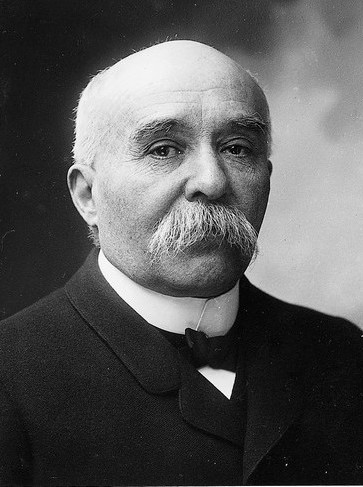
Georges Clemenceau
 France
politician•journalist•physician
Birthday
+1841-09-28
Birth Sign
Sagittarius
Birthplace
Mouilleron-en-Pareds
Age
Died at 88
About
Georges Benjamin Clemenceau, born on September 28, 1841, in Mouilleron-en-Pareds, was a French statesman who served as prime minister from 1906 to 1909 and again from 1917 to 1920. A physician turned journalist, he became a towering figure in the politics of the Third Republic, especially during the final years of World War I. As a leader of the Independent Radicals, he pushed for the separation of church and state and campaigned for amnesty for the Communards exiled to New Caledonia. After nearly 1.4 million French soldiers died between the German invasion and the Armistice, Clemenceau demanded total victory over the German Empire. He insisted on reparations, the transfer of colonies, strict measures to prevent German rearmament, and the return of Alsace-Lorraine, which Germany had annexed in 1871. He achieved these goals through the Treaty of Versailles, signed at the Paris Peace Conference in 1919–1920. His fierce determination earned him the nicknames Père la Victoire ("Father Victory") and Le Tigre ("The Tiger"). Clemenceau maintained his hardline stance against Germany in the 1920s, though he was less extreme than President Raymond Poincaré or Marshal Ferdinand Foch, who famously called the treaty "an armistice for twenty years." Clemenceau also secured mutual defense treaties with Britain and the United States against potential German aggression, but these never took effect because the U.S. Senate refused to ratify the treaty, which in turn released Britain from its obligations. He died on November 24, 1929, at the age of 88, leaving behind a legacy as one of France's most formidable wartime leaders.
Fame & Fandom
Georges Clemenceau never cultivated a modern fandom in the contemporary sense, lacking organized fan clubs, birthday billboards, or charity drives that define today's celebrity culture. His supporters were never a distinct subculture with a formal name; instead, admiration for him flows through historical institutions like the Musée de la Vie Romantique and the Maison de Clemenceau, where enthusiasts gather to tour his apartment and garden during Heritage Days. The closest equivalent to fan interaction involves academic study and visits to these heritage sites rather than digital campaigns or chart pushes. While he remains a towering figure in French history, iFANN has evaluated his global standing without finding a specific placement for him in the published rankings. Georges Clemenceau is currently unranked in the Global Top 1,000 and Top-100 scope lists, reflecting his enduring legacy as a statesman rather than a pop culture icon, with no current movement recorded in the latest data. The absence of a documented fandom name aligns with his status as a deceased historical figure whose influence is preserved through museums and scholarship rather than active fan engagement. His cultural mythology relies on verified political achievements and personal traits rather than viral moments or performance-based fame. The Tiger remains a nickname etched into history books, not a brand associated with a fanbase. While some might wish for a dedicated community to celebrate his life, the reality is that interest in Clemenceau is maintained through educational tours and historical preservation efforts. His story is one of statecraft and resilience, not the chaotic energy of modern stardom. The lack of a formal fanbase underscores the distinction between a political leader who shaped nations and an entertainer who commands crowds.
Interesting Facts and Legends
Born a physician before trading his stethoscope for a pen, Georges Clemenceau became one of the most formidable journalists of the Third Republic. Before his political dominance, he spent seven years in exile in the United States, working as a teacher and writer while opposing Napoleon III. A particularly touching story involves his close friendship with the painter Claude Monet. In 1925, Clemenceau used his immense political influence to rescue Monet's garden at Giverny from being sold to pay off debts, effectively preserving the water lilies that would later inspire some of the most famous paintings in history. Another iconic moment often retold is his return to power as Prime Minister at the age of 76 during the darkest days of World War I. Facing collapsing morale, he rallied the French nation with such ferocity that he earned the title "Père la Victoire," or Father Victory. His nickname, "The Tiger," perfectly captured his militant stance and fierce reputation in both journalism and politics. Recent scholarship also notes his complex relationship with antisemitism, describing it as a "strange anti-antisemitism" where he opposed the Dreyfus Affair's hateful currents while holding nuanced views that continue to spark academic debate today.
Death & Aftermath
Died
+1929-11-24 (aged 88)
Death Place
Paris, France
Cause of Death
Natural causes associated with advanced age
Georges Clemenceau passed away on November 24, 1929, at his residence in Paris. The final days of the eighty-eight-year-old statesman were marked by a quiet decline following his retirement from public life in 1920, during which he dedicated himself to writing memoirs and maintaining correspondence with figures like Claude Monet. Contemporary accounts describe a peaceful end without dispute or legal inquiry, consistent with natural causes associated with advanced age rather than any sudden event. The nation mourned deeply upon learning of his death, honoring him as Père Victoire for his decisive leadership during World War I. Tributes poured in from peers and officials who recognized him as the savior of France, cementing his legacy immediately through renewed academic interest in his role at the Treaty of Versailles and his defense of Dreyfus.
His funeral served as a significant public event attended by numerous dignitaries reflecting his stature as a former Prime Minister and key architect of the post-war peace. Clemenceau was laid to rest in the cemetery of Mouilleron-en-Pareds, his birthplace in the Vendée region. His Paris apartment was preserved as a museum dedicated to his life and work, allowing the public to view his personal effects and study his environment. Posthumously, he became the subject of numerous books and studies analyzing his letters to America and his complex relationship with artists, while his estate and papers were donated to the French state and the Bibliothèque nationale de France for future generations.
Awards & Accolades
Keywords
Quick Facts
- Profession
- politician, journalist, physician
- Born
- +1841-09-28
- Birthplace
- Mouilleron-en-Pareds
- Died
- +1929-11-24
- Death Place
- Paris
- Gender
- Male
- Spouse
- Mary Plummer
- Birth Sign
- Sagittarius
Personal Details
- Spouse
- Mary Plummer
Join the community
fans discussing