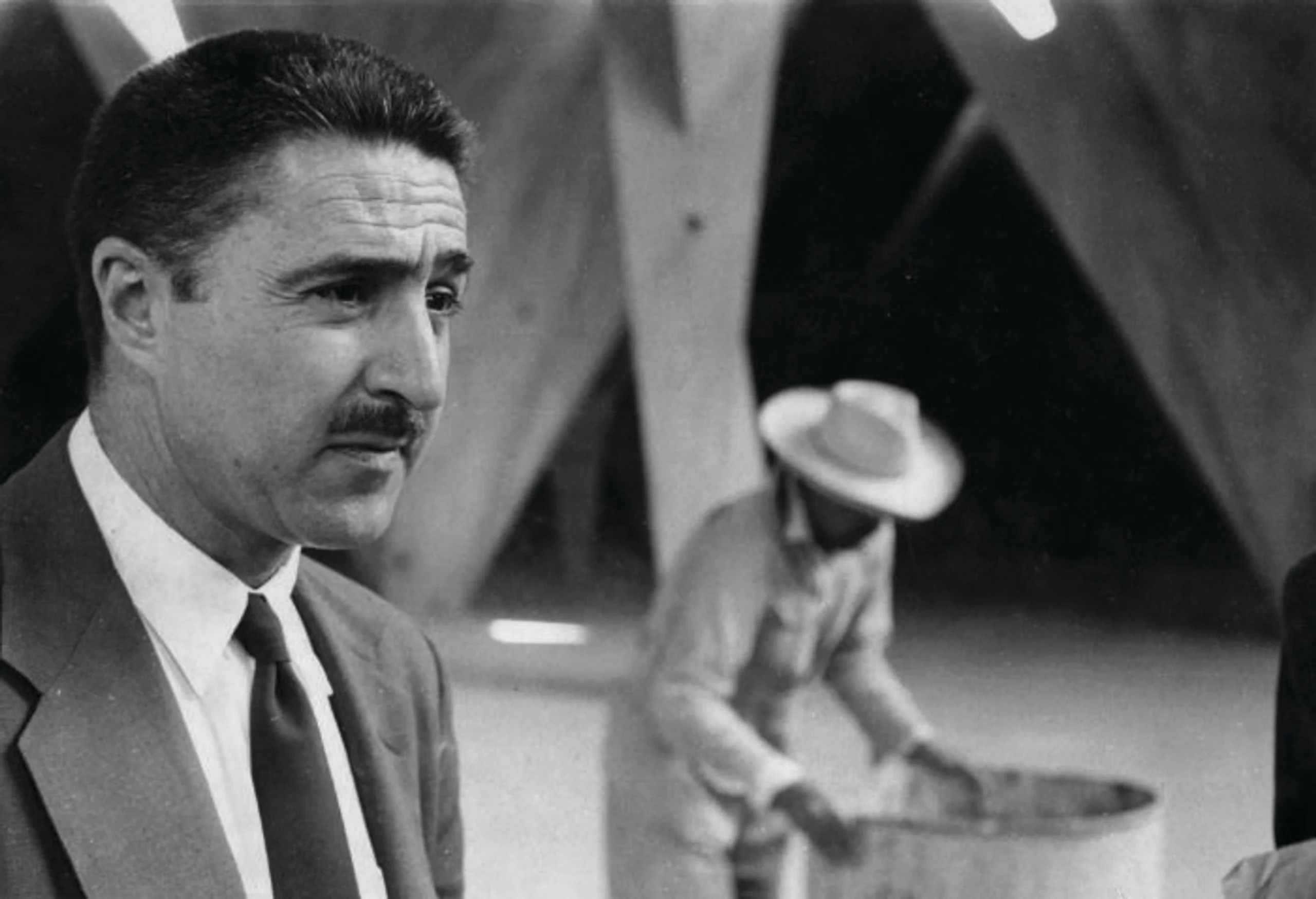
Félix Candela
 Mexico
Also known as: Félix Candela Outeriño, Felix Candela, Félix Candela y Outeriño
Birthday
January 27, 1910
Birth Sign
Aquarius
Birthplace
Madrid, Spain
Age
Died at 87
About
Félix Candela Outeriño was a Spanish-born architect and engineer whose name is inseparable from the bold thin-shell concrete structures that reshaped modern architecture. Working primarily in Mexico, Candela turned the hyperbolic paraboloid into a practical, elegant building system, producing sweeping roofs that seemed to float above their supports. His work earned him global recognition and influenced a generation of structural designers, including Santiago Calatrava.
Candela's structures, known as cascarones, or shells, combined mathematical precision with sculptural beauty. From the soaring Cosmic Rays Pavilion to the vast Palacio de los Deportes, he proved that concrete could be both economical and extraordinary. He was a professor, a practicing architect, and a tireless advocate for structural honesty in design. His legacy lives on in the many buildings that still stand across Mexico and in the Félix Candela Award, which continues to encourage young architects to explore innovative structural ideas.
Early Life & Background
Born in Madrid in 1910, Candela grew up in a Spain that was politically turbulent and culturally vibrant. He enrolled at the Escuela Técnica Superior de Arquitectura de Madrid, where his interest in geometry and structures first took root. His studies were interrupted by the Spanish Civil War, and as a supporter of the Republic, he faced an uncertain future after the Nationalist victory. In 1939, at the age of 29, Candela crossed the Atlantic to Mexico, settling in Mexico City, where he would soon find a new home and a new canvas for his ideas.
In Mexico, Candela initially worked as a draftsman and builder, but he quickly began to experiment with thin-shell concrete, a technique that was still in its infancy. He founded a construction company, Cubiertas Ala, with his brother, and began to refine the hyperbolic paraboloid form. The first major test came with the Cosmic Rays Pavilion at the National Autonomous University of Mexico in 1951, a structure that demonstrated the potential of his method. This early success set the stage for a career that would produce hundreds of buildings, from factories and churches to market halls and sports palaces.
Career Growth
Candela's breakthrough came in the early 1950s with a series of projects that showcased his mastery of the hyperbolic paraboloid. The Cosmic Rays Pavilion, built for the National Autonomous University of Mexico, was a thin-shell concrete structure that measured only 1.5 centimeters thick in places, yet spanned a large area with no internal supports. This project cemented his reputation as an innovator.
Throughout the 1950s and 1960s, Candela designed and built over 800 structures, including the Church of Our Lady of the Miraculous Medal in Mexico City, the Bacardi Rum Factory in Cuautitlán, and the Oceanogràfic in Valencia, Spain. His most ambitious commission came in 1968 when he was asked to design the Palacio de los Deportes for the Mexico City Olympics. The building's dome, supported by a lattice of hyperbolic paraboloids, was an engineering feat that captured the world's attention.
In his later years, Candela collaborated with architects such as Fernando Higueras and Emilio Pérez Piñero, exploring new forms and pushing the limits of concrete. He also taught at the University of Illinois at Chicago, where he influenced a new generation of engineers. His work remains a touchstone for those who believe that structure can be poetry.
Career Timeline
Public Image & Style
Candela was seen as a maverick, a builder who bridged the gap between architecture and engineering. He was admired for his hands-on approach, often visiting construction sites and working closely with craftsmen. His dislike for excessive ornamentation and his belief in structural honesty resonated with a generation of architects who sought to strip away the superfluous.
In Mexico, he was a cultural hero, a figure who brought international acclaim to the country's modern architecture. His work was featured in major publications, and he was invited to lecture around the world. Yet he remained humble, often deflecting praise and emphasizing the collaborative nature of his projects. Fans of his work point to his ability to create monumental spaces that feel light and airy, a quality that continues to inspire awe.
Fame & Fandom
Félix Candela's admirers form a devoted but informal community of architects, engineers, and students who revere him as a master of structural art. There is no formal fandom name; his following is built on professional admiration rather than fan culture. Tributes take the form of academic studies, exhibitions, and awards, most notably the Félix Candela Award, which continues to honor excellence in architecture. His legacy is kept alive by institutions like Columbia University, which houses his archives, and by ongoing retrospectives, such as the 2025 Chicago exhibition on his later years.
The stories that define his legend are rooted in engineering daring. The Cosmic Rays Pavilion, with its impossibly thin 1.5-centimeter shell, was completed in weeks and became the breakthrough that launched his career. The Palacio de los Deportes, spanning over 160 meters, showcased his ability to deliver monumental structures under Olympic deadlines. His exile from Spain and reinvention in Mexico as a penniless immigrant who revolutionized concrete construction is a foundational narrative that fans and scholars alike retell.
Despite this enduring reverence, iFANN's Global Fame Engine has evaluated Félix Candela and found that he does not currently hold a placement in the published rankings. He remains an unranked figure in iFANN's global fame index, a status that reflects his niche influence rather than any lack of significance.
Interesting Facts and Legends
Félix Candela was an accomplished painter in his youth and considered a career in art before turning to architecture. He held dual nationality, becoming a Mexican citizen in the 1940s while retaining his Spanish heritage. His thin-shell designs were often so efficient that they used less than half the concrete of conventional structures. Known for his sharp wit and blunt critiques of architects who hid structure behind decoration, he was as much a craftsman as an engineer.
The Cosmic Rays Pavilion, one of his earliest masterpieces, was so thin that workers had to be careful not to crack it while walking on it. The story of its construction is legendary: built in just a few weeks with an innovative method that avoided expensive formwork, it proved that concrete could be sculpted into forms that seemed to defy logic. Another iconic moment was the Palacio de los Deportes for the 1968 Mexico City Olympics, where his copper-domed roof spanned over 160 meters, a feat that cemented his status as a national hero of Mexican engineering.
Notable Quotes
“I have always believed that architecture should be honest, and that structure is the poetry of building.”
“The thin shell is not just a form; it is a way of thinking about materials and forces.”
“Concrete is a wonderful material, but it must be used with intelligence and restraint.”
Family & Personal Life
Details about Candela's family are scarce in public records. He was married and had children, but their names and professions are not widely documented. What is known is that his brother, Antonio Candela, was a key partner in Cubiertas Ala, the construction firm that brought many of his designs to life. The family shared a deep commitment to engineering and construction, and they worked together to realize Félix's ambitious visions.
After moving to Mexico, Candela made it his permanent home, raising his family there. He later spent time in the United States, teaching at the University of Illinois at Chicago, but Mexico remained his base. His personal life was largely private, and he preferred to let his buildings speak for him.
Notable Connections
Santiago Calatrava, the renowned Spanish architect and engineer, has cited Candela's work as a major influence on his own use of structural expressionism. Candela also collaborated with Spanish architects Fernando Higueras and Emilio Pérez Piñero on projects featuring inverted umbrella designs, and he was a contemporary of other mid-century structural innovators like Pier Luigi Nervi and Eduardo Torroja.
Relationships & Dating History
Félix Candela was a private individual, and little is known about his romantic relationships. He was married, and his wife's name is not widely recorded in public sources. The couple had children, but their lives have remained out of the public eye. Candela's focus was on his work, and he rarely spoke about his personal life in interviews.
At the time of his death in 1997, he was married, and his family was by his side. His legacy is carried on by his children and grandchildren, who have worked to preserve his architectural heritage.
Death & Aftermath
Died
December 7, 1997 (aged 87)
Death Place
Unknown
Cause of Death
Unknown
Félix Candela died on December 7, 1997. The available records confirm the date but do not specify a medical cause, the location of his passing within Mexico, or any details regarding his final days. Immediate tributes from peers and institutions at the time of his death are not detailed in the historical record, yet his influence has persisted with notable intensity in the decades that followed. In September 2025, the Polytechnic University of Madrid awarded him an honorary doctorate, recognizing his enduring impact on architectural theory and education. A photographic tribute presented by Óscar Hernández in Cuernavaca in July 2026 further highlighted the continued reverence for his work, while Zaha Hadid Architects organized an exhibition inspired by his designs in August 2026.
The legacy of Candela remains active through institutional honors rather than a singular family estate or foundation established immediately after his death. The Félix Candela Award continues to be held annually by the Spanish Association of Architecture, with its eighth iteration titled "Ehécatl" occurring in 2026. Recent publications, including the book "Félix Candela from Mexico City to Chicago: The Rise and Fall of Experimentation," ensure his contributions to thin-shell concrete structures remain accessible to new generations. His iconic structures, such as the Palacio de los Deportes and various works in Chicago, stand as permanent testaments to his engineering prowess.
Net Worth (Estate Value)
$10 Million
iFANN Editorial Team estimate
As a mid-20th-century architect and engineer, Candela's personal net worth was never publicly documented, and it is difficult to estimate his earnings in today's terms. His wealth was derived from his architectural practice, Cubiertas Ala, and from teaching positions. The firm was highly successful, completing hundreds of projects, and Candela's reputation brought in prestigious commissions. After his death in 1997, his estate has benefited from the continued recognition of his work. His buildings are considered landmarks, and his drawings and archives are held by institutions like Columbia University, adding to the estate's value. The Félix Candela Award, established in his honor, keeps his name in the public eye. As of 2026, iFANN currently estimates his estate to be worth around $10 million, a figure based on the value of his intellectual property and the ongoing interest in his designs.
Awards & Accolades
View 2 records, honours and achievementsKnown For
Cosmic Rays Pavilion
1951 · Architect
Church of Our Lady of the Miraculous Medal
1955 · Architect
Bacardi Rum Factory
1960 · Architect
Palacio de los Deportes
1968 · Architect
Keywords
Sources
Quick Facts
- Profession
- Architect, Engineer
- Born
- January 27, 1910
- Birthplace
- Madrid, Spain
- Died
- December 7, 1997
- Death Place
- Durham, North Carolina
- Gender
- Male
- Birth Sign
- Aquarius
Personal Details
- Full Name
- Félix Candela Outeriño
Frequently Asked Questions
Who was Félix Candela?
What is Félix Candela best known for?
When and where was Félix Candela born?
How did Félix Candela die?
What is the Félix Candela Award?
Similar People
Join the community
fans discussing