“A practically flawless film that feels both ancient and tragically contemporary.”
Leah Greenblatt
NPR
 United Kingdom
"A journey home to a country that no longer exists."
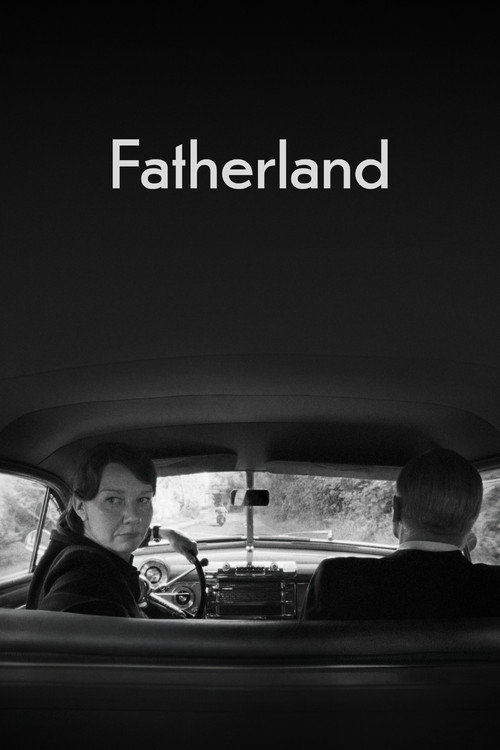
In 1949, the German writer Thomas Mann and his daughter Erika set out on a journey through a fractured nation. The trip spans from the American-occupied zone in Frankfurt to Soviet-controlled Weimar, capturing a country still reeling from World War II. Director Paweł Pawlikowski guides this intimate drama with a stark black-and-white aesthetic that mirrors the bleak landscape of post-war Europe.
The film explores the complex dynamic between a literary titan and his rebellious daughter as they navigate checkpoints, political tensions, and personal ghosts. Shot entirely in monochrome, Fatherland strips away visual distraction to focus on the raw emotions and moral ambiguities of two people trying to reconcile their past with a shattered present.
Stream
Rent
Availability and pricing can change. Confirm on the provider's site before purchasing.
Thomas Mann arrives in Frankfurt in early 1949 accompanied by his daughter Erika, an actress, writer, and rally driver who has long chafed under her father's towering reputation. Their destination is Weimar, deep within the Soviet occupation zone, where Mann intends to revisit the sites of his youth and confront the legacy of his work during the Nazi era. The road ahead is not merely a physical route but a passage through a landscape scarred by war, where ruins stand as silent witnesses to recent atrocities. The division of Germany is palpable; checkpoints separate the American West from the Soviet East, and every border crossing requires negotiation and exposes the fragility of their position.
As they travel eastward, the pair encounters a series of figures representing the fractured society around them: former colleagues navigating the new political realities, local officials enforcing strict controls, and fellow exiles struggling to find meaning in the aftermath of defeat. Erika drives the car, a practical necessity that also serves as a metaphor for her role in steering their relationship toward an uncertain future. Her cynicism clashes with Thomas's rigid adherence to cultural ideals, creating a tension that simmers beneath the surface of their quiet conversations. The journey forces both to question what it means to be German when the nation itself is split in two and its history is too heavy to ignore.
The narrative builds through a series of intimate encounters rather than grand action sequences. In small towns and ruined cities, the characters face the reality of a world that has moved on without them. Thomas struggles with the silence surrounding his family's role in the regime, while Erika grapples with her own alienation from a father who seems unable to acknowledge the full horror of the times. As they approach Weimar, the emotional stakes rise. The film does not offer easy answers or a triumphant resolution. Instead, it presents a meditation on memory and guilt, showing how the past continues to shape the present even when one tries to leave it behind.
The road trip format allows the story to unfold slowly, revealing layers of character through dialogue and observation. The stark black-and-white cinematography enhances the sense of desolation, turning every scene into a study of light and shadow. By the time they reach their destination, the weight of history has pressed down on them, forcing a confrontation that neither can fully resolve. The film ends without a neat conclusion, leaving the audience to contemplate the enduring burden of the past and the difficulty of finding a path forward in a broken world.
Official Trailer #2 [Subtitled]
Official Trailer [Subtitled]
Teaser Trailer
Critical Consensus
Paweł Pawlikowski delivers a masterfully restrained and visually stunning meditation on post-war Germany, anchored by powerhouse performances from Hanns Zischler and Sandra Hüller. The film's stark black-and-white cinematography perfectly captures the desolation of a fractured nation, while the intimate character study avoids melodrama to explore the heavy burdens of history and family.
“A practically flawless film that feels both ancient and tragically contemporary.”
Leah Greenblatt
NPR
“Paweł Pawlikowski's most potent film yet, a sparse but powerful piece of heartbreaking historical fiction.”
Richard Roeper
Roger Ebert
“A somber, stunning film about a broken Germany, guided by a luminous fictional account of a writer returning home.”
Manohla Dargis
The New York Times
“One of the most quietly surprising films of the year, offering a brisk but rich tour through the postwar German psyche.”
Peter Howell
The Globe and Mail
“Thomas Mann comes home, ambivalently, in a film that cleans up the rough edges of history without losing its emotional core.”
Anthony Lane
The New Yorker
Sandra Hüller
Erika Mann
Hanns Zischler
Thomas Mann
August Diehl
Klaus Mann
Anna Madeley
Betty Knox
Devid Striesow
Johannes R. Becher
David Menkin
Arthur Quint
Joachim Meyerhoff
Gustaf Gründgens
Enno Trebs
Wieland Wagner
Theo Trebs
Wolfgang Wagner
Waldemar Kobus
Mayor of Frankfurt
Director
Paweł Pawlikowski
Writers
Paweł Pawlikowski, Hendrik Handloegten, Kacper Lipiński
Composer
Marcin Masecki
Cinematographer
Łukasz Żal
Producers
Edward Berger, Mario Gianani, Lorenzo Mieli, Ewa Puszczyńska, Jeanne Tremsal
Cannes Film Festival (2026)
Best Director: Won
European Film Awards (2026)
Best Cinematography: Won
European Film Awards (2026)
Best Actress: Won
Golden Globes (2026)
Best Foreign Language Film: Nominated
BAFTA Awards (2026)
Best Film Not in the English Language: Nominated
Academy Awards (2026)
International Feature Film: Submitted
Join the community
fans discussing