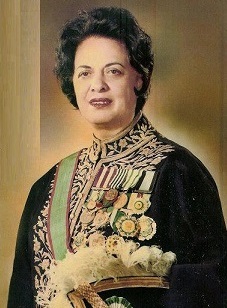
Farrokhroo Parsa
 Iran
IranBirthday
+1922-03-22
Birth Sign
Sagittarius
Birthplace
Qom
Age
Died at 58
About
Born in Qom in 1922, Farrokhroo Parsa was a pioneering figure in Iranian politics and society. She began her career as a physician, but her path soon led her into public service. Parsa made history in 1968 when she was appointed Minister of Education, becoming the first woman to hold a cabinet position in Iran. She served in this role until 1971 under Prime Minister Amir Abbas Hoveida, advocating for educational reforms and championing the rights of women throughout her tenure. Parsa's commitment to gender equality was a defining aspect of her public life. She was a vocal supporter of women's rights, pushing for greater opportunities and recognition in a society undergoing significant change. Her influence extended beyond her ministerial duties; she also served as a Member of the Parliament of Iran, contributing to the legislative landscape. Her work laid important groundwork for future generations of Iranian women. Tragically, Parsa's life was cut short. Following the Islamic Revolution, she was executed by firing squad in Tehran on May 8, 1980, at the age of 58. Her death marked a somber moment, silencing a powerful voice for women's rights. Despite the tragic end, Farrokhroo Parsa remains remembered for her groundbreaking political career and her unwavering dedication to advancing women's equality in Iran.
Fame & Fandom
Farrokhroo Parsa's admirers are not a fanbase in the conventional sense, there are no fan clubs, no official name, no inside jokes. Instead, her legacy is kept alive by Iranian diaspora communities, women's rights activists, and historians who honor her as a martyr and a symbol of pre-revolutionary feminism. Their devotion takes the form of annual remembrance posts on International Women's Day and the anniversary of her execution, educational projects that circulate her story, and advocacy that invokes her name in contemporary struggles for women's rights. Her final letter, written hours before her death, is treasured as a testament of courage and is frequently quoted in memorials.
This is a community bound by reverence and political purpose, not entertainment. They commemorate her birthday and the day she was executed, sharing her photograph and her words across social media, ensuring that her story is not forgotten. Human rights organizations maintain digital memorials, and journalists and bloggers have produced pictorial biographies to introduce her to new generations.
In the eyes of iFANN's Global Fame Engine, Parsa's standing reflects her enduring, if solemn, resonance. As of August 2026, she has been evaluated but does not currently hold a placement in the published rankings, neither in the Global Top 1,000 nor in any Top-100 scope list. Her fame is not measured by chart positions but by the persistence of her memory and the power of her example.
Interesting Facts and Legends
Farrokhroo Parsa's execution on May 8, 1980, has become the defining moment of her legacy. Arrested after the Iranian Revolution and charged with 'corruption on earth,' she was executed by firing squad at dawn. The night before, she wrote a letter that has since become legendary: 'I am a doctor, so I am not afraid of death. Death is only a moment and not more. I am not afraid of death because I have dedicated my life to the struggle for the freedom of women.' This letter is frequently quoted in memorials and is seen as her testament.
Another cornerstone of her legend is her role in securing Iranian women's right to vote in 1963. As a young parliamentarian, she worked to extend suffrage to women, and she is often said to have been among the first women to cast a ballot. This achievement is consistently cited as her defining political accomplishment.
Her refusal to flee Iran after the revolution, despite having opportunities to escape, is also part of her story. She chose to remain and face the consequences of her work, a decision that is highlighted as evidence of her courage. The narrative of her as an 'unsilenced woman', speaking truth to power until her final moment, has taken on mythic qualities in feminist retellings, though the underlying facts are well documented.
Death & Aftermath
Died
+1980-05-08 (aged 58)
Death Place
Tehran, Iran
Cause of Death
Execution by hanging
Decades after her execution, Farrokhroo Parsa emerged as a global symbol of women's rights and secular education in Iran. Her story found new life in digital archives and documentaries, where she is frequently cited to illustrate the contributions of women in pre-revolutionary society. Tributes from international institutions and academic circles eventually honored her role in expanding educational opportunities for girls during the 1960s and 1970s, cementing her legacy as a pioneering figure who broke gender barriers. This posthumous recognition stood in stark contrast to the silence that surrounded her death on May 8, 1980. Parsa was executed by hanging in Tehran following a summary trial by the Islamic Revolutionary Court.
Arrested in late 1979 and held without public trial for months, she faced charges widely regarded by historians as politically motivated fabrications of espionage and undermining Islam. The court sentenced her to death on April 26, 1980, carrying out the sentence immediately with no appeal or due process available. In the immediate aftermath, public reaction within Iran was suppressed under the climate of fear and censorship established by the new regime. Historical records indicate she was buried in the Zoroastrian cemetery in Tehran, reflecting her religious background, though details regarding the specific location were not widely publicized.
Awards & Accolades
Keywords
Quick Facts
- Profession
- politician, physician, feminist
- Born
- +1922-03-22
- Birthplace
- Qom
- Died
- +1980-05-08
- Death Place
- Tehran
- Gender
- Female
- Birth Sign
- Sagittarius
Join the community
fans discussing