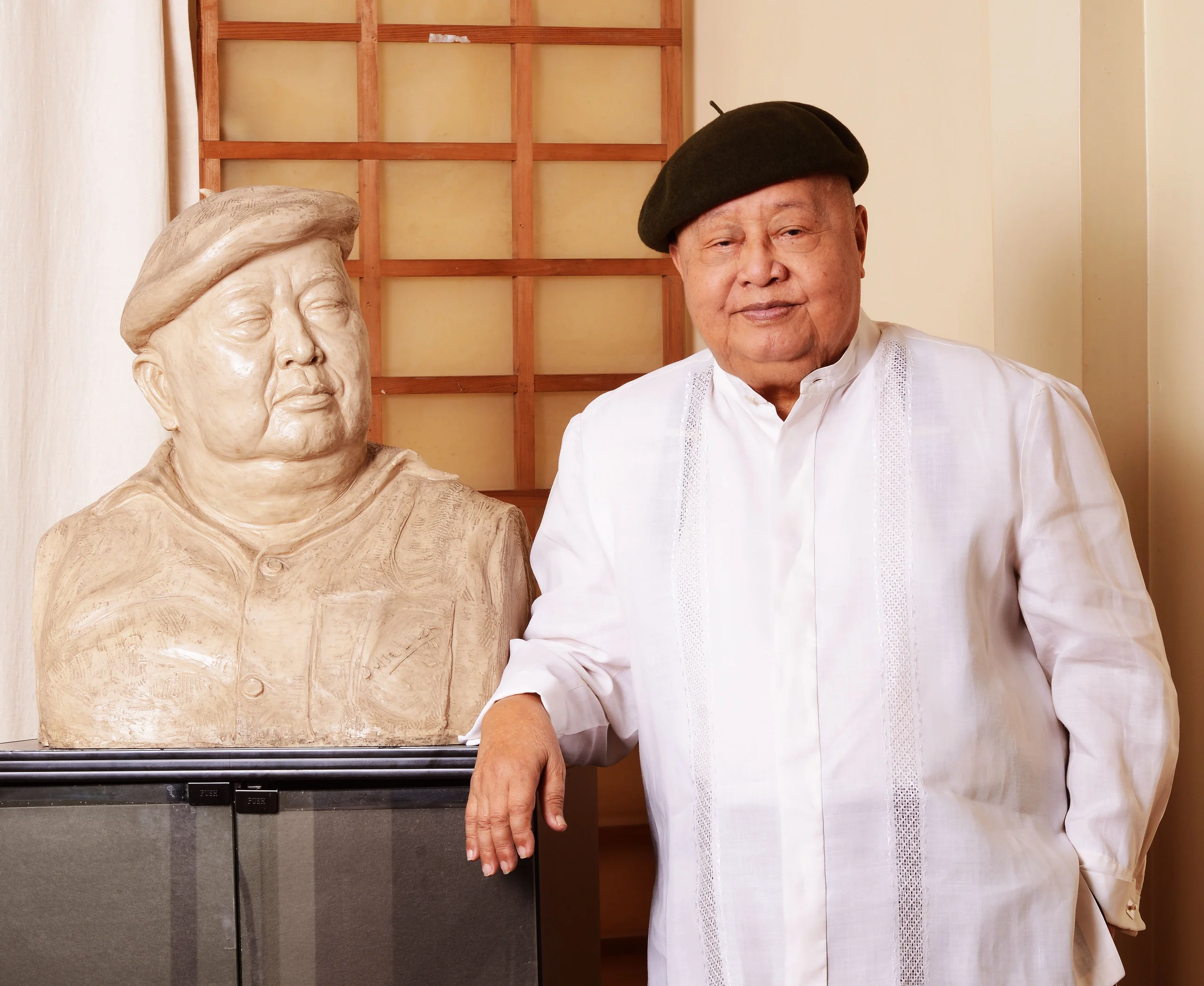
F. Sionil José
 Philippines
novelist•journalist•short story writer
Also known as: Francisco Sionil José, F. Sionil Jose
Birthday
December 3, 1924
Birth Sign
Sagittarius
Birthplace
Rosales, Pangasinan, Philippines
Age
Died at 97
About
Francisco Sionil José was a Filipino novelist, journalist, and short story writer, widely regarded as one of the most significant literary figures in Asia. He is best known for the Rosales Saga, a five-novel series that chronicles a century of Filipino life, exploring themes of land, class, and social justice. In 2001, he was named National Artist of the Philippines for Literature, the country's highest artistic honor. His works have been translated into 28 languages, including Korean, Indonesian, Czech, Russian, Latvian, Ukrainian, and Dutch, and he was consistently mentioned as a leading candidate for the Nobel Prize in Literature.
Beyond his writing, José was a cultural entrepreneur: he founded the Solidaridad Bookshop, the Solidarity journal, and the Solidaridad Galleries, creating a vibrant hub for Filipino and Asian intellectual life. He died on January 6, 2022, in Makati, at the age of 97, leaving behind a legacy that continues to inspire readers and writers across the globe. His centennial celebration in December 2024 was marked by tributes from the National Commission for Culture and the Arts, which praised his writings as "epic" and noted "the consistent espousal of the aspirations of the Filipino–for national sovereignty and social justice–that guarantees the value of his oeuvre" .
Early Life & Background
Francisco Sionil José was born on December 3, 1924, in Rosales, Pangasinan, in the Philippine Islands. He grew up in Barrio Cabugawan, a small village near Rosales, surrounded by rice fields. His home was a peasant house with a grass roof, walls of buri palm leaves, and bamboo posts and floors. His family were Ilocano settlers who had migrated from Ilocos to escape poverty, traveling toward Cagayan Valley in search of more fertile soil and freedom from Spanish colonizers.
His father, Antonio José, was an Aglipayan minister, while his mother, Sofia Sionil, worked as a dressmaker and sold food in the market. When she discovered Francisco's love of reading, she borrowed books from the homes of town officials, introducing him to classic novels like Cervantes' Don Quixote and the works of José Rizal. These early experiences of rural poverty and the stories of his ancestors' migration would later become the foundation of his literary work.
José studied at the University of Santo Tomas in Manila from 1946 to 1948, where he studied Philosophy under Professor Ariston Estrada and Literature under pioneering fictionist Paz Latorena. He served as UST Varsitarian editor-in-chief from 1948 to 1949. He also attended Far Eastern University, though he dropped out of the University of Santo Tomas before completing his degree. In 1949, he received a Litt.B. from the University of Santo Tomas. He later received a U.S. Department of State Smith-Mundt grant in 1955 and an Asia Foundation grant in 1960, which furthered his early career .
Career Growth
José's career spanned more than six decades, during which he produced a remarkable body of work. His magnum opus is the Rosales Saga, a five-novel series written between 1962 and 1984, comprising Dusk (also known as Po-on), Tree, My Brother, My Executioner, The Pretenders, and Mass. The saga traces the migration of peasants from the barren Ilocos range of northern Luzon to the fertile central plains and finally to metropolitan Manila, exploring how basic agrarian values were sacrificed to Western individualism and materialism.
In 1957, José founded the Philippine Center of PEN International. In 1965, he and his wife Teresita founded the Solidaridad Bookshop and Publishing House in Ermita, Manila. In 1967, he established Solidarity, a journal that enabled writers, artists, politicians, scholars, and activists from Asia and the Pacific to share their works. In 1968, he founded Solidaridad Galleries, providing young Filipino artists opportunities to showcase their work.
He also worked as a journalist and editor, serving as a staff member of The Commonweal from 1947 to 1948, Assistant Editor for the United States Information Service from 1948 to 1949, Managing Editor of The Manila Times Sunday Magazine from 1949 to 1960, editor of the quarterly Comment from 1956 to 1962, and managing editor of Asia magazine in Hong Kong from 1961 to 1962. He served as an information officer at the Colombo Plan Headquarters in Ceylon from 1962 to 1964 and as a correspondent for The Economist in London from 1968 to 1969. He lectured at Arellano University in 1962, the University of the East graduate school in 1968, and De La Salle University from 1984 to 1986. He was writer-in-residence at the National University of Singapore in 1987 and a visiting research scholar at the Center for Southeast Asian Studies, Kyoto University, Japan, in 1988. He also served as a consultant to the Department of Agrarian Reform from 1968 to 1979.
His other notable novels include Gagamba, Sin, Viajero, and Ermita, with short story collections including The God Stealer and Other Stories, Waywaya, and Platinum, and essay collections such as Why We Are Poor and This I Believe: Gleanings from a Life in Literature. He won Carlos Palanca Memorial Awards for "The God Stealer" (1959), "Waywaya" (1979), "Arbol de Fuego" (1980), "Tree" (1978), and "A Scenario for Philippine Resistance" (1979). He received the Ramon Magsaysay Award for Journalism, Literature, and Creative Communication Arts in 1980, the Chevalier dans l'Ordre des Arts et Lettres from France in 2000, the Order of the Sacred Treasure, 3rd Class, from the Emperor of Japan in 2001, and the Pablo Neruda Centennial Award in 2004. He was also honored with the CCP Centennial Honors for the Arts in 1999, the Outstanding Fulbrighters Award for Literature in 1988, the National Press Club award for journalism three times, the British Council grant in 1967, the Rockefeller Foundation Bellagio award in 1979, and the Cultural Center of the Philippines award. He received an honorary Doctor of Philosophy in Humane Letters from De La Salle University in 1995 .
Career Timeline
Public Image & Style
F. Sionil José was known as a writer of "fiction with a cause," dedicated to "social justice and a moral order." His writing amounted to "a continuing morality play about poverty and class divisions in the Philippines," exploring his anguish over his country's failure to overcome centuries of Spanish colonization and American domination. The New York Times described him as "the grand old man of Philippine letters" and "the conscience of his nation."
He was a towering figure in Asian literature, a cultural dynamo who managed a beloved bookstore and cultural hub, set up a publishing house, and held conferences featuring local and foreign writers, artists, and experts. His Solidaridad Bookshop in Ermita served as a nerve center for extraliterary conferences. His writing style was direct and unflinching, often drawing on his own family history and the agrarian struggles of the Ilocos region. Fans and critics alike respected his unwavering commitment to depicting the realities of Filipino life. His works have been translated into 28 languages, making him a global literary voice. The Philippine Center of International PEN noted that his magazine Solidarity helped "construct" Southeast Asia as a field of study and made Southeast Asian studies a vibrant academic discipline .
Fame & Fandom (iFAMOUS Rankings)
F. Sionil José's global renown rests on a lifetime of literary achievement, not on the ephemeral metrics of celebrity. His novels, translated into 28 languages, made him a towering figure in Asian literature, and his death in 2022 drew tributes from around the world. Yet, in the eyes of iFANN's Global Fame Engine, as of August 2026, he is evaluated but currently holds no placement in the published rankings, neither in the Global Top 1,000 nor in any Top-100 scope list. This absence from the rankings reflects the nature of his fame: enduring, academic, and cultural, rather than driven by the mass-media signals that dominate contemporary celebrity.
His readership, however, is devoted and institutionally embedded. There is no formal fandom name, no 'Joséites' or 'Sionilists', but his followers are a literary community that spans students, scholars, and general readers of Philippine literature. They gather in the halls of universities, in the aisles of his legendary Solidaridad Bookshop, and in the pages of the Solidarity journal he founded. The bookshop, which he ran for over fifty years, was a de facto cultural hub, a place where writers and readers converged. Its 2025 sale to Leandro Leviste, who pledged to preserve its legacy, marked a new chapter for this beloved institution. The F. Sionil Jose Young Writers Award, now in its 2026 search, continues to nurture the next generation of Filipino writers, ensuring that his influence endures.
Interesting Facts and Legends
José's childhood included catching crabs in rice fields, a memory he recounted with humor in his later years. His birthplace, Rosales, and his family's migration history became the setting for the Rosales Saga, and he used his own family history as the initial setting for the novel Dusk (Po-on). He was a visiting professor at De La Salle University's Department of Literature, teaching Philippine fiction and creative writing. His magazine Solidarity helped construct Southeast Asia as a field of study, making Southeast Asian studies a vibrant academic discipline. He was described by the New York Times as 'the grand old man of Philippine letters.' In a reflection on turning 90, he wrote about the importance of the poor in achieving national redemption, citing José Rizal and other young leaders.
One of the most enduring legends is the Solidaridad Bookshop itself, which he ran for over five decades and which became Manila's literary nerve center, a place where the country's most important writers, thinkers, and political figures would converge. The story fans still tell is that it was not just a bookstore but a living institution that shaped Philippine intellectual life. Another iconic moment came in 2015, when an open letter titled 'Dear F. Sionil Jose, Philippine National, Propagandist?' questioned his political alignments, sparking debate about the relationship between state recognition and artistic independence. His death in 2022 prompted national mourning, with tributes from the University of the Philippines and Far Eastern University, and international coverage from the New York Times to Eurasia Review.
Notable Quotes
“I will be 90 very soon, an old man by any standard, with so much hindsight, which is the lowest form of wisdom, to understand why we continue to be poor, why there's so much injustice ravaging this nation, and why wealth is coveted by so few.”
Family & Personal Life
F. Sionil José was born to Antonio José, an Aglipayan minister, and Sofia Sionil, a dressmaker who sold food in the market. His family were Ilocano settlers who had migrated from Ilocos to escape poverty, traveling toward Cagayan Valley. He married Teresita G. Jovellanos in 1949, and they had five sons and two daughters. Teresita, known as Tessie, was his partner in founding the Solidaridad Bookshop and Publishing House in 1965. The couple remained married until José's death in 2022. He was buried at the Libingan ng mga Bayani (Heroes' Cemetery), a significant national honor .
Notable Connections
F. Sionil José was associated with his wife and business partner Teresita G. Jovellanos, his academic mentors Ariston Estrada and Paz Latorena at the University of Santo Tomas, and literary predecessor José Rizal, whom he frequently cited as the greatest Filipino writer. He also worked with writers, artists, scholars, and activists across Asia through his Solidarity journal, and was a key figure in the Philippine Center of International PEN.
Relationships & Dating History
F. Sionil José married Teresita G. Jovellanos in 1949, and the couple had five sons and two daughters. Teresita, known as Tessie, was his partner in founding the Solidaridad Bookshop and Publishing House in 1965. The couple remained married until José's death in 2022. No other romantic relationships have been publicly documented.
At the time of his death, José was married to Teresita, who survived him. Their partnership was both personal and professional, as they worked together to create a cultural institution that supported Filipino writers and artists. The marriage lasted over 70 years, a testament to their enduring bond .
- MarriedTeresita G. Jovellanos1949 - 2022CurrentMarried in 1949, they had five sons and two daughters. Together, they founded the Solidaridad Bookshop in 1965.
Death & Aftermath
Died
January 6, 2022 (aged 97)
Death Place
Quezon City, Metro Manila, Philippines
Cause of Death
Natural causes at age 97
Francisco Sionil José died on January 6, 2022, at his home in Quezon City, Philippines. The National Artist for Literature passed peacefully at the age of 97 following a long life dedicated to chronicling Filipino society. While specific medical details regarding the cause remained private, family statements and major obituaries confirmed a natural passing. Tributes poured in immediately from the literary community and government institutions. Philippine Ambassador Jose Manuel Romualdez shared personal memories of their friendship, while universities like Far Eastern University and the University of Santo Tomas issued formal remembrances honoring his status as an alumnus. Social media vigils and video tributes appeared across platforms, cementing his reputation as the foremost contemporary Filipino writer in English.
Although precise logistics for his final rites remain unconfirmed in public records, his status as a National Artist implied state-sponsored honors were accorded during a period of significant national mourning. His legacy continues through the F. Sionil José Young Writers Award, which remains active under the management of his children and De La Salle University. The commercial side of his life saw the Solidaridad Bookshop sold to Leandro Leviste, marking a transition in the ownership of his business assets. Family statements emphasized that his works would live on, ensuring the preservation of his intellectual property and the continuation of his cultural impact.
Net Worth (Estate Value)
$10 Million
iFANN Editorial Team estimate
As a literary figure rather than a commercial entertainer, F. Sionil José's net worth was primarily tied to his literary estate and business ventures. At the time of his death in 2022, iFANN's editorial analysis estimates his estate was worth $10 million, a figure derived from his book royalties, the operations of the Solidaridad Bookshop, and the Solidarity journal. His books, translated into 28 languages, continue to generate royalties, and the Solidaridad Bookshop in Ermita, Manila, remains a cultural landmark that attracts readers and scholars. Following his death, the estate has continued to earn from book sales, translations, and the ongoing operations of the bookshop. The F. Sionil Jose Centennial Celebration, held in December 2024, further boosted interest in his work, leading to increased sales. The estate is managed by his family, with oversight from the National Commission for Culture and the Arts, ensuring that his literary legacy remains financially viable. As of 2026, the estate's value is estimated at $10 million, reflecting the enduring appeal of his novels and essays.
Awards Won (10)
F. Sionil José won numerous awards throughout his career, including five Carlos Palanca Memorial Awards for his short fiction and novels. In 1980, he received the Ramon Magsaysay Award for Journalism, Literature, and Creative Communication Arts. He was named National Artist of the Philippines for Literature in 2001, and received the Chevalier dans l'Ordre des Arts et Lettres from France in 2000. He also received the Order of the Sacred Treasure, 3rd Class, from the Emperor of Japan in 2001, and the Pablo Neruda Centennial Award in 2004.
1980 · Short Fiction
Arbol de Fuego
1979 · Short Fiction
Waywaya
1959 · Short Fiction
The God Stealer
1978 · Novel
Tree
Known For
Rosales Saga
1962–1984 · Author
The God Stealer and Other Stories
1959 · Author
Solidarity journal
1967 · Founder and Editor
National Artist of the Philippines for Literature
2001 · Honoree
Keywords
Sources
Quick Facts
- Profession
- novelist, journalist, short story writer
- Born
- December 3, 1924
- Birthplace
- Rosales, Pangasinan, Philippines
- Died
- January 6, 2022
- Death Place
- Makati, Metro Manila, Philippines
- Gender
- Male
- Birth Sign
- Sagittarius
- Nationality
- Filipino
Personal Details
- Full Name
- Francisco Sionil José
- Spouse
- Teresita G. Jovellanos
- Children
- 5 sons, 2 daughters
- Education
- University of Santo Tomas (1946–1948); Far Eastern University; Honorary Doctor of Philosophy in Humane Letters, De La Salle University (1995)
Frequently Asked Questions
What is F. Sionil José famous for?
How many languages have F. Sionil José's books been translated into?
Who was F. Sionil José's wife?
Did F. Sionil José win the Nobel Prize in Literature?
What is the Rosales Saga about?
Similar People
Join the community
fans discussing