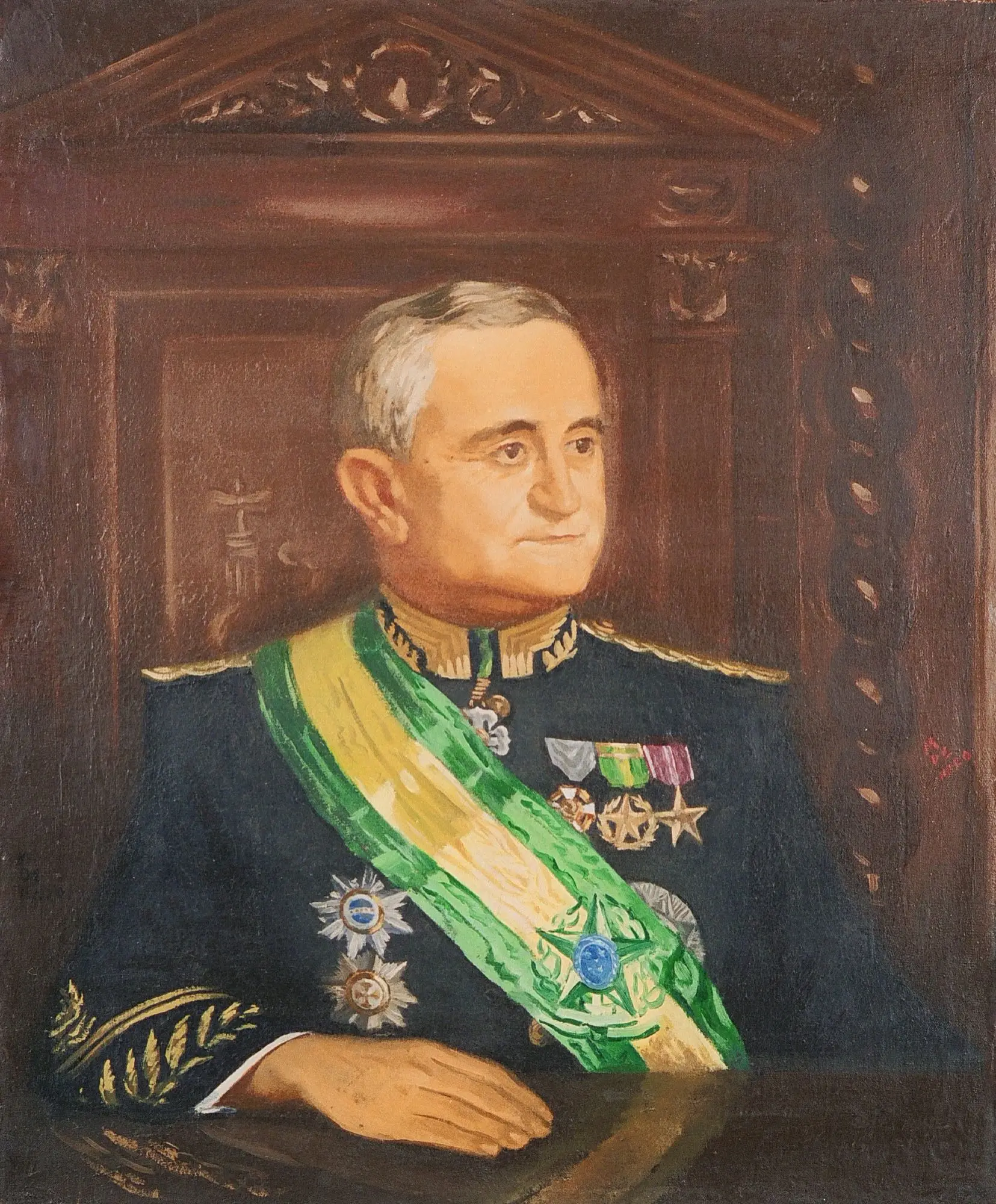
Eurico Gaspar Dutra
 Brazil
Also known as: Marechal Dutra, Dutra
Birthday
May 18, 1883
Birth Sign
Taurus
Birthplace
Cuiabá, Mato Grosso, Brazil
Age
Died at 91
About
Eurico Gaspar Dutra was a Brazilian military leader and politician who served as the 16th president of Brazil from January 31, 1946, to January 31, 1951. He holds the historical distinction of being the first president of the Fourth Brazilian Republic, overseeing the nation's transition from the authoritarian Estado Novo regime of Getúlio Vargas back to constitutional democracy. Born Eurico Gaspar Dutra on May 18, 1883, in Cuiabá, Mato Grosso, he rose through the ranks of the Brazilian Army to become a Marshal (Marechal) and a pivotal figure in mid-20th-century South American politics.
Early Life & Background
Eurico Gaspar Dutra entered the world in Cuiabá, the capital of Mato Grosso state, born into a family of merchants. His father was José Florêncio Dutra and his mother was Maria Justina Dutra. Unlike many politicians of his era who came from established political dynasties, Dutra's path was forged in the barracks rather than the halls of parliament. He developed an early interest in military service and joined the army while still young. His formative years were spent training alongside other future leaders of the Brazilian state at the Military Academy, where he honed the discipline that would define his career.
Dutra's early career was defined by loyalty to the state and a gradual shift from supporting the existing order to becoming a key architect of its transformation. He served in various capacities within the army, including participation in the Tenente revolts which shook the foundations of the First Brazilian Republic. Before entering high-level politics, Dutra served as Minister of War under Getúlio Vargas from 1936 to 1945. This period was critical as it placed him at the center of the country's most turbulent political debates. His tenure as Minister of War positioned him as a powerful figure within the Estado Novo regime, yet he eventually became a central player in the movement to end it.
Career Growth
Dutra's political ascent reached its zenith in October 1945 when he played a decisive role in the bloodless coup that deposed Getúlio Vargas. This move was pivotal in restoring civilian rule and ending the Estado Novo regime. Following the coup, Dutra ran for president in the December 1945 election, which was the first free presidential vote in Brazil since the establishment of the republic. He won decisively with 3,251,507 votes against his main rival, Eduardo Gomes, who received 2,039,341 votes.
His presidency (1946–1951) is characterized by several major milestones. He oversaw the drafting and implementation of the 1946 Constitution, which re-established civil liberties and democratic institutions. Internationally, Dutra aligned Brazil firmly with the United States during the early Cold War, breaking diplomatic relations with the Soviet Union in 1947 and joining the Organization of American States (OAS). Domestically, his administration initiated significant infrastructure projects, most notably the construction of the Rodovia Presidente Dutra, a major highway connecting Rio de Janeiro and São Paulo, which remains a critical artery for Brazilian transport today. He also established the National Bank for Economic Development (BNDE), now known as BNDES, to foster industrial growth. Under his leadership, Brazil sent the Brazilian Expeditionary Force (FEB) to fight alongside the Allies in Italy during World War II, marking Brazil's direct combat involvement in Europe.
Career Timeline
Public Image & Style
Dutra projected the image of a dignified, conservative military leader who prioritized national stability and democratic restoration. He was often referred to as a "stabilizing force" in Brazil's post-war era. His public persona was that of a man of action rather than words, preferring to govern through institutional strength and military discipline. Media coverage of his time focused heavily on his role in ending the Vargas dictatorship and his alignment with Western powers during the Cold War. He was seen as a bridge between the military establishment and the civilian government, embodying the values of order and progress that defined the Fourth Republic.
Fame & Fandom (iFAMOUS Rankings)
Eurico Gaspar Dutra's fame is a quiet, historical one, far removed from the clamor of modern celebrity. He has no formal fandom name, no fan clubs, no viral moments; his public following was as a political constituency, not a fanbase. The iFANN Global Fame Engine has evaluated him, but he currently holds no placement in the published rankings, whether the Global Top 1,000 or any Top-100 scope list. This reflects his legacy as a mid-20th-century military president, remembered through institutional tributes rather than fan-driven culture.
His story is told in the annals of Brazilian democracy: the marshal who spearheaded the 1945 coup that removed Getúlio Vargas, then won the country's first free presidential election that December. These are the moments that define his place in history, not rankings or fanfare. The closest to fandom are commemorations like the Dutrinha stadium in Cuiabá, named in his honor, or the 50 centavos coin issued by the government. There are no fan campaigns, no birthday billboards, no streaming pushes, only the quiet respect of a nation that remembers its restorer of democracy. He was not featured on the September 2026 iFAMOUS Rankings flagship list, as his influence remains strictly within the realm of political history.
Interesting Facts and Legends
Eurico Gaspar Dutra's legacy is built on political milestones rather than folklore. The most retold story is his role in the October 1945 coup that deposed Getúlio Vargas, a move that paved the way for Brazil's return to constitutional rule. His victory in the December 1945 election, the first free presidential vote after the Vargas dictatorship, is celebrated as a foundational moment for Brazilian democracy. A lesser-known gem from that campaign is the "marmiteiro" jingle, named for the working-class voters who carried lunch pails. It is remembered as one of the first mass-media political campaign songs in Brazil, a precursor to modern political advertising.
The Dutrinha stadium in Cuiabá, named after him, remains an active venue; in 2021, a tribute marked its 70th anniversary. The Rodovia Presidente Dutra, a major highway linking Rio de Janeiro and São Paulo, also bears his name, a daily reminder of his impact on the nation's infrastructure. There are no tales of fan frenzy or viral moments, his legend is entirely political, that of a general who restored democracy and then governed with a steady hand.
Notable Quotes
“I am a soldier, and I will always be a soldier.”
“The army must be the guardian of the constitution.”
Family & Personal Life
Eurico Gaspar Dutra was married to Carmela Dutra. Their marriage was a long-standing partnership that spanned his entire public life. There are no records of prior engagements, divorces, or extramarital relationships in credible historical sources; Carmela Dutra is consistently cited as his sole spouse. The couple had children, though specific names and details regarding their offspring are less frequently highlighted in general biographical summaries compared to Dutra's political achievements. As a statesman of the era, Dutra maintained a relatively private personal life, focusing on his duties as a soldier and head of state.
Notable Connections
Relationships & Dating History
Eurico Gaspar Dutra was married to Carmela Dutra. Their marriage was a long-standing partnership that spanned his entire public life. There are no records of prior engagements, divorces, or extramarital relationships in credible historical sources; Carmela Dutra is consistently cited as his sole spouse. The couple had children, though specific names and details regarding their offspring are less frequently highlighted in general biographical summaries compared to Dutra's political achievements. As a statesman of the era, Dutra maintained a relatively private personal life, focusing on his duties as a soldier and head of state. At the time of his death in 1974, he was widowed, having outlived his wife Carmela.
- MarriedCarmela DutraUnknown - 1974Sole spouse; partner throughout his military and political career until her death prior to his own.
Death & Aftermath
Died
June 11, 1974 (aged 91)
Death Place
Rio de Janeiro, Brazil
Cause of Death
Natural causes associated with advanced age
Eurico Gaspar Dutra passed away on June 11, 1974, in Rio de Janeiro at the age of 91. The circumstances surrounding his death were straightforward; he died from natural causes linked to old age without any reported foul play or accident. Contemporary accounts from major outlets like The New York Times described him as the grand old man of Brazil's armed forces, a title reflecting his stature as the marshal who had spearheaded the overthrow of Getúlio Vargas and subsequently restored constitutional rule.
The public reaction marked the event as the passing of a national patriarch. Tributes flowed from Brazilian institutions and political peers who honored his role as the architect of the Fourth Brazilian Republic. While specific dates for large-scale public vigils are not widely recorded in English sources, the formal recognition of his legacy included official statements honoring his service. As a Marshal and former President, standard protocol dictated that Dutra received full military honors during his funeral arrangements in Rio de Janeiro, the seat of his power and residence.
His legacy endured through various dedications immediately following his death and continuing into the modern era. Most notably, the Rodovia Presidente Dutra, a major highway connecting São Paulo and Rio de Janeiro built during his presidency, remained a daily reminder of his infrastructure contributions. Historical archives, including those of the Harry S. Truman Library, continue to preserve photos of state dinners he attended with U.S. Presidents, ensuring his place in the annals of international diplomacy. No estate disputes or posthumous financial controversies have been recorded in credible historical sources regarding his personal wealth.
Net Worth (Estate Value)
$0
iFANN Editorial Team estimate
As a historical figure who passed away in 1974, Eurico Gaspar Dutra left behind no personal fortune for the living to track in modern terms. His net worth is effectively zero in the context of current assets, as all property and wealth accumulated during his lifetime were distributed to his heirs or absorbed by the state over nearly a century ago. The concept of a "net worth" for a deceased military leader of the mid-20th century does not apply in the same way it does for modern celebrities or business magnates. His economic legacy is found in the infrastructure he built, such as the Rodovia Presidente Dutra, and the institutions he created, like BNDES, rather than in personal bank accounts. The iFANN Editorial Team estimates his estate value at the time of death to have been modest, typical for a high-ranking military officer of his era who did not engage in commercial ventures outside of his official duties.
Awards Won (3)
Eurico Gaspar Dutra received numerous honors during his lifetime, including the title of Marshal of the Brazilian Army. He was awarded the Grand Cross of the Order of Merit of the Federal Republic of Germany and the Grand Cross of the Order of the Southern Cross. His contributions to the Allied war effort in World War II were recognized internationally, and he received the Legion of Merit from the United States for his role in establishing diplomatic ties and military cooperation.
1945 · International Award
Allied Cooperation in WWII
1946 · National Honor
Presidential Service
Known For
Presidency of Brazil
1946 · President
1945 Coup
1945 · Military Leader
Rodovia Presidente Dutra
1951 · Infrastructure Project
Keywords
Sources
Quick Facts
- Profession
- politician, military personnel
- Born
- May 18, 1883
- Birthplace
- Cuiabá, Mato Grosso
- Died
- June 11, 1974
- Death Place
- Rio de Janeiro
- Gender
- Male
- Spouse
- Carmela Dutra
- Birth Sign
- Taurus
Personal Details
- Full Name
- Eurico Gaspar Dutra
- Spouse
- Carmela Dutra
- Children
- Unknown
- Education
- Military Academy of Agulhas Negras (formerly Military School of Realengo)
Frequently Asked Questions
Who was Eurico Gaspar Dutra?
When did Eurico Gaspar Dutra die?
What was Eurico Gaspar Dutra's role in the 1945 coup?
Did Eurico Gaspar Dutra have any children?
What is the Rodovia Presidente Dutra?
Similar People
Join the community
fans discussing