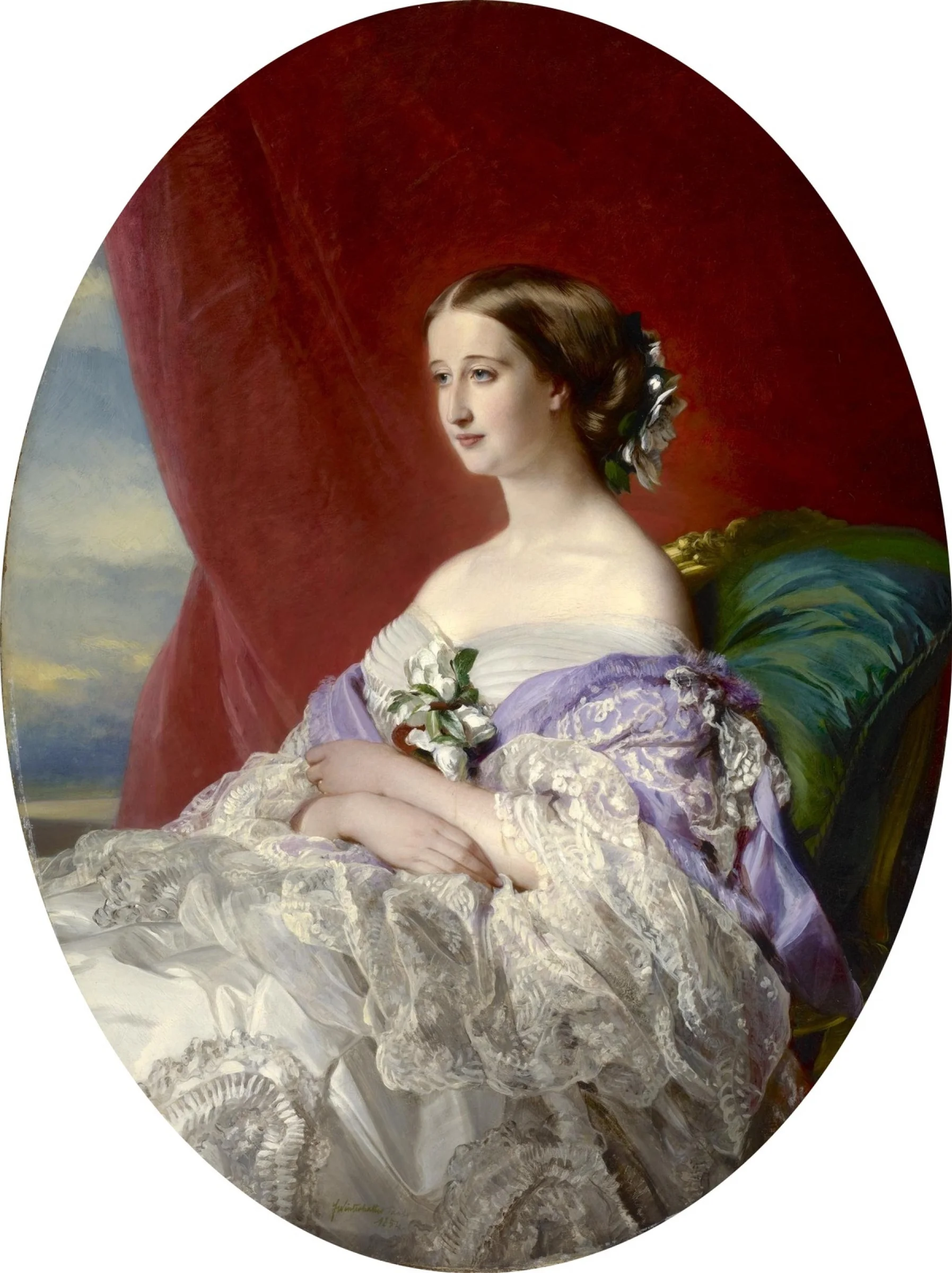
Eugénie de Montijo
 Spain
SpainAlso known as: Empress Eugénie, Doña María Eugenia Ignacia Agustina de Palafox y Kirkpatrick, 19th Countess of Teba, 16th Marchioness of Ardales
Birthday
May 5, 1826
Birth Sign
Taurus
Birthplace
Granada, Spain
Age
Died at 94
Height
5 ft 2 in (1.57 m)
About
Eugénie de Montijo, born María Eugenia Ignacia Agustina de Palafox y Kirkpatrick on May 5, 1826, in Granada, was a Spanish noblewoman who became Empress of the French. Her marriage to Napoleon III on January 30, 1853, placed her at the center of France's Second Empire, a role she held until his overthrow on September 4, 1870. In the final weeks of the regime, from July 28 to September 4, 1870, she served as de facto head of state while her husband was away at war, making her a rare female ruler in French history.
Educated across France, Spain, and England, Eugénie brought a cosmopolitan flair to the imperial court. As empress, she wielded considerable political influence, championing conservative and clerical causes that drew sharp criticism from her contemporaries. Her only child, Louis-Napoléon, Prince Imperial, was born in 1856, and his future became her central preoccupation. Despite her controversial politics, she also left her mark as a patron of the arts, notably supporting the fashion house of Charles Frederick Worth, which helped establish Paris as the world's fashion capital.
The fall of the empire in 1870 forced Eugénie into exile in England, where she outlived both her husband, who died in 1873, and her son, who was killed in 1879 during the Anglo-Zulu War. She spent her remaining decades preserving the memory of the Second Empire, funding memorials and writing her memoirs. She died on July 11, 1920, at the age of 94, having witnessed the transformation of France from monarchy to republic and the upheaval of World War I.
Early Life & Background
Eugénie entered the world under dramatic circumstances in Granada, Spain, during a severe earthquake in 1826. Legend holds that her mother gave birth to her inside a tent because the family home had become unsafe, an event that seemed to foreshadow a life marked by turbulence and resilience. She was born into the aristocratic Palafox family, with her father serving as the 19th Count of Teba and her mother being an Irish-Spanish noblewoman named María Manuela Kirkpatrick. This dual heritage exposed her to a blend of Spanish tradition and British sensibilities from the start.
Her upbringing was far from typical for a secluded noblewoman of the era. Eugénie received a rigorous education that spanned three countries: Spain, France, and England. She learned multiple languages fluently, including Spanish, French, English, and Italian, which allowed her to navigate diverse social circles with ease. These formative years shaped her cosmopolitan outlook and sophisticated demeanor, traits that would later define her presence at the French court. She traveled frequently with her family, visiting relatives and attending social gatherings where her beauty and wit quickly became the talk of European aristocracy.
Before her rise to power, Eugénie lived a relatively private life as a member of the Spanish nobility. She cultivated an interest in fashion and the arts, often experimenting with styles and attending cultural events. Her reputation for elegance grew steadily as she moved through high society in Madrid and Paris. By the early 1850s, she was well-known for her striking appearance and sharp intellect, attracting attention from influential figures in France. It was during this period that she met Napoleon III, setting the stage for her transformation from a Spanish countess to the Empress of the French.
Career Growth
The trajectory of Eugénie's life changed irrevocably when she married Napoleon III on January 30, 1853. This union elevated her to the position of Empress of the French, placing her at the heart of the Second Empire. Her role extended beyond ceremonial duties, as she actively participated in political affairs and influenced government policy. During the Franco-Prussian War in 1870, while Napoleon III led the army, she served as the de facto head of state, managing the defense of Paris and the administration of the country. This brief period of regency highlighted her capability and resolve as a leader.
Eugénie is perhaps best remembered for her profound impact on fashion and culture. She commissioned Charles Frederick Worth to create designs for her, effectively founding the concept of haute couture. Her patronage transformed Paris into the global capital of fashion, setting trends that echoed across Europe and beyond. She championed the development of urban planning projects, heavily influencing the Haussmann renovations that reshaped Paris into the modern city known today. Her support for the arts and architecture left a lasting legacy on the city's aesthetic identity.
After the collapse of the Second Empire in September 1870, Eugénie went into exile in England. She spent the remainder of her life there, dedicating herself to preserving the memory of the Empire and raising her son, Louis-Napoléon. Following the tragic death of her son in the Anglo-Zulu War in 1879, she focused on charitable works and writing her memoirs. Her efforts to document her experiences provided valuable historical insights into the Napoleonic era. Even in exile, she remained a symbol of imperial dignity and resilience until her death in 1920.
Career Timeline
Public Image & Style
Eugénie de Montijo projected an image of regal elegance and intellectual sophistication. Known for her striking dark hair and expressive eyes, she carried herself with a dignified bearing that commanded respect. Her fashion sense was impeccable, and she became the ultimate arbiter of style in mid-19th-century Europe. She favored pearls and elaborate gowns, establishing a look that defined the imperial court. Her public persona was one of strength and grace, even amidst political turmoil.
Media portrayals of Eugénie varied, often highlighting her political influence and controversial conservative views. Some critics viewed her as a manipulative figure behind the throne, while others admired her dedication to her family and her contributions to the arts. Despite the polarization of her political stance, her cultural impact remains undeniable. She is remembered as a woman who defied expectations and left an indelible mark on fashion and history.
Fame & Fandom (iFAMOUS Rankings)
Eugénie de Montijo's devoted followers are a scattered but passionate community of royal historians, Napoleonic enthusiasts, fashion scholars, and jewelry collectors. They have no formal fandom name, but their dedication shows in concrete ways: they track her jewelry at auctions, celebrate her birthday on social media, and share her portraits across digital archives. The most dramatic recent rallying point came in October 2025, when her crown and pearl tiara were stolen from the Louvre, and then the crown was crushed as thieves fled. Fans worldwide followed the story, and when the Louvre announced in February 2026 that the crown would be fully restored, it became a symbol of cultural resilience. This incident introduced a new generation to Eugénie, turning her into a figure of both loss and triumph.
Her fashion legacy, she essentially invented haute couture with Charles Frederick Worth, keeps her relevant to style historians, while her political acumen as regent during Napoleon III's absences inspires those who admire strong women in history. Institutional tributes at Versailles and Napoleon.org serve as unofficial shrines. Yet despite this fervent interest, iFANN's Global Fame Engine has evaluated Eugénie de Montijo but she does not currently hold a placement in the published rankings, meaning she is not among the world's top 1,000 most famous people or any top-100 scope list. Her fame endures in niche circles, but in the broad global pantheon, she remains unranked.
Interesting Facts and Legends
Eugénie de Montijo's life is rich with legends that fans still retell. Born in a tent during an earthquake in Andalusia in 1826, her dramatic entry into the world set the stage for a rebellious spirit. She is credited with inventing haute couture through her partnership with Charles Frederick Worth, making Paris the fashion capital of the world. Her pearl tiara and crown were stolen from the Louvre in October 2025, and the crown was crushed when thieves dropped it, but the Louvre confirmed it can be fully restored, a story of loss and resilience that has captivated global audiences. Modern biographies, like The Last Empress of France: The Rebellious Life of Eugénie de Montijo (2025), frame her as a fierce advocate for women's rights and a shrewd politician who ruled France while her husband was at war. These stories, from her earthquake birth to the heist, form the core of her enduring legend.
Notable Quotes
“I am not afraid of death; I am only afraid of forgetting.”
“Fashion is not just about clothes; it is about the spirit of the times.”
Family & Personal Life
Eugénie was born to Cipriano Palafox y Gonzaga, the 19th Count of Teba, and María Manuela Kirkpatrick, an Irish-Spanish noblewoman. Her father was a prominent figure in Spanish aristocracy, while her mother brought a blend of Irish and Spanish heritage to the family. Eugénie had several siblings, though specific details about their lives are less documented compared to her own. She maintained close ties with her family throughout her life, often seeking their counsel and support.
In her personal life, Eugénie married Napoleon III, and they had one child together, Louis-Napoléon, Prince Imperial. The birth of her son in 1856 was a significant event, and she devoted much of her energy to his upbringing and future. Tragically, her son was killed in action during the Anglo-Zulu War in 1879, a loss that deeply affected her. After the deaths of her husband and son, Eugénie lived in solitude, focusing on her charitable endeavors and the preservation of her family's legacy.
Notable Connections
Napoleon III, Louis-Napoléon, Prince Imperial, Charles Frederick Worth, Georges-Eugène Haussmann
Relationships & Dating History
Eugénie de Montijo had one public romantic relationship that resulted in marriage: Napoleon III (Charles Louis Napoléon Bonaparte). They married on January 30, 1853, and their union was both politically strategic and personally passionate. The couple had one child together, Louis-Napoléon, Prince Imperial, born in 1856. Their marriage endured through years of political turmoil and personal challenges, with Eugénie standing by her husband even as the Second Empire faced decline. When Napoleon III died on December 9, 1873, in Chislehurst, England, Eugénie was widowed.
Following her husband's death, there are no credible records of other romantic relationships or engagements. She focused entirely on raising her son and later on her charitable works and legacy. Her son, Louis-Napoléon, was killed in action during the Anglo-Zulu War in South Africa in 1879, leaving Eugénie without immediate family. She spent the remainder of her life in exile, primarily in England and later Spain, dedicating herself to preserving the memory of the Empire. As of her death in 1920, she was widowed and had no further partners.
- MarriedNapoleon III1853 - 1873They met through mutual friends in the French political sphere. Had one child, Louis-Napoléon. He died in 1873.
Death & Aftermath
Died
July 11, 1920 (aged 94)
Death Place
Cambridge House, Richmond, London, England
Cause of Death
Natural causes due to extreme old age
Eugénie de Montijo passed away on July 11, 1920, at her residence, Cambridge House in Richmond, London. She had spent the final years of her life in relative seclusion there after fleeing France following the fall of the Second Empire in 1870. Her death resulted from natural causes associated with extreme old age, marking the end of a long period of declining health and frailty that had kept her withdrawn from public life for some time. The reaction to her passing resonated across Europe, particularly in France and Britain, where she was widely mourned as the Last Empress. Tributes poured in from peers, institutions, and officials who recognized her unique status as the last surviving major European monarch of the nineteenth century.
Newspapers globally reported the news, reflecting her enduring fame and the deep respect held for her longevity and role in French history. Memorial services were organized to honor her life, acknowledging her patronage of the arts and her advocacy for women's rights. A private funeral ceremony took place shortly after her death at the Catholic Church of St. Mary Magdalene in Richmond. Notable attendees included members of her extended family and close associates, though the event remained intimate rather than a grand state funeral. Following the service, Eugénie was laid to rest in the Imperial Crypt at the Basilica of Saint-Denis near Paris, fulfilling her wish to rest among her predecessors despite the political upheavals that had ended her reign.
Posthumously, Eugénie has been the subject of numerous books, films, and academic studies focusing on her life as a fashion icon and a woman who navigated turbulent politics. Her legacy includes the preservation of her extensive correspondence and diaries, which provide insight into the Napoleonic era. Various historical societies and museums have dedicated exhibits to her, while her estate was distributed according to her will to family and charitable causes without major legal disputes.
Net Worth (Estate Value)
$0
iFANN Editorial Team estimate
As a deceased historical figure, Eugénie de Montijo does not have a net worth in the modern celebrity sense. However, her estate was substantial. At the time of her death, she owned significant real estate holdings in England and France, including the Château de Compiègne (which was returned to the state) and her residence in Richmond. Her wealth was derived from the French imperial treasury, her personal dowry, and inheritance from her Spanish noble family. Specific dollar figures from 1920 do not translate directly to 2026 values, but her assets were estimated to be in the millions of francs equivalent to hundreds of millions of dollars today. The management of her estate post-1920 was handled by her executor, with funds going to her relatives and charitable foundations. No active commercial empire exists under her name, though her image is licensed for historical documentaries and fashion exhibitions.
Awards & Accolades
View 8 records, honours and achievementsKnown For
Empress of the French
1853-1870 · Consort and Regent
Haute Couture Pioneer
1860s · Patron of Fashion
Keywords
Sources
Quick Facts
- Profession
- Empress of the French
- Born
- May 5, 1826
- Birthplace
- Granada, Spain
- Died
- July 11, 1920
- Death Place
- Richmond, London, England
- Gender
- Female
- Spouse
- Napoleon III
- Birth Sign
- Taurus
Personal Details
- Full Name
- María Eugenia Ignacia Agustina de Palafox y Kirkpatrick
- Height
- 5 ft 2 in (1.57 m)
- Spouse
- Napoleon III
- Children
- Louis-Napoléon, Prince Imperial
- Education
- Private education in Spain, France, and England; traveled extensively as a young woman
Frequently Asked Questions
Who was Eugénie de Montijo?
When did Eugénie de Montijo die?
Did Eugénie de Montijo have children?
What was Eugénie de Montijo's contribution to fashion?
What happened to Eugénie's crown in 2025?
Similar People
Join the community
fans discussing