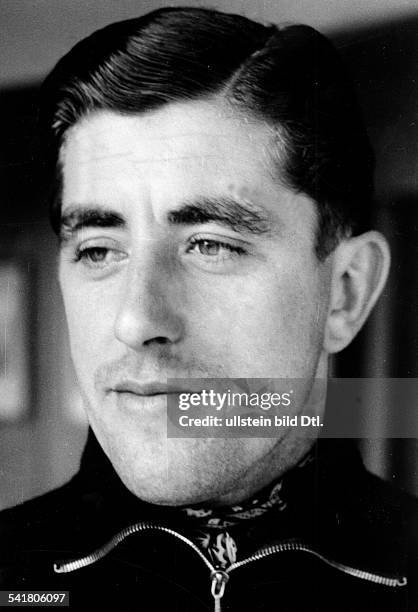
Ernst Lehner
 Germany
Birthday
November 7, 1912
Birth Sign
Scorpio
Birthplace
Augsburg, Germany
Age
Died at 73
About
Ernst Lehner was a German footballer who spent the prime of his career as a forward for TSV Schwaben Augsburg. He earned 65 caps for the German national team between 1933 and 1942, scoring 31 goals, and represented Germany at the 1934 and 1938 World Cups, finishing third in 1934. After retiring, he turned to coaching, managing several clubs including TSV Schwaben Augsburg and VfR Aalen. Today, he is remembered as one of Germany's most consistent pre-war forwards and a loyal one-club man for much of his playing days. Born on November 7, 1912, in Augsburg, he was the son of a butcher. He died on January 10, 1986, in Aschaffenburg, Germany, at age 73.
Early Life & Background
Ernst Lehner grew up in the working-class neighborhoods of Augsburg, the son of a butcher. He kicked a ball on the streets and local fields from a young age, developing a natural goal-scoring instinct. He joined the youth ranks of TSV Schwaben Augsburg, where his talent quickly set him apart. By the early 1930s, he had broken into the senior team, immediately establishing himself as a reliable and prolific forward. His performances at club level earned him a call-up to the German national team in 1933, just before his 21st birthday. His early life was rooted in the Bavarian city, and his first steps toward a professional career came through the club's youth system.
Career Growth
Lehner made his international debut in 1933 and was selected for the 1934 World Cup in Italy. Germany finished third, their best World Cup result until 1954, with Lehner scoring one goal in the tournament. He also played in the 1938 World Cup, where Germany was eliminated in the first round after a replay against Switzerland. He captained the national team on several occasions during World War II, when matches were limited to friendlies and propaganda games. After 17 years at TSV Schwaben Augsburg, he moved to VfL Neckarau in 1947, then joined Bayern Munich in 1950 at age 37, becoming one of the oldest players to represent the club. He retired in 1952 and later coached TSV Schwaben Augsburg and VfR Aalen. He was known for his powerful shot and heading ability, and he won the Gauliga Bayern Meister with Schwaben in 1944. His 65 caps and 31 goals for Germany earned him the status of honorary captain. He worked under coach Sepp Herberger and was a contemporary of Fritz Walter.
Career Timeline
Public Image & Style
In German football history, Lehner is remembered as a solid, reliable, and loyal forward. He is not a global household name but is respected by historians of the sport. His image is that of a hard-working pre-war professional who served his club and country with dedication. He has no official fandom name. He is honored by TSV Schwaben Augsburg as one of its greatest-ever players and is occasionally listed in historical rankings of Germany's best pre-war footballers.
Fame & Fandom
Ernst Lehner's legacy is not that of a man with a fan club, but of a player whose loyalty and consistency earned a quiet kind of reverence. The stands of the Rosenaustadion no longer echo with his name, and no organized fandom carries his banner today. His former club, TSV Schwaben Augsburg, still plays in the lower leagues, and the occasional historical feature on pre-war German football will pause to note his record: 65 caps in Germany's first 100 internationals, a goal tally of 31, and a career spent largely at a club that never won a national title. These are the facts that keep his memory alive, not the roar of a crowd or the flash of a viral moment. There is no documented fandom name, no fan campaigns, no rituals passed down through generations. The footballing world has moved on, but for those who study the game's deeper history, Lehner remains a figure of substance.
In the grand ledger of global fame, Ernst Lehner does not currently hold a placement in iFANN's published rankings. The Global Fame Engine has evaluated him, but he remains unranked in both the Global Top 1,000 and any Top-100 scope list. This is not a slight; it is the natural state for a man whose career predates the era of mass media and whose fame was always of a quieter, more local kind. His name does not trend, his face does not grace magazine covers, and his story is not the stuff of viral legend. Yet in the annals of German football, he is a remembered name, a reflection of a different kind of greatness, one measured in loyalty, consistency, and the respect of those who know the game's history.
Interesting Facts and Legends
Ernst Lehner captained Germany during World War II, when the national team played mostly propaganda matches. He played top-level football into his late 30s, a remarkable feat for the era. Despite offers from bigger clubs, he spent his prime at TSV Schwaben Augsburg, a club that never won a national championship. He is sometimes referred to as an honorary captain of the German national team. No widely recorded verbatim quotes from interviews are available. He never appeared on magazine covers like TIME or Rolling Stone. His legacy is occasionally referenced in historical articles about German football during the Nazi era and the pre-Bundesliga period.
Lehner's international record stands as a quiet monument: he appeared in 65 of Germany's first 100 international matches, a tally that made him the nation's record appearance holder at the time of his retirement. That statistical feat is verified in official Olympic records, yet it is presented as a career statistic rather than a legendary tale. No iconic moments or widely retold stories surround his career, no dramatic goals, no fan uprisings, no viral incidents. His club, Schwaben Augsburg, continues to play in the lower leagues, but there is no documented lore connecting his name to extraordinary fan reactions or cultural mythology. For the footballer and the author who shared his name, the legend is quiet, built on numbers and steadfast service rather than spectacle.
Family & Personal Life
Lehner was married, though his wife's name is not widely recorded. He had at least one child. His family life remained private, consistent with the era. He died on January 10, 1986, in Aschaffenburg, Germany, at age 73, predeceased by his wife.
Notable Connections
Lehner played under Sepp Herberger, the legendary German coach. He was a contemporary of Fritz Walter on the national team, though they did not play together in major tournaments.
Relationships & Dating History
Ernst Lehner was married, but specific details about his wife and the timeline of their relationship are not widely recorded. He had at least one child. He died in 1986, predeceased by his wife.
- MarriedMarried, but details are not publicly recorded.
Death & Aftermath
Died
January 10, 1986 (aged 73)
Death Place
Unknown
Cause of Death
Unknown
Net Worth (Estate Value)
As a player and coach from the early to mid-20th century, Ernst Lehner's career earnings were modest by modern standards. He did not accumulate significant personal wealth from endorsements or high salaries. Upon his death in 1986, his estate was likely modest and passed to his family. No credible celebrity net worth sources report a specific figure for him. His value is historical and cultural, not financial.
Awards Won (2)
Lehner's primary achievement is a third-place finish at the 1934 FIFA World Cup with Germany. He also won the Gauliga Bayern Meister with TSV Schwaben Augsburg in 1944, though that season was unofficial due to the war.
1934 · Team
Germany National Team
1944 · Team
TSV Schwaben Augsburg
Known For
TSV Schwaben Augsburg
1930s-1947 · Forward
Germany National Team
1933-1942 · Forward
1934 FIFA World Cup
1934 · Forward
Keywords
Quick Facts
- Profession
- Footballer, Coach
- Born
- November 7, 1912
- Birthplace
- Augsburg, Germany
- Died
- January 10, 1986
- Death Place
- Aschaffenburg, Germany
- Gender
- Male
- Birth Sign
- Scorpio
Personal Details
- Full Name
- Ernst Lehner
- Children
- 1
Frequently Asked Questions
How old was Ernst Lehner when he died?
What position did Ernst Lehner play?
How many goals did Ernst Lehner score for Germany?
Did Ernst Lehner play in the World Cup?
What clubs did Ernst Lehner play for?
Similar People
Join the community
fans discussing