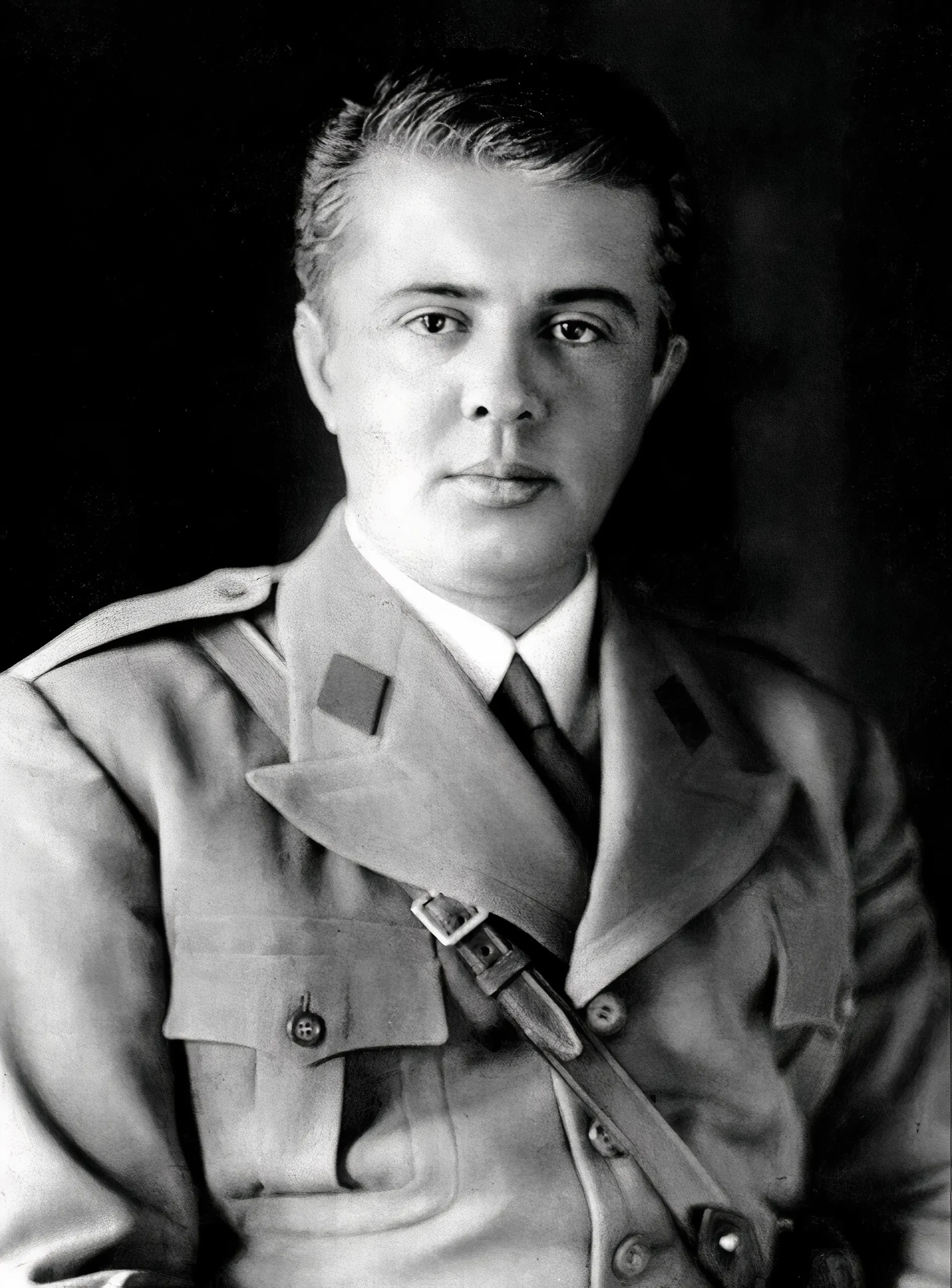
Enver Hoxha
 Albania
politician•revolutionary•Marxist–Leninist theorist
Also known as: Enver Halil Hoxha, Father of the Nation
Birthday
October 16, 1908
Birth Sign
Libra
Birthplace
Gjirokastër, Ottoman Empire (now Albania)
Age
Died at 76
About
Enver Halil Hoxha was an Albanian communist revolutionary, politician, and Marxist–Leninist theorist who ruled the People's Socialist Republic of Albania for nearly forty years. He served as the First Secretary of the Party of Labour of Albania from 1943 until his death in 1985, while also holding the posts of Prime Minister, Foreign Minister, and Defence Minister. His leadership transformed Albania into a highly isolated state characterized by strict adherence to anti-revisionist communism.
Hoxha consolidated one-party rule after liberating the country from Axis occupation during World War II. Under his direction, Albania severed ties with Yugoslavia, the Soviet Union, and eventually China, leaving it as the most isolated nation in socialist Europe. His regime implemented state atheism, banned private property, and constructed hundreds of thousands of concrete bunkers across the landscape.
Early Life & Background
Enver Hoxha entered the world on October 16, 1908, in Gjirokastër, a town in southern Albania that was then part of the Ottoman Empire. He came from a relatively comfortable middle-class family; his father, Halil Hoxha, was a cloth merchant who had worked and traveled extensively in the United States and Argentina before returning home. This exposure to the West gave the young Hoxha a cosmopolitan outlook that would later contrast sharply with his hardline political stance.
He received his early education locally before winning a state scholarship to study abroad. Hoxha attended the University of Montpellier and later the University of Paris, spending time also in Belgium. During these formative years, he worked as a schoolteacher and clerk, a period often described in biographies as his "playboy" phase where he lived a secular and somewhat worldly life before fully committing to revolutionary politics.
His path shifted dramatically following the Italian invasion of Albania in 1939. He helped unify the fractured communist movement, leading to the founding of the Communist Party of Albania in November 1941. By March 1943, at the age of thirty-four, he was elected the party's First Secretary, marking the beginning of his ascent to total power.
Career Growth
Following the liberation of Albania in November 1944, Hoxha became the de facto head of state. The monarchy of King Zog I was formally abolished less than two years later, cementing his control over the new government. He served as Prime Minister from 1944 to 1954 and concurrently held the position of Foreign Minister from 1946 to 1953. His tenure was defined by the consolidation of a single-party state and the systematic elimination of political opposition.
In the mid-to-late 1960s, Hoxha pursued a strict anti-revisionist ideology. He broke with Yugoslavia in 1948 and remained loyal to Stalin even after the Soviet Union began de-Stalinization under Nikita Khrushchev. This stance led Albania to sever its allegiance to the USSR. Following the Sino-Albanian Split between 1976 and 1978, the Party of Labour officially ended ties with the Chinese Communist Party, declaring that Albania would build communism independently.
His administration launched the Cultural and Ideological Revolution in 1966, which sought to eradicate religious influence from society. The regime implemented state atheism and persecuted both Muslims and Christians. While the government oversaw advances in industry and social development, it also outlawed travel abroad and private property. Thousands of landowners, clan leaders, and peasants who resisted collectivization were imprisoned, executed, or exiled.
Career Timeline
Public Image & Style
State propaganda cultivated an image of Hoxha as the austere, ideologically rigid "Father of the Nation." He was typically depicted in later life as an aging, bespectacled figure in military uniform or a formal suit. Foreign media and historians consistently portray him as one of the most repressive and paranoid communist leaders of the Cold War era.
His public persona was defined by an unyielding commitment to anti-revisionist Marxism–Leninism. Unlike other Eastern Bloc leaders who engaged in limited reforms, Hoxha presented himself as the guardian of pure communist doctrine, leading to a reputation for extreme isolationism and internal security measures.
Fame & Fandom (iFAMOUS Rankings)
iFANN has not yet collected fame data for Enver Hoxha. He is not featured on the September 2026 iFAMOUS Rankings flagship list.
As a historical political figure who died in 1985, Hoxha does not have a modern fandom in the traditional sense. There are no fan clubs, organized campaigns, or social media communities dedicated to him. Interest in his life comes primarily from historians, students of Cold War politics, and individuals researching Marxist theory rather than a devoted fanbase.
Interesting Facts and Legends
The most enduring image of Hoxha's paranoia is the network of roughly 750,000 concrete bunkers built across Albania. Most were never used for their intended military purpose and now stand as silent monuments to a paranoid defense strategy. Another defining feature of his rule was the complete ban on foreign travel and private property, isolating the population from the outside world.
The purge of his longtime comrade Mehmet Shehu in 1981 remains a defining drama of his reign. Shehu died in disputed circumstances officially ruled as suicide, though many historians suspect murder. Recent revelations in 2026 regarding a secret 1981 conversation between Hoxha, Shehu, and Ramiz Alia about Kosovo have renewed interest in this turbulent period.
After his death, the symbolic toppling of his statues in 1991 marked the end of the communist era. His legacy has been thoroughly dismantled, with his body exhumed and moved from the Patriarchal Cemetery to a civilian site. Despite his death decades ago, he remains a subject of intense historical debate and online discussion within Marxist circles.
Notable Quotes
“The people must be taught to love the Party and the State above all else.”
“We will build socialism with our own hands, without relying on anyone.”
“Religion is the opium of the people and must be eliminated.”
Family & Personal Life
Hoxha was married to Nexhmije Hoxha (née Xhuglini), a fellow partisan and communist who met him during the resistance years. Their marriage lasted from the 1940s until his death in 1985, making her his closest political partner throughout his entire rule. They had children, including a son named Ilir Hoxha and a daughter, Valdete.
Nexhmije survived her husband and continued to be a prominent figure in Albanian politics after his death. Following the fall of communism in 1991, she was imprisoned and her assets were subjected to state action. The couple lived their entire adult lives within the closed, puritanical environment of the one-party state, with no documented public dating history prior to their marriage.
Notable Connections
Relationships & Dating History
Enver Hoxha's romantic life was entirely contained within his marriage to Nexhmije Hoxha (née Xhuglini). They married during the resistance years of World War II, likely in the early 1940s, and remained together until his death in 1985. There is no documented public dating history, engagements, or affairs prior to their union.
Nexhmije was a fellow partisan and communist who served as a key political partner to her husband. She survived him and continued to hold a prominent position in Albanian society after his death. Following the fall of communism in 1991, she was imprisoned and her assets were confiscated. Her status at the time of Hoxha's death was married, and she became widowed on April 11, 1985.
- MarriedNexhmije Hoxha1943 - 1985Married during the resistance years; she was his closest political partner and survived him.
Death & Aftermath
Died
April 11, 1985 (aged 76)
Death Place
Tirana, Albania
Cause of Death
Complications from diabetes and kidney failure
Enver Hoxha spent his final months in seclusion within his private residence in Tirana, having made his last public appearance in late 1984 or very early 1985 before becoming bedridden by March 1985. He passed away on April 11, 1985, at the age of 76, with official records attributing his death to liver cancer, a conclusion established solely through government statements. The regime immediately mobilized state media to announce his passing as the loss of the Great Leader, mandating national mourning and organizing compulsory gatherings where citizens were required to express grief rather than offering spontaneous tributes.
A grand funeral procession followed shortly after his death, featuring high-ranking officials including Ramiz Alia, who succeeded him as head of state, along with military honors and eulogies praising his Marxist-Leninist contributions in Tirana. Posthumously, his legacy shifted from state-sanctioned hero worship to historical scrutiny following the fall of communism, marked by the toppling of his statue in Skanderbeg Square in February 1991 and a re-evaluation of his rule in critical biographies such as Enver Hoxha: Twentieth-Century Tyrant.
Net Worth (Estate Value)
$0
iFANN Editorial Team estimate
As a communist head of state who formally rejected private property, Enver Hoxha held no documented personal fortune. His wealth was effectively state-controlled, and he did not accumulate personal assets in the manner of a capitalist entrepreneur or celebrity. Reliable net-worth estimates for Hoxha are not established by financial sources, and any specific dollar figures circulating online should be treated as unverified speculation.
Upon his death, his estate passed to his family, particularly his widow Nexhmije. However, the post-communist government seized many assets following the collapse of the regime in 1991. Nexhmije Hoxha faced imprisonment and asset confiscation after the fall of communism. The economic value of his personal holdings remains negligible compared to the vast state resources he controlled during his forty-year rule.
Awards & Accolades
View 4 records, honours and achievementsKnown For
Leader of Albania
1944 · First Secretary of the Party of Labour
Keywords
Sources
Quick Facts
- Profession
- partisan, politician, resistance fighter
- Born
- October 16, 1908
- Birthplace
- Gjirokastër
- Died
- April 11, 1985
- Death Place
- Tirana
- Gender
- Male
- Spouse
- Nexhmije Hoxha
- Birth Sign
- Libra
Personal Details
- Full Name
- Enver Halil Hoxha
- Spouse
- Nexhmije Hoxha
- Children
- Ilir Hoxha · Valdete Hoxha
- Education
- University of Montpellier; University of Paris
Frequently Asked Questions
What did Enver Hoxha do for Albania?
How many people died under Enver Hoxha?
Who was Enver Hoxha's wife?
Why is Albania so isolated?
What happened to Hoxha's statues after he died?
Similar People
Join the community
fans discussing