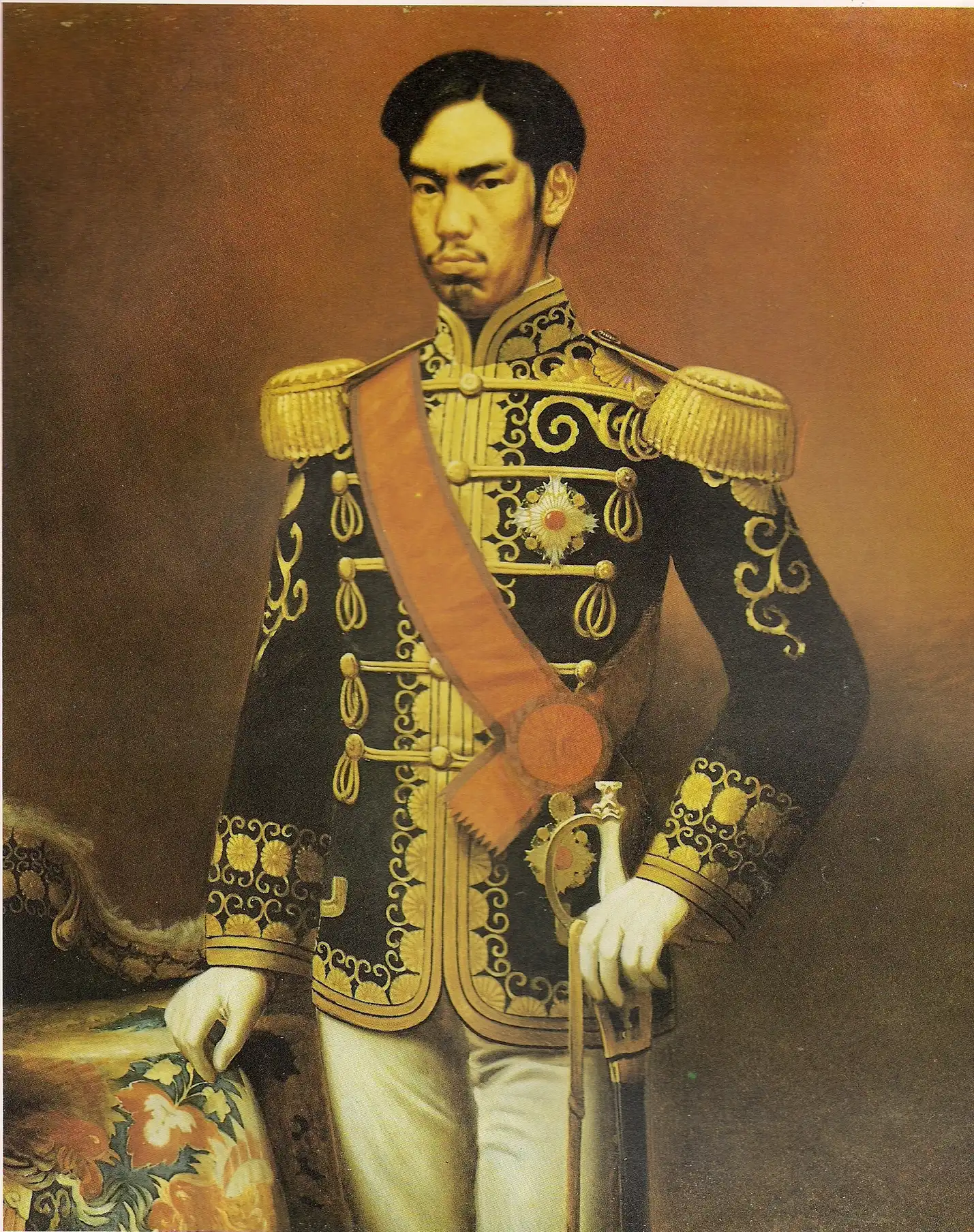
Emperor Meiji
 Japan
JapanAlso known as: Mutsuhito, Meiji-tennō, Meiji the Great, Prince Mutsuhito, Sachi-no-miya
Birthday
November 3, 1852
Birth Sign
Scorpio
Birthplace
Site of the Nakayama Residence, Kyoto
Age
Died at 59
About
Emperor Meiji, born Mutsuhito on November 3, 1852, was the 122nd Emperor of Japan, reigning from January 30, 1867, until his death on July 30, 1912. His rule marked a turning point in Japanese history, as the Meiji Restoration of 1868 dismantled the feudal Tokugawa shogunate and propelled Japan onto the world stage as a modern imperial power. Born into a time when Japan was a patchwork of 270 semi-autonomous domains ruled by daimyō under the shogun's authority, Mutsuhito's ascension came amid the Boshin War, a conflict that saw samurai from Chōshū and Satsuma overthrow the shogunate and restore nominal power to the throne. Over his 45-year reign, he oversaw a transformation that touched every corner of society, from politics and law to the military and education.
His reign produced foundational documents that shaped modern Japan, including the Charter Oath of 1868, the Meiji Constitution of 1889, the Imperial Rescript to Soldiers and Sailors of 1882, and the Imperial Rescript on Education of 1890. These were crafted with guidance from a group of elder statesmen known as the genrō, who advised the emperor on matters of state. The era also saw the establishment of the Cabinet in 1885, the Privy Council in 1888, and the Imperial Diet in 1890, laying the groundwork for a constitutional monarchy. Militarily, Japan flexed its new strength with victories in the First Sino-Japanese War (1894–1895) and the Russo-Japanese War (1904–1905), which led to the annexation of Taiwan in 1895 and Korea in 1910. Emperor Meiji died at Meiji Palace in Tokyo at age 59, succeeded by his eldest son, Yoshihito, who became Emperor Taishō. His legacy is one of rapid, deliberate modernization that transformed a secluded island nation into a formidable global power.
Early Life & Background
Mutsuhito entered the world on November 3, 1852, at the Nakayama Residence in Kyoto, the eldest son of Emperor Kōmei and Empress Ōkiku. His early childhood unfolded within the rigid, secluded walls of the Imperial Palace, where daily life was governed by centuries-old court rituals and deep-rooted Shinto traditions. Unlike later generations of emperors who would engage more freely with Western ideas, young Mutsuhito received an education steeped in classical Chinese literature, Confucian philosophy, and traditional Japanese arts. This upbringing prepared him for a life of spiritual and ceremonial duty rather than political maneuvering, though the turbulent times ahead would force a rapid maturation.
The political landscape shifted dramatically during his adolescence. By the mid-1860s, the Tokugawa shogunate faced internal collapse and external pressure from Western powers demanding trade agreements. The country descended into the Boshin War, a civil war pitting forces loyal to the shogunate against those rallying behind the restoration of imperial rule. When Emperor Kōmei died in 1867, the 14-year-old Mutsuhito ascended the throne as Emperor Meiji, inheriting a nation on the brink of chaos. His early years were defined not by leisure but by the struggle for legitimacy and survival amidst the crumbling feudal order.
The pivotal moment arrived in 1868 with the proclamation of the Meiji Restoration. This event effectively ended the 260-year rule of the Tokugawa shogunate and transferred real power back to the imperial court. Mutsuhito moved the capital from Kyoto to Tokyo (formerly Edo) in 1869, a symbolic act that signaled a break from the past and a commitment to a new direction. The young emperor navigated these early challenges with the support of influential advisors, setting the stage for the radical reforms that would follow. His pre-fame years were a crucible of political crisis that forged the foundation for his historic reign.
Career Growth
The defining achievement of Emperor Meiji's reign was the successful implementation of the Meiji Restoration in 1868, which dismantled the Tokugawa shogunate and initiated a period of unprecedented modernization. In 1868, he issued the Charter Oath, promising deliberative assemblies and an end to class restrictions, setting a new path for the nation. By 1871, the feudal domain system was abolished and replaced with prefectures, centralizing power under the imperial government. This structural overhaul paved the way for rapid industrialization and the adoption of Western technologies and institutions.
In 1889, the Meiji Constitution was promulgated, establishing a constitutional monarchy and creating the Imperial Diet. This document, along with the Imperial Rescript on Education in 1890, cemented loyalty to the state and laid the legal framework for modern Japan. The era also witnessed significant military successes that elevated Japan's status on the global stage. Victories in the First Sino-Japanese War (1894–1895) led to the annexation of Taiwan, while the Russo-Japanese War (1904–1905) marked a historic first where an Asian power defeated a European empire. These triumphs culminated in the annexation of Korea in 1910, solidifying Japan's position as a major imperial power capable of challenging Western nations.
Career Timeline
Public Image & Style
Emperor Meiji is portrayed as the "Father of Modern Japan," a stoic, wise, and visionary leader who balanced tradition with rapid Westernization. Media depictions emphasize his role in saving Japan from colonization and transforming it into a global power. He is seen as a unifying figure whose leadership guided the nation through a period of intense change. His image is one of dignity and resolve, reflecting the gravity of his responsibilities as a constitutional monarch and national symbol. The reverence for him extends beyond historical fact into a cultural iconography that celebrates his contributions to Japan's identity and sovereignty.
Fame & Fandom
Emperor Meiji commands a devotion that transcends modern fandom, rooted not in pop culture adoration but in state-sponsored veneration and religious reverence. Following his death in 1912, the Japanese nation mobilized to build the Meiji Shrine in Tokyo, a massive public project funded by donations from across the country that functions as the spiritual epicenter for his legacy. Millions gather annually at this sacred space during the Spring and Autumn Grand Festivals, engaging in rituals of traditional music, martial arts, and Shinto ceremonies that honor the man who transformed Japan from a feudal archipelago into a global industrial power. While no organized fan club or social media campaign exists to celebrate him today, the Emperor Cult forged in the early 20th century left an indelible imprint on national identity, treating his memory with the solemnity once reserved for deities. This unique form of worship persists through educational initiatives like the five-volume history published by Meiji Jingu in 2025 and ongoing imperial visits to his mausoleums. His story is one of a singular historical figure whose influence shaped the trajectory of a nation, creating a following that operates through cultural preservation rather than entertainment consumption. According to the iFANN Global Fame Rankings, Emperor Meiji holds a distinct place in historical consciousness. He is the 22nd most famous person from Japan and the 96th most famous person in Japan.
Interesting Facts and Legends
The era name "Meiji," meaning Enlightened Rule, was chosen upon his ascension and remains a practice used for subsequent eras in Japan. Historians often refer to him as the "Great Restorer," though he relied heavily on the genrō, or elder statesmen like Itō Hirobumi and Yamagata Aritomo, to implement policies. After his death, he was deified as a kami in the State Shinto religion, a status that influenced Japan's expansionist policies in the early 20th century. He was one of the few Japanese rulers to travel abroad, visiting Europe in 1871, although the trip was cut short. Folklore elevates him to a semi-divine status, with stories claiming his spirit protects Japan, a belief that persists in the Meiji Shrine where visitors seek his protective energy. The relocation of the capital from Kyoto to Tokyo in 1869 is a legendary moment, symbolizing the break from the past and the birth of modern Japan.
Notable Quotes
“We shall establish a constitution... and open the way to a new era.”
“The Emperor is the head of the Empire, combining in himself the rights of sovereignty.”
Family & Personal Life
Emperor Meiji was the eldest son of Emperor Kōmei and Empress Ōkiku. He married only once, to Takako, who became Empress Shōken, in 1867 when both were teenagers. Their union was politically strategic but reportedly affectionate, producing nine children including Crown Prince Yoshihito, who later became Emperor Taishō. Empress Shōken was known for her intelligence and support of the Emperor's modernization efforts, often accompanying him on state visits. She outlived him by two years, passing away in 1914. The imperial household maintained strict protocols, and their private life was largely shielded from public view, though they were deeply respected figures. The couple's legacy continued through their descendants, who remain part of the Japanese Imperial Family today.
Notable Connections
Relationships & Dating History
Emperor Meiji's personal life was strictly regulated by imperial protocol, and he was married only once. In 1867, at the age of 15, he married Takako, the daughter of Sanjō Sanetomi, a prominent noble. She became Empress Shōken and was the only wife permitted to the Emperor. The marriage was politically strategic but reportedly affectionate, and she supported his modernization efforts throughout his reign. They had nine children together, including Crown Prince Yoshihito, who succeeded him as Emperor Taishō. Empress Shōken outlived him by two years, passing away in 1914. There were no other public romantic relationships, engagements, or divorces. As a living deity (*arahitogami*) in the eyes of the state, his private life was not subject to the tabloid scrutiny of modern celebrities. As of 2026, his status remains Widowed, having been married to Empress Shōken at the time of his death.
- MarriedEmpress Shōken1867 - 1912Married in 1867; she died in 1914. Produced nine children including Emperor Taishō.
Death & Aftermath
Died
July 30, 1912 (aged 59)
Death Place
Tokyo
Cause of Death
uremia resulting from chronic nephritis
Flags flew at half-mast across the entire nation as Japan entered a period of official mourning that lasted for months. Tributes poured in from government officials, military leaders, and foreign dignitaries who gathered to pay their respects. Citizens crowded shrines and public spaces while newspapers published special editions eulogizing the Father of Modern Japan. The scale of grief reflected the profound impact of a reign that had transformed the country from feudal domains into a modern imperial power. Emperor Meiji passed away on July 30, 1912, at the Aoyama Detached Palace in Tokyo.
His health had deteriorated significantly over preceding months due to chronic nephritis, leading to uremia. Medical assessments by palace physicians confirmed the cause, maintaining the strict secrecy standard for the Imperial Household Agency. He died quietly while resting, ending the Meiji era and paving the way for his son, Emperor Taishō, to assume the throne seamlessly. Grand state funeral services followed in August 1912, conducted according to traditional Shinto and Buddhist rites. His body was cremated to preserve the sanctity of the imperial lineage, and his ashes were interred at the Nagareyama Mausoleum in Fushimi-ku, Kyoto.
The service featured traditional performances and included notable attendees such as high-ranking government officials and representatives from foreign nations. The Meiji Shrine in Harajuku was subsequently built between 1915 and 1920 to enshrine his spirit, funded by public donations. Posthumous commemorations include the Meiji Memorial Picture Gallery completed in 1926 and annual festivals held at the shrine today. The estate remained under the control of the Imperial Household Agency, ensuring assets stayed within the state for the benefit of the current imperial family.
Net Worth (Estate Value)
$0
iFANN Editorial Team estimate
As a historical monarch, Emperor Meiji did not possess a personal net worth in the modern sense. The Imperial Estate was managed by the state, and all assets were considered property of the Imperial Household Agency rather than individual holdings. Today, the value of assets associated with the Imperial Household Agency, which manages the legacy and properties linked to the Meiji era, is not publicly disclosed as a specific individual net worth. Estimates of the total value of the Imperial family's holdings are speculative and range widely. The wealth of his legacy is measured in cultural and historical impact rather than financial metrics. Research by the iFANN Editorial Team confirms that no financial valuation applies to his personal estate, as it was entirely state-managed.
Awards Won (3)
Emperor Meiji received numerous state honours and foreign orders during his reign, reflecting Japan's entry into the international community of powers. He was awarded the Order of the Garter by the United Kingdom and the Order of the Golden Fleece by Spain. Posthumously, he was honored as "Meiji the Great" and deified as a kami in State Shinto. The Meiji Shrine and Meiji Memorial Picture Gallery stand as enduring tributes to his legacy.
1876 · Foreign Order
State Relations
1871 · Foreign Order
State Relations
Known For
Meiji Restoration
1868 · Leader
First Sino-Japanese War
1894 · Commander-in-Chief
Russo-Japanese War
1904 · Commander-in-Chief
Meiji Constitution
1889 · Promulgator
Keywords
Sources
Quick Facts
- Profession
- monarch, aristocrat
- Born
- November 3, 1852
- Birthplace
- Site of the Nakayama Residence
- Died
- July 30, 1912
- Death Place
- Tokyo
- Gender
- Male
- Spouse
- Empress Shōken
- Birth Sign
- Scorpio
Personal Details
- Full Name
- Mutsuhito
- Spouse
- Empress Shōken
- Children
- Crown Prince Yoshihito (Emperor Taishō), Princess Masako, Prince Tomohito, Prince Kan'in, Princess Fusako, Princess Toshiko, Prince Asaka, Prince Takeda, Prince Kuni
- Education
- Classical Chinese literature, Confucianism, Shinto rituals, traditional Japanese arts
Frequently Asked Questions
Who was Emperor Meiji?
When did Emperor Meiji die?
What was Emperor Meiji's birth name?
Did Emperor Meiji have any wives?
What is the Meiji Shrine?
Similar People
Join the community
fans discussing