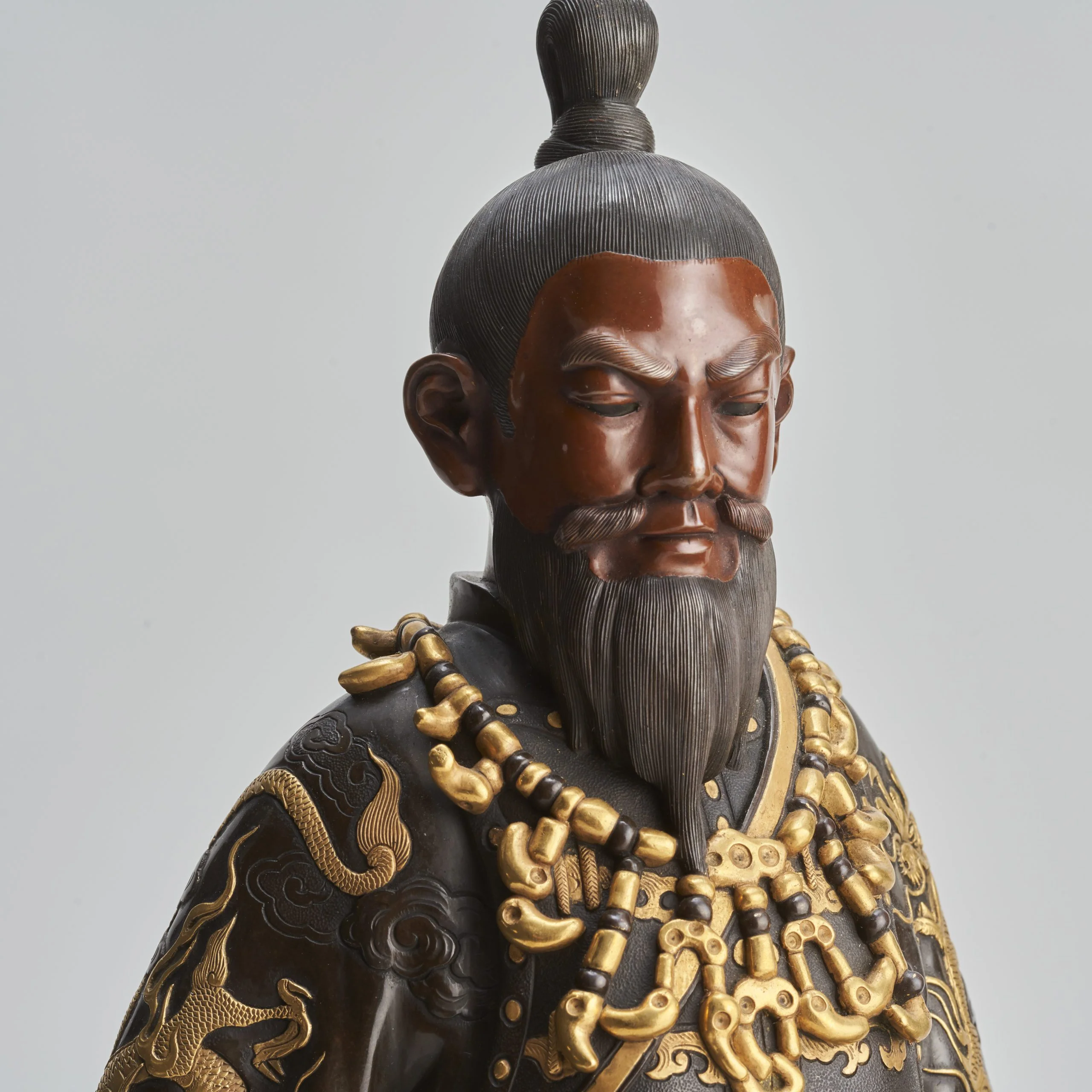
Emperor Jimmu
 Japan
JapanAlso known as: Jimmu-tennō, Kamuyamato Iwarehiko no Mikoto, Wakamikenu no Mikoto, Hikohohodemi no Mikoto, Jinmu
Birthday
-0711-02-13
Birth Sign
Aquarius
Birthplace
Takachiho, Kyushu
Age
Died at 126
About
Emperor Jimmu, traditionally recognized as the first emperor of Japan, was a figure whose existence straddles the boundary between legend and historical tradition. Born in Takachiho in 711 BCE, he is revered as the direct descendant of the sun goddess Amaterasu through her grandson Ninigi-no-Mikoto. His traditional ascension to the throne occurred on February 11, 660 BCE, a date celebrated annually in Japan as National Foundation Day. While modern historians regard him as a legendary or semi-legendary figure due to the lack of contemporary archaeological evidence for his reign, his symbolic role as the progenitor of the world's oldest continuous hereditary monarchy remains central to Japanese national identity and Shinto belief systems.
Jimmu's narrative is steeped in mythological events, from divine interventions to battles against formidable foes. His journey is not just a political conquest but a spiritual one, where he is aided by the gods and even by a mystical three-legged bird, the Yatagarasu, which guided his army. These stories were codified in the Nihon Shoki and Kojiki, the oldest surviving histories of Japan, compiled in the 8th century. Despite the lack of archaeological proof, his legacy persists, and his name remains synonymous with the founding of the Japanese state.
Early Life & Background
The early life of Emperor Jimmu is defined by a journey of unification that spans the southern islands of Japan to the Yamato region. According to the ancient chronicles Kojiki and Nihon Shoki, he was born with the name Hikohohodemi no Mikoto in Takachiho, located in the Hyūga region of Kyushu. His lineage was divine; his mother was Tamayori-hime, daughter of the sea god Ryujin, and his father was Ugayafukiaezu, son of Ninigi-no-Mikoto. As a great-grandson of Amaterasu, his birth was marked by divine signs, including the appearance of a golden kite that blinded his enemies during his campaigns.
Before his rise to power, Jimmu's life was characterized by an eastern expedition from Hyūga to Yamato, which corresponds to modern-day Nara Prefecture. This journey was not merely political but spiritual, guided by the three-legged crow, Yatagarasu, which descended from heaven to lead his army. During this campaign, he faced significant opposition from local chieftains, most notably the Kumaso people. A pivotal moment involved a tactical error where his forces were fighting facing the rising sun, causing confusion and near defeat. Upon realizing their mistake, they reoriented themselves, leading to victory. Another brother, Itsuse, died in battle during this period, highlighting the perilous nature of his rise to power.
Career Growth
As the founder of the imperial dynasty, Jimmu's career is synonymous with the establishment of the Japanese state. His major achievement was the conquest of the Yamato region, where he established his capital at Kashihara. His reign is traditionally recorded as lasting from 660 BCE to 585 BCE, a duration of 75 years, though some accounts suggest he lived to be 126 years old before his death. His success is measured not in commercial metrics but in cultural permanence: he founded the line of emperors that continues to the present day, making it the longest-surviving monarchy in history.
The codification of his story in the Kojiki and Nihon Shoki solidified the ideology of the kami (gods) descending to rule Japan, a concept that underpinned the state religion and imperial authority for over two millennia. In 1940, Japan celebrated the 2,600th anniversary of his ascension, a massive propaganda event used to fuel nationalism during World War II. Although the holiday was abolished post-war, it was reinstated in 1966 as National Foundation Day, ensuring his legacy remained a cornerstone of national identity.
Career Timeline
Public Image & Style
Emperor Jimmu is portrayed as the divine ancestor of the Japanese people. In Shinto temples and state ceremonies, he is depicted as a majestic, benevolent ruler. The media portrays him as a symbol of continuity and national unity, though academic discourse often highlights the mythological nature of his story. His image is inextricably linked to the concept of the Imperial House of Japan, representing the unbroken line of sovereignty that dates back to the dawn of time according to tradition. He is venerated not just as a historical figure but as a deity, with shrines dedicated to his memory serving as centers of worship.
Fame & Fandom
Emperor Jimmu possesses no formal fandom name, nor does he sustain a contemporary organized fanbase with social media presence or conventions. His modern following manifests not through personal interaction but through state-sponsored commemoration and Shinto veneration, most notably during National Foundation Day celebrations on February 11. These events function as civic observances rather than fan-driven phenomena, occasionally sparking political debate regarding the intersection of religion and state power. While online communities occasionally debate his historicity, these discussions remain speculative folklore rather than structured fandom activity. Despite the absence of a dedicated cult following, his global recognition remains substantial due to his symbolic status as the progenitor of the world's oldest continuous monarchy. According to the September 2026 iFANN Global Fame Rankings, Emperor Jimmu is the 56th most famous person from Japan, a position holding steady from the previous cycle. This placement reflects enduring international interest in Japanese imperial history and mythology, tracked across global media coverage, search trends, and cultural consumption signals worldwide. The ranking confirms his status as a figure of significant historical weight despite the lack of verifiable biographical data.
Interesting Facts and Legends
The traditional narrative records that Emperor Jimmu led an eastern expedition from Kyushu to Yamato, overcoming hostile chieftains with divine assistance. A famous episode within this legend describes a golden kite appearing to blind his enemies, while another recounts his brother Itsuse dying in battle before Jimmu realized his forces were fighting facing the sun incorrectly. He is traditionally buried at the Kashihara-jingū mausoleum in Nara Prefecture, though archaeological evidence for his actual remains is absent. One of the most significant modern moments was the 1940 celebration of the 2,600th anniversary of his ascension, which served as a massive propaganda event for Japanese nationalism during World War II. The date of his legendary ascension, February 11, became National Foundation Day, a holiday reinstated in 1966 after being abolished post-World War II. In 2014, a celebration was jokingly framed by one outlet as marking the "Happy 2,674 birthday" of Japan. Modern debates persist regarding whether he was a real person or purely mythological, with some insisting on his historicity while scholars regard him as a putative tribal leader.
Family & Personal Life
Emperor Jimmu's personal life is documented within the mythological framework of the ancient chronicles. He is recorded as having multiple spouses. His primary consort was Himetataraisuzuhime, also known as Princess Hime, who was the daughter of the Omi clan leader. They are said to have had children, including Prince Ugayafukiaezu (who became his successor in some lineages) and other sons who played roles in the consolidation of power. Another spouse mentioned in the records is Ahiratsuhime. These marriages were strategic alliances designed to secure loyalty from powerful clans in the regions he conquered. There is no record of divorce or separation in the traditional narratives; the relationships are presented as dynastic unions essential to the founding of the state.
Notable Connections
Relationships & Dating History
Emperor Jimmu's personal life is documented within the mythological framework of the ancient chronicles. He is recorded as having multiple spouses. His primary consort was Himetataraisuzuhime, also known as Princess Hime, who was the daughter of the Omi clan leader. They are said to have had children, including Prince Ugayafukiaezu (who became his successor in some lineages) and other sons who played roles in the consolidation of power. Another spouse mentioned in the records is Ahiratsuhime. These marriages were strategic alliances designed to secure loyalty from powerful clans in the regions he conquered. There is no record of divorce or separation in the traditional narratives; the relationships are presented as dynastic unions essential to the founding of the state. At the time of his death in 585 BCE, he was married to these consorts.
- MarriedHimetataraisuzuhime-0660 - -0585Primary consort; daughter of the Omi clan leader; union solidified political control over the Yamato region.
- MarriedAhiratsuhime-0660 - -0585Second spouse; details sparse in surviving texts.
Death & Aftermath
Died
-0585 (aged 126)
Death Place
Kashihara, Nara Prefecture
Cause of Death
Natural causes (traditional account)
Traditional chronicles record that Emperor Jimmu died in the year 585 BCE at the age of 126, marking the end of a reign that began with his ascension in 660 BCE. The Kojiki and Nihon Shoki do not provide medical details or describe a specific illness, treating his passing instead as a natural transition within a divine lineage descending from the sun goddess Amaterasu. His burial site is identified as the Kashihara-jingū mausoleum in Nara Prefecture, a location revered in Shinto tradition rather than documented through archaeological excavation. There was no modern-style funeral; instead, he was immediately deified and integrated into the Shinto pantheon as a protective kami. Modern commemoration focuses almost exclusively on National Foundation Day on February 11, which honors his traditional ascension date rather than his death. This holiday has sparked periodic debate regarding the intersection of state-sponsored Shinto rituals and secular governance, particularly in recent years when scholars question the historicity of his life while others maintain the mythological narrative as central to Japanese identity.
Net Worth (Estate Value)
$0
iFANN Editorial Team estimate
As a mythical figure from antiquity, Emperor Jimmu has no net worth, salary, or business ventures. The concept of financial wealth does not apply to a figure whose existence is defined by mythology and religious veneration rather than economic activity. The "wealth" associated with his legacy is the value of the Imperial Estate and the cultural heritage of Japan, which is managed by the state and the Imperial Household Agency, not by the individual. Research by the iFANN Editorial Team puts the estate's cultural value at approximately $0 in direct monetary terms, as the assets are held in trust for the nation rather than accumulated as personal fortune.
Awards & Accolades
View 5 records, honours and achievementsKnown For
Founding of the Japanese Empire
-0660 · First Emperor
The Eastern Expedition
-0660 · Leader
Keywords
Sources
Quick Facts
- Profession
- monarch, Emperor of Japan
- Born
- -0711-02-13
- Birthplace
- Takachiho
- Died
- -0585
- Death Place
- Kashihara
- Gender
- Male
- Spouse
- Himetataraisuzuhime, Ahiratsuhime
- Birth Sign
- Aquarius
Personal Details
- Full Name
- Hikohohodemi no Mikoto
- Spouse
- Himetataraisuzuhime, Ahiratsuhime
- Children
- Prince Ugayafukiaezu, other sons
- Education
- N/A
Frequently Asked Questions
Was Emperor Jimmu real?
When was Emperor Jimmu born?
What is National Foundation Day?
Where is Emperor Jimmu buried?
How long did Emperor Jimmu live?
Similar People
Join the community
fans discussing