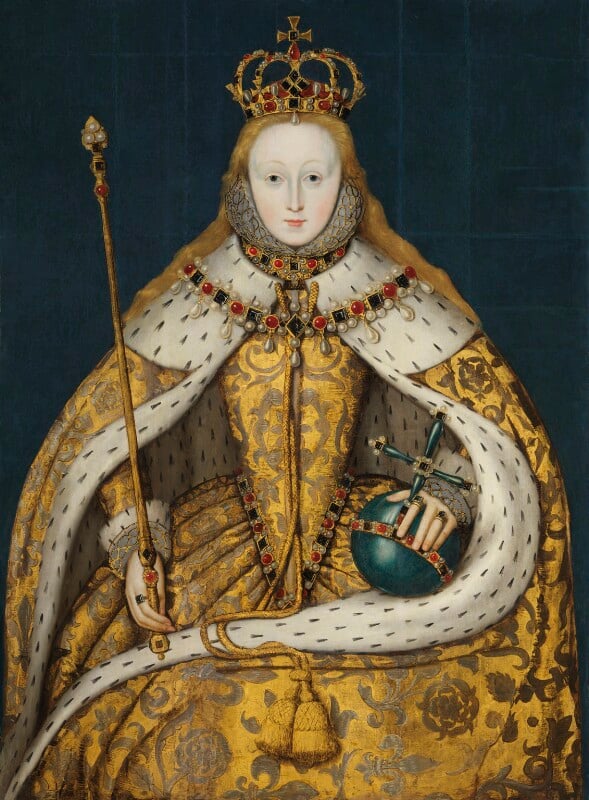
Elizabeth I of England
 United Kingdom
Birthday
September 7, 1533
Birth Sign
Virgo
Birthplace
Palace of Placentia, Greenwich, England
Age
Died at 69
Height
5 ft 5 in (165 cm)
About
Elizabeth I was Queen of England and Ireland from 1558 until her death in 1603. The last monarch of the House of Tudor, she is remembered as one of England's greatest rulers. Her reign, known as the Elizabethan Era, saw the flourishing of English drama, the defeat of the Spanish Armada, and the establishment of the Church of England. Elizabeth cultivated a powerful image as the "Virgin Queen" and "Gloriana," using portraiture and pageantry to project strength and unity. She never married and had no children, a deliberate choice that became central to her identity. Today she is celebrated as a symbol of national pride and a pioneering female leader.
Early Life & Background
Elizabeth was born at Greenwich Palace on September 7, 1533, the daughter of Henry VIII and Anne Boleyn. Her early life was marked by danger and instability. When she was two, her mother was executed and Elizabeth was declared illegitimate, stripped of her title of princess. She lived mostly at Hatfield House and was largely neglected by her father. After Henry's death in 1547, she lived with her stepmother Catherine Parr. During the reign of her half-sister Mary I, Elizabeth was imprisoned in the Tower of London for nearly a year on suspicion of supporting Protestant rebels. She narrowly escaped execution and survived by keeping a low profile. Her education was rigorous: she studied with Cambridge scholars and became fluent in five languages, skilled in music, and proficient in mathematics and astronomy.
Career Growth
Elizabeth ascended the throne on November 17, 1558, at age 25. One of her first acts was the Elizabethan Religious Settlement of 1559, which created a moderate Protestant church with herself as Supreme Governor. She faced constant pressure to marry and produce an heir but skillfully used courtship as a diplomatic tool. Her government, led by William Cecil and Francis Walsingham, uncovered numerous Catholic plots, culminating in the execution of Mary, Queen of Scots in 1587. The defining moment of her reign came in 1588 when the Spanish Armada was defeated, cementing England's naval power. The Elizabethan era saw a cultural golden age, with Shakespeare and Marlowe producing their greatest works. Elizabeth delivered her famous "Golden Speech" to Parliament in 1601, expressing her love for her people. She died at Richmond Palace on March 24, 1603.
Career Timeline
Public Image & Style
Elizabeth cultivated a carefully controlled public image as the "Virgin Queen" and "Gloriana." She wore elaborate jewel-encrusted gowns, high lace ruffs, and heavy white makeup. Her portraits used symbols like the moon, pearls, and the phoenix to represent virginity and power. She was known for her fiery temper and her ability to connect with common people. Fans today, often called Tudor enthusiasts, celebrate her as a feminist icon and a master of political survival. She has been portrayed by actresses including Cate Blanchett, Helen Mirren, and Judi Dench.
Fame & Fandom
Elizabeth I of England stands as the 43rd most famous person in United Kingdom, a position she holds steady within the iFANN Global Fame Rankings. She is also recognized as the 75th most famous person from United Kingdom and the 57th most famous person in Europe. These placements reflect a legacy that transcends centuries, anchored by her enduring presence in global cultural memory. While modern celebrities often boast organized fan clubs with specific names and rituals, Elizabeth's audience operates differently. There is no formal fandom name for Elizabeth I, nor do enthusiasts call themselves by a collective moniker like 'Tudors' or 'Istians.' Her admirers are not an active community organizing birthday billboards or charity drives under a specific banner. Instead, the interaction between fans and the Virgin Queen remains academic and cultural, sustained by museums, historical societies, and educational institutions rather than a structured fanbase. Social media posts about her generate thousands of reactions, yet these represent general public interest in history rather than an organized movement. The legends surrounding her life, from the calculated myth of her virginity to the victory over the Spanish Armada, form the core of what historians and the public recall, creating a profound legendary status built on verified political victories and strategic self-mythologizing.
Interesting Facts and Legends
Her reign was marked by a motto of 'video et taceo' (I see and keep silent), reflecting her cautious nature. A bout of smallpox in 1562 left her with permanent facial scars, which she later concealed with heavy makeup. She owned over 2,000 dresses and 80 wigs, maintaining a wardrobe that projected royal power. As the first English monarch to command a standing army, she reshaped military structures, yet she never visited Scotland or Ireland during her forty-five-year rule. Born in the ironic 'Chamber of the Virgins' at Greenwich Palace, she was excommunicated by Pope Pius V in 1570. Beyond these facts, the story of her image management remains a favorite among historians; recent discoveries suggest her secretary, Sir Francis Walsingham, may have rewritten letters to make her sound more decisive than she actually felt. Another enduring legend involves the naming of Virginia, where the American colony was named in honor of the unmarried queen, the land of the Virgin Queen. Folklore also preserves tales of her travels, such as the Shaven Crown inn in the Cotswolds, which claims to have served her during her time, serving as a physical anchor for her movements across the country.
Notable Quotes
“I know I have the body of a weak and feeble woman, but I have the heart and stomach of a king, and of a king of England too.”
“There is no jewel, be it of never so high a price, which I set before this jewel; I mean your love.”
“Video et taceo.”
“I would not open windows into men's souls.”
“Though God hath raised me high, yet this I count the glory of my crown, that I have reigned with your loves.”
Family & Personal Life
Elizabeth was the only surviving child of Henry VIII and his second wife, Anne Boleyn. Her mother was executed when Elizabeth was two. Her half-siblings were Mary I and Edward VI. After Henry's death, she lived with stepmother Catherine Parr. Elizabeth never married and had no children. She had a close relationship with her cousin Mary, Queen of Scots, but ultimately ordered her execution. Her household included many loyal servants, and she was particularly fond of her dogs.
Notable Connections
Elizabeth relied heavily on her chief advisor William Cecil, Lord Burghley, who served her for 40 years. Her spymaster Francis Walsingham uncovered numerous plots. She had a lifelong attachment to Robert Dudley, Earl of Leicester, and later favorites included Sir Walter Raleigh and Robert Devereux, Earl of Essex. Explorers like Francis Drake and Walter Raleigh expanded England's horizons under her reign.
Relationships & Dating History
Elizabeth famously never married, but she had several notable courtships and attachments. Her most significant relationship was with Robert Dudley, Earl of Leicester, whom she knew since childhood. They were imprisoned together in the Tower in 1554, and rumors of marriage persisted after his wife's suspicious death in 1560. She entertained proposals from Philip II of Spain, Archduke Charles of Austria, and Francis, Duke of Anjou, using them as diplomatic tools. As a teenager, she was involved in a scandal with Thomas Seymour, her stepmother's husband, which led to her interrogation. Later favorites included Sir Walter Raleigh and Robert Devereux, Earl of Essex, both of whom fell from favor. Elizabeth died unmarried and without children.
- RumouredThomas Seymour, 1st Baron Seymour of Sudeley1547 - 1549Inappropriate flirtation while Elizabeth lived in Catherine Parr's household; Seymour was executed for treason.
- RumouredRobert Dudley, Earl of Leicester1550 - 1588Childhood friend and lifelong favorite; rumored to be her lover; his wife died under suspicious circumstances.
- RumouredPhilip II of Spain1558 - 1559Proposed marriage after Mary I's death; Elizabeth used the courtship for diplomatic leverage.
- RumouredEric XIV of Sweden1559 - 1560Pursued Elizabeth persistently, even visiting England; she never seriously considered the match.
- RumouredHenry FitzAlan, 19th Earl of Arundel1559 - 1559Older nobleman who proposed marriage; Elizabeth rejected him.
- RumouredArchduke Charles of Austria1560 - 1567Habsburg marriage negotiations collapsed over religious differences.
- RumouredChristopher Hatton1570 - 1591Handsome courtier and Lord Chancellor; Elizabeth was very fond of him.
- RumouredFrancis, Duke of Anjou1570 - 1584Last serious marriage prospect; Elizabeth called him her 'frog' and gave him a betrothal ring, but marriage never materialized.
- RumouredSir Walter Raleigh1580 - 1592Explorer and court favorite; imprisoned when Elizabeth discovered his secret marriage to Bess Throckmorton.
- RumouredRobert Devereux, 2nd Earl of Essex1590 - 1601Last great favorite; stepson of Robert Dudley; executed for rebellion.
Death & Aftermath
Died
March 24, 1603 (aged 69)
Death Place
Richmond Palace
Cause of Death
Reported as complications from pneumonia and dropsy
The bells of St. Paul's Cathedral rang continuously as London observed a day of silence, marking the end of an era that had defined a nation for forty-five years. This solemn tribute followed the quiet passing of Elizabeth I at Richmond Palace on March 24, 1603, where she spent her final hours speaking with her ladies-in-waiting after refusing to leave her bedchamber during the harsh winter. Contemporary accounts describe her as conscious and lucid until shortly before death, having made her succession plans clear just hours prior by designating James VI of Scotland as her successor.
Historians attribute her passing to complications from severe pneumonia and a long-standing condition known as dropsy, compounded by general physical decline associated with old age and potential depression following the loss of Robert Dudley earlier in life. While disputed accounts occasionally suggested poisoning by Spanish or Catholic factions, no credible evidence supported these theories, leaving natural causes as the consensus among scholars. The funeral procession on April 28, 1603, featured a grand hearse drawn by six horses draped in black velvet, carrying her body to Westminster Abbey for burial in Henry VII's Chapel next to her half-sister Mary I.
King James I traveled from Scotland to attend the ceremony, which was witnessed by large crowds lining the streets who reflected deep respect for the Virgin Queen. Posthumously, Elizabeth became one of the most iconic figures in British history, immortalized through countless books, plays, and films, as well as statues like the equestrian monument in London. Her personal wealth and royal estates were consolidated into the Stuart monarchy under James I without division or legal contest, ensuring a smooth transition of power that bypassed any need for estate dispute litigation.
Net Worth (Estate Value)
$0
iFANN Editorial Team estimate
iFANN currently estimates Elizabeth I of England's net worth at $0. Since she died in 1603, no modern personal wealth exists for this Tudor monarch. During her reign, the English crown generated an annual income of roughly £200,000 to £300,000, a sum equivalent to tens of millions today. She was known for her frugality and successfully left the crown with manageable debts upon her death. The Crown Estate, which includes former Tudor properties, now generates hundreds of millions of pounds annually for the UK Treasury, but this revenue belongs to the state rather than her personal estate.
Awards & Accolades
View 7 records, honours and achievementsKeywords
Sources
Quick Facts
Personal Details
- Full Name
- Elizabeth Tudor
- Height
- 5 ft 5 in (165 cm)
- Education
- Tutored by Roger Ascham, John Cheke, and William Grindal; fluent in Latin, Greek, French, Italian
Frequently Asked Questions
How old was Elizabeth I when she died?
Why did Elizabeth I never marry?
What is Elizabeth I best known for?
Did Elizabeth I have any children?
What was Elizabeth I's relationship with Mary, Queen of Scots?
Join the community
fans discussing