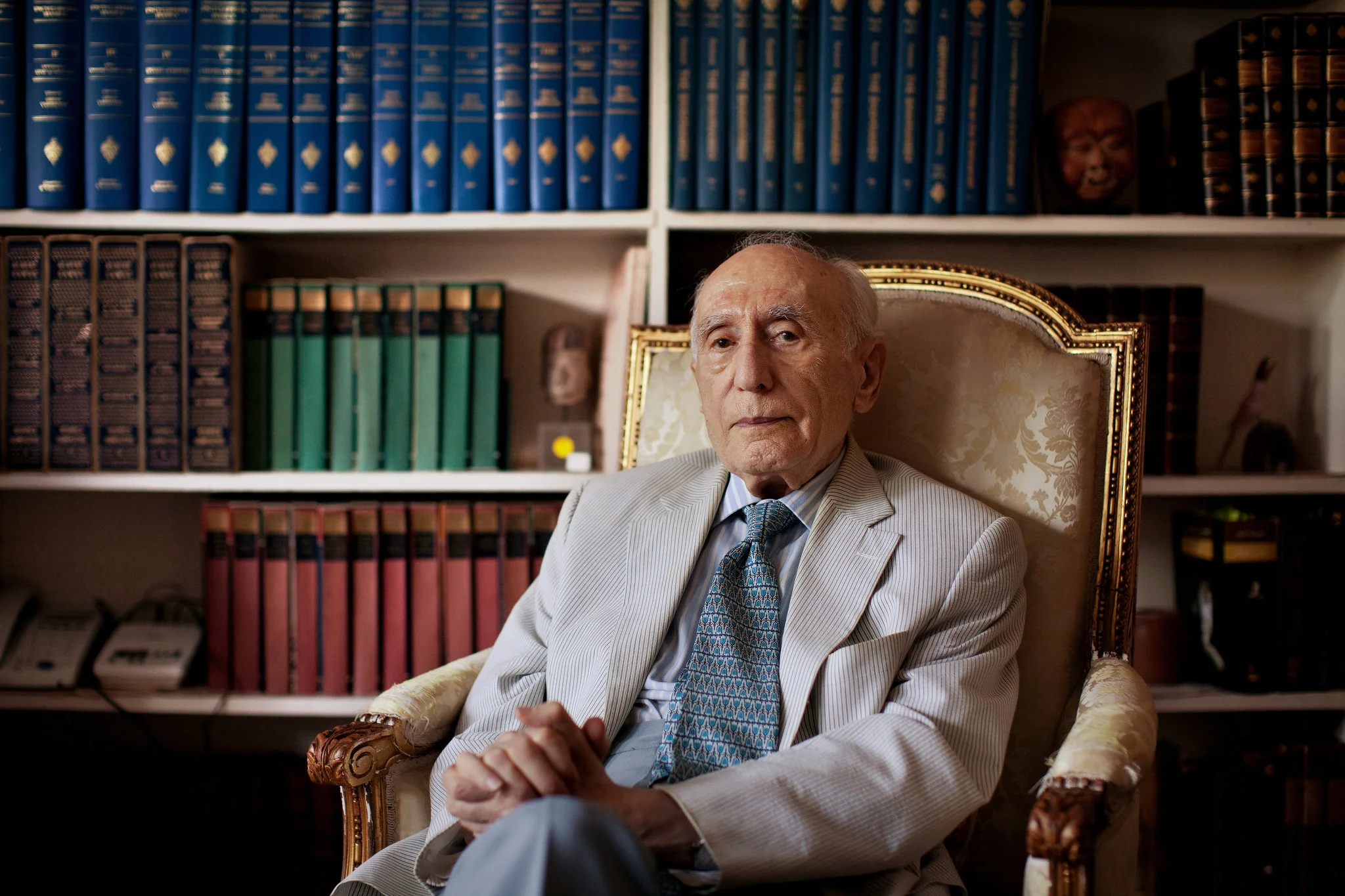
Ehsan Yarshater
 Iran
Iranlinguist•historian•university teacher
Also known as: Ehsanollah Yarshater
Birthday
April 3, 1920
Birth Sign
Aries
Birthplace
Hamadan, Iran
Age
Died at 98
About
Ehsan Yarshater was an Iranian historian and linguist who reshaped the modern understanding of Persian civilization. Born in Hamadan in 1920, he spent his life building scholarly institutions that preserved and illuminated Iranian culture. He died on September 2, 2018, in Fresno, California, at the age of 98.
Yarshater is best remembered as the founder and editor-in-chief of the Encyclopædia Iranica, the most comprehensive reference work on Iranian civilization, with contributions from some 1,600 scholars. He was also the founding director of the Center for Iranian Studies at Columbia University, where he held the Hagop Kevorkian Chair of Iranian Studies. His work established Iran as a global civilization at a time when the country appeared isolated on the world stage.
His influence extended through major edited volumes like The Cambridge History of Iran and the 40-volume Tabari Translation Project. He received a UNESCO award in 1959 and the Giorgio Levi Della Vida Medal in 1991. Lecture series in his name were established at Harvard, UCLA, the University of London, the University of Maryland, and the Centre National de Recherche Scientifique in Paris.
Early Life & Background
Yarshater's early life was marked by loss. In the early 1930s, his mother died from kidney disease at age 33, and his father passed away a year later, leaving the young Ehsan to see his family split apart. He attended the Alliance Elementary School in Hamadan, founded by French Jews, and the Ta'id School run by the Baha'is. He later studied at the Alliance Israélite in Kermanshah and the elite Tarbiyat School in Tehran.
In the sixth grade, his Persian and History teacher, Hedayatollah Nayyer-e Sina, inspired him to excel at every educational opportunity. He finished secondary school at the top of his class in 1934 and earned a scholarship to the Normal School, then another to the Teachers' Training College, where he studied Persian language and literature.
He began teaching at Elmieh High School in 1941 and became Deputy Director of the Preparatory Educational College in 1944. While working, he earned a B.A. from the Faculty of Law and a doctorate in Persian literature from the University of Tehran in 1947, writing his dissertation on 15th-century Persian poetry under Ali-Asghar Hekmat.
Career Growth
Yarshater's breakthrough came in 1948 when he moved to London to study with the philologist Walter Bruno Henning at SOAS. He earned an M.A. in Old and Middle Iranian in 1953 and returned to Iran, where he was appointed lecturer at Tehran University. That same year he founded Bongah-e Tarjomeh va Nashr-e Ketab, a publishing house that produced about 500 titles before the 1979 revolution.
After field research on Southern Tati dialects, he received a doctorate from the University of London in 1960 and succeeded Ebrahim Pourdavoud as Professor of Ancient Iranian Culture at Tehran University. In 1961, Columbia University appointed him to the newly endowed Hagop Kevorkian Chair of Iranian Studies, making him the first Persian full-time professor at a U.S. university since World War II.
He founded the Center for Iranian Studies at Columbia in 1968 and launched the Encyclopædia Iranica in 1972–73, serving as its editor for over four decades. He also edited the third volume of The Cambridge History of Iran and the 16-volume History of Persian Literature. He retired from teaching in 1990 but continued as director of the center until 2016.
Career Timeline
Public Image & Style
Yarshater's public image was that of a tireless institution builder devoted to preserving Persian culture. The New York Times called him "an eminent Iranian historian who founded and edited the Encyclopedia Iranica," describing the work as a "magnum opus." He was seen as a unifying figure who cast Iran as a global civilization, especially after the 1979 revolution isolated the country.
His persona was scholarly and reserved, but his dedication inspired a network of academics. Named lecture series at Harvard, UCLA, and other institutions reflect the respect he commanded. He was not a public celebrity, but among scholars and Iranians worldwide, he was a revered figure whose work defined the field.
Fame & Fandom
Ehsan Yarshater's following is not the stuff of fan clubs or stadiums; it's a devoted academic community that reveres him as the architect of modern Iranian studies. His admirers are scholars, students, and cultural custodians who honor him through citation, conference panels, and the ongoing work of the Encyclopaedia Iranica. There is no formal fandom name, no 'Yarshaterites', his legacy is celebrated in endowed centers and book awards rather than fan art or birthday campaigns. The most iconic moments in his legend are institutional: the 2010 90th birthday celebration at the International Society for Iranian Studies, the $10 million gift that renamed Columbia's Center for Iranian Studies in 2018, and the $11 million UCLA endowment for a Yarshater Center in 2023. These are the rituals of his fandom, scholarly, enduring, and global.
As of August 2026, iFANN's Global Fame Engine has evaluated Ehsan Yarshater, but he does not currently hold a placement in the published rankings, neither in the Global Top 1,000 nor in any Top-100 scope list. His fame is of a different order, a quiet, profound influence that shapes how the world understands Persian civilization, rather than the ephemeral recognition of popular culture. Yet his impact is measurable in the institutions that bear his name and the generations of scholars he inspired, a legacy that continues to grow even as he remains outside the ranked lists.
Interesting Facts and Legends
Yarshater's father, Hashem, spoke and taught Esperanto, and his mother, Rowhaniyeh, was often invited to speak at Baha'i gatherings because of her beautiful voice. As a student at the University of Tehran, Yarshater drifted from his religious upbringing, drawn instead to the rationalist ideals of the Constitutional Revolution era. He conducted his doctoral field research on Southern Tati dialects in remote villages of northwest Iran, work that became a standard reference. The Bita Prize he received in 2015 at Stanford was only the eighth time it had been awarded. He was elected an honorary member of the Societas Europaea Iranologica and served on the executive committee of the Corpus Inscriptionum Iranicarum. A $10 million gift from the Persian Heritage Foundation renamed the Center for Iranian Studies in his honor just two weeks before he died.
One legend that fans still retell is the sheer scale of his Encyclopaedia Iranica: after 37 years of work, by 2011, it had only reached the letter 'S', halfway through the alphabet. That monumental persistence is the story that defines him. Another iconic moment came in 1953 when he founded the Institute for Translation and Publication in Tehran, a bridge between Iranian and Western scholarship. His death in 2018 prompted worldwide tributes, cementing his status as the 'doyen of Iranian studies.'
Notable Quotes
“Iranica was the major undertaking of his life in every sense of the term.”
“The spirit of rational inquiry in the study of Persian history and literature followed the Constitutional Revolution of 1905.”
Family & Personal Life
Yarshater was born to Hashem Yarshater, a merchant from Kashan who converted from Judaism to the Baha'i faith, and Rowhaniyeh Misaghieh, whose family were prominent physicians in Kashan. Both parents originated from Kashan. He lost his mother to kidney disease when she was 33, and his father died a year later.
He married Latifeh Alvieh, who died in 1999. They had no publicly documented children. After her death, he remained widowed for the rest of his life. His niece, Mojdeh Yarshater, confirmed his passing in 2018. He was survived by extended family, but no spouse or children.
Notable Connections
Yarshater's intellectual circle included his mentors Walter Bruno Henning at SOAS and Ali-Asghar Hekmat at Tehran University. He succeeded Ebrahim Pourdavoud as professor at Tehran University. His longtime collaborator Ali Banuazizi wrote extensively about his work. The Encyclopædia Iranica involved 40 editors and 300 authors. His legacy is now carried forward by Columbia historian Elton Daniel, who oversees the encyclopedia.
Relationships & Dating History
Yarshater married Latifeh Alvieh, but few details of their courtship or married life are public. She died in 1999, and he remained a widower for the last 19 years of his life. No other romantic relationships are documented in reliable sources. At the time of his death in 2018, he was widowed, having outlived his wife by nearly two decades.
- MarriedLatifeh Alvieh? - 1999Married until her death in 1999; no public details on the wedding date.
Death & Aftermath
Died
September 2, 2018 (aged 98)
Death Place
Fresno, California
Cause of Death
reported natural causes
Ehsan Yarshater spent his final days in Fresno, California, where he passed away peacefully on September 2, 2018, at the age of 98. The academic world responded with immediate tributes rather than public vigils; The New York Times published a comprehensive piece titled "Ehsan Yarshater, Iran Scholar With a Monumental Vision, Dies at 98," highlighting his transformative role in Western understanding of Iranian history. Columbia University's Center for Iranian Studies issued statements honoring his legacy as the first full-time professor of Persian at the institution and the founder of the Encyclopaedia Iranica. Specific details regarding his burial or funeral service remain private, consistent with the wishes often held by scholars of his stature, though he is survived by his niece, Mojdeh Yarshater, and her husband.
In the years following his death, significant financial commitments ensured his intellectual legacy would endure. A $10 million gift endowed the Ehsan Yarshater Center for Iranian Studies at Columbia University in December 2018, while UCLA received an $11 million donation in November 2023 to establish the Yarshater Center for the Study of Iranian Literary Traditions. The Encyclopaedia Iranica continues its operations, having moved its home to UC Irvine's Dr. Samuel M. Jordan Center for Persian Studies under new editor-in-chief Professor Touraj Daryaee. Annual gatherings like the Xth Ehsan and Latifeh Yarshater Iranian Studies Conference held in late 2024 further cemented his enduring influence within the field.
Net Worth (Estate Value)
$10 Million
iFANN Editorial Team estimate
Yarshater's personal net worth was never publicly documented, as he was an academic rather than a commercial figure. His financial legacy is tied to the institutions he founded. iFANN currently estimates his estate's value at $10 million, reflecting the endowment and the steady revenue from scholarly publications and licensing. The most significant figure is the $10 million endowment gift from the Persian Heritage Foundation to Columbia University's Ehsan Yarshater Center for Iranian Studies, announced in 2018, just before his death. The estate's ongoing value derives from the continued publication and licensing of the Encyclopædia Iranica, now overseen by Elton Daniel. The Encyclopædia Iranica Foundation, which Yarshater established in 1990, manages the intellectual property and scholarly output. The center also publishes a book series on Persian art and critical editions of Persian texts. The Yarshater Center continues to be a major hub for Iranian studies, ensuring the financial and intellectual legacy endures.
Awards Won (4)
Yarshater won several prestigious awards, including a UNESCO award in 1959, the Giorgio Levi Della Vida Medal from UCLA in 1991, the first Lifetime Achievement Award from the Association for Iranian Studies in 2006, and the Bita Prize for Persian Arts from Stanford in 2015.
2015 · Persian Arts
Lifetime achievement
2006 · Lifetime Achievement
Scholarly career
Known For
Encyclopædia Iranica
1972 · Founder and Editor-in-Chief
The Cambridge History of Iran, Vol. 3
1983 · Editor
Center for Iranian Studies, Columbia University
1968 · Founding Director
Keywords
Sources
Quick Facts
- Profession
- linguist, historian, university teacher
- Born
- April 3, 1920
- Birthplace
- Hamadan, Iran
- Died
- September 2, 2018
- Death Place
- Fresno, California
- Gender
- Male
- Birth Sign
- Aries
- Spouse
- Latifeh Alvieh
Personal Details
- Full Name
- Ehsanollah Yarshater
- Spouse
- Latifeh Alvieh
- Education
- University of Tehran (PhD), School of Oriental and African Studies, University of London (MA, PhD)
Frequently Asked Questions
What was Ehsan Yarshater known for?
Was Ehsan Yarshater married?
How old was Ehsan Yarshater when he died?
What was Ehsan Yarshater's religion?
Where did Ehsan Yarshater teach?
Similar People
Join the community
fans discussing