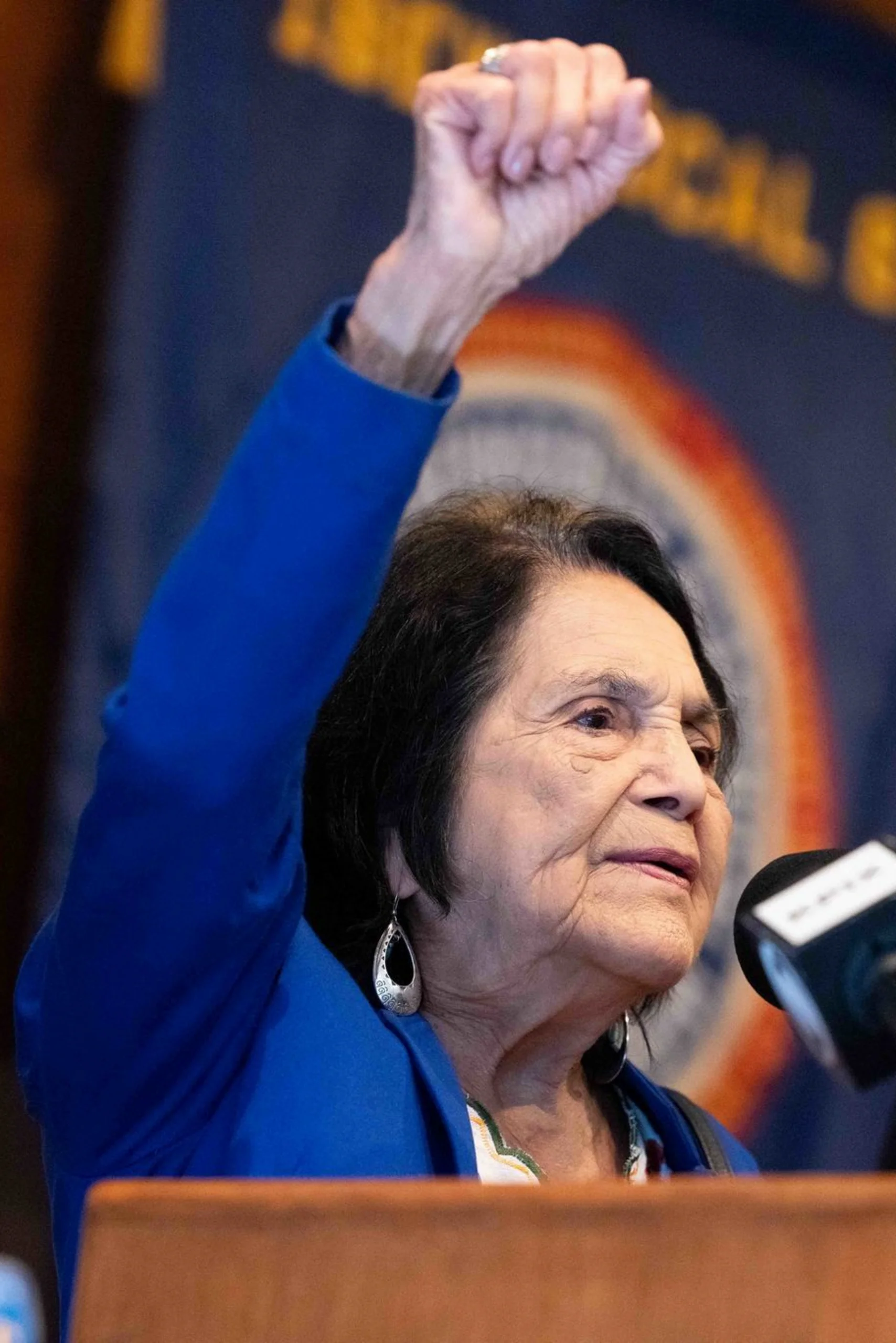
Dolores Huerta
 Mexico
Labor leader•community organizer•feminist activist
Also known as: Dolores Clara Fernández, Dolores Huerta
Birthday
April 10, 1930
Birth Sign
Aries
Birthplace
Dawson, New Mexico
Age
Died at 96
Height
5 ft 2 in (157 cm)
About
Dolores Huerta was an American labor leader, community organizer and feminist activist who co-founded the National Farm Workers Association, the organization that became the United Farm Workers. With César Chávez and Gilbert Padilla she built one of the most effective worker movements in American history, and she is credited with popularizing the rallying cry "¡Sí, se puede!" long before it became a national political slogan.
She was the strategist behind the national grape boycott, a contract negotiator who faced growers directly, and a lobbyist who pushed through disability insurance, pensions and Spanish-language ballots. In 2012 President Barack Obama awarded her the Presidential Medal of Freedom. California and Oregon both mark her birthday, April 10, as Dolores Huerta Day, and her image as a small woman with a megaphone became a shorthand for fearless organizing.
Huerta died on October 28, 2026, at the age of 96. She was still campaigning in her nineties, and the Dolores Huerta Foundation in Bakersfield continues the civic engagement work she started in 2002.
Early Life & Background
Dolores Clara Fernández was born on April 10, 1930, in Dawson, New Mexico, a coal mining town that hummed with the labor politics of her father, Juan Fernández. He mined and worked the fields, later becoming a union activist and a state assemblyman. Her mother, Alicia Chávez, divorced Juan and moved the family to Stockton, California, where she ran a restaurant and then a hotel. Stockton in those years was an agricultural hub, and Huerta grew up surrounded by farmworker families, many of them Mexican American, Filipino and Black.
She graduated from Stockton High School and earned a teaching credential from what is now San Joaquin Delta College. She briefly taught elementary school, but she left the classroom by her own account because she could not bear watching hungry farmworker children come to class without food. That decision pointed her toward organizing.
Her first political home was the Community Service Organization in the 1950s, where she registered voters, fought police brutality and learned the mechanics of lobbying. It was there she met César Chávez. The two became lifelong organizing partners, and Huerta developed into a sharp contract negotiator and a lobbyist who pushed Sacramento for disability insurance, pensions and Spanish-language voting ballots. By the early 1960s she was ready to build something new with Chávez and Gilbert Padilla, and in 1962 they founded the National Farm Workers Association.
Career Growth
The National Farm Workers Association merged with the Agricultural Workers Organizing Committee to form the United Farm Workers, and Huerta became one of its most visible leaders. During the 1965 Delano grape strike she worked alongside Filipino leader Larry Itliong and directed the national grape boycott, a campaign that reached consumers in cities far from California's fields. She negotiated contracts directly with growers, securing wage increases and better conditions for thousands of workers.
She coined and popularized "¡Sí, se puede!" as a UFW rallying cry, a phrase Barack Obama's 2008 campaign later adopted. In 1968 she stood beside Robert F. Kennedy at his victory speech in Los Angeles on the night he was assassinated. She served as a UFW vice president and in 1988 was beaten by San Francisco police during a protest, suffering serious injuries that became a defining image of her willingness to put her body on the line.
In 2002 she founded the Dolores Huerta Foundation in Bakersfield, California, focused on civic engagement and voter registration. She remained an activist into her nineties, backing Democratic campaigns from George McGovern and Robert Kennedy through Hillary Clinton, Joe Biden and Kamala Harris, and serving as honorary co-chair of the 2017 Women's March. She was inducted into the U.S. Department of Labor's Hall of Honor for co-founding the NFWA in 1962.
Career Timeline
Public Image & Style
Huerta's public image was inseparable from the megaphone. A small woman in plain clothes, often a wide-brimmed hat, she became the visual counterpoint to César Chávez: where he was quiet and ascetic, she was loud, fast and confrontational in the best sense. Media framed her as the fierce negotiator, the one who would face down growers and police alike. In later decades that image shifted into something broader, a feminist and civil rights icon in her own right, honored with the Presidential Medal of Freedom and celebrated in documentaries and films. She wore her age openly and kept the same direct, unsentimental speaking style to the end.
Fame & Fandom (iFAMOUS Rankings)
iFANN has not yet collected fame data for Dolores Huerta, so no ranking is available here. She is not on the September 2026 iFAMOUS Rankings flagship list. Her fame is of a different kind than most of the people on this site: it rests on decades of organizing, a Presidential Medal of Freedom and a place in school curricula rather than on streaming numbers or tabloid coverage.
The people who follow her work do not have a formal fandom name. They are labor organizers, Chicano studies students, teachers, union members and civil rights veterans, and they tend to engage with her legacy through the Dolores Huerta Foundation, through Dolores Huerta Day events on April 10 in California and Oregon, and through the documentary Dolores, which is often assigned in classrooms. Fans of her work quote "¡Sí, se puede!" the way other fandoms quote song lyrics, and the phrase shows up on picket signs at strikes she never attended, which is probably the tribute she would have appreciated most.
Interesting Facts and Legends
Huerta's rallying cry "¡Sí, se puede!" predates Barack Obama's 2008 campaign by decades, and Obama acknowledged her when he used it. She was not romantically involved with César Chávez, a misconception that persists in search results to this day. She stood about 5 feet 2 inches tall, and her public image was built around a megaphone, a wide-brimmed hat and a UFW eagle banner.
She had eleven children, a fact that surprises people who assume a life of organizing left no room for family. In 1988 San Francisco police beat her during a protest, and she suffered broken ribs and a ruptured spleen; she kept organizing. She appears as a character in the 2014 film Cesar Chavez, played by Rosario Dawson, and is the subject of the 2017 documentary Dolores.
Notable Quotes
“¡Sí, se puede!”
“Every moment is an organizing opportunity, every person a potential activist, every minute a chance to change the world.”
Family & Personal Life
Huerta's parents were Juan Fernández, a miner and farm worker who became a union activist and state assemblyman, and Alicia Chávez, who ran a restaurant and later a hotel in Stockton after the couple divorced. Huerta had eleven children across two marriages and other relationships. With her first husband, Ralph Head, she had two daughters, Celeste and Lori. With her second husband, Ventura Huerta, she had five children. She also had four children with Richard Chávez, César Chávez's brother, among them Juanita, who later worked at the Dolores Huerta Foundation. She lived much of her later life in Bakersfield, California, where her foundation is based.
Notable Connections
Relationships & Dating History
Huerta married twice. Her first husband was Ralph Head, with whom she had two daughters, Celeste and Lori; the marriage ended in divorce. She later married Ventura Huerta, with whom she had five children, and that marriage also ended in divorce. She had four additional children with Richard Chávez, César Chávez's brother, among them Juanita, who later worked at the Dolores Huerta Foundation.
She was not romantically involved with César Chávez, despite the persistent search query asking whether she married him. They were lifelong organizing partners and nothing more. At the time of her death in October 2026 she was not reported to be in any current romantic relationship, and her family statements were not made public.
- DivorcedRalph HeadFirst husband; the couple had two daughters, Celeste and Lori.
- DivorcedVentura HuertaSecond husband; the couple had five children.
- DatedRichard ChávezCésar Chávez's brother; the couple had four children, including Juanita.
Death & Aftermath
Died
October 28, 2026 (aged 96)
Death Place
Unknown
Cause of Death
Undisclosed
Word of Dolores Huerta's death reached the crowds already gathered in the streets she had spent a lifetime organizing. The labor organizer and civil rights activist, who co-founded the United Farm Workers with César Chávez, died on October 28, 2026, at the age of 96, a figure reported consistently by CNN, the Associated Press, The New York Times, NPR, The Washington Post, the BBC and California stations from Los Angeles to Sacramento. The precise place of death and the cause were not made public. The Washington Post's obituary called her a resolute champion of workers' rights, and a peer quoted in The Guardian's tribute coverage said she fought for farm workers to the very end, a phrase that fits a woman who was still campaigning in her nineties.
Reaction came fast from labor, civil rights and political circles. In Los Angeles, city leaders joined hundreds downtown for a candlelight vigil on the day she died, covered by CBS News Los Angeles within hours. CBS Sacramento aired a segment honoring a life of advocacy amid adversity, and the Los Angeles Times ran an appreciation on the Dolores Huerta I'll remember. The gathering in downtown Los Angeles stood as the first public memorial; funeral and burial arrangements were not disclosed.
Her institutional legacy runs through the Dolores Huerta Foundation, which she founded in Bakersfield in 2002 and which carried her civic advocacy work. She had already been inducted into the U.S. Department of Labor's Hall of Honor for co-founding the National Farm Workers Association in 1962, the union that became the UFW. Statements from her family and the handling of her estate were not made public.
Net Worth (Estate Value)
$2 Million
iFANN Editorial Team estimate
Dolores Huerta spent most of her life as a nonprofit organizer and union leader, and her personal wealth was modest. The iFANN Editorial Team's analysis of her earnings, speaking fees, book royalties and foundation work points to an estate valued at roughly $2 Million as of 2026. She did not draw a corporate salary, and much of her later income came from public speaking and appearances tied to her advocacy.
Her financial footprint is institutional rather than personal. The Dolores Huerta Foundation, which she founded in 2002 in Bakersfield, holds the bulk of the philanthropic and civic work associated with her name. Royalties from the 2017 documentary Dolores and from books about the farmworker movement, along with speaking fees from universities and unions, made up the rest. Her estate was not publicly disclosed after her death.
Awards Won (4)
Huerta received the Presidential Medal of Freedom in 2012, the Eleanor Roosevelt Human Rights Award, the Hispanic Heritage Award and the Puffin/Nation Prize for Creative Citizenship. She was inducted into the U.S. Department of Labor's Hall of Honor, and California and Oregon both designate April 10 as Dolores Huerta Day.
2012 · Civilian honor
Lifetime advocacy for farmworkers and civil rights
Human rights
Lifetime advocacy
Known For
Co-founding the United Farm Workers
1962 · Co-founder
Delano grape strike and national boycott
1965 · Organizer and negotiator
Popularizing "¡Sí, se puede!"
1960s · Originator
Dolores Huerta Foundation
2002 · Founder
Keywords
Sources
Quick Facts
- Profession
- Labor leader, community organizer, feminist activist
- Born
- April 10, 1930
- Birthplace
- Dawson, New Mexico
- Died
- October 28, 2026
- Age at death
- 96
- Gender
- Female
- Birth Sign
- Aries
- Children
- 11
Personal Details
- Full Name
- Dolores Clara Fernández
- Height
- 5 ft 2 in (157 cm)
- Children
- 11
- Education
- Stockton High School; San Joaquin Delta College (teaching credential)
Filmography
2
Total
2
Film
0
TV
Frequently Asked Questions
What was Dolores Huerta famous for?
Did Dolores Huerta marry Cesar Chavez?
How did Dolores Huerta die?
How many children did Dolores Huerta have?
What is Dolores Huerta's net worth in 2026?
Social Media
Similar People
Join the community
fans discussing