“A fierce, funny, and deeply moving portrait of a community on the brink, with a director who knows exactly how to make you feel the heat.”
Janet Maslin
The New York Times
 United States
"It's the hottest day of the summer. What will you do?"
User Score
2,038 votes
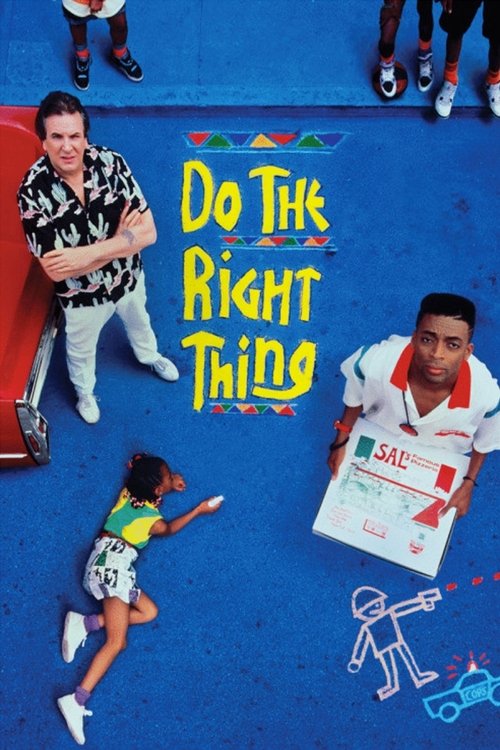
On the hottest day of the summer in 1989, the Bedford-Stuyvesant neighborhood of Brooklyn simmers. Spike Lee's Do the Right Thing drops us into a single block where the temperature isn't the only thing rising. At the center is Sal's Famous Pizzeria, run by Italian American Sal (Danny Aiello) and his two sons. The regulars, a mix of Black and Puerto Rican locals, come for the slices and the banter. But when Buggin' Out (Giancarlo Esposito) notices that Sal's Wall of Fame only honors Italian American icons, he demands change. That demand, small at first, cracks open a day of escalating friction.
Lee, who also wrote and produced, plays Mookie, the delivery man caught between his employer and his community. The ensemble, including Ossie Davis, Ruby Dee, and Bill Nunn, gives the block a lived-in rhythm. Shot on a $6.5 million budget, the film earned $37.3 million worldwide and an Oscar nomination for Best Original Screenplay. Its raw energy and unflinching look at race relations made it a cultural flashpoint, and the Library of Congress added it to the National Film Registry in 2021.
Availability and pricing can change. Confirm on the provider's site before purchasing.
The film opens with a radio DJ, Mister Señor Love Daddy, setting the scene: it's the hottest day of the year in Brooklyn. We meet Mookie, who works for Sal's Famous Pizzeria, delivering pies on foot. Sal's sons, Pino and Vito, help out. Pino, the angrier one, makes no secret of his disdain for the Black customers, while Vito is quieter, more accepting. The pizzeria is a neighborhood hub, where kids buy slices and adults argue about baseball.
Across the street, Da Mayor, an old drunk with a heart of gold, tries to win the affection of Mother Sister, a sharp-tongued widow. Radio Raheem, a giant of a man, carries a boombox that blasts Public Enemy's "Fight the Power" everywhere he goes. Buggin' Out, a hothead with a chip on his shoulder, notices something that sets him off: Sal's Wall of Fame, a collection of photos of Italian American celebrities, has no Black faces. He confronts Sal, demanding he add Malcolm X, Martin Luther King Jr., and others. Sal refuses, saying it's his wall and his heritage.
As the day wears on, the heat takes its toll. A man collapses from dehydration. A group of kids spray water from a fire hydrant. Mookie's girlfriend, Tina, pressures him for money and attention. The tensions simmer beneath the surface. Buggin' Out tries to organize a boycott of the pizzeria, but most residents aren't interested. He finds an ally in Radio Raheem, who agrees to blast his music even louder when they enter the pizzeria.
That evening, Buggin' Out and Radio Raheem walk into Sal's with the boombox at full volume. Sal, already on edge, demands they turn it off. Radio Raheem refuses. The argument escalates into a scuffle. Pino jumps in, and the chaos spills onto the street. A police car arrives. The officers, including a heavy-handed cop named Cavanaugh, try to break it up. The situation spirals out of control, and the neighborhood, already at a boiling point, explodes into violence. The film builds to a climax that forces every character to confront what "the right thing" really means.
Restored Trailer
Critical Consensus
Spike Lee's searing portrait of racial tension in Brooklyn remains as urgent today as it was in 1989. With a powerhouse ensemble and bold visual style, it forces audiences to confront uncomfortable truths about America.
“A fierce, funny, and deeply moving portrait of a community on the brink, with a director who knows exactly how to make you feel the heat.”
Janet Maslin
The New York Times
“Lee has created a masterpiece of American cinema, a film that is both a celebration of life and a warning about the consequences of hatred.”
Roger Ebert
Chicago Sun-Times
“Do the Right Thing is a firestorm of a movie, a blistering indictment of racism that never lets up. It's a film that demands to be seen and felt.”
Peter Travers
Rolling Stone
Danny Aiello
Sal
Ossie Davis
Da Mayor
Ruby Dee
Mother Sister
Spike Lee
Mookie
Giancarlo Esposito
Buggin' Out
Bill Nunn
Radio Raheem
John Turturro
Pino
Richard Edson
Vito
Joie Lee
Jade
Angela Bassett
Tina
Director
Spike Lee
Writer
Spike Lee
Composer
Bill Lee
Cinematographer
Ernest R. Dickerson
Producer
Spike Lee
Academy Award for Best Original Screenplay (1990)
Best Original Screenplay: Nominated
National Society of Film Critics Award for Best Director (1989)
Best Director: Won
National Society of Film Critics Award for Best Actor (1989)
Best Actor: Won
New York Film Critics Circle Award for Best Film (1989)
Best Film: Won
New York Film Critics Circle Award for Best Director (1989)
Best Director: Won
Independent Spirit Award for Best Feature (1990)
Best Feature: Won
Join the community
fans discussing