
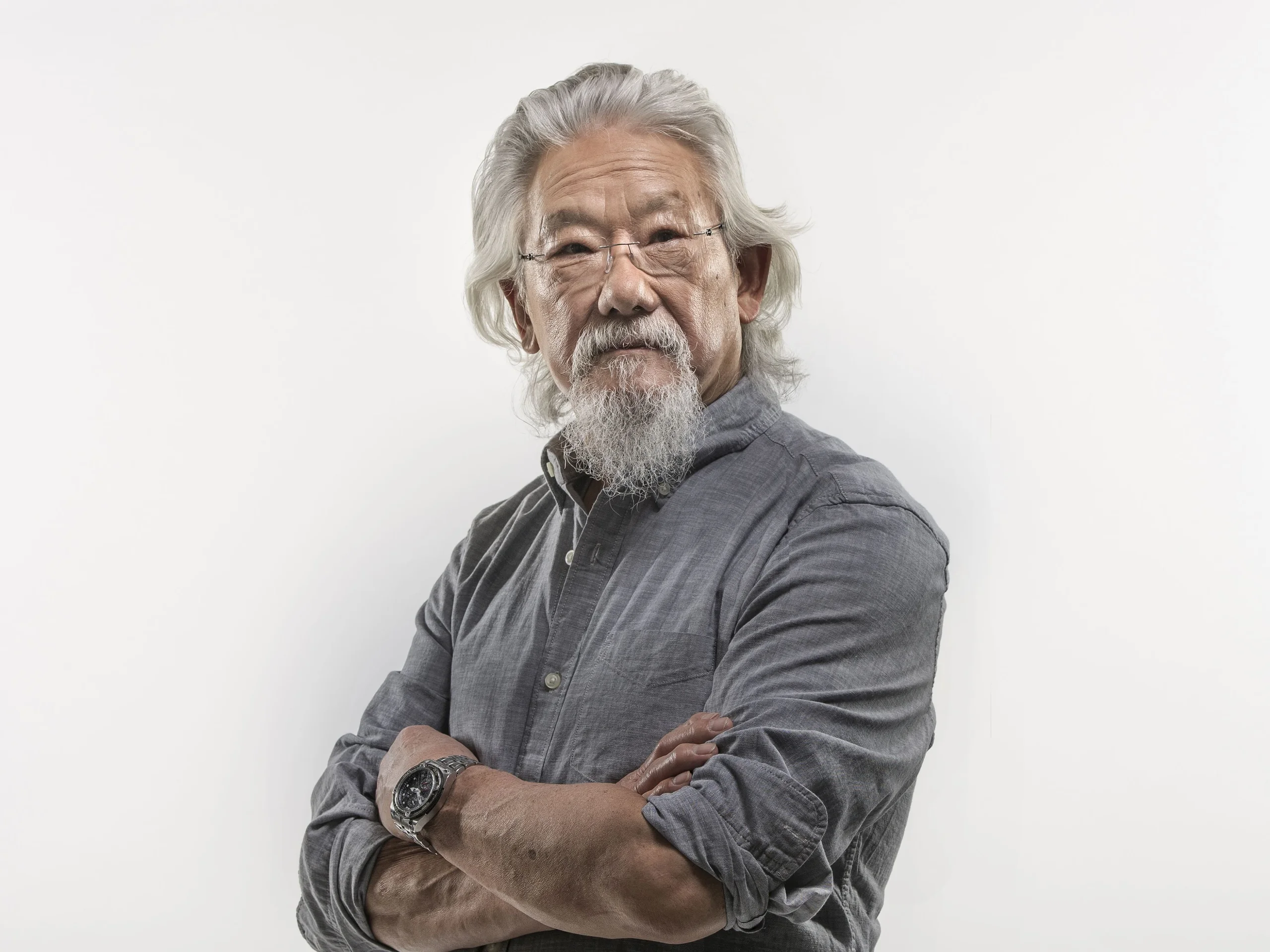
David Suzuki
 Canada
science broadcaster•geneticist•environmental activist
Also known as: Dr. David Suzuki, David Takayoshi Suzuki
Birthday
March 24, 1936
Birth Sign
Sagittarius
Birthplace
Vancouver, British Columbia, Canada
Age
90 years old
Height
5 ft 10 in (178 cm)
About
David Takayoshi Suzuki is a Canadian academic, science broadcaster, geneticist, and environmental activist born on March 24, 1936. He has spent over six decades making complex scientific concepts accessible to the public, most notably as the long-time host and narrator of the CBC Television program The Nature of Things. The show has aired continuously since 1969 and reached audiences in more than 40 countries, becoming the longest-running science program in North American history. Beyond broadcasting, Suzuki co-founded the David Suzuki Foundation in 1990, an organization dedicated to protecting oceans, combating climate change, and promoting sustainable development.
As of 2026, the 90-year-old remains a fiercely active voice in the fight for climate justice. He leads the "Stronger Together" tour and continues to issue stark warnings about the planetary crisis, refusing to offer what he calls "hopium" to younger generations facing an uncertain future. His career bridges the gap between rigorous academic genetics and passionate public advocacy, earning him the title of Companion of the Order of Canada and the Right Livelihood Award in 2009. Suzuki's work has fundamentally shaped how Canadians understand their relationship with the natural world.
Early Life & Background
David Suzuki was born into a Japanese Canadian family in Vancouver during a time of rising racial tension. His father, Isamu, worked as a florist, while his mother, Yoneko, labored in a cannery. The family's life changed drastically in 1941 following the attack on Pearl Harbor. The Canadian government forcibly relocated Japanese Canadians from the West Coast, sending the Suzuki family to the Slocan Valley in the interior of British Columbia. They lived in makeshift camps and lost their home and property, an experience that deeply instilled in Suzuki a lifelong commitment to social justice and civil rights.
Racial discrimination continued to block his path after the war. Although he attended Prince of Wales Secondary School in Vancouver, universities in Canada barred him from enrollment due to his heritage. Suzuki moved to the United States to pursue higher education, earning a Bachelor of Science degree from Amherst College in Massachusetts in 1957. He then completed a Master of Arts and a PhD in zoology at the University of Chicago, where his dissertation focused on the genetics of fruit flies. In 1963, he returned to Canada to join the faculty of the University of British Columbia as an assistant professor in the Department of Genetics. For nearly four decades, he conducted research on molecular biology while quietly beginning to write for magazines and appear on radio programs to explain science to the general public.
Career Growth
Suzuki's transition from academic scientist to household name began in the late 1960s when he started writing for Maclean's magazine and appearing on CBC radio. A pivotal moment arrived in 1969 when he was invited to host a new television series focused on science and nature. The Nature of Things premiered that year and quickly became a staple of Canadian broadcasting. Unlike many science communicators who rely on fleeting media attention, Suzuki built a consistent presence over five decades, translating complex genetic and ecological concepts into relatable narratives for millions of viewers.
In 1990, he shifted his focus toward direct activism by co-founding the David Suzuki Foundation. This non-profit organization became a powerful force in shaping Canadian environmental policy, tackling issues ranging from ocean conservation to clean energy. Suzuki retired from the University of British Columbia in 1993 to devote himself entirely to broadcasting, writing, and advocacy. His influence expanded globally with the launch of the Suzuki Challenge in 1997, a youth-led initiative designed to combat climate change. Throughout the 2000s and 2010s, he published numerous best-selling books, including The Legacy and Nature Matters, cementing his status as a leading intellectual voice on biodiversity and sustainability. In 2026, at age 90, he continues to lead the "Stronger Together" tour, delivering urgent messages about the climate emergency without softening the reality of the situation.
Career Timeline
Public Image & Style
Suzuki projects an image of a principled, urgent, and compassionate leader. His tone is often serious and direct, reflecting the gravity of the climate crisis he warns about daily. He is seen as a bridge between the ivory tower of academia and the everyday citizen, using his platform to advocate for evidence-based policy. His public persona is one of integrity and consistency, having maintained his message for over 50 years without compromising his stance on environmental protection. He is widely respected for his refusal to sugarcoat the reality of climate change, earning him a reputation as a truth-teller rather than a celebrity figure.
Fame & Fandom (iFAMOUS Rankings)
David Suzuki commands a distinct sphere of influence defined not by celebrity worship but by decades of scientific communication and environmental advocacy. His audience consists of supporters, activists, and readers who align with his evidence-based research rather than a fanbase seeking personal devotion or ritualistic engagement. Unlike pop culture figures, he does not possess a formal fandom name, organized campaigns, or fan-driven projects such as birthday billboards or charity drives funded solely by admirers. The public discourse surrounding him ranges from deep appreciation for his work on The Nature of Things to critical analysis of the environmental movement's efficacy, as seen in discussions on platforms like Reddit that treat his career as a case study rather than a source of entertainment lore. His cultural footprint is saturated through his books, television appearances, and the David Suzuki Foundation, creating a legacy built on intergenerational responsibility and urgent climate warnings rather than the chaotic reactions typical of entertainment icons. In August 2026, the iFANN Global Fame Engine evaluated his standing and determined that he currently holds no placement within the published rankings, including the Global Top 1,000 or any Top-100 scope list. Consequently, there is no numeric rank or score to report for this evaluation period, and no specific ranking page exists to link to for this individual.
Interesting Facts and Legends
Before becoming a famous broadcaster, Suzuki was a respected geneticist who studied the genetics of fruit flies, a model organism in biological research. His early life was marked by the forced relocation of Japanese Canadians during World War II, a traumatic event that profoundly influenced his later activism for civil rights and social justice. He is also a licensed pilot and has flown small planes to remote areas for both research and environmental advocacy. Suzuki maintains a close friendship with musician Neil Young, who frequently collaborates with him on environmental causes and even appeared at a benefit concert in his honor in 2026. He speaks English and some Japanese, reflecting his heritage, and is known for his distinctive expressive eyes and frequent use of glasses in public appearances.
Notable Quotes
“Climate change is evidence of intergenerational crime.”
“We need to declare an emergency that changes everything.”
“Love is the secret weapon in facing our collective crises.”
“I refuse to give young people 'hopium' about the future.”
Family & Personal Life
David Suzuki's personal life has been defined by two marriages and three children. He first married Barbara Hutton in 1961, but the couple divorced in 1966 without having children together. In 1967, he married Margaret "Peggy" MacLean, who remained his partner until her death in 2018. Peggy was a strong supporter of his work and played a significant role in the early days of the David Suzuki Foundation. The couple had three children: Kira Suzuki, who works in the arts and activism; Joshua Suzuki, an environmental lawyer; and Michelle Suzuki, involved in community organizing. Following Peggy's passing, Suzuki has not publicly entered into a new romantic relationship. As of 2026, he is widowed and lives primarily in Vancouver, British Columbia.
Notable Connections
Peggy Suzuki, Ian Hanington, Neil Young, Barbara Hutton
Relationships & Dating History
David Suzuki's romantic life has been relatively private compared to his public profile, though his long-term partnership is well-documented. He first married Barbara Hutton in 1961, but the marriage ended in divorce in 1966. There were no children from this union. In 1967, Suzuki married Margaret "Peggy" MacLean, marking the beginning of a partnership that lasted over 50 years. Peggy was a steadfast supporter of his work and played a crucial role in the foundation's early days. The couple raised three children together: Kira, Joshua, and Michelle. Their relationship stood as a pillar of stability throughout Suzuki's rise to fame and his transition into full-time activism. Following Peggy's death in 2018, Suzuki has not publicly entered into a new romantic relationship. As of 2026, he is widowed. While he has collaborated closely with various partners in his professional life, including Ian Hanington, these have been strictly professional partnerships rather than romantic entanglements. There are no credible reports of dating or engagement in his later years.
- DivorcedBarbara Hutton1961 - 1966First wife; no children together.
- WidowedMargaret MacLean1967 - 2018Second wife; mother of his three children; died in 2018.
Salary, Net Worth In 2026
$15 Million
iFANN Editorial Team estimate
iFANN Editorial Team estimates David Suzuki's net worth at approximately $15 million USD as of 2026. This figure reflects a lifetime of earnings from his long tenure as a science broadcaster, book royalties from over 20 publications, and high-profile speaking engagements. His primary wealth sources include a steady salary from CBC Television spanning decades, substantial income from book sales including titles like The Legacy and Nature Matters, and fees for lectures at major conferences. While the David Suzuki Foundation operates as a separate non-profit entity, his role as co-founder likely involves management stipends. He also owns significant real estate holdings in Vancouver and rural British Columbia, which contribute to his overall financial portfolio. The estimate accounts for his assets and income streams accumulated over a career that has spanned more than half a century.
Awards Won (5)
David Suzuki has received numerous accolades recognizing his contributions to science and environmentalism. He was awarded the Right Livelihood Award in 2009, often called the Alternative Nobel, for his lifelong commitment to sustainability. In 2011, he won the Nautilus Book Award for his book The Legacy. He is a Companion of the Order of Canada, the highest level of the order, and was inducted into the Order of British Columbia in 1999. Additionally, he received the Gairdner Foundation International Award in 1990 for his biomedical research contributions.
2009 · Environmental Sustainability
Lifelong commitment to environmental awareness
2011 · Best Book
The Legacy
Known For
The Nature of Things
1969 · Host/Narrator
The Legacy
2011 · Author
Nature Matters
2015 · Author
Keywords
Sources
Quick Facts
- Profession
- writer, environmentalist, science writer
- Born
- March 24, 1936
- Birthplace
- Vancouver
- Gender
- Male
- Birth Sign
- Sagittarius
Personal Details
- Full Name
- David Takayoshi Suzuki
- Height
- 5 ft 10 in (178 cm)
- Spouse
- Peggy MacLean (1967–2018), Barbara Hutton (1961–1966)
- Children
- Kira Suzuki, Joshua Suzuki, Michelle Suzuki
- Education
- Amherst College (B.S., 1957); University of Chicago (M.A., 1958; Ph.D., 1961)
Filmography
45
Total
12
Film
33
TV
Frequently Asked Questions
How old is David Suzuki?
Is David Suzuki still alive?
Who is David Suzuki's wife?
What is David Suzuki's net worth?
Why is David Suzuki famous?
Similar People
Join the community
fans discussing