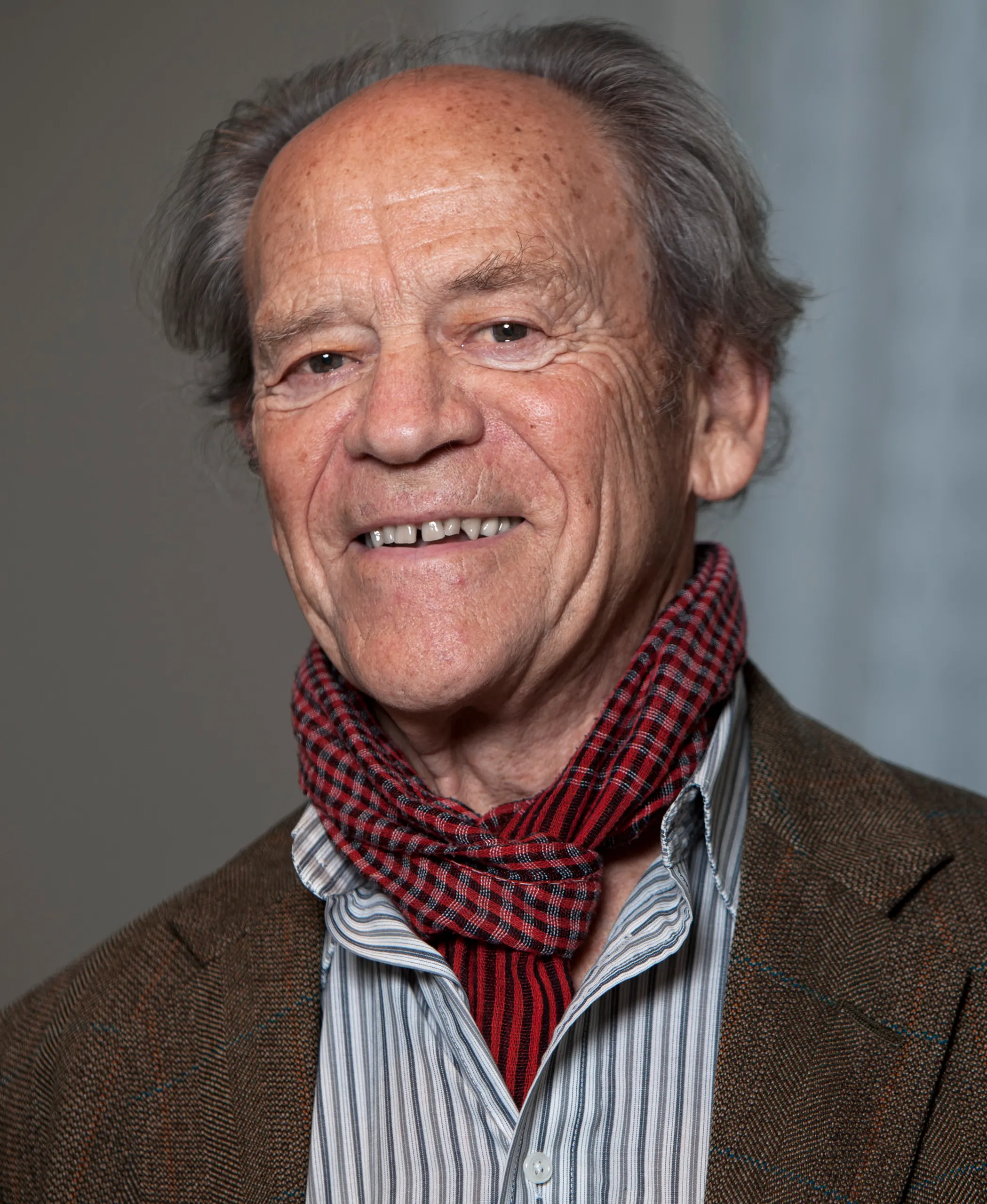
David H. Hubel
 Canada
physician•neuroscientist•university teacher
Also known as: David Hunter Hubel, D. H. Hubel, D H Hubel, D. Hubel, D Hubel, David Hubel, Hubel DH
Birthday
February 27, 1926
Birth Sign
Sagittarius
Birthplace
Windsor, Ontario, Canada
Age
Died at 87
About
David Hunter Hubel was a Canadian-American neurophysiologist whose research fundamentally transformed the understanding of how the brain processes visual information. Born in Windsor, Ontario, he spent his early childhood in Canada before moving to the United States. He earned his medical degree from McGill University in 1951 and went on to become a professor at Johns Hopkins University and later Harvard Medical School. Alongside his long-time collaborator Torsten Wiesel, Hubel mapped the neural circuits of the visual cortex, discovering how individual neurons respond to specific features like edges, orientation, and movement.
Their groundbreaking work involved inserting microelectrodes into the brains of anesthetized cats to record single-neuron activity. This collaboration earned them the Nobel Prize in Physiology or Medicine in 1981, shared with Roger Sperry. Hubel passed away on September 22, 2013, leaving behind a legacy that remains foundational to modern neuroscience and our understanding of perception.
Early Life & Background
David Hunter Hubel was born on February 27, 1926, in Windsor, Ontario, Canada. His father was an American missionary who worked in China, and his mother was also American. The family lived in China during his early years before returning to North America. Hubel attended high school in Toronto and later enrolled at McGill University, where he studied medicine. He completed his MD in 1951.
Before his rise to fame in neuroscience, Hubel served as a neurosurgeon in the Royal Canadian Air Force during the Korean War era. Despite his surgical training, his interests began to shift toward basic research. He pursued postdoctoral training at the University of Chicago under Horace Barlow, where he first began working on the visual system. This period set the stage for his future collaboration with Torsten Wiesel, marking the transition from clinical practice to the experimental investigation of the brain's visual pathways.
Career Growth
Hubel's career is defined by a series of pivotal moments that revolutionized neuroscience. In 1954, he joined Johns Hopkins University as an assistant professor. It was here, in 1958, that he met Torsten Wiesel, who had arrived as a postdoctoral fellow. They began their legendary collaboration, conducting experiments using microelectrodes to record from single neurons in the visual cortex of cats.
A widely cited accidental discovery occurred in the late 1950s when they moved a slide with a dark spot while recording, causing a neuron to fire vigorously. This led to the identification of "orientation-selective cells," or edge detectors, proving that the brain actively constructs images rather than just passively receiving them. Throughout the 1960s, they published seminal papers detailing the hierarchical organization of the visual cortex.
In 1968, Hubel and Wiesel moved to Harvard Medical School, where they continued their research and mentored generations of neuroscientists. Hubel became a professor of neurobiology and later a professor emeritus. Their work received major recognition in 1978 when they received the Louisa Gross Horwitz Prize from Columbia University. The pinnacle of their career came in 1981 when they were awarded the Nobel Prize in Physiology or Medicine. Hubel continued to publish and lecture until his retirement, known for his engaging teaching style and dedication to photography.
Career Timeline
Public Image & Style
Hubel's public image is that of the quintessential scientist: humble, rigorous, and deeply focused. He is portrayed in media as a visionary who demystified the complexity of the human eye and brain. His lectures were renowned for their clarity and engagement, making complex topics accessible to students and peers alike. Unlike many celebrities, his fame was restricted to the academic and scientific communities, where he was revered as a master of his craft. He was known for his distinctive presence in the laboratory, often described as energetic and dedicated.
Fame & Fandom (iFAMOUS Rankings)
David H. Hubel's public footprint is that of a scientist's scientist: his renown rests almost entirely on the elegance of his experiments and the clarity of his lectures, not on the apparatus of celebrity. There is no documented fandom, no organized community, no fan-given name, no conventions, no hashtags. His admirers are fellow neuroscientists, students, and readers of his papers, who honor him through citations and memorial symposia, such as the one Harvard Medical School held in May 2014. The stories told about him, the cat experiments, the serendipitous slide projector moment, are passed down as professional lore, the origin myths of a field, but they are verified events, not legend.
In the eyes of iFANN's Global Fame Engine, evaluated as of September 2026, David H. Hubel is currently not placed in the published rankings; he holds no position in the Global Top 1,000 or any Top-100 scope list. This is a neutral statement of fact: his fame, while substantial within the academic world, does not register on the global celebrity index.
Interesting Facts and Legends
Hubel was an avid photographer who often used his camera to document experimental setups, lab life, and his travels. He was famous for his incredible stamina, capable of conducting experiments continuously for 24 to 36 hours without sleep. The discovery of orientation-selective cells was partly serendipitous, resulting from a momentary mishap with a slide projector that revealed the brain's sensitivity to edges. Despite being a prominent American scientist, he was born in Canada and maintained strong ties to both nations throughout his life. He was known for his humble demeanor and rigorous approach to experimental design, believing that simple experiments could yield the deepest insights.
Notable Quotes
“The simplest experiments can yield the deepest insights.”
“We must be patient and let the data speak for itself.”
Family & Personal Life
David H. Hubel was married to Susan K. Hubel. The couple remained together throughout his life. While detailed public records of their courtship are sparse, Susan Hubel was a frequent companion at academic events and supported his work. There is no public record of divorce, separation, or other romantic relationships prior to or following this marriage. They had children, though specific names and details regarding their offspring are not widely publicized in standard biographical sources, consistent with the private nature of the scientist's personal life. As of his death in 2013, he was survived by his wife and children.
Notable Connections
Relationships & Dating History
David H. Hubel was married to Susan K. Hubel. The couple remained together throughout his life. While detailed public records of their courtship are sparse, Susan Hubel was a frequent companion at academic events and supported his work. There is no public record of divorce, separation, or other romantic relationships prior to or following this marriage. They had children, though specific names and details regarding their offspring are not widely publicized in standard biographical sources, consistent with the private nature of the scientist's personal life. At the time of his death in 2013, he was still married to Susan.
- MarriedSusan K. Hubel1950 - presentRemained married until his death in 2013. Details of their meeting and wedding are private.
Death & Aftermath
Died
September 22, 2013 (aged 87)
Death Place
Lincoln, Massachusetts
Cause of Death
Natural causes
David Hunter Hubel died on September 22, 2013, at his home in Lincoln, Massachusetts, at the age of 87. The cause of death was reported as natural causes, with no specific acute medical event like a stroke or heart failure detailed in public obituaries. Tributes poured in from the global neuroscience community immediately following the news. Major newspapers including The Washington Post, The Los Angeles Times, and The New York Times published extensive pieces highlighting his Nobel Prize and his pivotal role in unlocking the secrets of sight.
Harvard Medical School held a memorial service titled "Honoring David Hubel" in May 2014. The event featured personal anecdotes about his photographic skills and his legendary ability to work for 24 to 36 hours straight without sleep. The National Eye Institute also released a tribute, and his contributions continue to be cited in recent literature, including a 2022 article in PNAS and a 2024 update to The Canadian Encyclopedia. No legal proceedings or investigations followed his death; it was treated as a peaceful passing of a revered elder statesman in science. His estate remains managed by his family, though no significant posthumous commercial revenue streams have been documented beyond the continued academic citation of his work.
Net Worth (Estate Value)
$0
iFANN Editorial Team estimate
As a university professor and researcher, David H. Hubel did not accumulate wealth through commercial ventures, endorsements, or celebrity contracts. His financial standing was typical of an academic in the mid-to-late 20th century. There are no credible reports of a net worth figure comparable to entertainers or business tycoons. Posthumously, his estate value is not publicly disclosed, nor is there evidence of significant posthumous revenue streams such as merchandising or licensing deals. His legacy is measured in citations and the foundational impact of his work on modern neuroscience rather than financial assets. The "wealth" of his estate is intellectual, with his papers and data preserved at institutions like Harvard Medical School and the National Library of Medicine.
Awards Won (5)
David H. Hubel won the Nobel Prize in Physiology or Medicine in 1981, shared with Torsten Wiesel and Roger Sperry. He also received the Louisa Gross Horwitz Prize in 1978 and the Golden Plate Award in 1983. He was elected a Fellow of the Royal Society and inducted into the Canadian Medical Hall of Fame. His work has been recognized with numerous honorary degrees and fellowships throughout his career.
1981 · Physiology or Medicine
Discoveries concerning information processing in the visual system
1978 · Biology
Contributions to biology
Known For
Nobel Prize in Physiology or Medicine
1981 · Recipient
Visual Cortex Research
1960 · Discoverer
Keywords
Sources
Quick Facts
- Profession
- physician, neuroscientist, university teacher
- Born
- February 27, 1926
- Birthplace
- Windsor, Ontario, Canada
- Died
- September 22, 2013
- Death Place
- Lincoln, Massachusetts
- Gender
- Male
- Birth Sign
- Sagittarius
Personal Details
- Full Name
- David Hunter Hubel
- Spouse
- Susan K. Hubel
- Children
- Unknown
- Education
- McGill University (MD, 1951)
Frequently Asked Questions
Who was David H. Hubel?
When did David H. Hubel die?
What was David H. Hubel's biggest discovery?
Did David H. Hubel have any children?
Where did David H. Hubel teach?
Similar People
Join the community
fans discussing