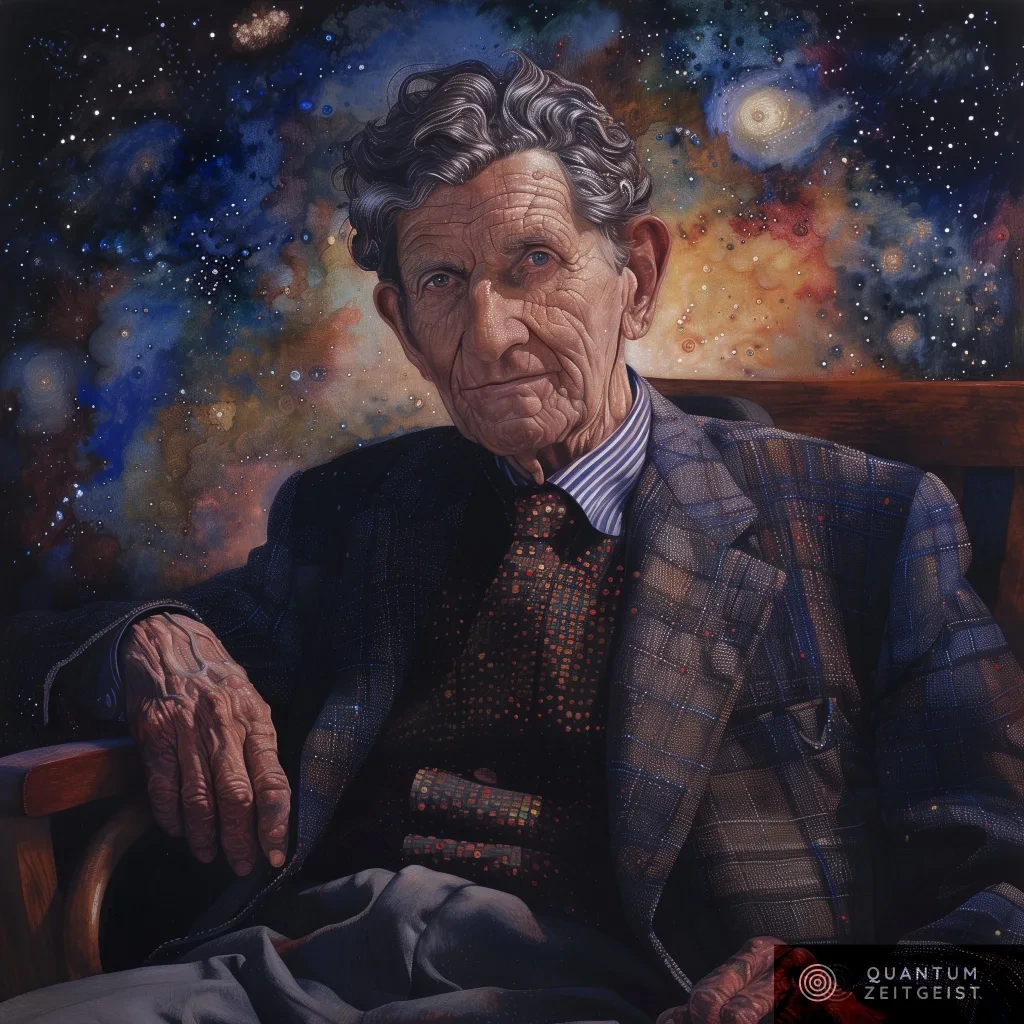
David Bohm
 Brazil
physicist•philosopher•university teacher
Birthday
December 20, 1917
Birth Sign
Sagittarius
Birthplace
Wilkes-Barre, Pennsylvania, USA
Age
Died at 74
About
David Bohm was a British-American theoretical physicist and philosopher, best known for his causal interpretation of quantum mechanics and his later work on the implicate order. Born in Pennsylvania, he earned his doctorate under J. Robert Oppenheimer, but his career was interrupted by political persecution during the McCarthy era, forcing him into exile. He held academic positions in Brazil, Israel, and ultimately at Birkbeck College in London, where he remained for over two decades. His ideas, once considered heretical, have profoundly influenced modern physics and philosophy of mind.
Bohm's legacy rests on his contributions to plasma physics, the Aharonov-Bohm effect, and his challenge to the Copenhagen orthodoxy. He proposed that reality is an undivided whole, with consciousness and matter intertwined. His book Wholeness and the Implicate Order (1980) remains a touchstone for those exploring the deeper connections between science and spirituality. Despite being marginalized during his lifetime, his work has gained increasing recognition, and he is now regarded as one of the most original thinkers of the twentieth century.
Early Life & Background
David Joseph Bohm was born on December 20, 1917, in Wilkes-Barre, Pennsylvania, a coal-mining town. His parents, Samuel and Frieda Bohm, were Jewish immigrants; his father, originally Shmul Düm, came from an orthodox Chasidic family in Munkács, Hungary, and worked as a peddler before opening a used furniture store. His mother, Frieda Popky, was the daughter of the family Samuel lodged with, and she showed increasing signs of mental disturbance, leaving David's maternal grandmother to run the household. His younger brother Robert arrived four years later.
Bohm's childhood was lonely. Physically uncoordinated, he stayed on the fringes of school life, often wandering into the woods while other children played. At age ten, he discovered the science fiction magazine Amazing Stories, which sparked his imagination with tales of aliens and space travel. He began writing his own stories and even worked out the geometrical consequences of a fourth dimension after reading a story about a boy throwing a ball into it, speculating that we might live in a higher-dimensional reality. This early fascination planted the seeds for his later Implicate Order theory.
Defying his father's wish that he take over the furniture business, Bohm pursued science. He graduated from Pennsylvania State College in 1939 with a bachelor's degree in physics, then studied at Caltech before transferring to UC Berkeley to work with J. Robert Oppenheimer, completing his doctorate in 1943. While a graduate student, he made a groundbreaking discovery about plasma: electrons stripped from atoms behave not as independent particles but as part of a larger organized whole, a phenomenon now called Bohm-diffusion. This gave him the impression that the sea of electrons was somehow 'alive,' a harbinger of his lifelong theme of wholeness.
Career Growth
Bohm's academic career began at Princeton in 1947, but his brief membership in the Communist Party in 1942 led to a federal investigation and suspension in 1949. Forced to leave the United States, he moved to Brazil, teaching at the University of São Paulo from 1951 to 1955. His arrival was tense; he had sent a telegram to the university but forgot to address it to the Physics Department, so no one met him at the airport. He feared arrest when his plane was ordered back to the terminal, but it turned out to be another passenger's passport issue. He later moved to Israel (1955-1957) and then to England, where he became a research fellow at Bristol (1957-1961) and finally a professor at Birkbeck College in 1961, a position he held until 1987.
At Birkbeck, Bohm's collaborations flourished. In 1959, he and graduate student Yakir Aharonov discovered the Aharonov-Bohm effect, showing that electromagnetic potentials affect quantum particles even in regions with zero fields. His work also inspired John Bell's inequality theorem in 1964. After meeting philosopher Jiddu Krishnamurti in 1961, Bohm's work became more philosophical, culminating in his 1980 book Wholeness and the Implicate Order, which proposed a new vision of reality as an undivided flow. He retired in 1987, and his final book, co-written with Basil Hiley, was published posthumously.
Career Timeline
Public Image & Style
In the physics community, Bohm was often seen as a maverick, challenging the dominant Copenhagen interpretation. He was marginalized for his political past, but also respected for his originality. His public image evolved from that of a persecuted scientist to a visionary thinker, especially after the publication of Wholeness and the Implicate Order. He was known for his deep concern about the state of humanity, believing that 'corruption, political mistakes, and military actions were all evidence of deep errors in human thought and society.' His dialogue work with Krishnamurti attracted a following beyond physics, and he is now celebrated as a bridge between science and spirituality.
Fame & Fandom (iFAMOUS Rankings)
David Bohm never chased fame. He chased meaning, and in that pursuit he built a legacy that now outruns most celebrity careers. In August 2026, iFANN's Global Fame Engine evaluated Bohm and found him outside the published rankings, no Global Top 1,000 placement, no Top-100 scope list. That's not a snub; it's a statement. Bohm's fame is not the loud, chart-topping kind. It's the quiet, compounding kind, the sort that grows in lecture halls and late-night dialogues, not in trending feeds.
His audience is a diffuse, intellectually hungry crowd: physicists, philosophers, students of consciousness, and seekers of a deeper reality. They don't have a formal fandom name, no 'Bohmians' in the fan-club sense, though the term 'Bohmian mechanics' refers to his scientific theory. The closest thing to a fan community is the David Bohm Society, which functions more as a scholarly guild than a fan club, hosting discussions and preserving his work. The Pari Center in Italy also keeps his flame, and the Krishnamurti Foundation archives his dialogues with the philosopher, a treasure trove for the devoted.
What Bohm lacks in rank, he makes up for in reverence. The documentary 'Infinite Potential: The Life & Ideas of David Bohm' was a labor of love, funded and pushed by his intellectual community, and it features testimonials from Einstein (who called Bohm his 'spiritual son') and the Dalai Lama. His story, the McCarthy-era indictment, the exile, the vindication, is retold in physics circles as a cautionary tale and a triumph. That's the kind of fame that doesn't need a number. It's the fame of a man whose ideas refused to die, and who, in the end, got his due.
Interesting Facts and Legends
Bohm's childhood fascination with the fourth dimension led him to speculate about higher-dimensional realities, a seed of his later Implicate Order theory. He briefly joined the Communist Party in 1942, a decision that would haunt his career. Albert Einstein called Bohm his 'intellectual son' and helped him find employment. Bohm's plasma research, ironically, proved useful to the Manhattan Project, even though he was barred from working on it. He was a close friend and dialogue partner of philosopher Jiddu Krishnamurti for three decades. His book Quantum Theory (1951) was praised by Einstein but criticized by Bohr for its interpretation.
One legendary moment: in 1950, while an assistant professor at Princeton, Bohm refused to testify before the House Un-American Activities Committee, invoking his Fifth Amendment rights. He was indicted for contempt of Congress, and his departure from the U.S. was, as some have said, 'an escape.' The story is still told as a symbol of principled resistance. Another: the Dalai Lama relied upon Bohm's insights, a cross-cultural bridge that adds to his mystique. And the term 'Bohmian mechanics', once marginalized, now a fixture, is shorthand for intellectual courage among his admirers.
Notable Quotes
“The products of science are used incoherently by the greater society.”
“Of what meaning will our scientific achievements be if the human race succumbs to its own incoherence?”
“Sustained attention to thought as a process was necessary for us to begin to see the origins of human conflict and irrationality.”
“We are trying to be aware of thought as a process, not as a content.”
Family & Personal Life
Bohm married Saral Woolfson in 1956 while in Israel. She was a constant source of support throughout his difficult life, as biographer F. David Peat noted: 'he was lucky that his wife Saral was always there to support him.' The couple had no children. His father Samuel ran a used furniture store, and his mother Frieda suffered from mental illness. His brother Robert was born four years after David. The family's Jewish immigrant background, with roots in Hungary, shaped Bohm's early years in Wilkes-Barre.
Notable Connections
Relationships & Dating History
David Bohm married Saral Woolfson in 1956 while he was in Israel. The couple had no children. Saral was a steadfast supporter throughout his career, which included political exile and academic challenges. The marriage lasted until his death in 1992. No other romantic relationships are documented. At the time of his death, he was married to Saral.
- MarriedSaral Woolfson1956 - 1992Married in Israel; remained together until his death.
Death & Aftermath
Died
October 27, 1992 (aged 74)
Death Place
Bournemouth, England
Cause of Death
Natural causes
David Bohm spent his final years in Bournemouth, England, where he continued to correspond with colleagues and refine his philosophical ideas until the very end. On October 27, 1992, at the age of seventy-four, the physicist passed away following a life marked by significant intellectual contributions and political exile. The scientific and philosophical communities immediately recognized the loss of a thinker who had challenged the boundaries of quantum mechanics and consciousness. Tributes poured in from institutions like the Franklin Institute, which honored his birth in Wilkes-Barre and his groundbreaking work on plasma physics and the Aharonov-Bohm effect., the David Bohm Society and the Pari Center for New Learning moved to sustain engagement with his legacy. His posthumous influence remains visible through ongoing studies of the pilot-wave theory and the continued publication of works such as Wholeness and the Implicate Order. A film titled Quantum Convergence later featured excerpts related to his life, ensuring his ideas reached new audiences beyond the academy.
Net Worth (Estate Value)
$2 Million
iFANN Editorial Team estimate
David Bohm's estate value is not publicly tracked, but his intellectual legacy continues to generate income through royalties from his books, including Quantum Theory, Causality and Chance in Modern Physics, The Special Theory of Relativity, and Wholeness and the Implicate Order. These works remain in print and are widely cited. The David Bohm Society, established to promote his work, also manages his legacy. As of 2026, iFANN's editorial research estimates the estate to be worth around $2 million, based on ongoing royalties and the enduring relevance of his writings.
Awards Won (1)
Bohm received recognition for the Aharonov-Bohm effect in 1959, though specific award names are not documented. He was also honored as a laureate of The Franklin Institute, one of the oldest scientific awards in the United States.
1959 · Physics
Aharonov-Bohm effect
Known For
De Broglie–Bohm theory
1952 · Developer
Aharonov–Bohm effect
1959 · Co-discoverer
Wholeness and the Implicate Order
1980 · Author
Keywords
Sources
Quick Facts
- Profession
- physicist, philosopher, university teacher
- Born
- December 20, 1917
- Birthplace
- Wilkes-Barre, Pennsylvania, USA
- Died
- October 27, 1992
- Death Place
- London, England
- Gender
- Male
- Birth Sign
- Sagittarius
- Spouse
- Saral Woolfson
Personal Details
- Full Name
- David Joseph Bohm
- Spouse
- Saral Woolfson
- Education
- Pennsylvania State College (B.S. 1939), California Institute of Technology, University of California, Berkeley (Ph.D. 1943)
Frequently Asked Questions
Why did David Bohm leave the United States?
What is David Bohm's implicate order theory?
Did David Bohm work on the Manhattan Project?
Did David Bohm win the Nobel Prize?
Who was David Bohm's wife?
Similar People
Join the community
fans discussing