 United States
“Oldman's Churchill is a marvel of physical transformation and psychological insight, a man who seems to have stepped out of the pages of history and into the living room of our nightmares.”
A.O. Scott
The New York Times
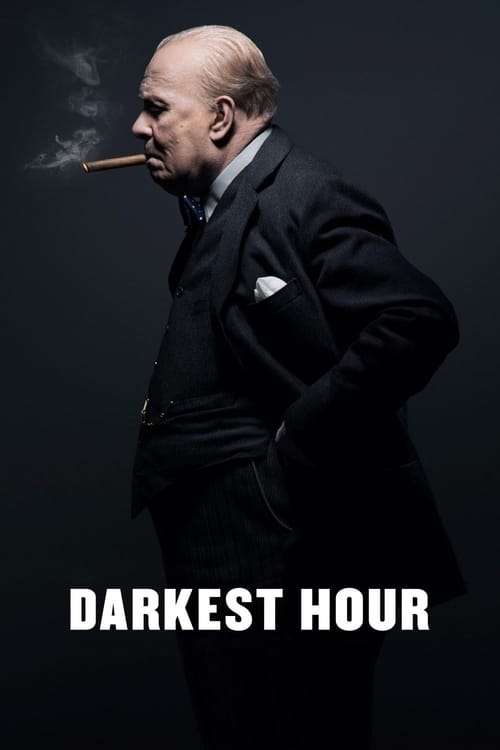
May 1940 marks a terrifying turning point in history where the British Empire stands alone against the Nazi war machine. The fate of democracy rests on the shoulders of a man who has spent his career in the political wilderness. Joe Wright directs this gripping drama, bringing Winston Churchill to life through a transformative performance by Gary Oldman.
The film explores the tense weeks leading up to the Battle of Britain, where the Prime Minister faces an impossible choice between peace negotiations and a fight that could destroy everything he knows. This narrative dives into the corridors of power at Downing Street, revealing the human cost of leadership when the world seems ready to collapse.
Stream
Availability and pricing can change. Confirm on the provider's site before purchasing.
In May 1940, the geopolitical landscape of Europe has been irrevocably shattered. The German Wehrmacht has executed a devastating blitzkrieg through the Low Countries and France, encircling hundreds of thousands of British Expeditionary Force troops at Dunkirk. With the French government collapsing and the prospect of an imminent invasion looming over the English Channel, the British Empire stands virtually alone against the Nazi war machine. The political atmosphere in London is one of panic and desperation. Prime Minister Neville Chamberlain, who had famously championed the policy of appeasement with Adolf Hitler, finds his leadership untenable as the military situation deteriorates. He resigns, and King George VI, recognizing the need for a leader with unwavering resolve, turns to Winston Churchill.
Churchill assumes the role of Prime Minister and forms a coalition government that includes members of the Labour Party, such as Clement Attlee and Arthur Greenwood, as well as Liberals like Sir John Simon. However, the new administration is immediately fractured by internal dissent. The central conflict of the film arises not from the battlefield, but within the corridors of Downing Street. Lord Halifax, the Foreign Secretary and a respected senior statesman, emerges as Churchill's primary antagonist within the cabinet. Halifax argues that Britain cannot win a land war against Germany and must seek a negotiated peace through Italian mediation. He believes that continuing the fight will only lead to the total destruction of the British Empire and the enslavement of its people. Churchill, conversely, views any negotiation with Hitler as a betrayal of democracy and a death sentence for Europe.
The narrative follows Churchill as he struggles to unite his fractious cabinet and the British public behind his vision of total resistance. He is supported by his wife, Clementine, whose steady presence grounds him during moments of profound doubt, and Elizabeth Layton, a fictionalized secretary who becomes his confidante and the audience's entry point into the private turmoil of the Prime Minister. Layton witnesses Churchill's terrifying insomnia, his fits of rage, and his deep-seated fear that he may have made a catastrophic error in judgment. As the pressure mounts, Churchill faces a series of critical decisions: whether to authorize the evacuation at Dunkirk without heavy equipment, how to respond to the German air raids, and most crucially, whether to accept Halifax's proposal to explore peace terms.
The tension escalates as the German Luftwaffe begins bombing London, and the reality of invasion grows palpable. Churchill delivers a rousing speech to the House of Commons, declaring his determination to fight on the beaches and in the fields, but the cabinet remains deadlocked. The film meticulously depicts the psychological toll of leadership, showing Churchill grappling with his own insecurities and the weight of history on his shoulders. He is forced to navigate the treacherous waters of British politics, where loyalty is fickle and the line between wisdom and recklessness is razor-thin. As the deadline for a decision approaches, with the Germans poised to strike and the Allies trapped on the continent, Churchill must find the courage to make the ultimate choice that will define not just his legacy, but the fate of civilization itself.
Official Trailer
Official Trailer 2
Critical Consensus
Gary Oldman delivers a career-defining performance as Winston Churchill, anchoring this tense historical drama with raw power and emotional depth. While the script occasionally simplifies complex political maneuvers, Joe Wright's direction and Bruno Delbonnel's cinematography create a gripping, atmospheric portrait of a leader at his breaking point.
“Oldman's Churchill is a marvel of physical transformation and psychological insight, a man who seems to have stepped out of the pages of history and into the living room of our nightmares.”
A.O. Scott
The New York Times
“Gary Oldman is so completely absorbed into the skin of Winston Churchill that you forget you are watching an actor. It is a masterclass in biographical acting.”
Peter Travers
Rolling Stone
“Joe Wright has crafted a film that feels less like a biography and more like a fever dream of the British psyche, driven by Oldman's electrifying, sweat-drenched performance.”
David Ehrlich
IndieWire
“A gripping, emotionally resonant drama that owes its success to the sheer force of Oldman's presence, making the political stakes feel visceral and immediate.”
Todd McCarthy
The Hollywood Reporter
Gary Oldman
Winston Churchill
Kristin Scott Thomas
Clementine Churchill
Lily James
Elizabeth Layton
Stephen Dillane
Viscount Halifax
Ben Mendelsohn
King George VI
Ronald Pickup
Neville Chamberlain
Nicholas Jones
Sir John Simon
Samuel West
Sir Anthony Eden
David Schofield
Clement Attlee
Director
Joe Wright
Writer
Anthony McCarten
Composer
Dario Marianelli
Cinematographer
Bruno Delbonnel
Producers
Tim Bevan, Lisa Bruce, Eric Fellner, Anthony McCarten, Douglas Urbanski
Academy Awards (2018)
Best Actor: Won
Golden Globe Awards (2018)
Best Actor – Motion Picture Drama: Won
BAFTA Awards (2018)
Best Actor: Won
BAFTA Awards (2018)
Best British Film: Won
Screen Actors Guild Awards (2018)
Outstanding Performance by a Male Actor in a Leading Role: Won
Join the community
fans discussing