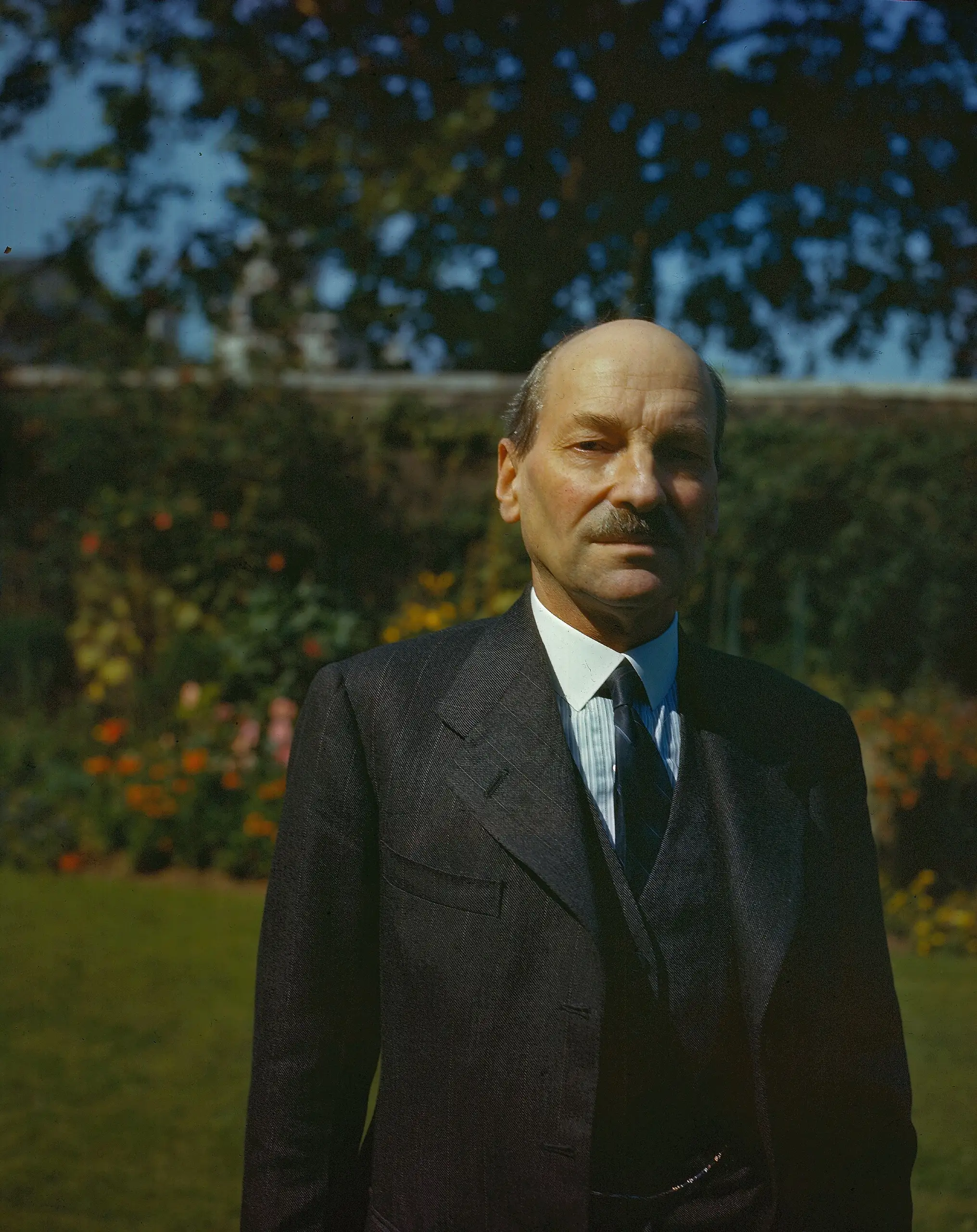
Clement Attlee
 United Kingdom
Also known as: Clement Richard Attlee, 1st Earl Attlee, Clem Attlee
Birthday
January 3, 1883
Birth Sign
Capricorn
Birthplace
Putney, London, United Kingdom
Age
Died at 84
Height
5 ft 9 in (175 cm)
About
Clement Richard Attlee, 1st Earl Attlee (3 January 1883 – 8 October 1967) was a British statesman who served as Prime Minister of the United Kingdom from 1945 to 1951 and Leader of the Labour Party from 1935 to 1955. He remains the longest-serving leader in the history of the Labour Party and is widely regarded as one of the greatest British prime ministers for his transformative domestic reforms and role in shaping the post-war world order.
Attlee served as Deputy Prime Minister during the Second World War coalition government led by Winston Churchill, managing domestic affairs while Churchill focused on military strategy. After the war, his Labour Party won a landslide victory, implementing sweeping changes that included the creation of the National Health Service and the nationalisation of key industries. His leadership style was characterized by quiet competence and pragmatism rather than flamboyance.
Early Life & Background
Born on January 3, 1883, in Putney, London, Clement Attlee grew up in an upper-middle-class Christian family. His father, Ernest Henry Attlee, was a wealthy solicitor and partner in the law firm Attlee & Co., while his mother, Violet Blanche Richardson, instilled strong social values in her children. Attlee attended Putney Primary School before moving to Haileybury College, a prestigious public school in Hertfordshire. There, he developed a keen interest in sports, particularly cricket and football, which would remain lifelong passions.
In 1902, he entered St John's College at Oxford University, initially studying classics before switching to modern history. He graduated with a third-class degree in 1906 and was called to the bar at the Inner Temple the same year. Despite qualifying as a barrister, Attlee found the legal profession unfulfilling. Seeking more meaningful work, he took a position as a lecturer at the London School of Economics in 1910, where he taught social science and economics. This period allowed him to engage deeply with socialist theory and practice, setting the stage for his future political career.
His time working as a barrister in London's East End, specifically in Stepney and Whitechapel, proved pivotal. Exposed to severe poverty, unemployment, and inadequate housing, Attlee became increasingly radicalized. He joined the Independent Labour Party in 1908 and gave up his legal career to focus on social reform. When World War I broke out in 1914, he volunteered for military service, rising to the rank of Lieutenant-Colonel in the Royal Field Artillery. He saw active service in France, Belgium, and Mesopotamia, where he was wounded twice and awarded the Distinguished Service Order for gallantry. These experiences reinforced his belief in the need for state intervention to protect citizens.
After the war, Attlee returned to civilian life and entered local politics. In 1919, he was elected Mayor of Stepney, a position he held until 1922. During his tenure, he focused on improving housing conditions and addressing unemployment, laying the groundwork for his national political career. In 1922, he was elected as the Member of Parliament for Limehouse, marking his entry into the House of Commons and the beginning of his long journey to becoming Prime Minister.
Career Growth
Attlee's political career began in earnest when he was elected MP for Limehouse in 1922. He served as a backbencher and then as a junior minister in Ramsay MacDonald's first Labour government in 1924 and later in the second Labour government from 1929 to 1931. He held roles such as Parliamentary Secretary to the Ministry of Health and Lord Privy Seal. However, he resigned from the cabinet in 1931 when MacDonald formed a National Government with the Conservatives and Liberals, viewing it as a betrayal of Labour principles.
Following the 1931 election defeat, Attlee became Deputy Leader of the Labour Party under George Lansbury. As the threat of Nazi Germany grew, he shifted towards supporting rearmament and opposing Neville Chamberlain's policy of appeasement. In 1935, following Lansbury's resignation over sanctions against Italy, Attlee was elected Leader of the Labour Party, a position he would hold for two decades.
When World War II broke out, Attlee took Labour into the wartime coalition government led by Winston Churchill. He served as Lord Privy Seal from 1940 to 1942 and then as Deputy Prime Minister from 1942 to 1945. In this role, he managed domestic affairs while Churchill focused on military strategy, ensuring political stability during the conflict.
The 1945 general election marked the pinnacle of Attlee's career. He led Labour to a landslide victory, defeating Churchill's Conservative Party. His government implemented a sweeping programme of social reform known as the "Attlee Revolution." Key achievements included the nationalisation of major industries like coal, steel, railways, electricity, and gas; the creation of the National Health Service in 1948; and the passage of the National Insurance Act 1946 and National Assistance Act 1948. He also oversaw the granting of independence to India and Pakistan in 1947, Burma in 1948, and Ceylon in 1948, effectively dismantling much of the British Empire.
Despite economic challenges, including currency crises and food rationing, Attlee's government laid the foundation for modern Britain. In the 1951 general election, Labour narrowly lost to the Conservatives despite winning more votes. Attlee continued as Leader of the Opposition until 1955, when Labour suffered another defeat. He retired from the House of Commons and was elevated to the House of Lords as Earl Attlee, serving there until his death in 1967.
Career Timeline
Public Image & Style
Clement Attlee is portrayed in media as a modest, pragmatic, and effective leader. His image is one of quiet competence and unwavering commitment to social justice. He is often depicted as the antithesis of the flamboyant politician, preferring substance over style. His plain, unremarkable demeanor contrasted sharply with the charisma of contemporaries like Winston Churchill, yet his depth of knowledge and objectivity proved decisive behind the scenes.
Media portrayals emphasize his role as the architect of the post-war welfare state. He is frequently shown in black-and-white photographs wearing a simple suit, reflecting his unpretentious nature. His public speeches were known for their clarity and lack of rhetorical flourish, focusing instead on practical solutions to societal problems. This approach earned him widespread respect across the political spectrum and cemented his legacy as a leader who prioritized the well-being of ordinary citizens.
Fame & Fandom (iFAMOUS Rankings)
iFANN has not yet collected fame data for this person. As of the September 2026 iFAMOUS Rankings flagship list, he does not appear. The ranking engine evaluates figures based on global attention signals, but historical political leaders like Attlee often fall outside current pop-culture metrics.
There is no formal fandom for Clement Attlee, as he is a historical political figure rather than a pop culture icon. However, historians, political scientists, and Labour Party supporters frequently discuss and celebrate his legacy. Fan-like campaigns include academic conferences, book launches, and commemorative events organized by institutions like the Labour Party and the Museum of London. Scholars and students often study his policies, particularly the creation of the NHS and the decolonisation of India, keeping his memory alive in academic circles. Occasional commemorations mark anniversaries of his birth and death, drawing attention from those interested in British political history.
Interesting Facts and Legends
Clement Attlee was a keen cricketer throughout his life. Even shortly before his death in 1967, he opened the innings for a match alongside Sir Edwin Stockton, demonstrating his enduring passion for the sport. Despite his massive impact on British history, Attlee was known for his quiet, unassuming demeanor. He rarely gave interviews and preferred to let his actions speak for themselves, earning him the nickname "the man of the people" among supporters.
Although a committed socialist, Attlee was a staunch anti-communist. This seemingly contradictory stance played a key role in shaping Britain's Cold War policies and its relationship with the United States. He supported the Marshall Plan to rebuild Western Europe and promoted the NATO military alliance against the Soviet bloc. Another notable fact is that despite his long marriage to Violet, the couple had no children together, a decision they made early in their lives.
Attlee's leadership during the war was often cited as a masterclass in political cooperation. While Churchill commanded the global war effort, Attlee managed the domestic front, ensuring the country remained functional and united. His ability to maintain political stability while navigating complex international relations during the war solidified his reputation as a pragmatic and effective leader.
Notable Quotes
“The task of the Labour Party is to make socialism a reality.”
“We must not be afraid to be different.”
“Socialism is not a dream but a necessity.”
Family & Personal Life
Clement Attlee married Violet Helen Haydon on April 12, 1912. Violet was the daughter of a clergyman, and the couple met through mutual friends in London. They remained married until Attlee's death in 1967, making it a lifelong partnership. Violet was known for her quiet support of her husband's political career and her own charitable work. The couple had no children together.
Attlee valued family life above all else and was described as a modest and private man. He enjoyed gardening, reading, and playing cricket in his retirement. His relationship with his wife was characterized by deep affection and mutual respect. There are no records of any other romantic relationships or extramarital affairs; Attlee was known for his fidelity and dedication to his family. He lived in Hampstead, London, during his later years and spent his retirement in Broadwater, Sussex.
Notable Connections
Relationships & Dating History
Clement Attlee married Violet Helen Haydon on April 12, 1912. Violet was the daughter of a clergyman, and the couple met through mutual friends in London. They remained married until Attlee's death in 1967, making it a lifelong partnership. Violet was known for her quiet support of her husband's political career and her own charitable work. The couple had no children together.
Attlee was described as a modest and private man who valued family life above all else. There are no records of any other romantic relationships or extramarital affairs; Attlee was known for his fidelity and dedication to his family. At the time of his death in 1967, he was widowed, having outlived his wife Violet. Their relationship was characterized by deep affection and mutual respect, providing a stable foundation for his demanding political career.
- MarriedViolet Helen Haydon1912 - 1967Married until his death; no children together.
Death & Aftermath
Died
October 8, 1967 (aged 84)
Death Place
Hampstead, London, United Kingdom
Cause of Death
Natural causes associated with advanced age
Clement Attlee passed away peacefully in his sleep on October 8, 1967, at the age of 84. He died at his home in Hampstead, London, though some reports indicate he was later moved to Westminster Hospital for treatment before passing. The cause of death was recorded as natural causes related to old age. His death marked the end of a significant chapter in British political history, prompting an outpouring of tributes from government officials, peers, and the public who recognized him as the architect of the post-war welfare state.
A private funeral was held to reflect his modest nature, followed by high honors befitting a former Prime Minister. He was cremated at Golders Green Crematorium in London, and his ashes were interred at St Mary's Church in Broadwater, Sussex, where he had spent his retirement years. Tributes poured in from across the political spectrum, acknowledging his transformative domestic reforms and steady leadership during wartime. Posthumously, his legacy has been maintained through extensive academic analysis and frequent citations in historical rankings of British prime ministers. Recent studies continue to examine his colonial policies and Cold War stance, often highlighting his anti-communist views and influence on Britain's intelligence agencies. His name remains attached to the "Attlee generation" of politicians, and numerous books and documentaries continue to explore his leadership style. No new films or major biographical releases were launched immediately following his death beyond standard historical accounts.
Net Worth (Estate Value)
$0
iFANN Editorial Team estimate
As a deceased historical figure, Clement Attlee does not have a current net worth in the traditional sense. His estate value is not publicly tracked in real-time, and there are no celebrity net worth estimates for him. His wealth during his lifetime was modest compared to modern politicians, derived primarily from his salary as a Member of Parliament and his earlier legal career. Upon his death, his estate was likely modest, consisting of personal belongings and perhaps some savings, as he was known for his frugal lifestyle.
Any posthumous earnings from books, documentaries, or licensing deals are managed by the state or his heirs but are not significant enough to be quantified as a net worth figure. Research by the iFANN Editorial Team confirms that no financial data exists to estimate a fortune for Attlee, given his status as a public servant who did not accumulate personal wealth through business ventures or endorsements. His legacy remains in his political contributions rather than financial assets.
Awards Won (18)
Clement Attlee received numerous honours throughout his life, including being knighted in 1937 and appointed to the Order of Merit in 1955. He was created Earl Attlee upon his retirement from the House of Commons in 1955 and was appointed to the Order of the Companions of Honour in 1945. He also received the Distinguished Service Order during World War I for gallantry. Posthumously, he was ranked as the fourth-greatest Briton of all time in a 2002 BBC poll.
1937 · Honour
Services to the Labour Party
1955 · Honour
Public Service
Known For
Prime Minister of the United Kingdom
1945 · Political Leader
Leader of the Labour Party
1935 · Party Leader
Architect of the Welfare State
1948 · Reformer
Keywords
Sources
Quick Facts
- Profession
- politician, diplomat, professor
- Born
- January 3, 1883
- Birthplace
- Putney, London, United Kingdom
- Died
- October 8, 1967
- Death Place
- Hampstead, London, United Kingdom
- Gender
- Male
- Spouse
- Violet Attlee, Countess Attlee
- Birth Sign
- Capricorn
Personal Details
- Full Name
- Clement Richard Attlee
- Height
- 5 ft 9 in (175 cm)
- Spouse
- Violet Helen Haydon
- Children
- Education
- Haileybury College; University of Oxford (St John's College); Inner Temple
Frequently Asked Questions
What was so significant about Clement Attlee?
What was the relationship between Churchill and Attlee?
What happened to Clement Attlee?
Who was the greatest prime minister of the UK?
Did Clement Attlee have any children?
Similar People
Join the community
fans discussing