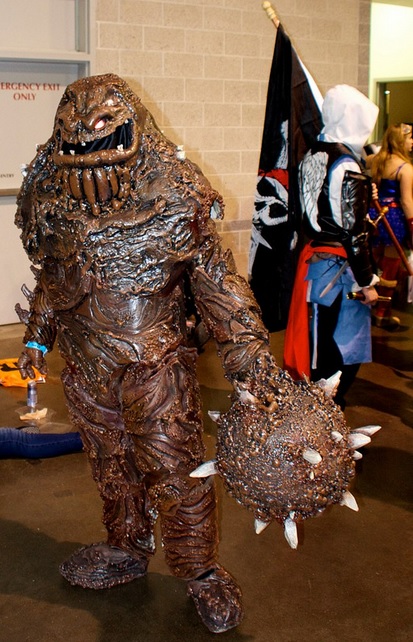
Clayface
Appears In
DC Universe
Species
Metahuman (varies by version)
First Appearance
Detective Comics #40 (June 1940)
Occupation
Criminal; former actor, treasure hunter, scientist, wrestler
Creator
Bill Finger, Bob Kane, Sheldon Moldoff, Len Wein, Mike W. Barr, Marshall Rogers, Doug Moench, Kelley Jones, Ed Brubaker, Darwyn Cooke
Overview
Origin Story
The mantle of Clayface has been worn by several individuals across DC Comics history. The original was Basil Karlo, a washed-up actor introduced in Detective Comics #40 (1940) by Bill Finger and Bob Kane. Karlo learned he was to be replaced in a remake of the horror film The Terror, in which he had played the monster Clayface. Driven mad, he donned a costume and used mud-based disguises to murder the cast and crew, initially possessing no superhuman abilities.
In Detective Comics #298 (1961), Bill Finger and Sheldon Moldoff introduced Matt Hagen, a treasure hunter who discovered a radioactive pool of protoplasmic slime in a cave. The substance granted him the ability to reshape his body at will, making him the first Clayface with genuine shapeshifting powers. Hagen later became addicted to the protoplasm and turned to crime to fund his supply.
Subsequent versions include Preston Payne (1978), a scientist with a degenerative disease who created a synthetic clay compound to save himself, only to gain a corrosive touch that dissolves organic matter; Sondra Fuller (1983), a metahuman who could absorb and mimic matter; and Johnny Williams (1998), a professional wrestler who took the Clayface name. In Detective Comics #604 (1989), Marv Wolfman and Jim Aparo amalgamated these characters into a single entity, with Basil Karlo absorbing the powers of the others, becoming the definitive Clayface with the full range of abilities.
Personality
Clayface is defined by a profound instability, both psychological and physical. Basil Karlo, the most prominent version, is a narcissistic and theatrical character who craves fame and recognition. His acting background gives him a flair for drama, but also a deep-seated insecurity that drives him to extremes. He is prone to fits of rage and melancholy, often lamenting his monstrous form while simultaneously reveling in the power it grants him.
Despite being a villain, Clayface has occasionally shown moments of altruism and regret. In the New 52 era, he joined the Justice League Dark as a reluctant hero, struggling with his own nature. His shapeshifting abilities make him an expert liar and impersonator, but also leave him with a fractured sense of identity. He can be manipulative and cruel, yet there remains a tragic core to his character, a desire to be seen as something more than a monster.
Story Arc
Clayface's story across DC Comics is one of constant transformation. Basil Karlo began as a mundane serial killer, but after absorbing the protoplasmic powers of Matt Hagen and other Clayfaces, he became a true shapeshifter. In the 1989 storyline The Mud Pack, Karlo united several Clayface incarnations to terrorize Gotham, but the alliance collapsed due to infighting. During No Man's Land (1999), Clayface carved out a territory in Gotham's ruins, showing a capacity for leadership and brutality.
In Batman: Hush (2002-2003), Clayface was manipulated by the villain Hush, impersonating various heroes to sow chaos. This storyline highlighted his impersonation skills as a weapon of psychological warfare. In the New 52 (2011-2016), a reformed Clayface joined the Justice League Dark, using his powers for good. He formed bonds with teammates like Swamp Thing and Zatanna, though his monstrous urges remained a constant struggle. After the New 52 continuity shift, Clayface returned to his villainous roots, but the character's capacity for change remains a defining theme.
Powers & Abilities
Shapeshifting into any form
Elasticity and stretching
Superhuman strength and durability
Regeneration from small fragments
Absorption and mimicry of matter
Voice mimicry
Weapon formation (blades, spikes, etc.)
Corrosive touch (Preston Payne version)
Relationships
Batman
EnemyPrimary adversary; Batman frequently thwarts Clayface's impersonation schemes.
Joker
RivalCompeting for dominance in Gotham's underworld; occasional uneasy alliances.
Poison Ivy
AllyOccasional partner in crime, often using Clayface as a distraction or enforcer.
Catwoman
AllyHas worked with Catwoman on heists, particularly in Ed Brubaker's run.
Sondra Fuller
FamilyDaughter in some continuities; strained relationship as both are Clayfaces.
Swamp Thing
AllyTeammate in Justice League Dark; shared elemental nature.
Hush
EnemyManipulated Clayface in the Hush storyline, using him as a pawn.
Memorable Quotes
“I'm an actor! I can be anyone!”
“You think you know someone? I can be anyone. That's the point.”
“I am Clayface. I am a monster. But I am also a man.”
“The show must go on... even if the audience is screaming.”
“I've worn a thousand faces. None of them were mine.”
Portrayed By
Key Appearances
Detective Comics #40
Detective Comics #298
Detective Comics #477
Detective Comics #604
Batman and the Outsiders #2
Batman #550
Batman: Hush (2002-2003)
No Man's Land (1999)
Justice League Dark (New 52)
Batman: The Animated Series
Harley Quinn (animated series)
Creature Commandos
Gotham (TV series)
Pennyworth (TV series)
Batman: Arkham City (video game)
Injustice 2 (video game)
Clayface (2026 film)
Reception & Legacy
Clayface has been a fixture in Batman's rogues gallery for over eight decades, consistently ranking among the most formidable foes. IGN placed him 73rd on its list of the greatest comic book villains in 2009, and he regularly appears in fan polls as a top-tier Batman antagonist. The character's shapeshifting abilities have made him a favorite for stories involving impersonation and identity theft, allowing writers to explore themes of selfhood and deception.
Critics have praised the tragic depth added to Clayface in the DC Animated Universe, where Ron Perlman's voice work gave the character a gravelly pathos. The Harley Quinn animated series offered a comedic take, with Alan Tudyk's performance turning Clayface into a fan-favorite narcissist. While some readers find the multiplicity of Clayface incarnations confusing, the amalgamated version has become the definitive interpretation, celebrated for its versatility and menace.
Interesting Facts and Legends
The original Clayface, Basil Karlo, was inspired by the fictional horror film The Terror, which featured a character named Clayface.
The character's name is a pun on 'clay' and 'face,' reflecting his malleable form.
Multiple Clayfaces have been combined into a single entity in the comics, including Basil Karlo, Matt Hagen, Preston Payne, Sondra Fuller, and Johnny Williams.
Clayface's vulnerability to heat is a nod to the properties of real clay, which hardens when fired.
In the Batman: Arkham video game series, Clayface is a central antagonist in Arkham City, where he impersonates the Joker.
The 2026 film Clayface is part of the new DC Universe slate, with Mike Flanagan, known for horror works like The Haunting of Hill House, writing the script.
Frequently Asked Questions
Who is Clayface?
Does Clayface die?
Who plays Clayface in movies and TV?
Is Clayface a villain?
Who does Clayface end up with?
Keywords
Character Info
- Universe
- DC Universe
- Creator
- Bill Finger, Bob Kane, Sheldon Moldoff, Len Wein, Mike W. Barr, Marshall Rogers, Doug Moench, Kelley Jones, Ed Brubaker, Darwyn Cooke
Join the community
fans discussing