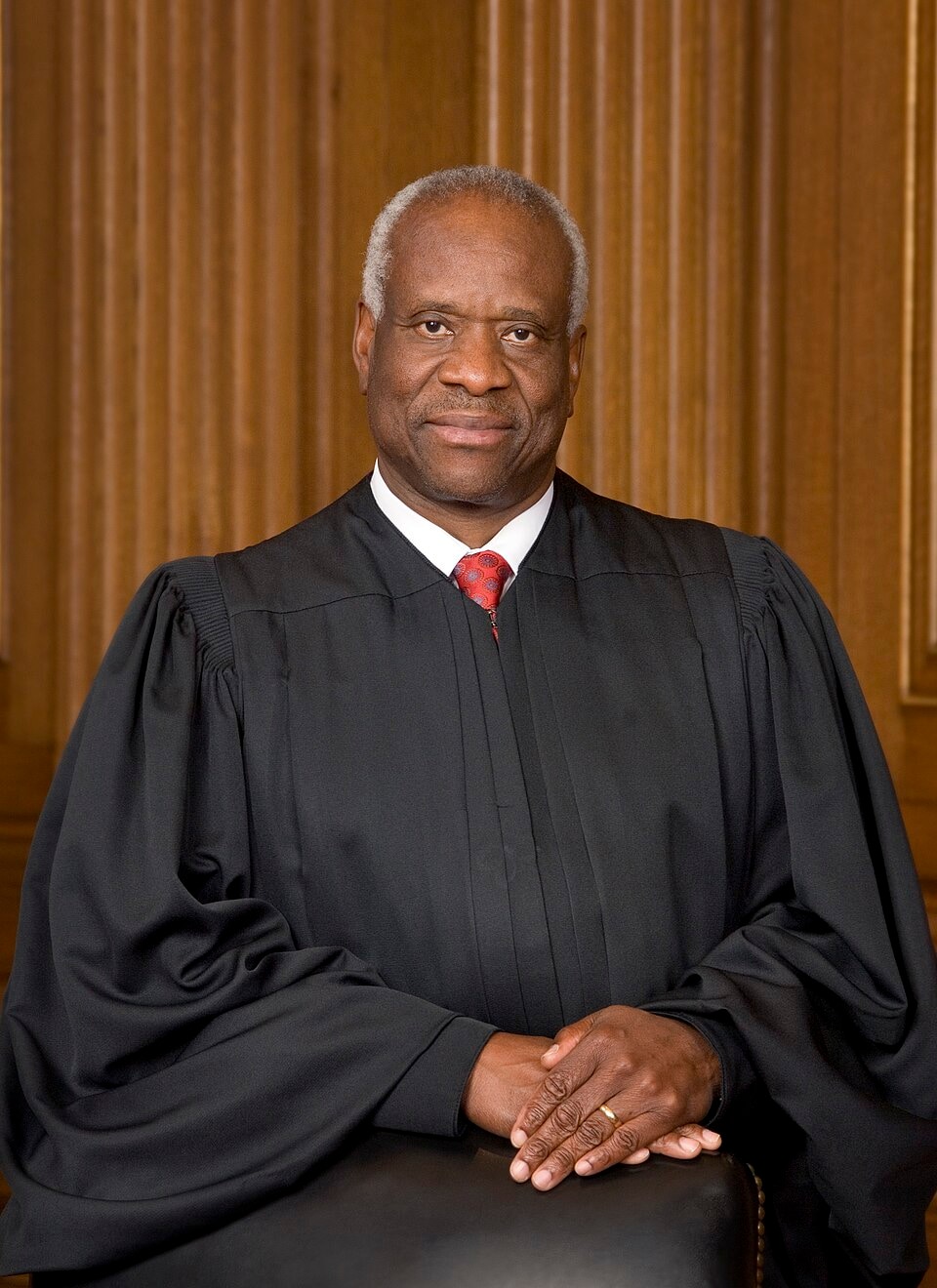
Clarence Thomas
 United States
Birthday
June 23, 1948
Birth Sign
Cancer
Birthplace
Pin Point, Georgia, USA
Age
78 years old
Height
5 ft 9 in (175 cm)
About
Clarence Thomas is an American jurist serving as an associate justice of the Supreme Court of the United States. He is the second-longest-serving justice in Supreme Court history. Thomas is widely regarded as the Court's most conservative member and a leading originalist, interpreting the Constitution according to its original public meaning. His jurisprudence has shaped American law on religious freedom, gun rights, and federal power. Over more than three decades on the bench, he has authored landmark majority opinions in cases like New York State Rifle & Pistol Association v. Bruen and Good News Club v. Milford Central School, while his dissents, such as in Gonzales v. Raich, have influenced legal thinking on federalism. As of 2026, he continues to serve actively, writing opinions and participating in oral arguments.
Early Life & Background
Clarence Thomas was born on June 23, 1948, in Pin Point, Georgia, a small coastal community founded by freed slaves after the Civil War. His early life was marked by poverty in the Gullah community, enduring a childhood without indoor plumbing or electricity. When Thomas was just two years old, his father abandoned the family. At the age of seven, his mother sent him and his younger brother, Myers, to live with their maternal grandparents, Myers and Christine Anderson, in Savannah. His grandfather, a hardworking fuel-oil deliveryman, emerged as the central figure in Thomas's upbringing, profoundly influencing his character and future path, a relationship later chronicled in Thomas's 2007 memoir, My Grandfather's Son.
Thomas's education began at St. Benedict the Moor Grammar School in Savannah, a segregated Catholic institution run by Irish nuns, where one of his teachers, Sister Mary Virgilius, had a lasting impact on him. He first experienced an integrated school environment in the tenth grade at St. John Vianney Minor Seminary. A devout Catholic, Thomas initially aspired to become a priest, enrolling at Conception Seminary College in Missouri. However, he ultimately left the seminary after encountering racism within the Church and being deeply affected by a fellow student's callous reaction to the assassination of Martin Luther King Jr.
He subsequently transferred to the College of the Holy Cross in Worcester, Massachusetts, where he pursued English literature and graduated cum laude in 1971. Thomas then matriculated at Yale Law School, notably as one of the first Black students admitted under affirmative action programs. After earning his Juris Doctor in 1974, he passed the Missouri bar and began his professional career as an assistant attorney general under John Danforth. During this formative period, Thomas faced significant personal challenges, including struggles with student debt and alcohol addiction, which he ultimately overcame by quitting drinking entirely.
Career Growth
Thomas's career in public service took off after he moved to Washington, D.C., in 1979 to work as a legislative assistant for Senator John Danforth. In 1981, President Ronald Reagan appointed him Assistant Secretary for Civil Rights at the U.S. Department of Education. The next year, Reagan named him Chairman of the Equal Employment Opportunity Commission (EEOC), a post he held for eight years. At the EEOC, Thomas shifted the agency's focus from class-action litigation to individual complaints, emphasizing conservative civil rights principles.
In 1990, President George H. W. Bush nominated Thomas to the U.S. Court of Appeals for the District of Columbia Circuit. He served just 19 months before being nominated to the Supreme Court to replace the retiring Thurgood Marshall. His confirmation hearings exploded when Anita Hill, a former subordinate at the EEOC, accused him of sexual harassment. Thomas denied the charges and called the proceedings a high-tech lynching for uppity blacks. The Senate confirmed him 52-48, the narrowest margin for a successful nominee in over a century.
On the Supreme Court, Thomas quickly established himself as a conservative originalist. He wrote the majority opinion in Good News Club v. Milford Central School (2001), expanding religious speech rights, and in New York State Rifle & Pistol Association v. Bruen (2022), striking down New York's concealed-carry law. His dissent in Gonzales v. Raich (2005) argued for limiting federal power over medical cannabis. After decades of near-silence during oral arguments, Thomas began asking questions more regularly after 2020. In 2024, he authored majority opinions in Vidal v. Elster (trademarks and the First Amendment) and Starbucks Corporation v. McKinney (labor law). As of May 2026, he has served 12,615 days, making him the second-longest-serving justice in history.
Career Timeline
Public Image & Style
Clarence Thomas is known for his reserved, intellectual demeanor and his deeply conservative judicial philosophy. He is often called the silent justice for his long stretches of silence during oral arguments, though he has become more vocal since 2020. Media coverage of Thomas is sharply polarized: conservative outlets celebrate his originalism and his rise from poverty, while liberal outlets focus on the Anita Hill allegations, his wife Ginni's political activism, and ethics controversies surrounding undisclosed gifts. Among conservative legal circles and the Federalist Society, Thomas is revered as a principled originalist and a trailblazer. He rarely gives media interviews, letting his opinions speak for themselves. His personal style is understated, and he maintains a low public profile outside of his judicial work. Supporters often refer to him as a hero for overcoming adversity, while critics question his ethics and judicial independence.
Fame & Fandom (iFAMOUS Rankings)
Clarence Thomas commands a devoted following that is less a conventional fanbase than a school of thought. His admirers, concentrated in conservative legal circles and originalist think tanks, celebrate his jurisprudence as a bulwark of constitutional fidelity. There is no formal fandom name, no organized fan clubs, and no documented collective moniker, his support is intellectual and ideological rather than cultural. Yet his influence is such that a 2026 Hoover Institution event featuring Thomas in conversation on the legacy of Thomas Sowell drew an audience of scholars and activists, and a 2026 Claremont Review piece dubbed a notable opinion 'Clarence Thomas's Birthday Present to America,' framing his judicial output as a gift to the nation.
Thomas's legend is built on iconic moments that transcend legal circles. The 1991 confirmation hearing, with his 'high-tech lynching' rebuke, remains a defining cultural flashpoint. His decades-long silence during oral arguments, earning him the nickname 'the Silent Justice,' has become a talking point that even his critics acknowledge. In August 2026, he fired back at critics who questioned his Blackness with a simple 'Look at me!', a moment widely covered and retold. His rise from poverty in Pin Point, Georgia, to the second-longest-serving justice in history is itself a foundational narrative his supporters frequently invoke.
As of August 2026, the iFANN Global Fame Engine has evaluated Clarence Thomas, but he does not currently hold a placement in the published rankings, neither in the Global Top 1,000 nor in any Top-100 scope list. His fame, while substantial, is not quantified by iFANN's ranking system at this time.
Interesting Facts and Legends
Thomas was a seminarian studying to become a Catholic priest before leaving due to racism within the Church. He struggled with alcohol addiction in his early career and quit drinking entirely, calling it a decision he could no longer afford. Thomas was famously silent during Supreme Court oral arguments for many years, earning the nickname 'the Silent Justice'; he began asking questions regularly after 2020. His grandfather, Myers Anderson, was such a major influence that Thomas called him 'Daddy' and titled his memoir My Grandfather's Son. Thomas grew up in a home without indoor plumbing or electricity in Pin Point, a community founded by freed slaves. He is one of the few Supreme Court justices to have written a memoir while still serving on the Court. His confirmation vote of 52-48 was the narrowest margin for a successful Supreme Court nominee in over a century. Thomas initially opposed affirmative action despite benefiting from Yale Law School's diversity admissions program.
One of the most retold stories from his career is his 1991 confirmation hearing, where he denounced the proceedings as a 'high-tech lynching' of an uppity Black man who dared to think for himself. Another legend is his extraordinary silence on the bench, he reportedly went over a decade without asking a single question during oral arguments, a fact that both supporters and critics reference. In August 2026, he made headlines by responding to critics who questioned his racial authenticity with 'Look at me!', a moment that quickly became part of his public lore.
Notable Quotes
“This is a high-tech lynching for uppity blacks.”
“He was the one hero in my life. What I am is what he made me.”
“Ask yourself before each case, what is my role in this case as a judge? Notice how that limits you, not as a person, not as a Catholic, not as a policymaker, not as a husband, as a judge.”
“There isn't a single judge I know who does hard things because they get joy out of it. They do hard things because they signed up to do hard things.”
Family & Personal Life
Thomas was raised by his maternal grandparents, Myers Anderson and Christine Anderson, in Savannah, Georgia. His grandfather, a fuel-oil deliveryman, was the most influential person in his life. Thomas has one younger brother, Myers Thomas. From his first marriage to Kathy Ambush, Thomas has a son, Jamal Adeen Thomas, born in 1973. Jamal is a graduate of the University of Virginia and works in business. Thomas married Virginia Ginni Lamp in 1987; Ginni, a conservative activist and attorney, helped raise Jamal. The couple lives in the Washington, D.C., suburbs and has no children together. Thomas has described his family as a source of strength and stability throughout his career.
Notable Connections
Clarence Thomas was preceded on the Supreme Court by Thurgood Marshall, the first African American justice. He was nominated by President George H. W. Bush and mentored by Senator John Danforth and Judge Larry Silberman. His wife, Virginia Ginni Thomas, is a prominent conservative activist. Anita Hill, who accused Thomas of sexual harassment, remains a central figure in his public narrative. Thomas was a close friend and intellectual ally of Justice Antonin Scalia.
Relationships & Dating History
Clarence Thomas married Kathy Ambush in 1971 while they were both students. The couple had one son, Jamal Adeen Thomas, born in 1973. They divorced in 1984 during Thomas's early career in Washington, D.C. Details of their courtship and separation are not widely publicized. In 1987, Thomas married Virginia Ginni Lamp, a conservative activist and attorney. They met through mutual political and conservative circles in Washington. Ginni worked as a staffer for Republican members of Congress and later founded the conservative group Liberty Central. The couple has no children together, but Ginni helped raise Jamal from Thomas's first marriage. Ginni Thomas has been a controversial figure, particularly for her involvement in efforts to overturn the 2020 presidential election results. As of 2026, Thomas remains married to Ginni, and they live in the Washington, D.C., suburbs.
- MarriedKathy Ambush1971 - 1984Married while both were students; had one son, Jamal; divorced in 1984.
- MarriedVirginia Thomas1987 - presentCurrentMet through political circles; Ginni is a conservative activist; no children together.
Salary, Net Worth In 2026
$1.5 Million
iFANN Editorial Team estimate
iFANN currently estimates Clarence Thomas's net worth at $1.5 million, reflecting a career of government service rather than private-sector wealth. His primary income is his Supreme Court salary, which for associate justices was approximately $285,400 as of 2026. Thomas has earned that salary since joining the Court in 1991, accumulating over three decades of federal judicial pay. He also received royalties from his 2007 memoir My Grandfather's Son, a New York Times bestseller. Thomas has delivered paid lectures and speeches at universities and conservative organizations, though disclosure rules limit outside income for justices. He and his wife Ginni have owned homes in the Washington, D.C., suburbs, but specific property values are not publicly detailed. His financial assets include bank accounts and retirement accounts, but his holdings are modest compared to other justices. As a retired federal employee, Thomas would qualify for a federal pension based on his years of service. The $1.5 million figure is per iFANN's editorial analysis.
Awards Won (2)
Clarence Thomas has received the Francis Boyer Award from the American Enterprise Institute (2007) and the Presidential Citizens Medal (2001), presented by President Bill Clinton. He has been awarded honorary degrees from multiple institutions, including the College of the Holy Cross. His most notable distinction is becoming the second-longest-serving Supreme Court justice in U.S. history as of 2026.
2001 · Civilian Honor
Public Service
2007 · Public Policy
Legal Career
Known For
Associate Justice of the Supreme Court of the United States
1991 · Associate Justice
Chairman of the Equal Employment Opportunity Commission
1982 · Chairman
Judge of the United States Court of Appeals for the District of Columbia Circuit
1990 · Judge
Assistant Secretary for Civil Rights, U.S. Department of Education
1981 · Assistant Secretary
Keywords
Sources
Quick Facts
- Profession
- judge, lawyer
- Born
- June 23, 1948
- Birthplace
- Pin Point, Georgia, USA
- Gender
- Male
- Spouse
- Virginia Thomas, Kathy Ambush
- Birth Sign
- Cancer
Personal Details
- Full Name
- Clarence Thomas
- Height
- 5 ft 9 in (175 cm)
- Spouse
- Virginia Thomas, Kathy Ambush
- Children
- 1 son: Jamal Adeen Thomas
- Education
- College of the Holy Cross (BA, cum laude, 1971), Yale Law School (JD, 1974)
Frequently Asked Questions
Is Clarence Thomas still alive?
How old is Clarence Thomas?
Who is Clarence Thomas's wife?
What is Clarence Thomas's net worth?
Does Clarence Thomas have children?
Similar People
Join the community
fans discussing