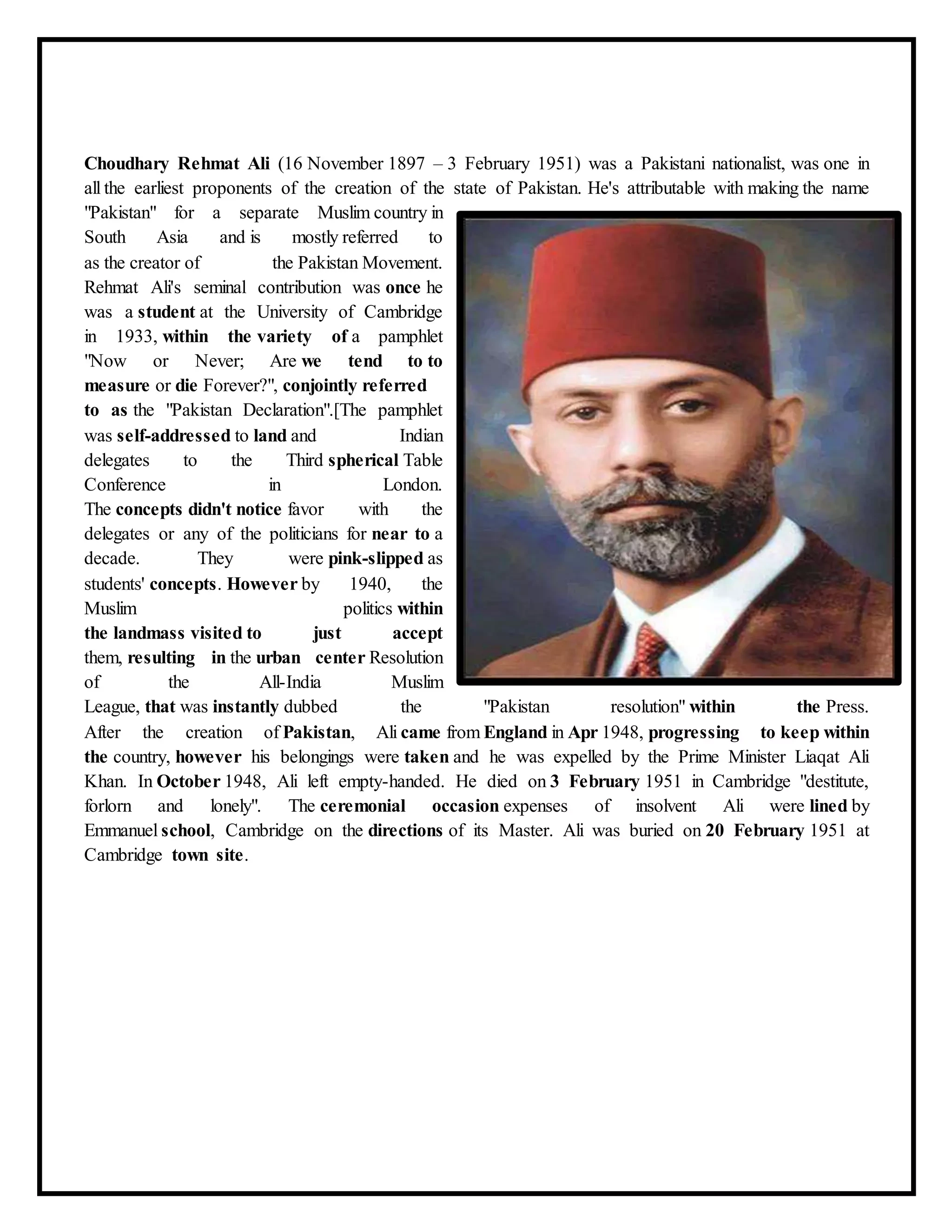
Chuhdary Rahmat Ali
 Pakistan
political theorist•jurist•nationalist activist
Also known as: Choudhry Rahmat Ali, Chaudhry Rahmat Ali, Rahmat Ali
Birthday
November 16, 1897
Birth Sign
Scorpio
Birthplace
Balachaur, Punjab
Age
Died at 53
About
Choudhry Rahmat Ali was a Muslim nationalist activist, political theorist, and jurist best known for coining the name "Pakistan" to describe a separate homeland for Muslims in British India. Born in Balachaur, Punjab, on November 16, 1897, he grew up in a region that would become central to the movement he inspired. After completing his early education in Lahore, he moved to England to study law at the University of Cambridge. In 1933, while still a student, he published a pamphlet titled Now or Never; Are We to Live or Perish Forever?, which proposed the creation of a Muslim state in the northwest of the subcontinent. This document, often called the Pakistan Declaration, laid out a bold vision for a separate Muslim state, initially dismissed as the fanciful idea of a student by Muhammad Ali Jinnah and others. It took nearly a decade for the idea to gain traction, culminating in the 1940 Lahore Resolution, which the press immediately dubbed the "Pakistan Resolution."
Early Life & Background
Rahmat Ali's childhood and upbringing were rooted in the Punjabi Muslim community of Balachaur. He attended the Municipal Board Middle School in Balachaur before moving to Lahore for further education. His early interests lay in politics and Islamic nationalism, influenced by the growing tensions between Hindus and Muslims in British India. He pursued higher studies at the University of the Punjab in Lahore, where he began to formulate the ideological framework that would eventually lead to the creation of Pakistan.
His pivotal moment came during his time at Cambridge, where he developed the ideological framework for a separate Muslim state. Despite his contributions, he remained largely unrecognized during his lifetime, dying in poverty in Cambridge in 1951. Before fame, Rahmat Ali's life was defined by academic rigor and a deep commitment to the cause of Muslim nationalism, setting the stage for his future impact on history.
Career Growth
Rahmat Ali's career success is defined by his role as the intellectual architect of the Pakistan Movement. His breakthrough moment was the publication of Now or Never in 1933, which introduced the acronym "Pakistan" derived from Punjab, Afghania, Kashmir, Sindh, and Baluchistan. Although initially ignored, the idea gained momentum over the next decade, leading to the creation of Pakistan in 1947. However, after independence, Rahmat Ali returned to Pakistan in April 1948 but was expelled by Prime Minister Liaquat Ali Khan, with his belongings confiscated. He left empty-handed in October 1948 and died destitute in Cambridge on 3 February 1951. His funeral expenses were paid by Emmanuel College, Cambridge, and he was buried at Cambridge City Cemetery.
Career Timeline
Public Image & Style
Rahmat Ali's public image is that of a visionary dissenter whose ideas were ahead of his time. Media portrayals emphasize his intellectual rigor and ideological purity, though his contributions were overshadowed by political realities after independence. His content and tone remain relevant in discussions about the origins of Pakistan.
Fame & Fandom
Chaudhry Rahmat Ali, the political theorist who coined the name "Pakistan," does not currently appear in iFANN's published rankings. As of August 2026, the Global Fame Engine has evaluated his historical and cultural footprint, but he holds no placement in the Global Top 1,000 or any Top-100 scope list. This is not a reflection of his historical importance, which is considerable, but rather a measure of contemporary global attention, which remains limited to academic, political, and commemorative circles.
His audience is not a fandom in the modern sense; there is no formal fan name, no organized fan clubs, and no social media campaigns. Instead, his legacy is preserved through state-sponsored commemorations in Pakistan, such as the annual observances of his birth and death anniversaries, and through scholarly retrospectives that continue to analyze his contribution to the idea of Pakistan. The most notable tribute is the Chaudhry Rahmat Ali Hospital, which maintains a presence honoring him as a visionary. These are institutional remembrances, not grassroots fan activity, reflecting the nature of his historical rather than contemporary fame.
Interesting Facts and Legends
One of the most enduring legends surrounding Rahmat Ali is the story of how he coined the word "Pakistan" in 1933. Multiple versions exist: one claims the idea came to him on the top deck of a London bus, another on a walk along the Thames. The exact location remains unverified, but the pamphlet Now or Never is documented as the first use of the name. Another legend is that of the "forgotten founder," highlighting his death in poverty and lack of recognition despite his pivotal role in naming the nation.
His vision was more expansive than the Pakistan that came to be; he advocated for multiple Muslim states in South Asia, a stance that positioned him as an ideological purist. This narrative, while contested, adds to his mystique as a dissenting intellectual.
Notable Quotes
“We must live or perish forever.”
Family & Personal Life
In terms of personal life, Rahmat Ali never married and had no children. He lived alone in Cambridge during his final years, surrounded by declining health and financial hardship. His estrangement from the leadership of the newly formed Pakistan left him isolated, and his death marked a quiet tragedy rather than a subject of legal inquiry or formal investigation.
Notable Connections
Relationships & Dating History
Death & Aftermath
Died
February 3, 1951 (aged 53)
Death Place
Cambridge, England
Cause of Death
Illness and poverty
Chaudhry Rahmat Ali spent his final years in relative obscurity within the vicinity of Emmanuel College in Cambridge, England, where he lived with declining health and financial hardship following his estrangement from the leadership of the newly formed Pakistan. The circumstances surrounding his end were marked by a lack of immediate family presence or state representation, leaving his death as a quiet tragedy rather than a subject of legal inquiry or formal investigation. His funeral was arranged privately by Edward Welbourne, the Master of Emmanuel College, and took place seventeen days later on February 20, 1951, at the Mill Road Cemetery in Cambridge without notable public attendance or political figures.
For decades, Rahmat Ali remained largely forgotten in official narratives, with his contributions overshadowed by the political realities that emerged after independence. It was only in later years, particularly from the 2010s onward, that a retrospective movement emerged to honor him through social media campaigns, op-eds, and commemorations by outlets such as The Express Tribune and APP. These modern tributes have re-evaluated his role as the visionary who coined the name Pakistan, leading to the dedication of the Rahmat Ali Hospital in Lahore and various educational scholarships named in his memory.
Net Worth (Estate Value)
$0
iFANN Editorial Team estimate
As Rahmat Ali passed away in 1951, there is no net worth to report for 2026. His estate value is similarly not applicable, as he died in poverty with no significant assets. Posthumous earnings from licensing deals, royalties, or merchandise are minimal, managed by institutional bodies rather than an estate.
Awards & Accolades
Known For
Now or Never; Are We to Live or Perish Forever?
1933 · Author
Keywords
Sources
Quick Facts
- Profession
- politician, jurist, political theorist
- Born
- November 16, 1897
- Birthplace
- Balachaur
- Died
- February 3, 1951
- Death Place
- Cambridge
- Gender
- Male
- Birth Sign
- Scorpio
Personal Details
- Full Name
- Choudhry Rahmat Ali
- Children
- Education
- University of Cambridge
Frequently Asked Questions
Who coined the name "Pakistan"?
Where was Choudhry Rahmat Ali born?
Did Choudhry Rahmat Ali marry?
How did Choudhry Rahmat Ali die?
Why is Choudhry Rahmat Ali considered the "founder" of Pakistan?
Similar People
Join the community
fans discussing