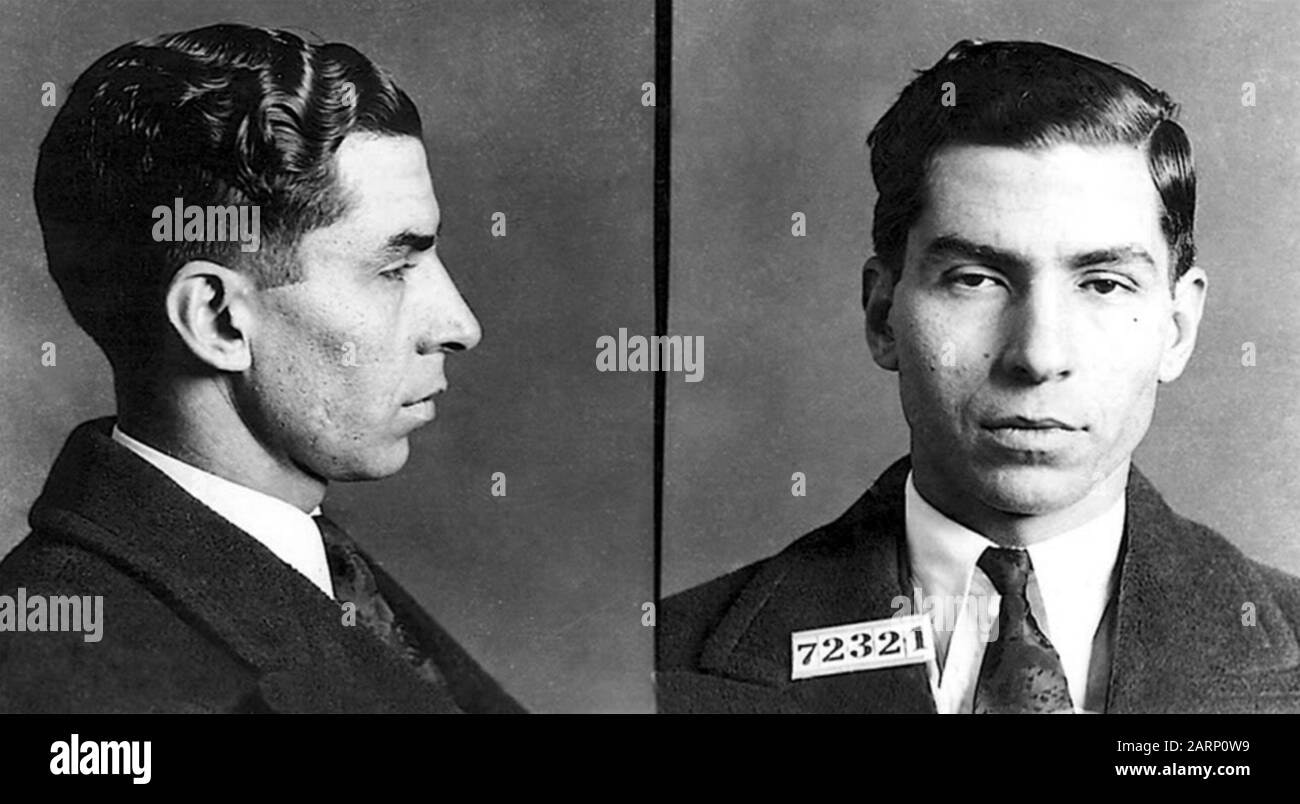
Charles Lucky Luciano
 Italy
ItalyMob boss•crime syndicate architect
Also known as: Salvatore Lucania, Lucky Luciano
Birthday
November 24, 1897
Birth Sign
Sagittarius
Birthplace
Lercara Friddi, Sicily, Italy
Age
Died at 64
About
Charles Lucky Luciano was an Italian-born American mob boss who reshaped organized crime in the United States. Known as the father of the modern Mafia, he dismantled the old Mustache Pete system and built a national crime syndicate run by a board of directors called the Commission. His influence reached into every major racket: bootlegging, narcotics, gambling, loan sharking, and labor racketeering. At his peak in the 1930s, he controlled a criminal empire that stretched from New York to Chicago to Miami, with a hand in Hollywood and Havana. For fans of true crime history, Luciano is the central figure who turned street thuggery into a corporate-like operation. His legacy is both admired and reviled, a strategic genius who brought order to the underworld but left a trail of violence and corruption.
Early Life & Background
Luciano was born Salvatore Lucania in the sulfur-mining town of Lercara Friddi, Sicily. His family immigrated to New York in 1906, settling in a tenement on the Lower East Side. As a kid, he ran errands for local gangs and got into street fights. He dropped out of school after the fifth grade to work odd jobs, shipping clerk, errand boy, but the real money came from gambling and petty theft. By his teens he was running his own crew, shaking down pushcart vendors and protecting Jewish kids from bullies for a dime a week. A turning point came when he met Meyer Lansky and Bugsy Siegel; they formed a partnership that would define his rise. Luciano was arrested multiple times for drug possession and assault but always dodged serious time. During Prohibition, he joined Joe Masseria's gang, running bootleg liquor across the East River. But he chafed under the old-school Sicilian bosses who refused to work with non-Italians. That tension set the stage for his big move.
Career Growth
In 1931, Luciano orchestrated the murder of Joe Masseria, ending the Castellammarese War. That same year he had Salvatore Maranzano killed, clearing the path for a new order. He then established the Five Families of New York, Genovese, Bonanno, Colombo, Gambino, and Lucchese, with himself at the head of what became the Genovese family. He created the Commission, a board of bosses to settle disputes and divvy up territories. During the Depression, Luciano's syndicate expanded into labor racketeering, controlling the garment district and waterfront unions. In 1936, prosecutor Thomas Dewey got him on compulsory prostitution charges, landing a 30-to-50-year sentence. But in 1942, the U.S. Navy secretly enlisted him to secure New York's docks against Nazi saboteurs. His cooperation led to a commuted sentence in 1946, with the condition he be deported to Italy. From Naples, he kept pulling strings, smuggling heroin into the U.S. with French Corsican connections, until his death in 1962.
Career Timeline
Public Image & Style
Luciano cultivated an image of a gentleman gangster, impeccably dressed, soft-spoken, and ruthlessly efficient. He rarely raised his voice and preferred negotiation over violence. The press painted him as a criminal mastermind, while the public saw a folk hero who beat the system. His deportation made him a symbol of the Mafia's reach. In Italian exile, he was a tourist attraction, with reporters and photographers chronicling his every move. True-crime fans today debate his role: some see a visionary who rationalized organized crime; others, a violent thug. His nickname 'Lucky' stuck, but he always insisted it was earned, not given.
Fame & Fandom
Charles Lucky Luciano never cultivated a fanbase in the traditional sense, as his life was defined by criminal enterprise rather than public entertainment. No organized group of devotees, no official fandom name, and no grassroots campaigns exist to honor him; instead, his legacy is maintained through historical study, true-crime literature, and museum exhibits where he remains a central figure in American organized crime mythology. While modern audiences consume his story with fascination, this interest stems from academic and forensic curiosity rather than personal adoration or celebrity worship. Despite the absence of a formal following, his global notoriety remains immense according to the iFANN Global Fame Rankings. Current data places him as the 38th most famous person from Italy, a standing that has held steady since the previous cycle. Furthermore, within the specific domain of true crime history, he is ranked as the 10th most famous person in True Crime, maintaining his position among the era's most significant figures. These placements reflect his enduring presence across media coverage and consumption signals worldwide, solidifying his status as a historical archetype rather than a pop culture icon.
Interesting Facts and Legends
Charles Lucky Luciano earned the nickname Lucky after surviving a brutal 1929 gangland slashing that left him for dead, a feat he attributed to a lucky rabbit's foot he always carried. He never learned to drive a car, yet preferred negotiation over violence, cultivating an image of a gentleman gangster who rarely raised his voice. His favorite meal was pasta with clam sauce, and he insisted on wearing custom-tailored suits even while imprisoned. A soft spot for stray cats led him to keep several at his Italian villa until his death. The 1972 film The Valachi Papers and the 1974 movie Lucky Luciano both dramatize his life. He once said, 'I never killed anyone who didn't deserve it.' Historical records confirm he orchestrated the murder of Joe Masseria in 1931 to seize control of New York's underworld, establishing the Commission to govern the Five Families. During World War II, he allegedly negotiated a deal with the U.S. government from prison, offering intelligence on Nazi sabotage in exchange for a sentence reduction and subsequent deportation to Italy in 1946. His downfall was engineered by prosecutor Thomas E. Dewey, utilizing testimony from prostitutes like Eunice Carter and Polly Adler to convict him of compulsory prostitution in 1936.
Notable Quotes
“I never killed anyone who didn't deserve it.”
“I'm not a gangster. I'm a businessman.”
“The only way to stay alive is to be smarter than the other guy.”
“I built the Commission to keep peace.”
Family & Personal Life
Luciano was born to Antonio Lucania, a sulfur miner, and Rosalia Capporelli. He had three siblings: brothers Bartolo and Giuseppe, and sister Maria. His parents were strict Catholics, but Luciano rejected religion early on. In 1948, while in exile in Italy, he met Igea Lissoni, a dancer from Milan. They married in 1949 and lived together in Naples until her death from breast cancer in 1959. Luciano never had children, saying he didn't want to burden them with his criminal legacy. He kept a villa in Posillipo and a house in Palermo, but his inner circle remained his American associates. He was buried in St. John's Cemetery in Queens, New York, alongside his parents and brother.
Notable Connections
Luciano partnered closely with Meyer Lansky, the financial brain behind the syndicate. He also worked with Bugsy Siegel, Frank Costello, and Vito Genovese. His rivalries included Joe Masseria and Salvatore Maranzano. Later in life, he had ties to French Corsican heroin traffickers. His nemesis was prosecutor Thomas Dewey.
Relationships & Dating History
Luciano had a long-term relationship with a woman named Mildred in the 1920s, but she died of a drug overdose. In the 1930s, he was linked to several showgirls and actresses, though none seriously. In 1948, while in exile, he met Igea Lissoni, a 27-year-old dancer from Milan. They married in 1949 and lived together in Naples. Igea died of breast cancer in 1959. Luciano never remarried. He was known to have a mistress, Adriana Rizzo, in his final years. As of 1962, he was widowed.
- DatedMildred1920 - 1928Long-term girlfriend who died of a drug overdose.
- MarriedIgea Lissoni1949 - 1959Italian dancer; married until her death from breast cancer.
Death & Aftermath
Died
January 26, 1962 (aged 64)
Death Place
Naples, Campania, Italy
Cause of Death
Heart failure
The passing of Charles Luciano marked the end of an era for organized crime, a moment noted by law enforcement as the conclusion of the figure who transformed street thuggery into a corporate-like operation. His death occurred on January 26, 1962, at his residence in the Posillipo district of Naples, Italy, where he had lived in relative obscurity since his deportation from the United States in 1946. Official records attribute the cause to heart failure, a ruling established by his personal physician and confirmed by family statements. While biographical narratives suggest declining health following his years in exile, no disputed accounts regarding the immediate circumstances of his final days have emerged in the historical record. Public reaction to the event was characterized by silence rather than tributes, as the deported alien held no official standing in the United States and government officials issued no formal statements.
A private funeral service took place shortly after his death in Naples, attended only by a small circle of family members and close associates before he was buried in the Cimitero di Poggioreale. The low-key nature of the burial avoided attracting media attention consistent with his status as an exiled gangster. Following his death, Luciano became the subject of numerous books, documentaries, and films, including the 1973 television movie Lucky Luciano. He has been inducted into various halls of fame related to organized crime history and is frequently featured in museum exhibits such as those at The Mob Museum.
Net Worth (Estate Value)
$12 Million
iFANN Editorial Team estimate
At the height of his power in the 1930s, Luciano's criminal enterprises generated tens of millions annually from bootlegging, gambling, and labor rackets. After deportation, he continued to profit from heroin smuggling through the French Connection. Per iFANN's editorial analysis, his estate was valued at $12 Million at the time of his death in 1962. His assets included a villa in Naples, property in Sicily, and cash stashed in Swiss banks, all managed by his brother and associates. As of 2026, the estimated net worth of Luciano's empire at its peak, adjusted to modern dollars, would be in the hundreds of millions.
Awards & Accolades
View 4 records, honours and achievementsKnown For
Founding the Commission
1931 · Architect
Leading the Genovese crime family
1931 · Boss
WWII naval intelligence cooperation
1942 · Informant
Modernizing American organized crime
1931 · Reformer
Keywords
Sources
Quick Facts
- Profession
- Mob boss
- Born
- 1897-11-24
- Birthplace
- Lercara Friddi, Italy
- Birth Sign
- Sagittarius
- Height
- 5 ft 10 in (178 cm)
- Nationality
- Italian
Personal Details
- Full Name
- Salvatore Lucania
- Spouse
- Igea Lissoni
Frequently Asked Questions
How did Lucky Luciano die?
What was Lucky Luciano's net worth at his death?
Why was Lucky Luciano called Lucky?
Was Lucky Luciano ever married?
What did Lucky Luciano do during World War II?
Similar People
Join the community
fans discussing