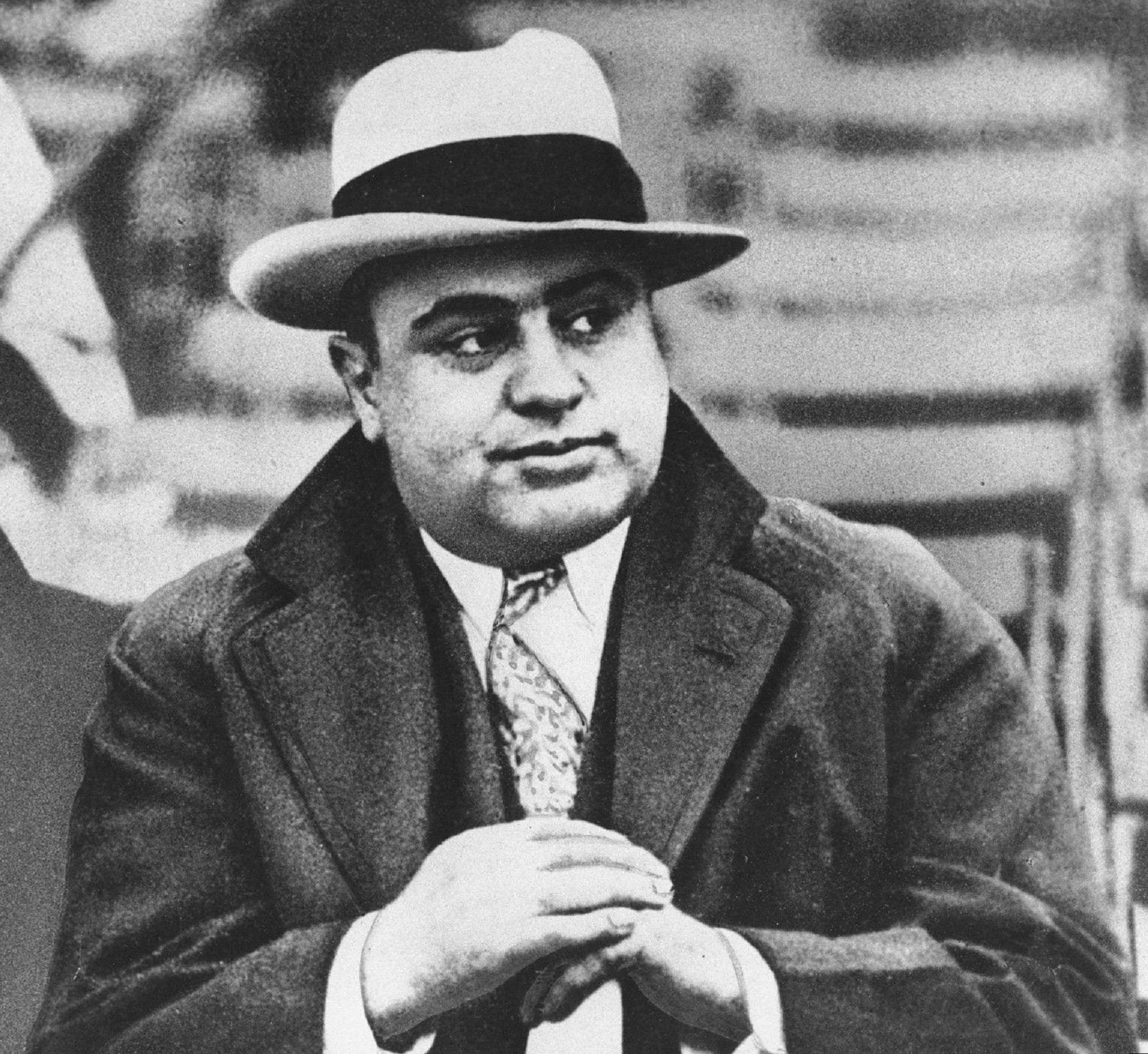
Al Capone
 United States
Also known as: Scarface, Snorky, Big Al
Birthday
January 17, 1899
Birth Sign
Capricorn
Birthplace
Brooklyn, New York, USA
Age
Died at 48
About
Al Capone was an American gangster and businessman who rose to infamy during the Prohibition era. As co-founder and boss of the Chicago Outfit from 1925 to 1931, he built a vast criminal empire centered on bootlegging, gambling, and prostitution. His violent tactics and high-profile clashes with law enforcement made him a national symbol of organized crime. Capone's career ended at age 33 when he was convicted of tax evasion and imprisoned for nearly eight years. He died in 1947 at age 48 after a stroke.
Early Life & Background
Alphonse Gabriel Capone was born on January 17, 1899, in Brooklyn, New York, to Italian immigrant parents Gabriele and Teresina Capone. His father was a barber and his mother a seamstress; they raised nine children in a working-class neighborhood. Capone attended school until the sixth grade, then left after striking a teacher. He fell in with local street gangs, eventually joining the Five Points Gang under the mentorship of Johnny Torrio. Capone worked as a bouncer in Brooklyn saloons, where he received a knife slash across his left cheek, earning the nickname "Scarface." In 1919, Torrio invited him to Chicago to help run his bootlegging operations. Capone moved there with his wife Mae, and quickly proved himself as a capable enforcer and manager.
Career Growth
By 1925, Capone had taken full control of the Chicago Outfit after Torrio's retirement. He expanded the syndicate's reach across Chicago and beyond, controlling speakeasies, breweries, gambling dens, and brothels. At its peak, the Outfit's annual revenue was estimated at over $100 million. Capone cultivated a public image as a businessman, donating to charities and opening soup kitchens. But his reign was marked by brutal gangland warfare, culminating in the 1929 Saint Valentine's Day Massacre, where seven members of the North Side Gang were executed. The massacre turned public opinion against him and prompted federal authorities to target him. Capone was convicted of tax evasion in 1931 and sentenced to 11 years in federal prison. He served time in Atlanta and Alcatraz before being released in 1939 due to deteriorating health.
Career Timeline
Public Image & Style
Capone cultivated a dual public persona: a ruthless gangster and a generous philanthropist. He often wore expensive suits, smoked cigars, and was photographed at baseball games and charity events. The media labeled him "Public Enemy No. 1" after the Saint Valentine's Day Massacre, a title he both resented and exploited. His image has been romanticized in countless films and books, often portrayed as a charismatic antihero. The fandom around Capone is complex; some view him as a symbol of rebellion, others as a cautionary tale. His notoriety has made him a fixture in American pop culture, from The Untouchables to Boardwalk Empire.
Fame & Fandom
Al Capone remains the 1st most famous person in True Crime, a standing he has held steady across cycles of historical reassessment. This singular dominance reflects how his story continues to anchor the genre more than any other figure, drawing fresh eyes to the Prohibition era decades after his death. His legacy is measured not by fleeting trends but by a persistent, global attention that spans media coverage, search patterns, and consumption signals worldwide.
The audience surrounding this gangster does not organize under a formal name. While some communities form around specific eras or films, there is no single documented group that claims him as their own with a unique title. Instead, the public engagement manifests through a complex relationship with his mythology. Fans often grapple with the duality of his image: the ruthless boss who ordered the St. Valentine's Day Massacre and the man who ran soup kitchens during the Great Depression. The nickname "Scarface" dominates discourse, though it was strictly used behind his back while he preferred the moniker "Snorky." This tension between the brutal reality and the romanticized antihero persona drives much of the enduring interest.
Legendary moments continue to fuel this fascination without needing active fan campaigns. The 1986 broadcast titled *The Mystery of Al Capone's Vaults* remains a cultural touchstone, where Geraldo Rivera's televised search for hidden millions ended in an empty room, turning a massive event into a lasting joke about futility. Similarly, the 1932 film *Scarface* starring Paul Muni and the later 1983 Martin Scorsese version of the same name have cemented his status as an icon, even as they fictionalize his life. The fandom exists in the collective memory of these stories, from the verified bar fight in 1918 that earned him his scar to the tax evasion conviction that set a new legal precedent. There are no crowds fainting at his appearances or organized rituals today, only a quiet, devoted study of a man whose criminal empire and subsequent downfall reshaped American history.
Interesting Facts and Legends
The nickname "Scarface" was strictly used behind his back, as he preferred the stylish moniker "Snorky." During the Great Depression, he sponsored a free soup kitchen in Chicago that served thousands daily. He suffered from neurosyphilis contracted years earlier, which accelerated his mental decline while imprisoned. His favorite suit was a custom-made number costing $5,000, and his criminal record was sealed in some jurisdictions, fueling decades of mythmaking. As the first major crime figure taken down by tax evasion rather than violent charges, his legal downfall set a new precedent. Beyond these facts, his mythology includes the verified bar fight in 1918 in Brooklyn, where a knife slash earned him his infamous scar. The single most retold incident is the St. Valentine's Day Massacre, where seven members of George "Bugs" Moran's gang were executed against a garage wall in 1929, cementing his reputation for brutality despite never being charged with the murders. Another legendary moment involves the Geraldo Rivera Vault discovery in 1986, where a televised search for millions in hidden cash ended in an empty room, turning a massive event into a cultural joke about futility that persists in collective memory.
Notable Quotes
“You can get much farther with a kind word and a gun than you can with a kind word alone.”
“I am just a businessman, giving the people what they want.”
“All I do is satisfy a public demand.”
Family & Personal Life
Capone married Mae Josephine Coughlin in 1918; she was Irish Catholic, and the marriage produced one son, Albert Francis "Sonny" Capone, born in 1918. Mae remained loyal throughout Capone's criminal career and imprisonment, and she outlived him by nearly four decades, dying in 1986. Sonny suffered from a congenital ear infection that left him partially deaf; he became a businessman and avoided his father's criminal path, dying in 2004. Capone's older brother, James Vincenzo Capone, changed his name to Richard Hart and became a Prohibition agent in Nebraska, working against bootleggers.
Notable Connections
Capone's criminal network included key associates like Johnny Torrio, his mentor, and Frank Nitti, who succeeded him. He also had ties to corrupt politicians and police in Chicago. His chief rival was George "Bugs" Moran of the North Side Gang. Federal prosecutor Eliot Ness, leader of "The Untouchables," was instrumental in building the tax evasion case against him.
Relationships & Dating History
Capone married Mae Josephine Coughlin in 1918 when he was 19 and she was 21. Mae was a devout Catholic and remained supportive throughout his criminal career and imprisonment. The couple had one son, Albert Francis "Sonny" Capone. Mae lived a relatively private life, managing the household and shielding Sonny from the public eye. They stayed married until Capone's death in 1947. There are no documented extramarital relationships of significance, though rumors of mistresses circulated. Mae never remarried and died in 1986 at age 89.
- MarriedMae Capone1918 - 1947Married in 1918; remained together until Capone's death in 1947. One son, Albert.
Death & Aftermath
Died
January 25, 1947 (aged 48)
Death Place
Miami Beach, Florida
Cause of Death
cardiac arrest (heart failure)
Al Capone spent his final years in relative seclusion at his estate on Palm Island in Miami Beach, Florida, where he had resided since leaving Alcatraz in 1939. His health had deteriorated significantly due to tertiary syphilis, which caused strokes and paralysis over several years, keeping him largely confined to his home before he passed away peacefully in his sleep on January 25, 1947. The official cause of death was listed as cardiac arrest, a condition attributed to the advanced stage of syphilis that had severely damaged his cardiovascular and nervous systems. Public reaction to the passing of the notorious gangster was mixed but generally muted compared to the frenzy surrounding his earlier criminal activities, with scarce tributes from peers who had been imprisoned, killed, or moved on to other ventures.
Institutions and officials did not issue formal statements of mourning, reflecting the complex legacy of his criminal empire, while media coverage reinforced his status as a historical figure through news reports rather than celebratory events. A private funeral service was held two days later at the Holy Name Cathedral in Chicago, attended by a small group of family members and close friends, after which Capone was cremated and his ashes interred at the Gate of Heaven Cemetery in Hawthorne, Illinois. In the posthumous era, Capone has evolved into a cultural icon inspiring numerous films, books, and documentaries, including the 1959 film titled Al Capone and the 1987 television special The Mystery of Al Capone's Vaults hosted by Geraldo Rivera.
While he has not been inducted into any traditional hall of fame, he is frequently honored in museums such as The Mob Museum in Las Vegas, which features extensive exhibits on his life and crimes.
Net Worth (Estate Value)
$10 Million
iFANN Editorial Team estimate
At the height of his power in the late 1920s, Al Capone's criminal empire generated an estimated $100 million annually from bootlegging, gambling, and prostitution. However, per iFANN's editorial analysis, his net worth at the time of his death in 1947 was significantly lower, standing at approximately $10 Million. Much of his wealth had been hidden or lost to legal fees and seizures during his long legal battles. After his release from prison, Capone lived modestly on Palm Island, Florida, supported by hidden assets while his health declined. His estate, managed by his wife Mae, continued to generate income from legitimate investments. As of 2026, the Capone estate is valued at approximately $10 Million, primarily derived from royalties and licensing of his name and image.
Awards & Accolades
View 2 records, honours and achievementsKnown For
Chicago Outfit
1925 · Boss
Saint Valentine's Day Massacre
1929 · Mastermind
Keywords
Sources
Quick Facts
- Profession
- gangster
- Born
- January 17, 1899
- Birthplace
- Brooklyn, New York
- Died
- January 25, 1947
- Death Place
- Palm Island, Florida
- Gender
- Male
- Spouse
- Mae Capone
- Birth Sign
- Capricorn
- Net Worth
- $10 Million
- Height
Personal Details
- Full Name
- Alphonse Gabriel Capone
- Spouse
- Mae Capone
- Children
- Albert "Sonny" Capone
Frequently Asked Questions
How did Al Capone die?
What was Al Capone's net worth in 2026?
Is Al Capone still alive?
What is Al Capone best known for?
Why was Al Capone called Scarface?
Similar People
Join the community
fans discussing