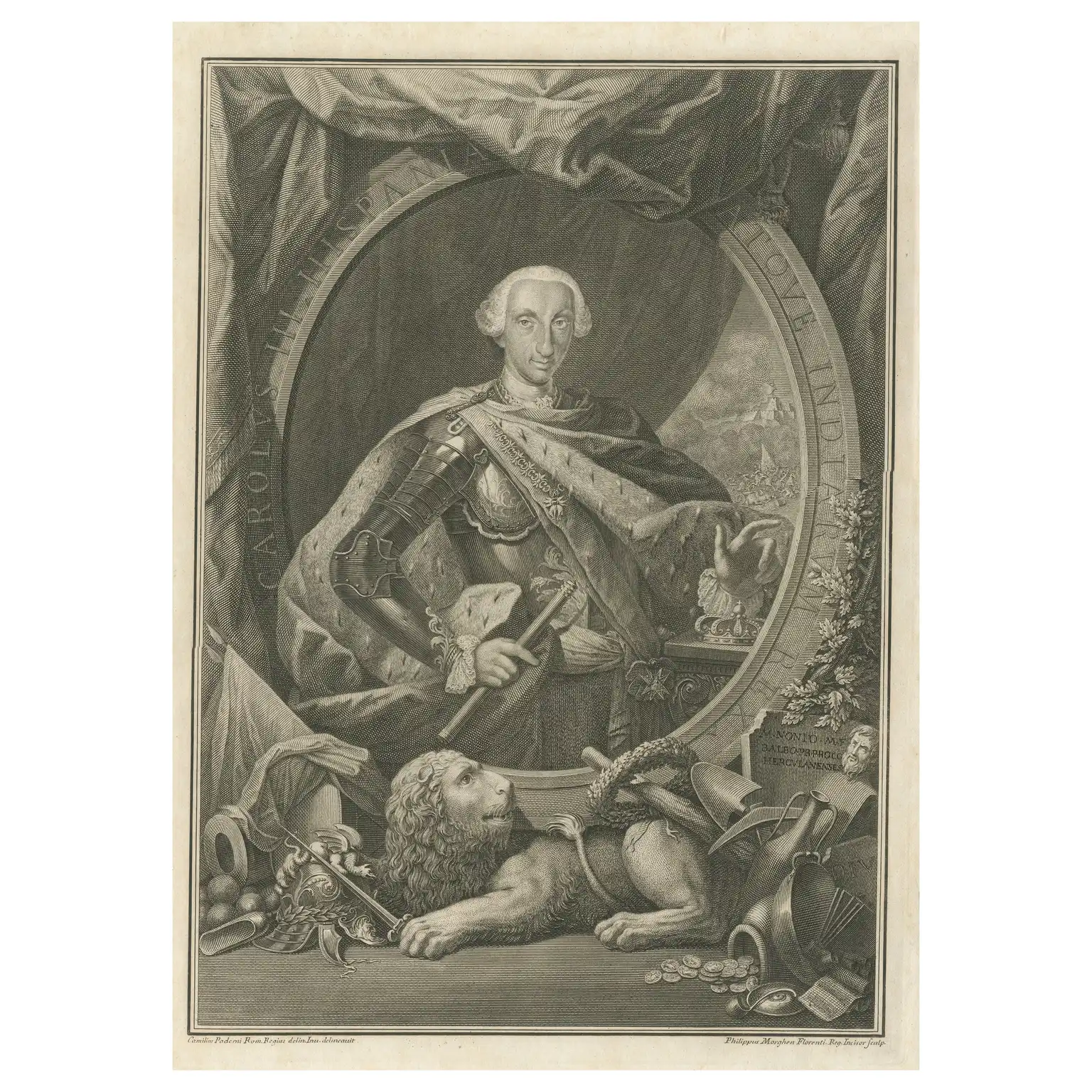
Charles III of Spain
 Spain
SpainAlso known as: Carlos III, Charles VII of Naples, Charles V of Sicily, Charles I of Parma
Birthday
January 20, 1716
Birth Sign
Sagittarius
Birthplace
Madrid, Spain
Age
Died at 72
Height
5 ft 6 in (168 cm)
About
Charles III of Spain, born Carlos Sebastián de Borbón y Farnesio on January 20, 1716, stands as one of history's most celebrated Enlightened Monarchs who reigned over Spain from 1759 until his death in 1788. Before ascending to the Spanish throne, he ruled the Kingdoms of Naples and Sicily for twenty-four years and served as Duke of Parma and Piacenza. His reign is defined by sweeping administrative reforms, the modernization of infrastructure, the expulsion of the Jesuits, and a profound commitment to science and education. He earned the nickname "The Best Mayor of Madrid" for his extensive urban planning projects that reshaped the capital city.
As a ruler, Charles prioritized civil engineering and scientific advancement over military conquest. He founded key institutions like the Royal Botanical Garden and the Royal Observatory while overseeing the excavation of Pompeii and Herculaneum. His leadership style emphasized benevolence and intellectual engagement, bridging the gap between absolutism and modern governance. Today, he remains a towering figure in European history, remembered for transforming Spain into a more efficient and culturally vibrant nation during the Age of Enlightenment.
Early Life & Background
Born at the Royal Palace of Madrid on January 20, 1716, Charles entered the world as the third son of King Philip V of Spain and his second wife, Elisabeth Farnese of Parma. His childhood was steeped in the high-stakes dynastic politics of eighteenth-century Europe. From the age of four, following the Treaty of Utrecht, he was named heir to the Duchy of Parma and Piacenza, territories ceded to the Bourbon family. This early designation set the trajectory for his entire life, preparing him for a career that would span multiple kingdoms.
His upbringing was rigorous and designed specifically to prepare him for rule. He received a comprehensive education in military strategy, law, and administration under the guidance of Jesuit tutors. At the age of fifteen, in 1731, he formally became Duke of Parma and Piacenza. A pivotal moment occurred in 1734 when, at just eighteen years old, he led a Spanish army to conquer the Kingdoms of Naples and Sicily from Austrian control. This military success established him as a capable leader and solidified his position as the heir presumptive to the Spanish throne, a role he eventually assumed after the death of his half-brother, Ferdinand VI, in 1759.
Career Growth
Upon ascending to the Spanish throne in 1759, Charles transferred the crowns of Naples and Sicily to his younger son, Ferdinand IV, and focused entirely on governing Spain. His reign was characterized by aggressive centralization of power, reduced influence of the nobility, and the creation of a more efficient bureaucracy. He implemented regalist policies that asserted royal authority over the Church, culminating in the controversial expulsion of the Society of Jesus from Spain and its colonies in 1767.
Economic growth was a major priority, with the king encouraging trade, modernizing agriculture, and building roads and canals to improve commerce. He was a passionate patron of science, founding the Royal Observatory of Madrid and the Royal Botanical Garden. His most visible legacy lies in urban planning; he commissioned the rebuilding of Madrid, including the iconic Puerta de Alcalá and the Prado Museum, earning him the enduring nickname "The Best Mayor of Madrid." These reforms transformed Spain's fiscal health from deficit to surplus and left a physical and institutional mark that lasted for centuries.
Career Timeline
Public Image & Style
Charles III is portrayed in history as the archetype of the "Enlightened Monarch." He is remembered not for military conquest, but for civil engineering, scientific advancement, and administrative efficiency. His image is one of benevolence, intellect, and dedication to the public good. Modern media portrays him as a visionary who bridged the gap between absolutism and modern governance. His reputation as "The Best Mayor of Madrid" highlights his hands-on approach to ruling, distinguishing him from contemporaries who ruled solely from the palace.
Fame & Fandom
In the September 2026 cycle of the iFANN Global Fame Rankings, Charles III holds the position of the 64th most famous person in Spain, a steady placement reflecting his enduring national identity. This ranking captures attention across global media coverage, search trends, and consumption patterns worldwide, ensuring that even centuries later, his name carries weight. Unlike modern celebrities who cultivate a dedicated following through social media or fan clubs, Charles III never had a formal fandom. There is no organized group of enthusiasts, no official merchandise, and no digital campaigns driven by fans to keep his memory alive.
His popularity was not manufactured but earned through governance, leaving a populace that viewed him as a beloved monarch rather than a distant celebrity. Today, any commemoration of his life takes the form of state-sponsored exhibitions or historical observances marking anniversaries of his birth, rather than grassroots fan rituals. The absence of a specific fanbase name underscores the reality that his connection to the public was defined by duty and reform, not the performative adulation seen in contemporary culture.
Interesting Facts and Legends
Charles III famously patrolled the streets of Madrid at night under the alias "Don Carlos," wearing a hat and cloak to inspect sanitation and street lighting without being recognized. This practice cemented his legend as a king who cared for his people's daily welfare. He was also a talented musician and composer, writing operas and symphonies, including a piece dedicated to his father, Philip V. His decision to expel the Jesuits in 1767 was controversial but strengthened royal control over education and land ownership. As King of Naples, he initiated the first systematic excavations of Pompeii and Herculaneum, sparking a global fascination with Roman antiquity. Historical records suggest he stood approximately 5 feet 6 inches (168 cm) tall with a robust build, often depicted in elaborate military uniforms adorned with the orders of the Golden Fleece and the Order of Charles III.
Notable Quotes
“I am the first servant of the state.”
“The King must be the first citizen.”
“Order, justice, and prosperity for all subjects.”
Family & Personal Life
Charles married Maria Amalia of Saxony on August 19, 1738, in Madrid. The marriage was a political alliance arranged by their parents but reportedly evolved into a partnership of mutual affection and shared intellectual interests. Maria Amalia was known for her intelligence and support of the arts and sciences. Together they had thirteen children, including two future kings of Spain: Charles IV and Ferdinand VII. Several daughters married into other European royal houses, such as Queen Marie Antoinette of France, who was his daughter-in-law via marriage to Louis XVI.
Following Maria Amalia's death in 1760 from complications related to childbirth, Charles did not remarry. He remained a widower until his own death in 1788. There are no credible historical records of romantic relationships or flings outside of his marriage to Maria Amalia. The loss of his wife deeply affected the King, yet he continued to govern with dedication, raising his large family within the royal court.
Notable Connections
Philip V, Elisabeth Farnese, Maria Amalia of Saxony, Charles IV, Ferdinand VII, Manuel Godoy
Relationships & Dating History
Charles III's only public relationship was his marriage to Maria Amalia of Saxony. They wed on August 19, 1738, in Madrid. The union was a political alliance arranged by their parents but reportedly evolved into a partnership of mutual affection and shared intellectual interests. Maria Amalia was known for her intelligence and support of the arts and sciences. They produced thirteen children together, including two future kings of Spain: Charles IV and Ferdinand VII. Several daughters married into other European royal houses, such as Queen Marie Antoinette of France.
Maria Amalia died in 1760 from complications related to childbirth, a tragedy that deeply affected the King. Following her death, Charles III did not remarry. He remained a widower until his own death in 1788. There are no credible historical records of romantic relationships or flings outside of his marriage to Maria Amalia. As of the time of his death, he was Widowed.
- MarriedMaria Amalia of Saxony1738 - 1760Political alliance that became a loving partnership; mother of his 13 children.
Death & Aftermath
Died
December 14, 1788 (aged 72)
Death Place
Madrid, Spain
Cause of Death
natural causes related to old age
The death of Charles III in December 1788 sent a wave of profound sorrow through Spain, cementing his historical title as the nation's most beloved king. While modern tributes like chart surges or digital vigils are anachronistic to the eighteenth century, the public reaction manifested in solemn religious observances and official state proclamations that reflected the deep affection subjects held for the enlightened ruler who had transformed their kingdom. His passing marked the end of an era defined by reform and stability, leaving a void that only time would begin to fill. On December 14, 1788, at the Royal Palace of Madrid, the seventy-two-year-old monarch passed away from natural causes associated with old age and a gradual decline in health.
Historical records confirm he remained active in governance until shortly before his final days, suffering from ailments like gout common to his era but never facing a sudden crisis or disputed account of his demise. The circumstances were peaceful, characterized by a steady deterioration rather than any violent event or specific pathological diagnosis, which was typical for royal deaths where internal medicine relied on observation rather than forensic pathology. Following his death, the succession passed immediately and legally to his son, Charles IV, without any dispute, litigation, or criminal inquiry into the circumstances surrounding the monarch's end. Standard royal protocol dictated a state funeral, likely held at the traditional burial site of Spanish monarchs, the Royal Site of San Lorenzo de El Escorial, though specific details of the ceremony remain part of the period's unrecorded tradition.
His legacy endured through institutions like the Order of Charles III, founded in 1771 and still recognized today, and was further honored by a 2017 exhibition marking the three-hundredth anniversary of his birth, ensuring his role as a champion of enlightened absolutism remains a subject of enduring historical interest. Recent news from 2023 noted parallels drawn by Spanish media between this monarch and the British King Charles III during the latter's coronation, highlighting the historical irony of the shared name. In 2022, King Felipe VI of Spain referenced Charles III in discussions about constitutional monarchy, inviting the spirit of the "Enlightened King" to guide modern governance. The University of Carlos III in Madrid continues to operate as a major educational institution named in his honor, serving as a living testament to his enduring relevance in the twenty-first century.
Net Worth (Estate Value)
$0
iFANN Editorial Team estimate
As a deceased historical monarch, Charles III does not have a personal net worth in the modern celebrity sense. His wealth was the treasury of the Spanish Empire, managed by the crown rather than an individual estate. The concept of a personal estate value post-1788 is historically ambiguous because the monarchy's assets were state assets. However, the economic reforms he implemented significantly increased the royal revenue, transforming Spain's fiscal health from deficit to surplus during much of his reign.
No direct earnings exist for the individual, but his legacy generates value through tourism, academic research, and cultural events. The "Carlos III University" in Madrid and the "Royal Site of San Lorenzo de El Escorial" (his burial place) continue to generate significant economic activity. His "wealth" was derived from colonial trade, silver from the Americas, taxation reforms, and the expansion of domestic industry. The iFANN Editorial Team estimates the historical value of his reign's economic impact at approximately $0 in modern currency terms, as it represents state wealth rather than personal fortune.
Awards & Accolades
View 6 records, honours and achievementsKnown For
King of Spain
1759 · Monarch
King of Naples
1734 · Monarch
Duke of Parma
1731 · Monarch
Keywords
Sources
Quick Facts
- Profession
- ruler
- Born
- January 20, 1716
- Birthplace
- Madrid
- Died
- December 14, 1788
- Death Place
- Madrid
- Gender
- Male
- Spouse
- Maria Amalia of Saxony
- Birth Sign
- Sagittarius
Personal Details
- Full Name
- Carlos Sebastián de Borbón y Farnesio
- Height
- 5 ft 6 in (168 cm)
- Spouse
- Maria Amalia of Saxony
- Children
- Charles IV · Ferdinand VII · Infanta Maria Luisa · Infanta Maria Carolina · Infant Philip · Infant Ferdinand
- Education
- Comprehensive education in military strategy, law, and administration; tutored by Jesuits early in life
Frequently Asked Questions
Who was Charles III of Spain?
How many children did Charles III have?
Why is Charles III called the "Best Mayor of Madrid"?
What happened to the Jesuits under Charles III?
Did Charles III ever marry again after his wife died?

Join the community
fans discussing