 United States
“Mr. Rose's film is a skillful, scary piece of work, with a genuinely eerie atmosphere and a strong performance from Tony Todd as the Candyman.”
Janet Maslin
The New York Times
Part of a Collection
Candyman Collection
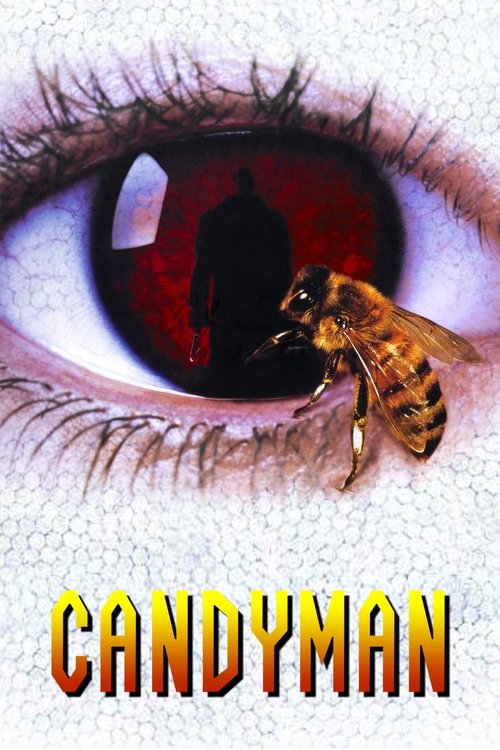
Bernard Rose's 1992 horror film Candyman arrived with a hook hand and a swarm of bees, but it carried something rarer than blood: an idea. Based on Clive Barker's short story The Forbidden, the movie transplants the action from Liverpool to Chicago's Cabrini-Green housing projects. Virginia Madsen plays Helen Lyle, a graduate student whose academic study of urban legends turns deadly when she summons a supernatural killer by saying his name five times into a mirror. Tony Todd's towering, tragic performance as the Candyman turned a B-movie premise into something operatic.
Shot on location in the actual projects, the film cost $6 million and grossed over $25 million worldwide. Philip Glass composed the score, his minimalist piano and strings giving the horror a mournful, almost classical weight. The movie earned mixed reviews on release but has since been reclaimed as a landmark of 1990s horror, praised for its willingness to confront racism, class, and the mechanics of myth-making head-on.
Availability and pricing can change. Confirm on the provider's site before purchasing.
Helen Lyle is a graduate student at the University of Illinois at Chicago, researching urban legends alongside her friend and colleague Bernadette Walsh. Their work leads them to a story circulating in the nearby Cabrini-Green housing projects: say the name Candyman five times in a mirror, and a hook-handed ghost will appear and kill you. Helen's husband Trevor, a successful physician, dismisses her research as trivial, but Helen is drawn deeper into the legend.
She interviews residents, including Anne-Marie McCoy, who claims the Candyman attacked her young son. Helen finds the story compelling but remains skeptical. She visits the infamous Cabrini-Green bathroom where a murder supposedly occurred, and on a dare, she says the name five times. Nothing happens at first, but soon the Candyman begins to haunt her. He is a tall, imposing figure with a hook for a hand, dressed in a tattered coat, and trailed by a cloud of bees. He speaks in a deep, seductive voice and seems to know her secrets.
The Candyman frames Helen for a series of brutal murders. Bernadette is killed, and Helen is arrested and placed in a psychiatric hospital. She escapes, determined to prove the Candyman is real and to stop his rampage. Her investigation takes her back to Cabrini-Green, where she learns more about the Candyman's origins: he was once Daniel Robitaille, the son of a wealthy slave owner who fell in love with a white woman. A lynch mob cut off his hand with a rusty saw and smeared him with honey, leaving him to be stung to death by bees. His spirit now feeds on fear and memory.
Helen's academic detachment crumbles as she confronts the reality of the Candyman. She realizes that belief itself gives him power. The story builds to a final confrontation in the projects, where Helen must decide how far she is willing to go to stop him. The film weaves together themes of urban decay, racial violence, and the way stories shape our world, leaving the question of what is real and what is legend hanging in the air.
Official Trailer
Critical Consensus
Candyman transcends typical slasher fare with its intelligent script, atmospheric direction, and Tony Todd's iconic performance. While some critics found its social commentary heavy-handed, the film's blend of gothic horror and urban realism has earned it a lasting reputation as a thoughtful, genuinely frightening horror classic.
“Mr. Rose's film is a skillful, scary piece of work, with a genuinely eerie atmosphere and a strong performance from Tony Todd as the Candyman.”
Janet Maslin
The New York Times
“The film is a clever, disturbing meditation on the power of urban legends, and Tony Todd's Candyman is a genuinely frightening creation.”
Owen Gleiberman
Entertainment Weekly
“Tony Todd's Candyman is a figure of tragic grandeur, a monster who is also a victim, and his performance gives the film a dark, operatic quality.”
Richard Harrington
The Washington Post
“A rare horror film that works on multiple levels, as a slasher, a social critique, and a meditation on the power of myth. Philip Glass's score is a masterpiece.”
Kim Newman
Empire Magazine
Virginia Madsen
Helen Lyle
Tony Todd
Candyman
Xander Berkeley
Trevor Lyle
Kasi Lemmons
Bernadette Walsh
Vanessa Williams
Anne-Marie McCoy
DeJuan Guy
Jake
Michael Culkin
Professor Purcell
Stanley DeSantis
Dr. Burke
Gilbert Lewis
Detective Frank Valento
Marianna Elliott
Clara
Ted Raimi
Billy
Ria Pavia
Monica
Director
Bernard Rose
Writers
Clive Barker, Bernard Rose
Composer
Philip Glass
Cinematographer
Anthony B. Richmond
Producers
Steve Golin, Alan Poul, Sigurjón Sighvatsson
Fangoria Chainsaw Awards (1993)
Best Actor: Won
Saturn Awards (1993)
Best Horror Film: Nominated
Saturn Awards (1993)
Best Actress: Nominated
Saturn Awards (1993)
Best Make-Up: Nominated
MTV Movie Awards (1993)
Best Villain: Nominated
Join the community
fans discussing