 Spain
SpainAbout
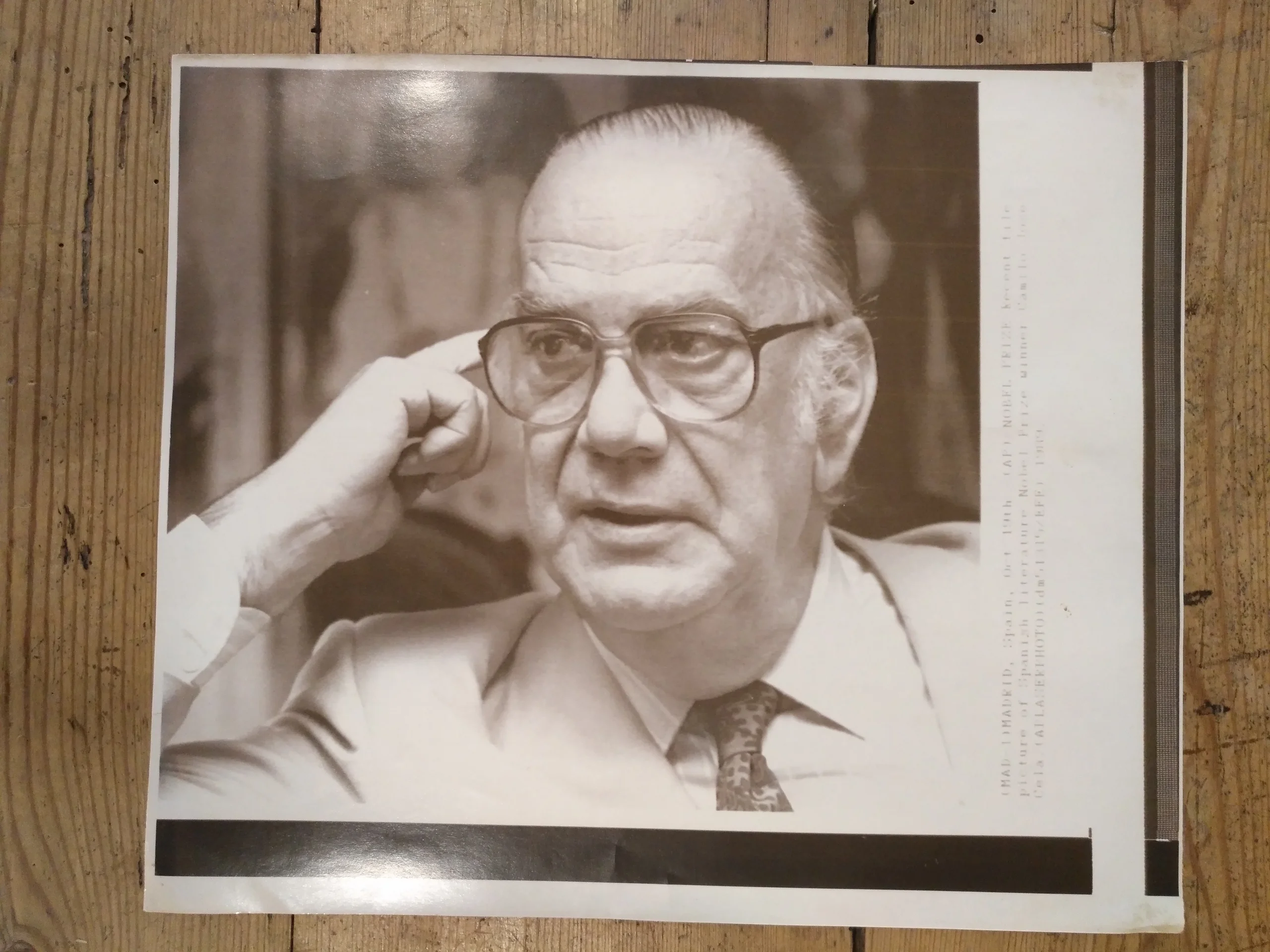
Camilo José Cela y Trulock was a towering figure in Spanish literature whose career spanned more than six decades. Born in Iria Flavia, Galicia, he became a leading voice of the Generation of '36 and is best known for launching the Tremendismo movement with his debut novel The Family of Pascual Duarte. His rich, intense prose earned him the Nobel Prize in Literature in 1989, cementing his legacy as a global literary icon who chronicled the harsh realities of post-war Spain with unflinching realism.
Cela remained a formidable intellectual presence until his death in 2002. He was granted the title of 1st Marquess of Iria Flavia in 1995, recognizing his immense contribution to Spanish culture. His body of work includes over fifty books, ranging from novels and short stories to travelogues and essays, all characterized by a unique blend of grotesque realism and deep human compassion.
Early Life & Background
Born into a family of Galician nobility on May 11, 1916, Camilo José Cela spent his early years in Iria Flavia before moving to Madrid with his family. His father was a lawyer and his mother came from a distinguished lineage, providing a stable but traditional upbringing that young Camilo often chafed against. His education was marked by rebellion; he was expelled from two schools during his youth. The most famous incident involved him throwing a compass at a teacher, an act that cemented his reputation as an irascible and non-conformist figure even before he picked up a pen professionally.
Before establishing himself as a writer, Cela pursued higher education at the University of Madrid, studying law, medicine, and philosophy. He abandoned these studies to dedicate himself entirely to literature. During the Spanish Civil War (1936–1939), he served in the Nationalist army, an experience that deeply influenced his worldview and later works. The war's brutality and the subsequent post-war austerity shaped the grim, realistic tone characteristic of his early fiction. He began contributing to literary magazines in the late 1930s, honing a style that would soon revolutionize Spanish letters.
Career Growth
Cela's breakthrough arrived in 1942 with the publication of La familia de Pascual Duarte (The Family of Pascual Duarte). This novel became a sensation and is credited with launching the "Tremendismo" movement in Spanish literature, a style characterized by exaggerated violence, grotesque realism, and a raw depiction of human suffering. The book's success established Cela as a major literary voice almost overnight.
Following this debut, Cela continued to produce a prolific body of work. In 1951, he published La colmena (The Hive), a sprawling, fragmented novel depicting the squalor and survivalism of Madrid in the immediate aftermath of the Civil War. Initially banned by Francoist censors for its critical portrayal of society, it was eventually published abroad and later in Spain, becoming one of his most celebrated works. Throughout the 1950s and 1960s, he traveled extensively, particularly through Italy and Latin America, drawing inspiration for his travelogues and novels.
His career reached its zenith in 1989 when he was awarded the Nobel Prize in Literature. The Swedish Academy cited his "rich and intensive prose, which with restrained compassion forms a challenging vision of man's vulnerability." This honor elevated him to the status of a global literary icon. In 1995, he was granted the title of 1st Marquess of Iria Flavia by King Juan Carlos I, recognizing his immense contribution to Spanish culture.
Career Timeline
Public Image & Style
Cela was known for his imposing presence and sharp intellect. Contemporary descriptions often portray him as tall and distinguished, with a piercing gaze that matched his uncompromising literary style. His public image was that of a formidable, sometimes controversial intellectual, rebellious, witty, and fiercely independent. He was known for his aphorisms, such as "There are two classes of men: those who make history and those who suffer it," which became part of Spanish cultural mythology. His writing style evolved from the harsh realism of Tremendismo to a more varied, often ironic and multilingual approach in later years.
Fame & Fandom (iFAMOUS Rankings)
Camilo José Cela's admirers form a readership and scholarly following rather than a formally organized fandom; no official fandom name has ever been documented. His most devoted readers are found among students of Spanish literature, academics, and general readers of postwar fiction, a base that has remained steady but modest since his death in 2002. The 1989 Nobel Prize in Literature broadened his international audience, and his works continue to be rediscovered through critical reappraisals, such as a 2023 New York Times review of The Hive and a January 2023 essay in The Rumpus analyzing its multilingual texture.
As of August 2026, iFANN's Global Fame Engine has evaluated Cela but he does not currently hold a placement in the published rankings, whether the Global Top 1,000 or any Top-100 scope list. This absence from the rankings reflects the engine's assessment of his contemporary fame signals, which are largely confined to academic and literary circles rather than broad popular recognition. No fan campaigns or organized rituals have been documented for Cela, a fact consistent with his pre-social-media era. Instead, his legacy is maintained through institutional projects, such as the University of Barcelona's 2022 discovery of what is believed to be his first manuscript, and through the continued circulation of his aphorisms in Spanish media, as seen in recent articles quoting his observations on history and the writer's vocation.
Interesting Facts and Legends
One of the most frequently retold stories from Cela's youth is that he was expelled from school for throwing a compass at a teacher, a tale that aligns with his reputation as a rebellious and irascible figure. His aphorisms have taken on a life of their own, often the first encounter newcomers have with his wit. Among the most quoted is his observation that "There are two classes of men: those who make history and those who suffer it," which has circulated widely in Spanish media. Another favorite is his dictum that a writer who cannot face starvation should change professions, reflecting his uncompromising artistic ethos.
Cela was also a polyglot, fluent in several languages, which influenced his experimental style in later works. Despite his fame, he remained relatively private about his personal life, preferring to let his work speak for itself. The ban of The Hive by the Franco regime created a legend of resistance and artistic freedom, while his extensive travels documented in books like Viaje a la Alcarria set a standard for travel writing in Spanish.
Notable Quotes
“There are two classes of men: those who make history and those who suffer it.”
“A writer who cannot face starvation should change professions.”
“It is better to spend oneself than to rust.”
“I am a man of my time, but I do not want to be a slave of it.”
Family & Personal Life
Camilo José Cela was born into a family of Galician nobility; his father was a lawyer and his mother was from a distinguished lineage. He had children, including the journalist and writer Camilo José Cela Conde. Although born in Iria Flavia, he spent much of his childhood and youth in Madrid, where his family moved when he was young. The family environment was formal yet supportive of his intellectual pursuits, despite his early rebellious behavior at school.
Notable Connections
Relationships & Dating History
Camilo José Cela was married twice. His first marriage was to María del Rosario Conde Picavea. They wed in 1942, the same year his debut novel was published. The couple remained together until her death, though specific dates of their separation or her passing are less frequently detailed in public records compared to his second union. From this marriage, he had children, including the journalist and writer Camilo José Cela Conde.
After the death of his first wife, Cela married Marina Castaño. This union occurred later in his life, though exact wedding dates are not always highlighted in biographical summaries. The marriage lasted until his own death in 2002. There are no widely documented romantic relationships outside of these two marriages in credible sources, and no evidence of high-profile flings or divorces exists in the public record. As of his death in 2002, he was married to Marina Castaño until his final days. He died leaving behind a legacy maintained by his descendants and the Fundación Camilo José Cela.
- MarriedMaría del Rosario Conde Picavea1942 - presentFirst wife; married the same year as his debut novel; she passed away before his second marriage.
- MarriedMarina Castaño? - 2002Second wife; married later in life until his death in 2002.
Death & Aftermath
Died
January 17, 2002 (aged 85)
Death Place
Madrid, Spain
Cause of Death
Cardiac failure
Camilo José Cela died on January 17, 2002, in a Madrid hospital at the age of 85. The attending medical staff and family confirmed that cardiac failure was the cause of his passing, a natural conclusion to declining health after decades of literary activity. Tributes arrived swiftly from Spanish institutions and peers, with The Guardian publishing an obituary on January 18 noting his status as one of only five Spanish writers to receive the Nobel Prize in Literature. The Royal Spanish Academy and other cultural bodies honored his pivotal role in post-war literature without dispute regarding the facts of his final days.
His funeral served as a significant state occasion held at the San Isidro Cemetery in Madrid, where he was interred in the Panteón de Hombres Ilustres, a burial reserved for those who made exceptional contributions to Spanish culture. High-ranking government officials, including the King of Spain, attended the service to pay respects to the author whose works spanned novels, poetry, and essays. Following his death, the Fundación Camilo José Cela assumed management of his estate in Padrón, Galicia, to preserve his archives and promote Galician culture. Posthumous engagement with his work continued through renewed translations, such as James Womack's 2023 English edition of The Hive, and academic commemorations like the centennial session held by the Real Academia Española in 2016.
Net Worth (Estate Value)
$5 Million
iFANN Editorial Team estimate
As Camilo José Cela died in 2002, his net worth as of 2026 refers to the value of his estate. Specific dollar figures for his personal wealth at death are not publicly itemized in modern financial reports, as was common for authors of his era who relied on royalties rather than equity stakes. However, the Fundación Camilo José Cela, based in Padrón, manages his estate, archives, and intellectual property. The estate continues to generate revenue through ongoing sales of his translated works globally, licensing rights for film adaptations, and operations of a museum and library in Padrón.
iFANN Editorial Team research puts the current value of Cela's estate at approximately $5 million. This valuation accounts for continuous royalty streams, posthumous publications, and the cultural asset value of his archives managed by the foundation. The estate remains financially active and stable, with income reinvested into cultural promotion and archival research. While exact current valuations vary by source and are not typically reported in celebrity net worth databases, the foundation's management ensures the preservation of his legacy.
Awards Won (5)
Cela's accolades reflect his towering status in the literary world. He won the Nobel Prize in Literature in 1989, the Prince of Asturias Award for Literature in 1981, and the Planeta Prize in 1958. He was elected to the Royal Spanish Academy in 1948 and received the Grand Cross of the Order of Isabella the Catholic. In 1995, he was granted the title of 1st Marquess of Iria Flavia by King Juan Carlos I.
1989 · Literature
Lifetime achievement
1981 · Literature
Lifetime achievement
Known For
The Family of Pascual Duarte
1942 · Author
The Hive
1951 · Author
Journey to the Alcarria
1948 · Author
Keywords
Sources
Quick Facts
- Profession
- writer, poet, novelist
- Born
- May 11, 1916
- Birthplace
- Iria Flavia, A Coruña, Spain
- Died
- January 17, 2002
- Death Place
- Madrid, Spain
- Gender
- Male
- Spouse
- María del Rosario Conde Picavea, Marina Castaño
- Birth Sign
- Taurus
Personal Details
- Full Name
- Camilo José Cela y Trulock
- Spouse
- María del Rosario Conde Picavea, Marina Castaño
- Children
- Camilo José Cela Conde
- Education
- University of Madrid (Law, Medicine, Philosophy)
Frequently Asked Questions
What is Camilo José Cela best known for?
When did Camilo José Cela die?
Who was Camilo José Cela married to?
What is the significance of The Hive?
Did Camilo José Cela write any other famous works?
Similar People
Join the community
fans discussing