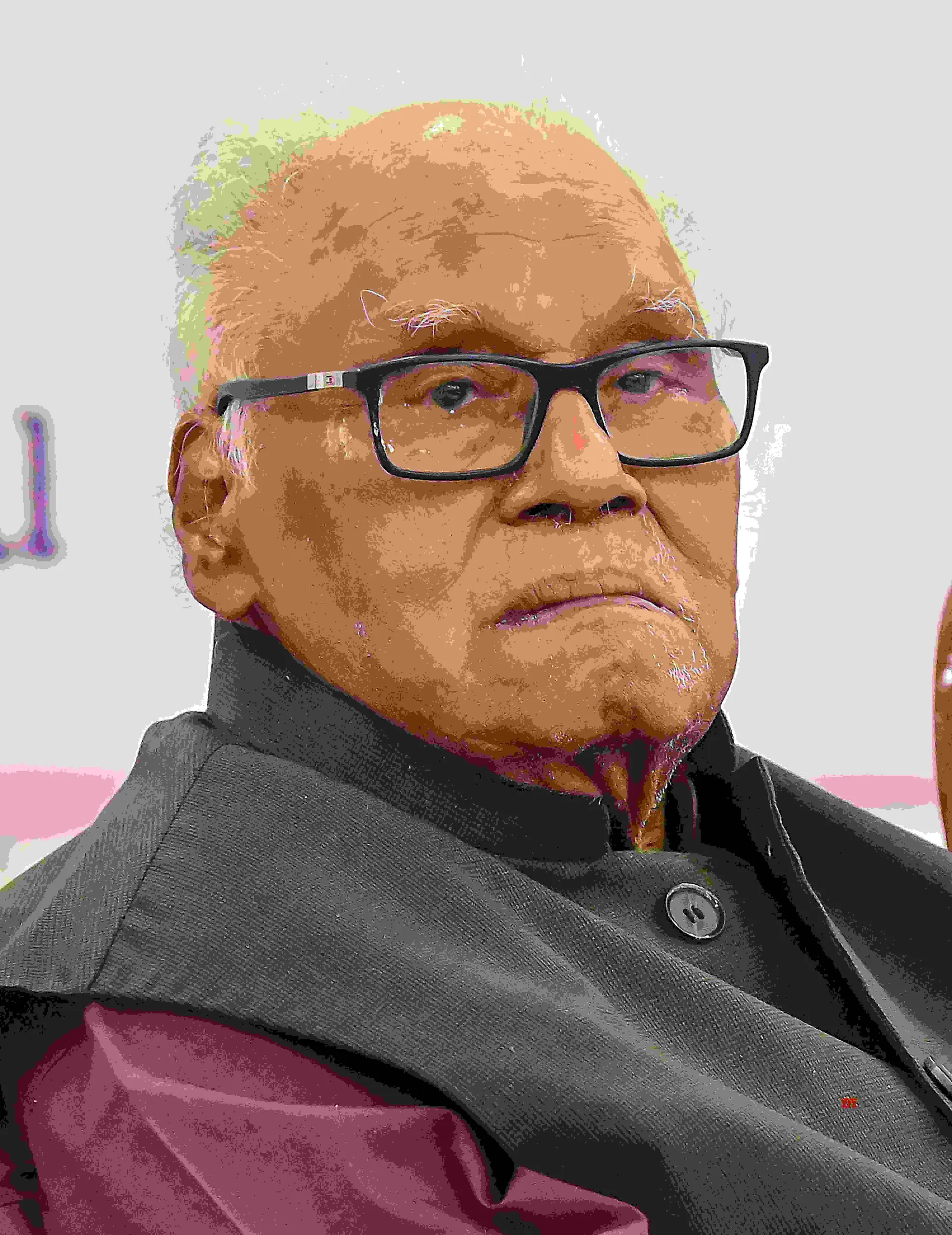
C. N. R. Rao
 India
IndiaAlso known as: C.N.R. Rao, Chintamani Nagesa Ramachandra Rao
Birthday
June 30, 1934
Birth Sign
Cancer
Birthplace
Bengaluru, India
Age
92 years old
About
Chintamani Nagesa Ramachandra Rao, better known as C. N. R. Rao, is an Indian chemist whose work in solid-state and structural chemistry has reshaped the field. Born on June 30, 1934, in Bengaluru, he has spent his life pushing the boundaries of materials science. His research has earned him honorary doctorates from 86 universities worldwide, and he has authored roughly 1,800 research publications and 58 books. Many colleagues describe him as a scientist who has won every major award in his field except the Nobel Prize.
Rao's academic journey was remarkably swift. He earned his BSc from Mysore University at seventeen and an MSc from Banaras Hindu University at nineteen. By twenty-four, he had a PhD from Purdue University. In 1959, he became the youngest lecturer at the Indian Institute of Science (IISc). After a stint at the Indian Institute of Technology Kanpur, he returned to IISc, eventually serving as its director from 1984 to 1994. He also chaired the Scientific Advisory Council to the Prime Minister of India from 1985 to 1989 and again from 2005 to 2014. He founded the Jawaharlal Nehru Centre for Advanced Scientific Research and the International Centre for Materials Science, where he continues to work.
Rao's contributions have been recognized with numerous honors, including the Marlow Medal, the Shanti Swarup Bhatnagar Prize, the Hughes Medal, the India Science Award, the Dan David Prize, the Royal Medal, the Von Hippel Award, and the ENI Award. The Government of India bestowed on him the Padma Shri and Padma Vibhushan. On November 16, 2013, he was selected for the Bharat Ratna, India's highest civilian award, making him only the third scientist after C. V. Raman and A. P. J. Abdul Kalam to receive it. President Pranab Mukherjee presented the award on February 4, 2014, at Rashtrapati Bhavan.
Early Life & Background
Rao grew up in Bengaluru in a family that valued education deeply. His father was a teacher, and young Chintamani showed an early fascination with the natural world, often conducting small experiments at home. He attended the local schools in the city, where his aptitude for science quickly became evident. By the time he was seventeen, he had completed his BSc from Mysore University, a feat that marked the beginning of a meteoric academic rise.
He moved to Varanasi for his MSc at Banaras Hindu University, finishing at just nineteen. It was there that his interest in chemistry crystallized, particularly the structure of materials. In 1955, he traveled to the United States to pursue a PhD at Purdue University, where he studied under the guidance of Professor R. L. Livingston. His doctoral research focused on molecular spectroscopy, laying the groundwork for his later work on solid-state chemistry. He completed his PhD in 1958, at the age of twenty-four.
Returning to India, Rao joined the Indian Institute of Science in Bengaluru as a lecturer in 1959, becoming the youngest person to hold that position at the institute. He later moved to the Indian Institute of Technology Kanpur, where he spent over a decade building a strong research group. During this period, he began his pioneering studies on transition metal oxides, a subject that would define his career. His early work on the electronic structure of these materials set the stage for his later discoveries in high-temperature superconductivity.
Career Growth
Rao's breakthrough came in the 1970s and 1980s when his research on transition metal oxides and high-temperature superconductivity gained international recognition. He was one of the first scientists to synthesize and characterize cuprate superconductors, contributing to the understanding of these complex materials. His work on the metal-insulator transition in oxides earned him a reputation as a leader in solid-state chemistry.
In 1984, he became the director of the Indian Institute of Science, a position he held for a decade. During his tenure, he expanded the institute's research capabilities and fostered a new generation of scientists. In 1989, he founded the Jawaharlal Nehru Centre for Advanced Scientific Research (JNCASR), which has become a premier research institution in India. He also established the International Centre for Materials Science, further solidifying his commitment to advancing materials research.
Throughout his career, Rao has published over 1,800 papers and authored or edited 58 books. He has been a visiting professor at many leading universities, including Oxford, Cambridge, and the University of California. He has also served on numerous national and international scientific committees, including chairing the Scientific Advisory Council to the Prime Minister of India on two separate occasions. His recent work continues to focus on novel materials, including graphene and other two-dimensional systems, and he remains an active researcher even in his nineties.
Career Timeline
Public Image & Style
Rao is widely regarded as a towering figure in Indian science, often referred to as the "father of solid-state chemistry" in India. He is known for his rigorous scientific approach, his dedication to nurturing young talent, and his unwavering commitment to advancing scientific research in India. His public persona is that of a humble, approachable scientist who is always willing to share his knowledge.
He is frequently invited to deliver lectures at universities and conferences around the world, where his talks are known for their clarity and depth. He has a distinctive style of wearing simple, traditional Indian attire, often a kurta, which adds to his approachable image. He does not have a significant social media presence, but his work is celebrated in scientific circles and by the Indian public.
His birthday is commemorated with science-themed events, such as the Science Thought Programme held in Dharwad in 2026. He is also honored through awards named after him, like the Prof. C.N.R. Rao Bengaluru India Nano Science Award, which recognizes outstanding contributions in nanoscience. This reflects his lasting influence as a mentor and a leader in the scientific community.
Fame & Fandom
C. N. R. Rao, the Indian chemist and institution builder, has been evaluated by iFANN's Global Fame Engine but currently holds no placement in the published rankings, including the Global Top 1,000 or any Top-100 scope list. His fame, while immense in scientific circles, does not translate into the mass-media visibility that drives these rankings.
Rao's admirers form a devoted but informal following, with no formal fandom name. They celebrate his birthday each year, most notably in 2026 when Dharwad hosted civic events for his 93rd birthday, covered by The Hindu and Times of India. His legacy is institutionalized through the Jawaharlal Nehru Centre for Advanced Scientific Research (JNCASR), where he serves as Honorary President, and the Prof. C.N.R. Rao Bengaluru INDIA NANO Science Award, named in his honor. A Bengaluru traffic circle also bears his name.
His real fanbase consists of fellow scientists and students, reflected in over 126,000 citations on Google Scholar. His 2014 Bharat Ratna, India's highest civilian honor, sparked national pride, and his return to Purdue University for a lecture that same year drew attention as a homecoming story. Rao's supporters engage in ceremonial appreciation rather than organized fan campaigns, a fitting tribute to an elder statesman of science.
Interesting Facts and Legends
Rao is an avid reader with a deep appreciation for classical music, often listening to Carnatic music while working in his lab. Despite his towering scientific stature, he is approachable and generous with his time, mentoring young students who seek his guidance. He carries a small notebook to jot down ideas at any time, and his favorite quote from Linus Pauling, 'The best way to have a good idea is to have a lot of ideas', drives his prolific output. He enjoys gardening and takes pride in his Bengaluru home's plants. His memory for scientific facts is remarkable, recalling details of papers read decades ago. His witty one-liners during lectures endear him to students. In 2016, he published his memoir, 'A Life in Science.'
A legend persists of Rao as 'the scientist who does not want to retire,' a narrative crystallized by a 2016 Nature India profile. Even in his 90s, he remains active as National Research Professor and Honorary President of JNCASR, embodying an almost mythic dedication. His 2014 Bharat Ratna is retold as a moment of national redemption, recognizing his lifelong institution-building. A story of his Purdue homecoming, where he earned his PhD in 1958, frames his journey from graduate student to global icon, an origin tale for newcomers.
Notable Quotes
“Science has been an essential part of my life.”
“God gave Linus Pauling to chemistry.”
“The best way to have a good idea is to have a lot of ideas.”
“I have never thought of retiring. There is so much to do.”
Family & Personal Life
Details about Rao's family are scarce, as he has kept his personal life largely private. He was born to Hanumantha Rao and Nagamma Rao in Bengaluru. His father was a school teacher, which instilled in him a love for learning. He has a brother, but little is known about his siblings. Rao married Indumati Rao, and the couple has two daughters. His wife has been a supportive partner throughout his career, though she prefers to stay out of the public eye. The family resides in Bengaluru, where Rao continues his research.
Rao has often mentioned that his family's encouragement was crucial in his early years. His parents emphasized the importance of education, and he inherited a strong work ethic from them. He has also spoken about how his wife's patience and understanding allowed him to devote long hours to his research. Despite his fame, he remains grounded and values the simple joys of family life.
Notable Connections
C. N. R. Rao is closely associated with Linus Pauling, after whom his research professorship is named. He has also been associated with other Bharat Ratna recipients C. V. Raman and A. P. J. Abdul Kalam. In 2025, he received a visit from Professor Sir Cato T. Laurencin, a fellow of the Indian Academy of Sciences. He has mentored numerous scientists, including Prof. B. L. V. Prasad, who received the award named after Rao in 2026.
Relationships & Dating History
Salary, Net Worth In 2026
$5 Million
iFANN Editorial Team estimate
As a government-funded scientist and academic administrator, C. N. R. Rao's net worth is not publicly documented. His income derives primarily from his academic salary, research grants, book royalties, and honoraria from lectures. Over his long career, he has authored or edited 58 books, which continue to generate royalties. He has also received numerous awards, some with cash prizes, such as the Dan David Prize and the ENI Award. iFANN currently estimates his net worth in 2026 at around $5 million, reflecting a lifetime of academic work rather than commercial ventures. He has no endorsement deals or business interests, and he has lived a modest lifestyle. His wealth is largely tied to his intellectual contributions and the prestige of his positions.
Awards Won (10)
C. N. R. Rao has received numerous prestigious awards throughout his career. He is one of only three scientists to receive India's highest civilian honor, the Bharat Ratna. He has also been awarded the Padma Shri, Padma Vibhushan, Hughes Medal, Royal Medal, Dan David Prize, and many others.
2014 · Civilian
Lifetime achievement in science
2005 · Science
Materials science
Known For
Pioneering work in solid-state and structural chemistry
· Researcher
Research on transition metal oxides
· Researcher
High-temperature superconductivity
· Researcher
Keywords
Sources
Quick Facts
- Profession
- chemist, physicist, researcher
- Born
- +1934-06-30
- Birthplace
- Bengaluru
- Gender
- Male
- Birth Sign
- Cancer
- Education
- BSc, Mysore University; MSc, Banaras Hindu University; PhD, Purdue University
- Awards
- Bharat Ratna, Padma Vibhushan, Padma Shri, Royal Medal, Dan David Prize
Personal Details
- Full Name
- Chintamani Nagesa Ramachandra Rao
- Education
- BSc from Mysore University, MSc from Banaras Hindu University, PhD from Purdue University
Frequently Asked Questions
What is C. N. R. Rao famous for?
How old is C. N. R. Rao?
What is C. N. R. Rao's net worth?
Did C. N. R. Rao win the Nobel Prize?
Is C. N. R. Rao still active in 2026?
Similar People
Join the community
fans discussing