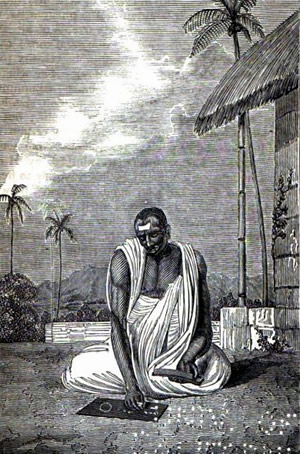
Brahmagupta
 India
IndiaAlso known as: Brahmagupta of Bhinmal, The Master of Zero
Birthday
+0598
Birth Sign
Capricorn
Birthplace
Bhinmal, India
Age
Died at 70
About
Brahmagupta was a preeminent Indian mathematician and astronomer born around 598 CE who fundamentally reshaped the trajectory of human mathematics and astronomy. He is universally credited as the first scholar to treat zero not merely as a placeholder but as a number with its own distinct properties, bridging abstract numerical theory and practical celestial observation. His life's work established rules for arithmetic that remain foundational today, transforming mathematics from a tool of counting into a system of abstract logic. Before his contributions, empty spaces in calculations held no value, but he proved that a symbol for nothing could function as a complete entity within mathematical logic. He spent much of his career in Ujjain, working within the great astronomical traditions of the time, producing two monumental texts that revolutionized science.
His magnum opus, the Brāhmasphuṭasiddhānta, published in 628 CE, introduced complex operations involving zero and negative numbers while solving linear and quadratic equations. This work laid the groundwork for the development of algebra and trigonometry in both the Islamic world and Europe. Decades later, he published the Khaṇḍakhādyaka, a practical manual for calculating planetary positions. Brahmagupta died around 668 CE, leaving behind a legacy that continues to define how humanity calculates and understands the universe, with his name attached to fundamental concepts like Brahmagupta's Theorem and Formula.
Early Life & Background
Born around 598 CE in Bhinmal, also known historically as Bhillamala, located in the Mālava region of northwestern India (present-day Rajasthan), Brahmagupta entered a world where mathematics was primarily a tool for trade and basic land measurement. The town of Bhinmal served as his early home before he moved to Ujjain, which had emerged as a major hub for astronomical study during the Gupta period. While specific details about his parents or childhood tutors have been lost to history, the scholarly environment of the time suggests he received a rigorous education within the established intellectual traditions of ancient India, possibly at the great astronomical school in Ujjain. Unlike modern figures who might struggle with obscurity before breaking through, Brahmagupta's path was one of singular dedication to inquiry.
By the age of thirty, he had already established himself as a leading intellect in the field. Historical accounts indicate he moved to Ujjain to join its prestigious astronomical school, a decision that would define the rest of his career. He immersed himself in the study of celestial movements and numerical theory, refining his skills until he was ready to compose his first major treatise. The period leading up to 628 CE was defined by this intense preparation, where he synthesized existing knowledge and began formulating the radical new ideas that would soon change mathematics forever. He likely lived during a time when scholars resided in monastic or academic communities, dedicating their lives entirely to their work rather than building a traditional household.
Career Growth
Brahmagupta's career reached its zenith with the publication of the Brāhmasphuṭasiddhānta in 628 CE. This twenty-five-chapter treatise, translating to "The Correctly Established Doctrine of Brahma," was a revolutionary document that formally defined zero as a number. He provided explicit rules for arithmetic operations involving zero, such as addition ($a + 0 = a$) and multiplication ($a imes 0 = 0$), alongside the introduction of negative numbers which he referred to as "debts" and positive numbers as "fortunes." The text also offered the first clear descriptions for solving linear and quadratic equations, marking a massive leap forward in algebraic thought.
Decades later, in 665 CE, he published the Khaṇḍakhādyaka, meaning "Edible Bite." This work served as a more practical manual designed specifically for calculating planetary positions and eclipses, intended to be easier to digest than his earlier theoretical masterpiece. Throughout his career, he developed Brahmagupta's formula for finding the area of a cyclic quadrilateral and hypothesized that objects fall toward the earth due to an attractive force, a concept that anticipated Newton's law of universal gravitation by over a millennium. His work remained the standard reference for Indian astronomy and mathematics for centuries, influencing giants like Al-Khwarizmi.
Career Timeline
Public Image & Style
Brahmagupta is portrayed as a visionary genius and a pioneer of rational thought. Media and educational materials depict him as a calm, contemplative scholar who dedicated his life to uncovering the hidden patterns of the universe. His tone is one of profound respect and reverence, often celebrated as a national hero in India. Modern textbooks and scientific literature consistently present him as the architect of modern arithmetic, emphasizing his role in defining zero and negative numbers. He is viewed as a bridge between ancient empirical methods and the abstract algebraic systems used today. His image appears frequently on the covers of educational textbooks, such as the NCERT Class 9 textbook released in 2026, highlighting his contributions to ancient mathematics.
Fame & Fandom (iFAMOUS Rankings)
iFANN has not yet collected fame data for this person. As a historical figure from the seventh century, he does not appear in modern global fame rankings or iFANN's current evaluation metrics. His recognition comes from his enduring impact on science rather than contemporary popularity metrics. There is no organized fandom for Brahmagupta in the pop-culture sense, and no formal fanbase name is documented in iFANN data. However, he has a dedicated following among mathematicians, historians, and students worldwide. Educational campaigns and museum exhibits often serve as the primary "fan interactions," celebrating his birthday and contributions. His name is frequently invoked in academic settings and science communication to promote STEM education. Students studying the history of mathematics often regard him as a central figure, keeping his legacy alive through the continued teaching of his theorems and formulas.
Interesting Facts and Legends
Brahmagupta was the first to systematically use negative numbers in calculations, referring to them as "debts" and positive numbers as "fortunes." Before his work, zero was often just a symbol for an empty space with no inherent value. He suggested that the earth attracts all things, a hypothesis that served as a precursor to the law of universal gravitation. His formula for the area of a cyclic quadrilateral is still taught in geometry classes today. A verified historical fact is that his work was translated into Arabic and heavily influenced the Persian mathematician Al-Khwarizmi, who is often called the "father of algebra." The most iconic moment in his lore remains the formalization of zero, transforming mathematics from a tool of counting to a system of abstract logic. Legends suggest he moved to Ujjain because it was the premier center for astronomy, seeking to refine his calculations against the stars.
Notable Quotes
“Zero is the result of subtracting a number from itself.”
“A debt minus zero is a debt; a fortune minus zero is a fortune.”
“The earth attracts all things.”
Family & Personal Life
As a figure from the seventh century, Brahmagupta's personal family life is shrouded in the mists of antiquity. There are no historical records detailing romantic relationships, marriages, children, or siblings. The biographical focus of the era was on scholarly contribution rather than personal celebrity. Consequently, there is no data regarding partners or family lineage. He likely lived during a time when scholars resided in monastic or academic communities, dedicating their lives entirely to their work rather than building a traditional household. His legacy rests solely on his intellectual output rather than any familial connections. Specific physical attributes such as height are not recorded in historical texts, consistent with the population of 7th-century India.
Notable Connections
Aryabhata, Al-Khwarizmi, Bhaskara I.
Relationships & Dating History
As a figure from the seventh century, Brahmagupta's personal life is shrouded in the mists of antiquity. There are no historical records detailing romantic relationships, dating history, marriages, or children. The biographical focus of the era was on scholarly contribution rather than personal celebrity. Consequently, there is no data regarding partners, divorces, or current relationship status. He lived during a time when scholars often resided in monastic or academic communities, dedicating their lives entirely to their work. His legacy rests solely on his intellectual output rather than any familial or romantic connections. No direct quotes regarding personal relationships exist, only his core definitions on zero and negative numbers preserved in Sanskrit texts.
Death & Aftermath
Died
+0668 (aged 70)
Death Place
Ujjain, India
Cause of Death
Natural causes (age)
Brahmagupta passed away around the year 668 CE in Ujjain, a city that served as the premier center for astronomical study in ancient India. Historical records from the seventh century do not preserve specific medical details regarding his final days or an official cause of death, so scholars generally attribute his passing to natural causes given his advanced age for the period. He lived approximately seventy years, a significant lifespan that allowed him to produce four decades of rigorous mathematical and astronomical work. His death marked the end of a prolific career that spanned forty years of observation and writing.
His death did not mark the end of his influence but rather the beginning of a new era for his ideas. Following his passing, his texts were preserved by scholars who recognized their immense value. During the Islamic Golden Age, his works were translated into Arabic, ensuring that his concepts survived the decline of the Gupta Empire and spread across the Middle East. These translations introduced his rules for zero and negative numbers to the Arab world, where they influenced giants like Al-Khwarizmi. The *Brāhmasphuṭasiddhānta* became a foundational text for algebra and arithmetic in the Islamic world before eventually making its way to Europe through Latin translations. His legacy was cemented not through monuments built during his lifetime, but through the enduring utility of his formulas which continue to underpin modern mathematics and computing systems today. In 2026, the International Centre for Theoretical Physics awarded the ICTP-IBM Brahmagupta Prize for Artificial Intelligence, continuing the tradition of recognizing excellence in fields influenced by his mathematical insights.
Net Worth (Estate Value)
$0
iFANN Editorial Team estimate
As a historical figure who died in 668 CE, Brahmagupta does not have a net worth in the modern sense. He lived in a barter and coin-based economy where wealth was measured in land, grain, and patronage from kings. There are no estate values, business ventures, or endorsement deals associated with him. His "wealth" was intellectual, and his legacy generates value today through the continued use of his mathematical principles in computing, engineering, and science. The economic value of his contributions is incalculable, forming the basis of the digital age, but no monetary figure can be assigned to his personal estate. In 2026, the state of Rajasthan launched the "Brahmagupta Award" to foster innovation in robotics and AI, directly invoking his legacy, though this represents a modern institutional honor rather than personal income.
Awards & Accolades
View 7 records, honours and achievementsKnown For
Brāhmasphuṭasiddhānta
628 · Author
Khaṇḍakhādyaka
665 · Author
Keywords
Sources
Quick Facts
- Profession
- mathematician, astronomer
- Born
- +0598
- Birthplace
- Bhinmal
- Died
- +0668
- Death Place
- Ujjain
- Gender
- Male
Personal Details
- Education
- Scholarly traditions of the Mālava region; likely trained at the astronomical school in Ujjain
Frequently Asked Questions
Who was Brahmagupta?
When did Brahmagupta live?
What is Brahmagupta famous for?
Where was Brahmagupta born?
Did Brahmagupta discover gravity?
Similar People
Join the community
fans discussing