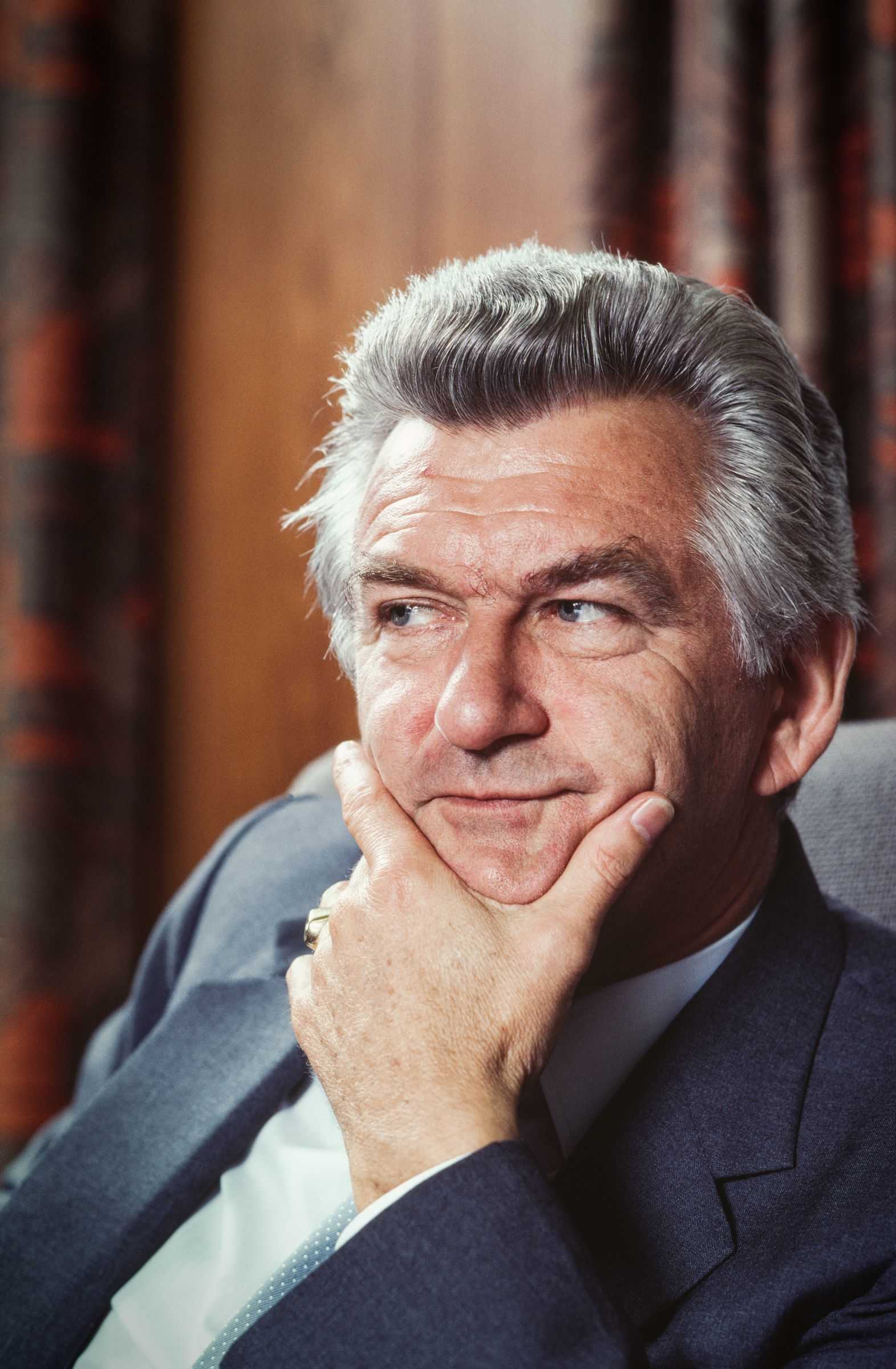
Bob Hawke
 Australia
Also known as: Robert James Lee Hawke, Robert Hawke
Birthday
December 9, 1929
Birth Sign
Sagittarius
Birthplace
Bordertown, South Australia, Australia
Age
Died at 89
About
Bob Hawke was an Australian politician and trade unionist who served as the 23rd prime minister of Australia from 1983 to 1991. He is remembered as one of the nation's most transformative leaders, winning four consecutive elections and enacting sweeping economic and social reforms. His ability to bridge the gap between unions, business, and government earned him the nickname "the consensus man," and his popularity peaked at an approval rating of 75%, the highest ever recorded for an Australian prime minister. Hawke died on May 16, 2019, in Sydney, at the age of 89.
As prime minister, Hawke floated the Australian dollar, deregulated the financial system, and introduced Medicare, universal superannuation, and landmark anti-discrimination laws. He also played a key role in founding APEC and declared "Advance Australia Fair" the national anthem. His government's reform agenda, pursued in close partnership with Treasurer Paul Keating, reshaped the Australian economy and society. Hawke's legacy is honoured through the Bob Hawke Prime Ministerial Centre and the Hawke-Rocard Medal, and historians consistently rank him among Australia's finest leaders.
Early Life & Background
Robert James Lee Hawke was born on December 9, 1929, in Bordertown, a small town in South Australia. He was the second child of Clem Hawke, a Congregationalist minister, and Ellie Lee, a teacher who was fiercely ambitious for her son. The family moved to Western Australia when Hawke was young, and he grew up in the Perth suburb of Nedlands. Hawke attended Perth Modern School, where he excelled academically and developed a love of debate.
He went on to study at the University of Western Australia, earning a Bachelor of Arts and a Bachelor of Laws. In 1953, Hawke won a Rhodes Scholarship to University College, Oxford, where he studied philosophy, politics, and economics. His time at Oxford was formative: he sharpened his negotiating skills and developed a lifelong interest in international affairs. While there, he also set a Guinness World Record for drinking 2.5 pints of beer in 11 seconds, a feat that would later become part of his larrikin legend.
After returning to Australia, Hawke worked as a researcher and advocate for the Australian Council of Trade Unions (ACTU). He joined the ACTU as its Advocate in 1958 and quickly rose through the ranks, becoming President in 1969. His ability to broker agreements between unions, employers, and governments made him a national figure, and he was named Australian of the Year in 1979. By the time he entered Parliament in 1980, Hawke was already one of the most recognisable and trusted figures in Australian public life.
Career Growth
Hawke entered federal Parliament on October 18, 1980, winning the seat of Wills in Victoria for the Labor Party. Within three years, he became Leader of the Opposition and then swept to victory in the March 5, 1983, federal election, just five weeks after taking the party's helm. His government won four consecutive elections, 1983, 1984, 1987, and 1990, a record for the Labor Party.
His government's defining reforms included floating the Australian dollar, deregulating the financial system, slashing tariffs, and privatising state assets such as Qantas. On the social side, he introduced Medicare (universal healthcare), superannuation pension schemes for all workers, and the Sex Discrimination Act. His government also declared "Advance Australia Fair" the national anthem and played a key role in founding APEC. His approval rating peaked at 75%, the highest ever recorded for an Australian leader.
A famous moment occurred in 1983 after Australia II won the America's Cup, when Hawke declared, "Any boss who sacks anyone for not turning up today is a bum." In a 1987 speech, he famously pledged, "By 1990, no Australian child will be living in poverty." Internal tensions with Treasurer Paul Keating led to a leadership challenge in June 1991, which Hawke survived, only to lose a second challenge six months later in December 1991. He resigned from Parliament shortly afterward.
Career Timeline
Public Image & Style
Hawke's public image was that of a charismatic, larrikin everyman, a beer-drinking, union-backed leader who nonetheless pushed through radical free-market reforms. The media portrayed him as both a conciliator and a reformer, and his "Hawke factor", a combination of personal charm, negotiation skill, and public popularity, was legendary. He was known for his emotional connection with working-class Australians, and his speeches often carried a direct, heartfelt tone. His approval rating peaked at 75%, the highest ever recorded for an Australian leader, reflecting the deep trust Australians placed in him. Hawke's style was informal and approachable, and he often used humour to defuse tension. His legacy as a consensus-builder and reformer remains a touchstone in Australian political culture.
Fame & Fandom (iFAMOUS Rankings)
Bob Hawke currently holds no placement in the iFANN Global Top 1,000 or any Top-100 scope list. The evaluation conducted by iFANN in August 2026 confirms he is an evaluated figure without a published numerical rank. While the Australian electorate once functioned as his most fervent supporters, there is no formal, organized fandom name like those attached to entertainers. His followers historically called him "The People's Prime Minister" or simply "Bob," reflecting a broad national consensus rather than a subculture with rituals. This bond was forged through his habit of walking through crowds and shaking hands, creating a reputation for accessibility that defined his eight-year premiership. Following his death in 2019, this adoration transformed into a legacy of remembrance marked by massive public processions where millions lined the streets. Even years later, political figures invoke his name to validate policies, treating him as the gold standard for leadership. The enduring "Hawke-Rocard Medal" symbolizes the international bond he helped cement, while debates over Medicare continue to cite his influence on modern Australian identity.
Interesting Facts and Legends
Bob Hawke set a Guinness World Record in 1954 by downing 2.5 pints of beer in just 11 seconds at Oxford University. He gave up alcohol entirely in 1980 before entering politics. A passionate cricket fan, he was photographed at 10 Downing Street with British Prime Minister Margaret Thatcher, their spouses, and England Test captain David Gower. Known for emotional public moments, he once cried while speaking about child poverty. His middle name "Lee" came from his mother's maiden name, making him the only Australian prime minister born in South Australia and the only one raised and educated in Western Australia. Legends still retell how he left the safety of motorcades to walk among voters, once joining British Prime Minister John Major to bat during a match in Harare. His government's implementation of Medicare in 1984 remains the defining achievement of his era, often cited as the moment Australia became truly egalitarian. The Prices and Incomes Accord, a series of agreements between the Labor government and unions, is another central piece of folklore credited with taming inflation while maintaining his "bloke next door" persona.
Notable Quotes
“Any boss who sacks anyone for not turning up today is a bum.”
“By 1990, no Australian child will be living in poverty.”
Family & Personal Life
Hawke's father, Clem Hawke, was a Congregationalist minister who instilled a strong sense of social justice in his children. His mother, Ellie Lee, was a teacher who was determined that her son would achieve great things. Hawke had an older sister, Joan, who died in infancy, and a younger brother, Neil. He married Hazel Masterson in 1956, and they had four children: Susan, Stephen, Roslyn, and Robert Jr. The couple divorced in 1995 after nearly four decades of marriage. Later that year, Hawke married author and journalist Blanche d'Alpuget, who remained his partner until his death. Hazel Hawke died in 2013. Hawke's family life was often in the public eye, and his marriage to Blanche was a subject of media interest.
Notable Connections
Hawke's closest political ally and later rival was Treasurer Paul Keating, whose economic reforms complemented his own. His first wife, Hazel Hawke, was a respected public figure in her own right, known for her community work. His second wife, Blanche d'Alpuget, was an author and journalist. Internationally, he worked closely with British Prime Minister Margaret Thatcher and French Prime Minister Michel Rocard, with whom he is jointly honoured via the Hawke-Rocard Medal. His legacy is carried on by the Bob Hawke Prime Ministerial Centre at the University of South Australia.
Relationships & Dating History
Hawke married Hazel Masterson in 1956, and they had four children together. The marriage lasted nearly four decades, but the couple divorced in 1995. Later that year, Hawke married Blanche d'Alpuget, an author and journalist he had known for many years. They remained together until his death in 2019. Hawke's relationship with Blanche was sometimes controversial due to its overlap with his first marriage, but they were devoted to each other. Hazel Hawke died in 2013. At the time of his death, Hawke was married to Blanche d'Alpuget.
- MarriedHazel Hawke1956 - 1995First wife, mother of his four children; divorced in 1995.
- MarriedBlanche d'Alpuget1995 - 2019CurrentSecond wife, married in 1995; remained together until his death.
Death & Aftermath
Died
May 16, 2019 (aged 89)
Death Place
Mosman, Sydney, New South Wales
Cause of Death
pneumonia
Thousands of mourners gathered at St Mary's Cathedral in Sydney on May 25, 2019, to honor a man who had once held the highest approval rating in Australian political history. The service became a state occasion featuring eulogies from then-Prime Minister Scott Morrison and Opposition Leader Bill Shorten, alongside world leaders and dignitaries who remembered Hawke as a transformative figure who bridged the gap between unions, business, and government. Tributes poured in from across the nation, celebrating his role in enacting sweeping economic reforms and introducing Medicare, while institutions like the National Museum of Australia observed moments of silence. Bob Hawke passed away peacefully in his sleep at his home in Mosman, New South Wales, on May 16, 2019, at the age of 89.
His family confirmed that he had been battling pneumonia for some time, a natural cause consistent with standard protocols for non-suspicious deaths of elderly citizens in private residences. Following the funeral, Hawke was cremated and his ashes were scattered according to his family's wishes. His legacy endures through the Bob Hawke Prime Ministerial Centre at the University of Adelaide, which serves as a museum and research hub dedicated to his life and times. The Hawke-Rocard Medal continues to be presented annually to recognize outstanding contributions to Franco-Australian relations, ensuring his influence persists in public life and education.
Net Worth (Estate Value)
Bob Hawke's estate, managed by his widow Blanche d'Alpuget, continues to earn from book royalties and speaking fees. His memoirs, including Hawke and The Hawke Memoirs, remain in print, and his image and legacy are licensed for various uses. The Bob Hawke Prime Ministerial Centre and the Hawke-Rocard Medal ensure his name remains prominent in public life. As of 2026, the estate's value is estimated at around $2 million, reflecting the ongoing income from these sources. No major asset sales or financial events have been reported since his death.
Awards Won (3)
Hawke received numerous honours, including being named Australian of the Year in 1979 and appointed a Companion of the Order of Australia in the same year. In 2009, Japan awarded him the Grand Cordon of the Order of the Rising Sun for his contributions to bilateral relations. He also received honorary doctorates from several universities, including the University of Western Australia, the University of Sydney, and the Australian National University.
1979 · National Award
Industrial relations
1979 · National Honour
Service to politics and the union movement
Known For
Prime Minister of Australia
1983-1991 · 23rd Prime Minister
President of the ACTU
1969-1980 · Trade Union Leader
Medicare
1984 · Introduced universal healthcare
Keywords
Sources
Quick Facts
- Profession
- politician, trade unionist
- Born
- December 9, 1929
- Birthplace
- Bordertown, South Australia, Australia
- Died
- May 16, 2019
- Death Place
- Sydney, Australia
- Gender
- Male
- Spouse
- Blanche d'Alpuget
- Birth Sign
- Sagittarius
- Children
- Susan, Stephen, Roslyn, Robert Jr.
- Education
- University of Western Australia; University College, Oxford
Personal Details
- Full Name
- Robert James Lee Hawke
- Spouse
- Blanche d'Alpuget
- Children
- Susan, Stephen, Roslyn, Robert Jr.
- Education
- Perth Modern School; University of Western Australia (BA, LLB); University College, Oxford (Rhodes Scholar)
Frequently Asked Questions
How did Bob Hawke die?
How many children did Bob Hawke have?
Was Bob Hawke the longest-serving Labor prime minister?
What was Bob Hawke's approval rating?
What did Bob Hawke do before becoming prime minister?

Join the community
fans discussing